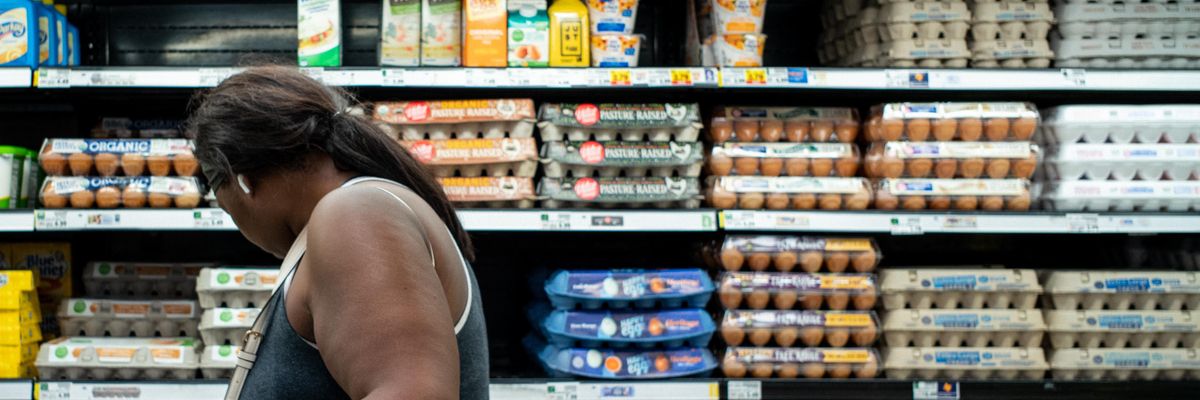
A customer shops for eggs at a Kroger grocery store on August 15, 2022 in Houston, Texas.
As Kroger Eyes Albertsons, Biden Admin Urged to Reject 'Greed-Driven' Grocery Buyout
"There is no reason to allow two of the biggest supermarket chains in the country to merge—especially with food prices already soaring," said one policy analyst.
Warning that a potential merger between Kroger and Albertsons--two of the nation's largest grocery chains--would hurt workers and force consumers to endure even more corporate price gouging, which has intensified following years of supermarket consolidation, progressives on Thursday implored the Biden administration to nix the deal if finalized.
"This merger is a cut and dry case of monopoly power, and enforcers should block it."
"At a moment when American families are already struggling with skyrocketing food prices from a hyper-consolidated grocery industry, the notion of another megamerger between corporate food giants couldn't be more alarming," Mitch Jones, managing director of policy at Food & Water Watch, said in a statement.
"The federal government's own analysis finds that supermarket consolidation typically leads to price hikes," said Jones. "For the sake of everyday consumers, farmers, and food workers, the Biden administration should be rejecting this terrible, greed-driven proposal out of hand."
According to CNBC, Kroger's acquisition of Albertsons could be announced as soon as Friday morning. If an agreement between the rivals is reached, the resulting grocery conglomerate would enjoy a market share of nearly 16% and a market cap approaching $50 billion.
Cincinnati-based Kroger, the nation's second-biggest grocery store behind Walmart, controls 9.9% of the market and is valued at $32.5 billion. Boise-based Albertsons, the fourth-largest grocer with a 5.7% market share, is worth $15.2 billion. Kroger and its subsidiaries employ around 420,000 workers in almost 2,800 stores across 35 states. Albertsons and its banners employ approximately 290,000 workers at more than 2,200 stores in 34 states plus Washington, D.C.
Kroger has made an all-cash offer to buy its smaller competitor. But as Bloomberg, which first reported that the two companies were in merger talks, pointed out: "The exact structure and price of the deal couldn't immediately be learned. Any potential transaction, if agreed, may face antitrust scrutiny and require asset sales."
The news outlet continued:
The potential deal would be among the largest U.S. retail transactions in years, and the biggest U.S. supermarket deal since the last time Albertsons changed hands in 2006, when it was was bought by Supervalu, CVS Health Corp., and a group of investment firms for about $9.8 billion, according to data compiled by Bloomberg.
These talks come amid a dramatically different deal-making landscape. Soaring food prices are a key driver behind inflation in the U.S., while industry consolidation has given top players in the space much greater market share. That could present a number of political and regulatory hurdles for this kind of tie-up, as politicians blame corporate greed for higher prices, while antitrust officials eye tougher merger rules.
"The actual practicality of achieving regulatory approval by the FTC [Federal Trade Commission] could be difficult," said Jennifer Bartashus, an analyst at Bloomberg Intelligence. "If you think about the store bases of the two respective entities, there is a lot of overlap in very competitive markets."
Sarah Miller, executive director of the American Economic Liberties Project (AELP), said in a statement that "there is no reason to allow two of the biggest supermarket chains in the country to merge--especially with food prices already soaring."
Consumer Price Index data released Thursday morning showed that food prices are still surging. Over the past year, the price of eggs, chicken, and bread has increased by 30.5%, 17.2%, and 14.7%, respectively, with similar spikes for other staples.
Progressive economists have attributed above-average price increases for certain products to decades of consolidation, which has given a handful of corporations an ever-greater degree of market control and with it, the power to hike prices and inflate profits.
Last year, Food & Water Watch published a report--The Economic Cost of Food Monopolies: The Grocery Cartels--examining how workers and consumers nationwide are harmed by a worsening consolidation crisis.
Researchers found that between 1993 and 2019, the number of grocery stores in the U.S. decreased by roughly 30% while the combined market share of the country's four largest food retailers tripled to 69%.
Meanwhile, as grocers with their own vertically integrated supply chains increasingly dominate the market, the food industry is becoming more highly concentrated, with a growing number of monopolies and oligopolies.
According to AELP:
Consolidation in the grocery sector has long been an issue--one that has previously been mismanaged by antitrust enforcers. In 2015, Albertsons sought to acquire competitor Safeway for $9.4 billion. Of the more than 2,400 grocery stores that Albertsons and Safeway owned in total, the FTC required the sale of 168 of them located in eight Western states. That divesture was a disaster. Within a year, Albertsons had bought back 33 of the stores for about one-fifth of what it had sold them for, and communities across these states ultimately ended up with a monopoly.
"With 60% of grocery sales concentrated among just five national chains, a Kroger-Albertsons deal would squeeze consumers already struggling to afford food, crush workers fighting for fair wages, and destroy independent, community stores," said Miller. "This merger is a cut and dry case of monopoly power, and enforcers should block it."
We are at a crossroads
This country and this world are at a monumental crossroads. In a few short weeks, US voters will have an opportunity to beat back the forces of fascism and confront the billionaires who are rigging the economy, our media system, and our democracy, making it increasingly impossible for ordinary people to get by. We’re not just talking about the election. We’re talking about what must be done once these fascist elements are vanquished from power. We need a bolder set of solutions than what either major party has so far been willing to offer and a working-class movement ready to fight like hell for it. Trump didn't emerge from nowhere. The conditions that fueled MAGA authoritarianism were created by decades of radical neoliberal economic policies and a corrupt political system dominated by corporate interests. They slashed taxes on the super-rich, promising that the benefits would trickle down. They said giveaways to the corporate titans would make life more affordable for the rest of us. It was all bullshit. And when a bitter, betrayed populace searches for someone to blame, right-wing demagogues have little trouble finding scapegoats. People know when they're being lied to, but you won't hear any of this from the corporate media. Only independent journalism—powered and funded by people who believe in building a better world—can deliver truly trustworthy daily news. Our Fall Campaign is underway, and we need your help. To power our newsroom through the rest of the year, we need to raise $125,000 by midnight on October 31. So if you share our vision, please contribute whatever you can to sustain our work. |
Warning that a potential merger between Kroger and Albertsons--two of the nation's largest grocery chains--would hurt workers and force consumers to endure even more corporate price gouging, which has intensified following years of supermarket consolidation, progressives on Thursday implored the Biden administration to nix the deal if finalized.
"This merger is a cut and dry case of monopoly power, and enforcers should block it."
"At a moment when American families are already struggling with skyrocketing food prices from a hyper-consolidated grocery industry, the notion of another megamerger between corporate food giants couldn't be more alarming," Mitch Jones, managing director of policy at Food & Water Watch, said in a statement.
"The federal government's own analysis finds that supermarket consolidation typically leads to price hikes," said Jones. "For the sake of everyday consumers, farmers, and food workers, the Biden administration should be rejecting this terrible, greed-driven proposal out of hand."
According to CNBC, Kroger's acquisition of Albertsons could be announced as soon as Friday morning. If an agreement between the rivals is reached, the resulting grocery conglomerate would enjoy a market share of nearly 16% and a market cap approaching $50 billion.
Cincinnati-based Kroger, the nation's second-biggest grocery store behind Walmart, controls 9.9% of the market and is valued at $32.5 billion. Boise-based Albertsons, the fourth-largest grocer with a 5.7% market share, is worth $15.2 billion. Kroger and its subsidiaries employ around 420,000 workers in almost 2,800 stores across 35 states. Albertsons and its banners employ approximately 290,000 workers at more than 2,200 stores in 34 states plus Washington, D.C.
Kroger has made an all-cash offer to buy its smaller competitor. But as Bloomberg, which first reported that the two companies were in merger talks, pointed out: "The exact structure and price of the deal couldn't immediately be learned. Any potential transaction, if agreed, may face antitrust scrutiny and require asset sales."
The news outlet continued:
The potential deal would be among the largest U.S. retail transactions in years, and the biggest U.S. supermarket deal since the last time Albertsons changed hands in 2006, when it was was bought by Supervalu, CVS Health Corp., and a group of investment firms for about $9.8 billion, according to data compiled by Bloomberg.
These talks come amid a dramatically different deal-making landscape. Soaring food prices are a key driver behind inflation in the U.S., while industry consolidation has given top players in the space much greater market share. That could present a number of political and regulatory hurdles for this kind of tie-up, as politicians blame corporate greed for higher prices, while antitrust officials eye tougher merger rules.
"The actual practicality of achieving regulatory approval by the FTC [Federal Trade Commission] could be difficult," said Jennifer Bartashus, an analyst at Bloomberg Intelligence. "If you think about the store bases of the two respective entities, there is a lot of overlap in very competitive markets."
Sarah Miller, executive director of the American Economic Liberties Project (AELP), said in a statement that "there is no reason to allow two of the biggest supermarket chains in the country to merge--especially with food prices already soaring."
Consumer Price Index data released Thursday morning showed that food prices are still surging. Over the past year, the price of eggs, chicken, and bread has increased by 30.5%, 17.2%, and 14.7%, respectively, with similar spikes for other staples.
Progressive economists have attributed above-average price increases for certain products to decades of consolidation, which has given a handful of corporations an ever-greater degree of market control and with it, the power to hike prices and inflate profits.
Last year, Food & Water Watch published a report--The Economic Cost of Food Monopolies: The Grocery Cartels--examining how workers and consumers nationwide are harmed by a worsening consolidation crisis.
Researchers found that between 1993 and 2019, the number of grocery stores in the U.S. decreased by roughly 30% while the combined market share of the country's four largest food retailers tripled to 69%.
Meanwhile, as grocers with their own vertically integrated supply chains increasingly dominate the market, the food industry is becoming more highly concentrated, with a growing number of monopolies and oligopolies.
According to AELP:
Consolidation in the grocery sector has long been an issue--one that has previously been mismanaged by antitrust enforcers. In 2015, Albertsons sought to acquire competitor Safeway for $9.4 billion. Of the more than 2,400 grocery stores that Albertsons and Safeway owned in total, the FTC required the sale of 168 of them located in eight Western states. That divesture was a disaster. Within a year, Albertsons had bought back 33 of the stores for about one-fifth of what it had sold them for, and communities across these states ultimately ended up with a monopoly.
"With 60% of grocery sales concentrated among just five national chains, a Kroger-Albertsons deal would squeeze consumers already struggling to afford food, crush workers fighting for fair wages, and destroy independent, community stores," said Miller. "This merger is a cut and dry case of monopoly power, and enforcers should block it."
- New Report on 'Grocery Cartels' Details Exploitive Retailer Monopolies ›
- Progressive Senators Demand Answers From Kroger on 'Widespread Wage Theft' ›
- Citing 'Aggressive Profiteering,' Sanders and Warren Urge FTC to Stop Kroger-Albertsons Merger ›
- Coalition Rises to 'Stop the Merger' of Kroger and Albertsons ›
- Opinion | Grocery Store Workers Stand to Lose Over $300 Million Annually if Kroger and Albertsons Merge | Common Dreams ›
- FTC-DOJ Merger Guidelines Aim to 'Restore Competition and Strengthen Democracy' ›
- Opinion | Giant Food Corps Are Largely to Blame for Higher Grocery Prices | Common Dreams ›
Warning that a potential merger between Kroger and Albertsons--two of the nation's largest grocery chains--would hurt workers and force consumers to endure even more corporate price gouging, which has intensified following years of supermarket consolidation, progressives on Thursday implored the Biden administration to nix the deal if finalized.
"This merger is a cut and dry case of monopoly power, and enforcers should block it."
"At a moment when American families are already struggling with skyrocketing food prices from a hyper-consolidated grocery industry, the notion of another megamerger between corporate food giants couldn't be more alarming," Mitch Jones, managing director of policy at Food & Water Watch, said in a statement.
"The federal government's own analysis finds that supermarket consolidation typically leads to price hikes," said Jones. "For the sake of everyday consumers, farmers, and food workers, the Biden administration should be rejecting this terrible, greed-driven proposal out of hand."
According to CNBC, Kroger's acquisition of Albertsons could be announced as soon as Friday morning. If an agreement between the rivals is reached, the resulting grocery conglomerate would enjoy a market share of nearly 16% and a market cap approaching $50 billion.
Cincinnati-based Kroger, the nation's second-biggest grocery store behind Walmart, controls 9.9% of the market and is valued at $32.5 billion. Boise-based Albertsons, the fourth-largest grocer with a 5.7% market share, is worth $15.2 billion. Kroger and its subsidiaries employ around 420,000 workers in almost 2,800 stores across 35 states. Albertsons and its banners employ approximately 290,000 workers at more than 2,200 stores in 34 states plus Washington, D.C.
Kroger has made an all-cash offer to buy its smaller competitor. But as Bloomberg, which first reported that the two companies were in merger talks, pointed out: "The exact structure and price of the deal couldn't immediately be learned. Any potential transaction, if agreed, may face antitrust scrutiny and require asset sales."
The news outlet continued:
The potential deal would be among the largest U.S. retail transactions in years, and the biggest U.S. supermarket deal since the last time Albertsons changed hands in 2006, when it was was bought by Supervalu, CVS Health Corp., and a group of investment firms for about $9.8 billion, according to data compiled by Bloomberg.
These talks come amid a dramatically different deal-making landscape. Soaring food prices are a key driver behind inflation in the U.S., while industry consolidation has given top players in the space much greater market share. That could present a number of political and regulatory hurdles for this kind of tie-up, as politicians blame corporate greed for higher prices, while antitrust officials eye tougher merger rules.
"The actual practicality of achieving regulatory approval by the FTC [Federal Trade Commission] could be difficult," said Jennifer Bartashus, an analyst at Bloomberg Intelligence. "If you think about the store bases of the two respective entities, there is a lot of overlap in very competitive markets."
Sarah Miller, executive director of the American Economic Liberties Project (AELP), said in a statement that "there is no reason to allow two of the biggest supermarket chains in the country to merge--especially with food prices already soaring."
Consumer Price Index data released Thursday morning showed that food prices are still surging. Over the past year, the price of eggs, chicken, and bread has increased by 30.5%, 17.2%, and 14.7%, respectively, with similar spikes for other staples.
Progressive economists have attributed above-average price increases for certain products to decades of consolidation, which has given a handful of corporations an ever-greater degree of market control and with it, the power to hike prices and inflate profits.
Last year, Food & Water Watch published a report--The Economic Cost of Food Monopolies: The Grocery Cartels--examining how workers and consumers nationwide are harmed by a worsening consolidation crisis.
Researchers found that between 1993 and 2019, the number of grocery stores in the U.S. decreased by roughly 30% while the combined market share of the country's four largest food retailers tripled to 69%.
Meanwhile, as grocers with their own vertically integrated supply chains increasingly dominate the market, the food industry is becoming more highly concentrated, with a growing number of monopolies and oligopolies.
According to AELP:
Consolidation in the grocery sector has long been an issue--one that has previously been mismanaged by antitrust enforcers. In 2015, Albertsons sought to acquire competitor Safeway for $9.4 billion. Of the more than 2,400 grocery stores that Albertsons and Safeway owned in total, the FTC required the sale of 168 of them located in eight Western states. That divesture was a disaster. Within a year, Albertsons had bought back 33 of the stores for about one-fifth of what it had sold them for, and communities across these states ultimately ended up with a monopoly.
"With 60% of grocery sales concentrated among just five national chains, a Kroger-Albertsons deal would squeeze consumers already struggling to afford food, crush workers fighting for fair wages, and destroy independent, community stores," said Miller. "This merger is a cut and dry case of monopoly power, and enforcers should block it."
- New Report on 'Grocery Cartels' Details Exploitive Retailer Monopolies ›
- Progressive Senators Demand Answers From Kroger on 'Widespread Wage Theft' ›
- Citing 'Aggressive Profiteering,' Sanders and Warren Urge FTC to Stop Kroger-Albertsons Merger ›
- Coalition Rises to 'Stop the Merger' of Kroger and Albertsons ›
- Opinion | Grocery Store Workers Stand to Lose Over $300 Million Annually if Kroger and Albertsons Merge | Common Dreams ›
- FTC-DOJ Merger Guidelines Aim to 'Restore Competition and Strengthen Democracy' ›
- Opinion | Giant Food Corps Are Largely to Blame for Higher Grocery Prices | Common Dreams ›