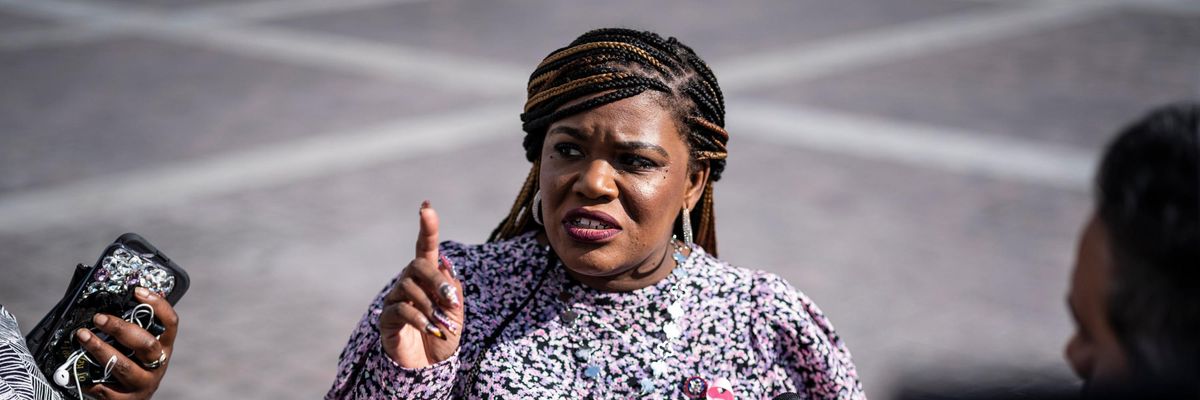
Rep. Cori Bush (D-Mo.) speaks to reporters on October 22, 2021 in Washington, D.C. (Photo: Jabin Botsford/The Washington Post via Getty Images)
Cori Bush to GOP: Stop Putting 'Profits Over People' With Attacks on Student Debt Relief
"The American people overwhelmingly support student debt cancellation and neither partisan nor corporate interests should prevent borrowers from receiving the life-changing relief they need and deserve."
As a federal court in her home state of Missouri heard arguments Wednesday in a case that could determine the fate of federal student debt cancellation, Democratic Rep. Cori Bush condemned GOP attorneys general for attempting to tank much-needed economic relief for tens of millions of borrowers.
"Efforts to undermine the Biden administration's student loan cancellation program are the latest example of Republicans and student loan servicers prioritizing profits over people and corporations over constituencies," Bush said in a statement as a group of GOP attorneys general--including Missouri AG Eric Schmitt--made their case for an injunction against student debt forgiveness.
"I urge MOHELA and these six Republican attorneys general to stop putting profits over the interests of student loan borrowers."
The Republican plaintiffs claim in their lawsuit that the Biden administration's student debt cancellation plan would harm the Missouri Higher Education Loan Authority (MOHELA) by depriving it of "the ongoing revenue it earns from servicing" privately held Federal Family Education Loan Program (FFELP) loans.
In an effort to undercut such legal claims of harm, the Biden administration decided last month to scale back its debt forgiveness program to exclude many student borrowers with FFELP loans, denying relief to hundreds of thousands of people.
In her statement Wednesday, Bush noted that MOHELA "has remained silent" about the GOP lawsuit, "seemingly complicit in Republican efforts to prevent over 40 million borrowers from receiving the debt relief they have been promised."
"Actions to delay or prevent this economic program from moving forward will disproportionately harm Black and brown borrowers," Bush continued. "I urge MOHELA and these six Republican attorneys general to stop putting profits over the interests of student loan borrowers and halt all activities that interfere with the president's student loan debt cancellation plan."
"The American people overwhelmingly support student debt cancellation," the Missouri Democrat added, "and neither partisan nor corporate interests should prevent borrowers from receiving the life-changing relief they need and deserve."
In recent weeks, Republican officials and right-wing advocacy organizations have filed a number of lawsuits against the Biden administration's limited student debt cancellation program, which has yet to fully launch as the Department of Education builds out the application website--a costly undertaking that could also create additional barriers to relief for the most vulnerable borrowers.
At least one of the lawsuits against the debt relief program has already been struck down.
During Wednesday's hearing on the GOP attorneys general lawsuit, the George W. Bush-appointed federal judge appeared to voice skepticism that the Republican officials have standing to sue over the debt forgiveness program.
As Matt Bruenig of the People's Policy Project noted last week, "Finding a person, business, or government that will suffer a concrete and particularized injury as a result of the student debt forgiveness and that is willing to be a plaintiff in a lawsuit over it is not easy to do."
"The core legal argument against the student debt forgiveness is that the HEROES Act that the Biden administration relies upon does not actually give them the authority to do it," Bruenig explained. "But the procedural challenge is how exactly to get that legal argument in front of a judge without having your lawsuit dismissed for lack of standing.
"The fact that the Biden administration made two swift changes to the program in response to these lawsuits--including a very substantial change in cutting FFELP debtors out of relief--suggests that they are not very confident that the courts would side with them on the question of whether the HEROES Act actually allows the executive to do a student debt forgiveness of this sort," he added. "So they are trying to avoid litigating that question by changing the program to undercut theories of standing that get presented in the courts."
We are at a crossroads
This country and this world are at a monumental crossroads. In a few short weeks, US voters will have an opportunity to beat back the forces of fascism and confront the billionaires who are rigging the economy, our media system, and our democracy, making it increasingly impossible for ordinary people to get by. We’re not just talking about the election. We’re talking about what must be done once these fascist elements are vanquished from power. We need a bolder set of solutions than what either major party has so far been willing to offer and a working-class movement ready to fight like hell for it. Trump didn't emerge from nowhere. The conditions that fueled MAGA authoritarianism were created by decades of radical neoliberal economic policies and a corrupt political system dominated by corporate interests. They slashed taxes on the super-rich, promising that the benefits would trickle down. They said giveaways to the corporate titans would make life more affordable for the rest of us. It was all bullshit. And when a bitter, betrayed populace searches for someone to blame, right-wing demagogues have little trouble finding scapegoats. People know when they're being lied to, but you won't hear any of this from the corporate media. Only independent journalism—powered and funded by people who believe in building a better world—can deliver truly trustworthy daily news. Our Fall Campaign is underway, and we need your help. To power our newsroom through the rest of the year, we need to raise $125,000 by midnight on October 31. So if you share our vision, please contribute whatever you can to sustain our work. |
As a federal court in her home state of Missouri heard arguments Wednesday in a case that could determine the fate of federal student debt cancellation, Democratic Rep. Cori Bush condemned GOP attorneys general for attempting to tank much-needed economic relief for tens of millions of borrowers.
"Efforts to undermine the Biden administration's student loan cancellation program are the latest example of Republicans and student loan servicers prioritizing profits over people and corporations over constituencies," Bush said in a statement as a group of GOP attorneys general--including Missouri AG Eric Schmitt--made their case for an injunction against student debt forgiveness.
"I urge MOHELA and these six Republican attorneys general to stop putting profits over the interests of student loan borrowers."
The Republican plaintiffs claim in their lawsuit that the Biden administration's student debt cancellation plan would harm the Missouri Higher Education Loan Authority (MOHELA) by depriving it of "the ongoing revenue it earns from servicing" privately held Federal Family Education Loan Program (FFELP) loans.
In an effort to undercut such legal claims of harm, the Biden administration decided last month to scale back its debt forgiveness program to exclude many student borrowers with FFELP loans, denying relief to hundreds of thousands of people.
In her statement Wednesday, Bush noted that MOHELA "has remained silent" about the GOP lawsuit, "seemingly complicit in Republican efforts to prevent over 40 million borrowers from receiving the debt relief they have been promised."
"Actions to delay or prevent this economic program from moving forward will disproportionately harm Black and brown borrowers," Bush continued. "I urge MOHELA and these six Republican attorneys general to stop putting profits over the interests of student loan borrowers and halt all activities that interfere with the president's student loan debt cancellation plan."
"The American people overwhelmingly support student debt cancellation," the Missouri Democrat added, "and neither partisan nor corporate interests should prevent borrowers from receiving the life-changing relief they need and deserve."
In recent weeks, Republican officials and right-wing advocacy organizations have filed a number of lawsuits against the Biden administration's limited student debt cancellation program, which has yet to fully launch as the Department of Education builds out the application website--a costly undertaking that could also create additional barriers to relief for the most vulnerable borrowers.
At least one of the lawsuits against the debt relief program has already been struck down.
During Wednesday's hearing on the GOP attorneys general lawsuit, the George W. Bush-appointed federal judge appeared to voice skepticism that the Republican officials have standing to sue over the debt forgiveness program.
As Matt Bruenig of the People's Policy Project noted last week, "Finding a person, business, or government that will suffer a concrete and particularized injury as a result of the student debt forgiveness and that is willing to be a plaintiff in a lawsuit over it is not easy to do."
"The core legal argument against the student debt forgiveness is that the HEROES Act that the Biden administration relies upon does not actually give them the authority to do it," Bruenig explained. "But the procedural challenge is how exactly to get that legal argument in front of a judge without having your lawsuit dismissed for lack of standing.
"The fact that the Biden administration made two swift changes to the program in response to these lawsuits--including a very substantial change in cutting FFELP debtors out of relief--suggests that they are not very confident that the courts would side with them on the question of whether the HEROES Act actually allows the executive to do a student debt forgiveness of this sort," he added. "So they are trying to avoid litigating that question by changing the program to undercut theories of standing that get presented in the courts."
As a federal court in her home state of Missouri heard arguments Wednesday in a case that could determine the fate of federal student debt cancellation, Democratic Rep. Cori Bush condemned GOP attorneys general for attempting to tank much-needed economic relief for tens of millions of borrowers.
"Efforts to undermine the Biden administration's student loan cancellation program are the latest example of Republicans and student loan servicers prioritizing profits over people and corporations over constituencies," Bush said in a statement as a group of GOP attorneys general--including Missouri AG Eric Schmitt--made their case for an injunction against student debt forgiveness.
"I urge MOHELA and these six Republican attorneys general to stop putting profits over the interests of student loan borrowers."
The Republican plaintiffs claim in their lawsuit that the Biden administration's student debt cancellation plan would harm the Missouri Higher Education Loan Authority (MOHELA) by depriving it of "the ongoing revenue it earns from servicing" privately held Federal Family Education Loan Program (FFELP) loans.
In an effort to undercut such legal claims of harm, the Biden administration decided last month to scale back its debt forgiveness program to exclude many student borrowers with FFELP loans, denying relief to hundreds of thousands of people.
In her statement Wednesday, Bush noted that MOHELA "has remained silent" about the GOP lawsuit, "seemingly complicit in Republican efforts to prevent over 40 million borrowers from receiving the debt relief they have been promised."
"Actions to delay or prevent this economic program from moving forward will disproportionately harm Black and brown borrowers," Bush continued. "I urge MOHELA and these six Republican attorneys general to stop putting profits over the interests of student loan borrowers and halt all activities that interfere with the president's student loan debt cancellation plan."
"The American people overwhelmingly support student debt cancellation," the Missouri Democrat added, "and neither partisan nor corporate interests should prevent borrowers from receiving the life-changing relief they need and deserve."
In recent weeks, Republican officials and right-wing advocacy organizations have filed a number of lawsuits against the Biden administration's limited student debt cancellation program, which has yet to fully launch as the Department of Education builds out the application website--a costly undertaking that could also create additional barriers to relief for the most vulnerable borrowers.
At least one of the lawsuits against the debt relief program has already been struck down.
During Wednesday's hearing on the GOP attorneys general lawsuit, the George W. Bush-appointed federal judge appeared to voice skepticism that the Republican officials have standing to sue over the debt forgiveness program.
As Matt Bruenig of the People's Policy Project noted last week, "Finding a person, business, or government that will suffer a concrete and particularized injury as a result of the student debt forgiveness and that is willing to be a plaintiff in a lawsuit over it is not easy to do."
"The core legal argument against the student debt forgiveness is that the HEROES Act that the Biden administration relies upon does not actually give them the authority to do it," Bruenig explained. "But the procedural challenge is how exactly to get that legal argument in front of a judge without having your lawsuit dismissed for lack of standing.
"The fact that the Biden administration made two swift changes to the program in response to these lawsuits--including a very substantial change in cutting FFELP debtors out of relief--suggests that they are not very confident that the courts would side with them on the question of whether the HEROES Act actually allows the executive to do a student debt forgiveness of this sort," he added. "So they are trying to avoid litigating that question by changing the program to undercut theories of standing that get presented in the courts."