

SUBSCRIBE TO OUR FREE NEWSLETTER
Daily news & progressive opinion—funded by the people, not the corporations—delivered straight to your inbox.
5
#000000
#FFFFFF
To donate by check, phone, or other method, see our More Ways to Give page.
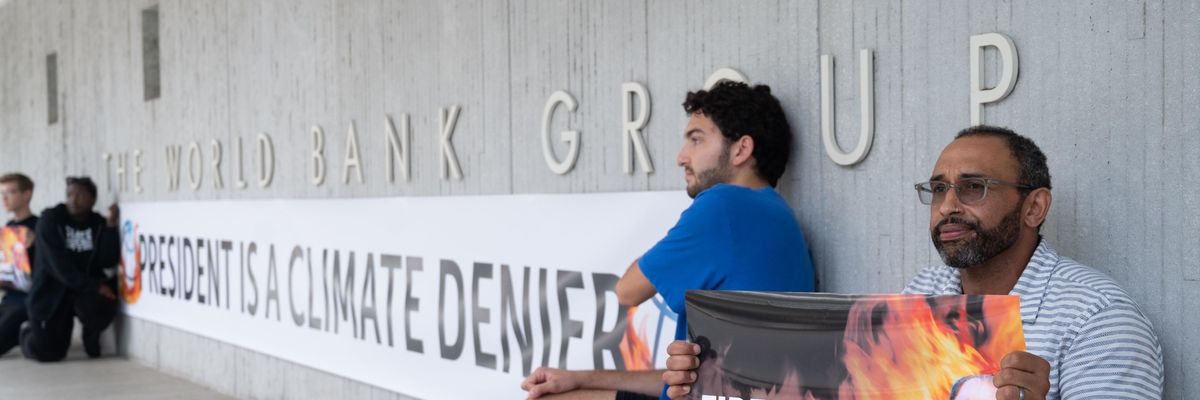
Amid preparations for a United Nations summit in November and calls for the World Bank Group president's ouster, Oxfam revealed Monday that the financial institution's "reporting practices make it impossible to independently verify their climate finance claims."
"This audit exposes the danger that some climate finance claims could simply be greenwashing."
Oxfam's new report--titled Unaccountable Accounting: The World Bank's unreliable climate finance reporting--details the group's attempt to audit the multilateral development bank (MDB), a difficult task due to lack of transparency around climate financing.
"This audit exposes the danger that some climate finance claims could simply be greenwashing, which would lead to a dangerous under-investment in poor countries' mitigation and adaptation efforts," declared Oxfam's climate change policy lead, Nafkote Dabi.
"The bank's public disclosure of its climate finance is like a faulty thermometer that's currently reading $17.2 billion," she explained. "We've found that it could be off by 40% in either direction and as such we simply can't be sure of the actual value."
In other words, the World Bank's reported climate finance for fiscal year 2020 could be off by up to $7 billion, according to Oxfam's review. Dabi said that "our concern of course is the worst-case scenario--that the bank could be significantly overstating its contribution to the cause."
"Climate finance is a lifeline to some of the world's poorest people and countries," Dabi noted. "It is also a vital component of these global negotiations that depend upon a consensus agreement to keep the world safe. Without better disclosure, the World Bank is asking us all to take too much on faith. These funds are too important for that."
"It is alarming--at a time when climate change is driving such damage and poverty and hunger around the world--that we could find so little clarity about the quality and quantity of these financial flows," she added. "It is more worrying that developing countries are being sold this promise on trust rather than on public evidence."
Oxfam's report urges the bank to "standardize how it reports on climate finance in projects by providing detailed climate finance assessments for all projects consistently," create a public database for such spending, and disclose internal methodology for related calculations.
"Other financiers will follow the bank's lack of disclosure," Dabi stressed. "Stakeholders like developing country governments do not have the right information to hold them and other rich donor governments to account. This introduces a significant deficit of confidence to the U.N. climate negotiations."
Without going into detail, a World Bank spokesperson told multiple media outlets that the MDB stood by its figures for the year reviewed by Oxfam.
"Our co-benefits are calculated using the joint MDB methodology," the spokesperson said. "We are rigorous about how we apply the methodology and only assign co-benefits for the share of financing in a given project that is directly tied to climate action. We stand by our assessment of co-benefits."
Oxfam's report comes as rich countries are under fire for failing to provide the Global South with $100 billion a year in climate finance--a topic that is expected to be a major focus at COP27, a U.N. conference in Egypt scheduled for next month.
Related Content

The audit also comes as climate groups, scientists, Democrats in Congress, and other public figures call on U.S. President Joe Biden to push for the removal or resignation of World Bank President David Malpass.
The calls stem from Malpass--who was nominated in 2019 by then-U.S. President Donald Trump--being asked last month whether he accepts the scientific consensus that burning fossil fuels is dangerously warming the planet and his response: "I don't even know. I'm not a scientist."
A recent letter from congressional Democrats to Biden notes that the United States is the World Bank's largest shareholder and argues that it must be led by someone "who fully appreciates the threat of climate change and the need to accelerate the global transition to a clean just energy future to improve living standards, reduce poverty, and encourage sustainable growth."
Amid preparations for a United Nations summit in November and calls for the World Bank Group president's ouster, Oxfam revealed Monday that the financial institution's "reporting practices make it impossible to independently verify their climate finance claims."
"This audit exposes the danger that some climate finance claims could simply be greenwashing."
Oxfam's new report--titled Unaccountable Accounting: The World Bank's unreliable climate finance reporting--details the group's attempt to audit the multilateral development bank (MDB), a difficult task due to lack of transparency around climate financing.
"This audit exposes the danger that some climate finance claims could simply be greenwashing, which would lead to a dangerous under-investment in poor countries' mitigation and adaptation efforts," declared Oxfam's climate change policy lead, Nafkote Dabi.
"The bank's public disclosure of its climate finance is like a faulty thermometer that's currently reading $17.2 billion," she explained. "We've found that it could be off by 40% in either direction and as such we simply can't be sure of the actual value."
In other words, the World Bank's reported climate finance for fiscal year 2020 could be off by up to $7 billion, according to Oxfam's review. Dabi said that "our concern of course is the worst-case scenario--that the bank could be significantly overstating its contribution to the cause."
"Climate finance is a lifeline to some of the world's poorest people and countries," Dabi noted. "It is also a vital component of these global negotiations that depend upon a consensus agreement to keep the world safe. Without better disclosure, the World Bank is asking us all to take too much on faith. These funds are too important for that."
"It is alarming--at a time when climate change is driving such damage and poverty and hunger around the world--that we could find so little clarity about the quality and quantity of these financial flows," she added. "It is more worrying that developing countries are being sold this promise on trust rather than on public evidence."
Oxfam's report urges the bank to "standardize how it reports on climate finance in projects by providing detailed climate finance assessments for all projects consistently," create a public database for such spending, and disclose internal methodology for related calculations.
"Other financiers will follow the bank's lack of disclosure," Dabi stressed. "Stakeholders like developing country governments do not have the right information to hold them and other rich donor governments to account. This introduces a significant deficit of confidence to the U.N. climate negotiations."
Without going into detail, a World Bank spokesperson told multiple media outlets that the MDB stood by its figures for the year reviewed by Oxfam.
"Our co-benefits are calculated using the joint MDB methodology," the spokesperson said. "We are rigorous about how we apply the methodology and only assign co-benefits for the share of financing in a given project that is directly tied to climate action. We stand by our assessment of co-benefits."
Oxfam's report comes as rich countries are under fire for failing to provide the Global South with $100 billion a year in climate finance--a topic that is expected to be a major focus at COP27, a U.N. conference in Egypt scheduled for next month.
Related Content
The audit also comes as climate groups, scientists, Democrats in Congress, and other public figures call on U.S. President Joe Biden to push for the removal or resignation of World Bank President David Malpass.
The calls stem from Malpass--who was nominated in 2019 by then-U.S. President Donald Trump--being asked last month whether he accepts the scientific consensus that burning fossil fuels is dangerously warming the planet and his response: "I don't even know. I'm not a scientist."
A recent letter from congressional Democrats to Biden notes that the United States is the World Bank's largest shareholder and argues that it must be led by someone "who fully appreciates the threat of climate change and the need to accelerate the global transition to a clean just energy future to improve living standards, reduce poverty, and encourage sustainable growth."
Amid preparations for a United Nations summit in November and calls for the World Bank Group president's ouster, Oxfam revealed Monday that the financial institution's "reporting practices make it impossible to independently verify their climate finance claims."
"This audit exposes the danger that some climate finance claims could simply be greenwashing."
Oxfam's new report--titled Unaccountable Accounting: The World Bank's unreliable climate finance reporting--details the group's attempt to audit the multilateral development bank (MDB), a difficult task due to lack of transparency around climate financing.
"This audit exposes the danger that some climate finance claims could simply be greenwashing, which would lead to a dangerous under-investment in poor countries' mitigation and adaptation efforts," declared Oxfam's climate change policy lead, Nafkote Dabi.
"The bank's public disclosure of its climate finance is like a faulty thermometer that's currently reading $17.2 billion," she explained. "We've found that it could be off by 40% in either direction and as such we simply can't be sure of the actual value."
In other words, the World Bank's reported climate finance for fiscal year 2020 could be off by up to $7 billion, according to Oxfam's review. Dabi said that "our concern of course is the worst-case scenario--that the bank could be significantly overstating its contribution to the cause."
"Climate finance is a lifeline to some of the world's poorest people and countries," Dabi noted. "It is also a vital component of these global negotiations that depend upon a consensus agreement to keep the world safe. Without better disclosure, the World Bank is asking us all to take too much on faith. These funds are too important for that."
"It is alarming--at a time when climate change is driving such damage and poverty and hunger around the world--that we could find so little clarity about the quality and quantity of these financial flows," she added. "It is more worrying that developing countries are being sold this promise on trust rather than on public evidence."
Oxfam's report urges the bank to "standardize how it reports on climate finance in projects by providing detailed climate finance assessments for all projects consistently," create a public database for such spending, and disclose internal methodology for related calculations.
"Other financiers will follow the bank's lack of disclosure," Dabi stressed. "Stakeholders like developing country governments do not have the right information to hold them and other rich donor governments to account. This introduces a significant deficit of confidence to the U.N. climate negotiations."
Without going into detail, a World Bank spokesperson told multiple media outlets that the MDB stood by its figures for the year reviewed by Oxfam.
"Our co-benefits are calculated using the joint MDB methodology," the spokesperson said. "We are rigorous about how we apply the methodology and only assign co-benefits for the share of financing in a given project that is directly tied to climate action. We stand by our assessment of co-benefits."
Oxfam's report comes as rich countries are under fire for failing to provide the Global South with $100 billion a year in climate finance--a topic that is expected to be a major focus at COP27, a U.N. conference in Egypt scheduled for next month.
Related Content
The audit also comes as climate groups, scientists, Democrats in Congress, and other public figures call on U.S. President Joe Biden to push for the removal or resignation of World Bank President David Malpass.
The calls stem from Malpass--who was nominated in 2019 by then-U.S. President Donald Trump--being asked last month whether he accepts the scientific consensus that burning fossil fuels is dangerously warming the planet and his response: "I don't even know. I'm not a scientist."
A recent letter from congressional Democrats to Biden notes that the United States is the World Bank's largest shareholder and argues that it must be led by someone "who fully appreciates the threat of climate change and the need to accelerate the global transition to a clean just energy future to improve living standards, reduce poverty, and encourage sustainable growth."

