SUBSCRIBE TO OUR FREE NEWSLETTER
Daily news & progressive opinion—funded by the people, not the corporations—delivered straight to your inbox.
5
#000000
#FFFFFF
To donate by check, phone, or other method, see our More Ways to Give page.

Advocacy groups on Thursday renewed calls for Congress to ban members and their families from trading stock amid reporting that Democratic leaders in the U.S. House--despite intense public pressure--are unlikely to bring a vote on the issue before the November midterm election.
"It it is time to take the next step and ban stock trading activity altogether by members of Congress and their spouses."
"As members of Congress craft laws that directly impact the lives of Americans, voters have a right to know whether their representatives are acting in the interest of the public, or in ways that serve their own personal interest," said Trevor Potter, president of Campaign Legal Center (CLC) and former chair of the Federal Election Commission (FEC), in a statement.
"Congress passed the Stop Trading on Congressional Knowledge (STOCK) Act into law 10 years ago," he noted, "but the STOCK Act did not decrease the appearance of corruption that arises when members of Congress engage in suspicious stock trades."
The New York Times earlier this month published an investigation revealing that 97 members of Congress "bought or sold stock, bonds, or other financial assets that intersected with their congressional work or reported similar transactions by their spouse or a dependent child," a revelation that bolstered calls for reforms to ethics rules on the matter.
"Members of Congress have routine access to confidential inside information of public policies that directly and substantially affect the economy--and the stock markets," Craig Holman, government affairs lobbyist for the watchdog group Public Citizen, highlighted Thursday. "Yet these same lawmakers buy and sell stocks at whim, often after confidential briefings on the likely spikes and downturns of the economy from information unavailable to the public."
Public Citizen executive vice president Lisa Gilbert said that "the disclosure system of the STOCK Act itself should have prevented members of Congress from insider trading."
"In fact, it resulted in a dramatic reduction of stock trading activity by members of Congress," Gilbert continued. "But it is time to take the next step and ban stock trading activity altogether by members of Congress and their spouses."
House Democrats' latest proposal to do so is the Combatting Financial Conflicts of Interest in Government Act (H.R. 8990)--which was officially introduced Wednesday and spearheaded by House Administration Committee Chair Zoe Lofgren (D-Calif.), at the direction of House Speaker Nancy Pelosi (D-Calif.).
"Pelosi has gotten criticism over stock trading by her husband, investor Paul Pelosi, although there's been no allegation of improper or unethical behavior," Punchbowl News reported Thursday, adding that "the Lofgren bill has come under heavy criticism on and off Capitol Hill."
However, CLC, Public Citizen, other organizations, and the vast majority of Americans want lawmakers to act on the issue.
"The Combatting Financial Conflicts of Interest in Government Act, designed with the shortcomings of the STOCK Act in mind, will work to repair that trust by banning members of Congress from trading stock while in office and prohibiting such activity by their spouses, dependent children, and senior staff," Potter said. "The law establishes significant penalties to promote compliance, an area where the STOCK Act fell woefully short. To comply with the new law, officials may transfer their investments to a blind trust to avoid conflicts of interest."
"Although this bill has room for improvement concerning the scope of covered officials and potential loopholes, it answers voters' calls for reform and I urge every member of the House to vote in favor of the Combatting Financial Conflicts of Interest in Government Act," he added.
As Potter also pointed out, "Public polling confirms that most Americans support banning lawmakers from trading stocks, and it is therefore crucial that the House passes this legislation."
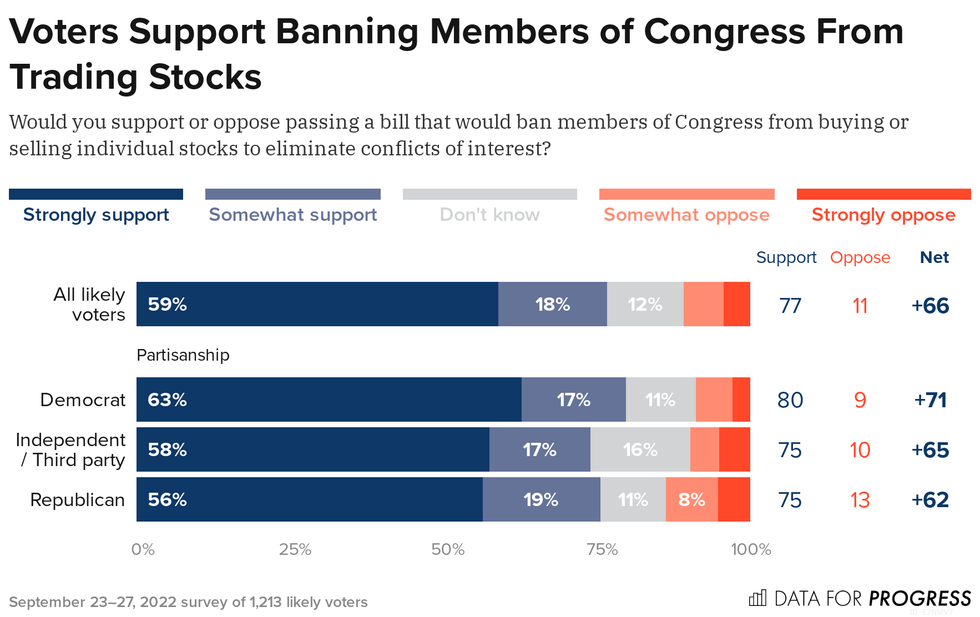
One such poll from Stand Up America and Data for Progress, conducted within the past week, shows that 77% of all U.S. voters--including 80% of Democrats and 75% of both Independents and Republicans--somewhat or strongly support a congressional stock trading ban.
Majorities of the Democrats, Independents, and Republicans surveyed also indicated that they would be somewhat or much more likely to vote for congressional candidates this November "if they agree members of Congress should not be allowed to trade stocks."
In a Wednesday statement, Stand Up America founder and president Sean Eldridge stressed that "our representatives should be focused on public service, not personal profit."
"That's why an overwhelming majority of Americans agree that it's time to end stock trading by sitting members of Congress," he said. "Existing ethics laws do not go far enough to prevent members of Congress from using the information they have access to for personal gain. No more excuses. No more delays. It's time for action."
Despite such pressure from voters and pro-democracy groups, Punchbowl reported that "sources inside the House Democratic leadership said there was 'very little chance' this bill would be acted upon before the House adjourns for the election" on Friday.
The outlet noted that "one senior aide suggested 'Pelosi never really wanted a vote on this anyway' when describing how the speaker handled this issue."
Late Thursday morning, CNN similarly reported that House Majority Leader Steny Hoyer (D-Md.) said "probably no vote this week," meaning that House members--expected to head for their districts this weekend--likely won't have to make a decision on the bill until after the election.
"I haven't read it, it's a complicated issue, as you can imagine, as a new rule for members they have to follow, and their families as I understand, so I think it deserves careful study to make sure if we do something, we do it right," Hoyer added.
As Common Dreams reported Tuesday, Hoyer, the second-ranking Democrat in the House, signaled his opposition to the bill in meetings with colleagues--which critics called "shameful."
The Senate is also not expected to vote on the issue in the weeks ahead. Sen. Jeff Merkley (D-Ore.), who led the upper chamber's version, said earlier this month that he is "looking forward to getting this across the finish line, but it's not going to happen before the election."
Advocacy groups on Thursday renewed calls for Congress to ban members and their families from trading stock amid reporting that Democratic leaders in the U.S. House--despite intense public pressure--are unlikely to bring a vote on the issue before the November midterm election.
"It it is time to take the next step and ban stock trading activity altogether by members of Congress and their spouses."
"As members of Congress craft laws that directly impact the lives of Americans, voters have a right to know whether their representatives are acting in the interest of the public, or in ways that serve their own personal interest," said Trevor Potter, president of Campaign Legal Center (CLC) and former chair of the Federal Election Commission (FEC), in a statement.
"Congress passed the Stop Trading on Congressional Knowledge (STOCK) Act into law 10 years ago," he noted, "but the STOCK Act did not decrease the appearance of corruption that arises when members of Congress engage in suspicious stock trades."
The New York Times earlier this month published an investigation revealing that 97 members of Congress "bought or sold stock, bonds, or other financial assets that intersected with their congressional work or reported similar transactions by their spouse or a dependent child," a revelation that bolstered calls for reforms to ethics rules on the matter.
"Members of Congress have routine access to confidential inside information of public policies that directly and substantially affect the economy--and the stock markets," Craig Holman, government affairs lobbyist for the watchdog group Public Citizen, highlighted Thursday. "Yet these same lawmakers buy and sell stocks at whim, often after confidential briefings on the likely spikes and downturns of the economy from information unavailable to the public."
Public Citizen executive vice president Lisa Gilbert said that "the disclosure system of the STOCK Act itself should have prevented members of Congress from insider trading."
"In fact, it resulted in a dramatic reduction of stock trading activity by members of Congress," Gilbert continued. "But it is time to take the next step and ban stock trading activity altogether by members of Congress and their spouses."
House Democrats' latest proposal to do so is the Combatting Financial Conflicts of Interest in Government Act (H.R. 8990)--which was officially introduced Wednesday and spearheaded by House Administration Committee Chair Zoe Lofgren (D-Calif.), at the direction of House Speaker Nancy Pelosi (D-Calif.).
"Pelosi has gotten criticism over stock trading by her husband, investor Paul Pelosi, although there's been no allegation of improper or unethical behavior," Punchbowl News reported Thursday, adding that "the Lofgren bill has come under heavy criticism on and off Capitol Hill."
However, CLC, Public Citizen, other organizations, and the vast majority of Americans want lawmakers to act on the issue.
"The Combatting Financial Conflicts of Interest in Government Act, designed with the shortcomings of the STOCK Act in mind, will work to repair that trust by banning members of Congress from trading stock while in office and prohibiting such activity by their spouses, dependent children, and senior staff," Potter said. "The law establishes significant penalties to promote compliance, an area where the STOCK Act fell woefully short. To comply with the new law, officials may transfer their investments to a blind trust to avoid conflicts of interest."
"Although this bill has room for improvement concerning the scope of covered officials and potential loopholes, it answers voters' calls for reform and I urge every member of the House to vote in favor of the Combatting Financial Conflicts of Interest in Government Act," he added.
As Potter also pointed out, "Public polling confirms that most Americans support banning lawmakers from trading stocks, and it is therefore crucial that the House passes this legislation."
One such poll from Stand Up America and Data for Progress, conducted within the past week, shows that 77% of all U.S. voters--including 80% of Democrats and 75% of both Independents and Republicans--somewhat or strongly support a congressional stock trading ban.
Majorities of the Democrats, Independents, and Republicans surveyed also indicated that they would be somewhat or much more likely to vote for congressional candidates this November "if they agree members of Congress should not be allowed to trade stocks."
In a Wednesday statement, Stand Up America founder and president Sean Eldridge stressed that "our representatives should be focused on public service, not personal profit."
"That's why an overwhelming majority of Americans agree that it's time to end stock trading by sitting members of Congress," he said. "Existing ethics laws do not go far enough to prevent members of Congress from using the information they have access to for personal gain. No more excuses. No more delays. It's time for action."
Despite such pressure from voters and pro-democracy groups, Punchbowl reported that "sources inside the House Democratic leadership said there was 'very little chance' this bill would be acted upon before the House adjourns for the election" on Friday.
The outlet noted that "one senior aide suggested 'Pelosi never really wanted a vote on this anyway' when describing how the speaker handled this issue."
Late Thursday morning, CNN similarly reported that House Majority Leader Steny Hoyer (D-Md.) said "probably no vote this week," meaning that House members--expected to head for their districts this weekend--likely won't have to make a decision on the bill until after the election.
"I haven't read it, it's a complicated issue, as you can imagine, as a new rule for members they have to follow, and their families as I understand, so I think it deserves careful study to make sure if we do something, we do it right," Hoyer added.
As Common Dreams reported Tuesday, Hoyer, the second-ranking Democrat in the House, signaled his opposition to the bill in meetings with colleagues--which critics called "shameful."
The Senate is also not expected to vote on the issue in the weeks ahead. Sen. Jeff Merkley (D-Ore.), who led the upper chamber's version, said earlier this month that he is "looking forward to getting this across the finish line, but it's not going to happen before the election."
Advocacy groups on Thursday renewed calls for Congress to ban members and their families from trading stock amid reporting that Democratic leaders in the U.S. House--despite intense public pressure--are unlikely to bring a vote on the issue before the November midterm election.
"It it is time to take the next step and ban stock trading activity altogether by members of Congress and their spouses."
"As members of Congress craft laws that directly impact the lives of Americans, voters have a right to know whether their representatives are acting in the interest of the public, or in ways that serve their own personal interest," said Trevor Potter, president of Campaign Legal Center (CLC) and former chair of the Federal Election Commission (FEC), in a statement.
"Congress passed the Stop Trading on Congressional Knowledge (STOCK) Act into law 10 years ago," he noted, "but the STOCK Act did not decrease the appearance of corruption that arises when members of Congress engage in suspicious stock trades."
The New York Times earlier this month published an investigation revealing that 97 members of Congress "bought or sold stock, bonds, or other financial assets that intersected with their congressional work or reported similar transactions by their spouse or a dependent child," a revelation that bolstered calls for reforms to ethics rules on the matter.
"Members of Congress have routine access to confidential inside information of public policies that directly and substantially affect the economy--and the stock markets," Craig Holman, government affairs lobbyist for the watchdog group Public Citizen, highlighted Thursday. "Yet these same lawmakers buy and sell stocks at whim, often after confidential briefings on the likely spikes and downturns of the economy from information unavailable to the public."
Public Citizen executive vice president Lisa Gilbert said that "the disclosure system of the STOCK Act itself should have prevented members of Congress from insider trading."
"In fact, it resulted in a dramatic reduction of stock trading activity by members of Congress," Gilbert continued. "But it is time to take the next step and ban stock trading activity altogether by members of Congress and their spouses."
House Democrats' latest proposal to do so is the Combatting Financial Conflicts of Interest in Government Act (H.R. 8990)--which was officially introduced Wednesday and spearheaded by House Administration Committee Chair Zoe Lofgren (D-Calif.), at the direction of House Speaker Nancy Pelosi (D-Calif.).
"Pelosi has gotten criticism over stock trading by her husband, investor Paul Pelosi, although there's been no allegation of improper or unethical behavior," Punchbowl News reported Thursday, adding that "the Lofgren bill has come under heavy criticism on and off Capitol Hill."
However, CLC, Public Citizen, other organizations, and the vast majority of Americans want lawmakers to act on the issue.
"The Combatting Financial Conflicts of Interest in Government Act, designed with the shortcomings of the STOCK Act in mind, will work to repair that trust by banning members of Congress from trading stock while in office and prohibiting such activity by their spouses, dependent children, and senior staff," Potter said. "The law establishes significant penalties to promote compliance, an area where the STOCK Act fell woefully short. To comply with the new law, officials may transfer their investments to a blind trust to avoid conflicts of interest."
"Although this bill has room for improvement concerning the scope of covered officials and potential loopholes, it answers voters' calls for reform and I urge every member of the House to vote in favor of the Combatting Financial Conflicts of Interest in Government Act," he added.
As Potter also pointed out, "Public polling confirms that most Americans support banning lawmakers from trading stocks, and it is therefore crucial that the House passes this legislation."
One such poll from Stand Up America and Data for Progress, conducted within the past week, shows that 77% of all U.S. voters--including 80% of Democrats and 75% of both Independents and Republicans--somewhat or strongly support a congressional stock trading ban.
Majorities of the Democrats, Independents, and Republicans surveyed also indicated that they would be somewhat or much more likely to vote for congressional candidates this November "if they agree members of Congress should not be allowed to trade stocks."
In a Wednesday statement, Stand Up America founder and president Sean Eldridge stressed that "our representatives should be focused on public service, not personal profit."
"That's why an overwhelming majority of Americans agree that it's time to end stock trading by sitting members of Congress," he said. "Existing ethics laws do not go far enough to prevent members of Congress from using the information they have access to for personal gain. No more excuses. No more delays. It's time for action."
Despite such pressure from voters and pro-democracy groups, Punchbowl reported that "sources inside the House Democratic leadership said there was 'very little chance' this bill would be acted upon before the House adjourns for the election" on Friday.
The outlet noted that "one senior aide suggested 'Pelosi never really wanted a vote on this anyway' when describing how the speaker handled this issue."
Late Thursday morning, CNN similarly reported that House Majority Leader Steny Hoyer (D-Md.) said "probably no vote this week," meaning that House members--expected to head for their districts this weekend--likely won't have to make a decision on the bill until after the election.
"I haven't read it, it's a complicated issue, as you can imagine, as a new rule for members they have to follow, and their families as I understand, so I think it deserves careful study to make sure if we do something, we do it right," Hoyer added.
As Common Dreams reported Tuesday, Hoyer, the second-ranking Democrat in the House, signaled his opposition to the bill in meetings with colleagues--which critics called "shameful."
The Senate is also not expected to vote on the issue in the weeks ahead. Sen. Jeff Merkley (D-Ore.), who led the upper chamber's version, said earlier this month that he is "looking forward to getting this across the finish line, but it's not going to happen before the election."