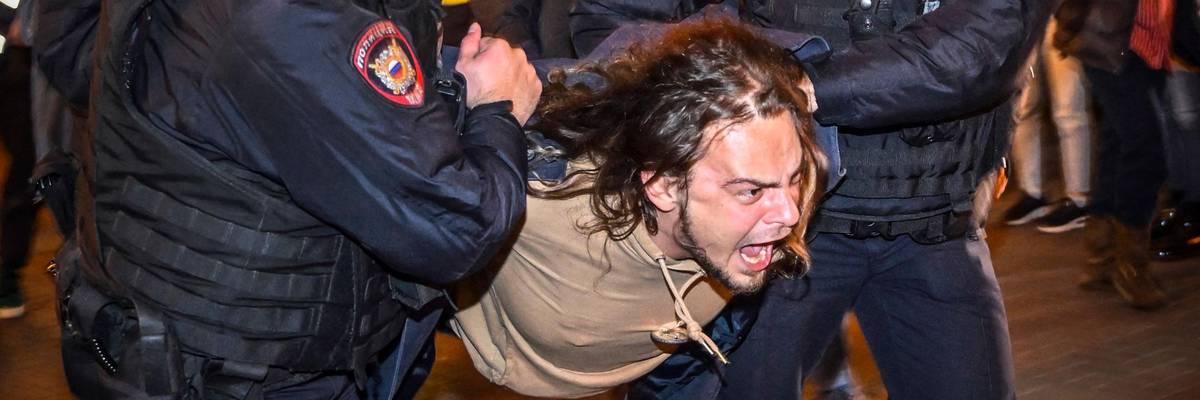
The Office of the United Nations High Commissioner for Human Rights said Tuesday that "we are deeply disturbed" by the nearly 2,400 arrests of Ukraine war critics since Russian President Vladimir Putin last week announced a "partial mobilization" of military reservists.
"Arresting people solely for exercising their rights of peaceful assembly and freedom of expression constitutes an arbitrary deprivation of liberty."
The U.N. office spokesperson, Ravina Shamdasani, referenced reporting that at least 2,377 demonstrators have been detained across the country as of Monday. The Russia-based independent monitoring group OVD-Info has documented 2,398 detentions.
"In the Russian region of Dagestan, protests continued for a second day on Monday with hundreds of people taking to the streets of the capital, Makhachkala, where clashes erupted between demonstrators and the police," Shamdasani said. "Dozens of people were reported to have been arrested."
The crackdown on anti-war protests over the past week resembles Russian authorities' response to peace demonstrations that occurred just after the invasion of Ukraine in late February.
Shamdasani acknowledged Tuesday that "while the majority of the protests are reported to have been peaceful, military and administrative buildings, including enlistment offices, have been attacked in several regions."
In one case, a gunman--reportedly upset that his best friend with no military history received draft papers despite Russian authorities' claims that only experienced reservists are being called up to fight in Ukraine--shot up an enlistment office in the town of Ust-Ilimsk.
Related Content

'We Aren't Going to War': Draft Officer Shot Amid Russian Anger Over Conscription
Since Putin's speech last week, which also included nuclear weapons threats, "at least 20 military or administrative buildings across the country have been targeted by Molotov cocktails or arson attacks," The Moscow Times reported Tuesday.
"Russia's North Caucasus regions have seen some of the fiercest anti-mobilization protests, with hundreds of protesters detained and scenes of brawls with police," the newspaper noted. "Two of the country's poorer ethnic republics--that have already suffered some of the highest known death rates in Ukraine--are now reportedly being called on to provide a disproportionate amount of men."
While urging the people of Russia "to protest peacefully and avoid resorting to violence," Shamdasani emphasized the need for Russian authorities to respect demonstrators.
"We stress that arresting people solely for exercising their rights of peaceful assembly and freedom of expression constitutes an arbitrary deprivation of liberty," she said. "We call for the immediate release of all those arbitrarily detained and for the authorities to abide by their international obligations to respect and ensure the rights to freedom of expression and of peaceful assembly."
As she told journalists in Geneva on Tuesday, "Our key concerns are the need for lawfulness, a need for a lack of arbitrariness and clear scope for conscientious objection and independent review of individual decisions on how the mobilization has been carried out."
Shamdasani also said reporting that up to tens of thousands of men at risk of being drafted have fled Russia in the past week is "heartbreaking."
The New York Times reported at the end of August, six months into the war, that "military losses have been heavy on both sides, with about 9,000 Ukrainians and as many as 25,000 Russians said to be killed."
Additionally, across Ukraine, at least 5,996 civilians have been killed and 8,848 injured, according to the Office of the U.N. High Commissioner for Human Rights, which notes that the true figures are likely "considerably higher."
The Office of the United Nations High Commissioner for Human Rights said Tuesday that "we are deeply disturbed" by the nearly 2,400 arrests of Ukraine war critics since Russian President Vladimir Putin last week announced a "partial mobilization" of military reservists.
"Arresting people solely for exercising their rights of peaceful assembly and freedom of expression constitutes an arbitrary deprivation of liberty."
The U.N. office spokesperson, Ravina Shamdasani, referenced reporting that at least 2,377 demonstrators have been detained across the country as of Monday. The Russia-based independent monitoring group OVD-Info has documented 2,398 detentions.
"In the Russian region of Dagestan, protests continued for a second day on Monday with hundreds of people taking to the streets of the capital, Makhachkala, where clashes erupted between demonstrators and the police," Shamdasani said. "Dozens of people were reported to have been arrested."
The crackdown on anti-war protests over the past week resembles Russian authorities' response to peace demonstrations that occurred just after the invasion of Ukraine in late February.
Shamdasani acknowledged Tuesday that "while the majority of the protests are reported to have been peaceful, military and administrative buildings, including enlistment offices, have been attacked in several regions."
In one case, a gunman--reportedly upset that his best friend with no military history received draft papers despite Russian authorities' claims that only experienced reservists are being called up to fight in Ukraine--shot up an enlistment office in the town of Ust-Ilimsk.
Related Content
'We Aren't Going to War': Draft Officer Shot Amid Russian Anger Over Conscription
Since Putin's speech last week, which also included nuclear weapons threats, "at least 20 military or administrative buildings across the country have been targeted by Molotov cocktails or arson attacks," The Moscow Times reported Tuesday.
"Russia's North Caucasus regions have seen some of the fiercest anti-mobilization protests, with hundreds of protesters detained and scenes of brawls with police," the newspaper noted. "Two of the country's poorer ethnic republics--that have already suffered some of the highest known death rates in Ukraine--are now reportedly being called on to provide a disproportionate amount of men."
While urging the people of Russia "to protest peacefully and avoid resorting to violence," Shamdasani emphasized the need for Russian authorities to respect demonstrators.
"We stress that arresting people solely for exercising their rights of peaceful assembly and freedom of expression constitutes an arbitrary deprivation of liberty," she said. "We call for the immediate release of all those arbitrarily detained and for the authorities to abide by their international obligations to respect and ensure the rights to freedom of expression and of peaceful assembly."
As she told journalists in Geneva on Tuesday, "Our key concerns are the need for lawfulness, a need for a lack of arbitrariness and clear scope for conscientious objection and independent review of individual decisions on how the mobilization has been carried out."
Shamdasani also said reporting that up to tens of thousands of men at risk of being drafted have fled Russia in the past week is "heartbreaking."
The New York Times reported at the end of August, six months into the war, that "military losses have been heavy on both sides, with about 9,000 Ukrainians and as many as 25,000 Russians said to be killed."
Additionally, across Ukraine, at least 5,996 civilians have been killed and 8,848 injured, according to the Office of the U.N. High Commissioner for Human Rights, which notes that the true figures are likely "considerably higher."
The Office of the United Nations High Commissioner for Human Rights said Tuesday that "we are deeply disturbed" by the nearly 2,400 arrests of Ukraine war critics since Russian President Vladimir Putin last week announced a "partial mobilization" of military reservists.
"Arresting people solely for exercising their rights of peaceful assembly and freedom of expression constitutes an arbitrary deprivation of liberty."
The U.N. office spokesperson, Ravina Shamdasani, referenced reporting that at least 2,377 demonstrators have been detained across the country as of Monday. The Russia-based independent monitoring group OVD-Info has documented 2,398 detentions.
"In the Russian region of Dagestan, protests continued for a second day on Monday with hundreds of people taking to the streets of the capital, Makhachkala, where clashes erupted between demonstrators and the police," Shamdasani said. "Dozens of people were reported to have been arrested."
The crackdown on anti-war protests over the past week resembles Russian authorities' response to peace demonstrations that occurred just after the invasion of Ukraine in late February.
Shamdasani acknowledged Tuesday that "while the majority of the protests are reported to have been peaceful, military and administrative buildings, including enlistment offices, have been attacked in several regions."
In one case, a gunman--reportedly upset that his best friend with no military history received draft papers despite Russian authorities' claims that only experienced reservists are being called up to fight in Ukraine--shot up an enlistment office in the town of Ust-Ilimsk.
Related Content
'We Aren't Going to War': Draft Officer Shot Amid Russian Anger Over Conscription
Since Putin's speech last week, which also included nuclear weapons threats, "at least 20 military or administrative buildings across the country have been targeted by Molotov cocktails or arson attacks," The Moscow Times reported Tuesday.
"Russia's North Caucasus regions have seen some of the fiercest anti-mobilization protests, with hundreds of protesters detained and scenes of brawls with police," the newspaper noted. "Two of the country's poorer ethnic republics--that have already suffered some of the highest known death rates in Ukraine--are now reportedly being called on to provide a disproportionate amount of men."
While urging the people of Russia "to protest peacefully and avoid resorting to violence," Shamdasani emphasized the need for Russian authorities to respect demonstrators.
"We stress that arresting people solely for exercising their rights of peaceful assembly and freedom of expression constitutes an arbitrary deprivation of liberty," she said. "We call for the immediate release of all those arbitrarily detained and for the authorities to abide by their international obligations to respect and ensure the rights to freedom of expression and of peaceful assembly."
As she told journalists in Geneva on Tuesday, "Our key concerns are the need for lawfulness, a need for a lack of arbitrariness and clear scope for conscientious objection and independent review of individual decisions on how the mobilization has been carried out."
Shamdasani also said reporting that up to tens of thousands of men at risk of being drafted have fled Russia in the past week is "heartbreaking."
The New York Times reported at the end of August, six months into the war, that "military losses have been heavy on both sides, with about 9,000 Ukrainians and as many as 25,000 Russians said to be killed."
Additionally, across Ukraine, at least 5,996 civilians have been killed and 8,848 injured, according to the Office of the U.N. High Commissioner for Human Rights, which notes that the true figures are likely "considerably higher."