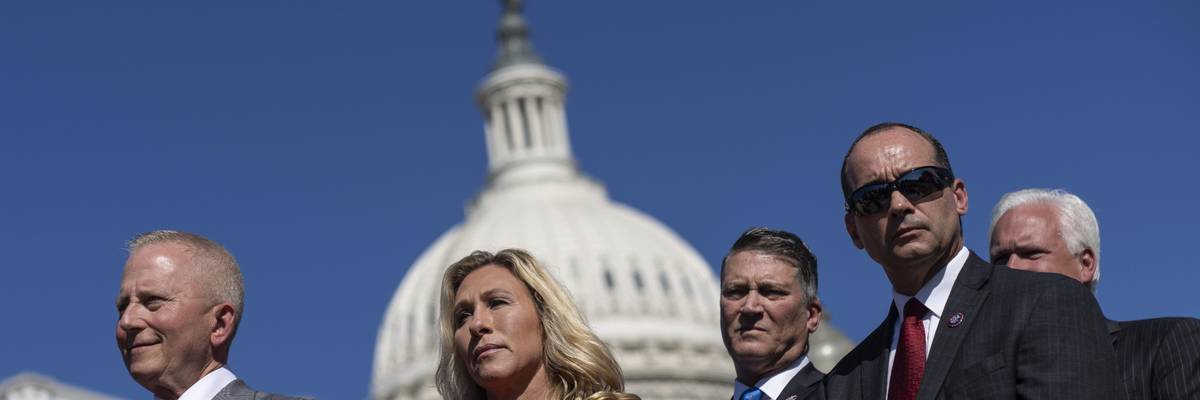
Reps. Jeff Van Drew (R-N.J.), Marjorie Taylor Greene (R-Ga.), Ronny Jackson (R-Texas), Bob Good (R-Va.), and American Conservative Union chairman Matt Schlapp attend a news conference on September 20, 2022 in Washington, D.C. (Photo: Drew Angerer/Getty Images)
Majority of Republican Voters Say US Should Be Declared a 'Christian Nation'
More than 60% of GOP voters supported codifying Christian nationalism even as they said the U.S. Constitution does not support such a declaration.
Far-right Republican lawmakers who have recently invoked Christian nationalist messages appear to be representing a growing portion of their voter base, according to a new poll released Wednesday showing that a sizable majority of Republicans believe the U.S. should be declared a "Christian nation."
As Professors Stella Rouse and Shibley Telhami of the University of Maryland wrote at Politico, the school's critical issues poll found that while a majority of Republican voters agree that such a declaration would be unconstitutional, most also believe that the U.S. should be officially known as Christian.
"We see that 51% of Millennial Republicans and 51% of Generation Z Republicans want the U.S. to be declared a Christian nation."
The professors surveyed 2,091 voters between May 6-16, 2022, first asking them "if they believed the Constitution would even allow the United States government to declare the U.S. a 'Christian Nation'" and finding that 57% of Republicans--as well as more than 80% of Democrats--said no.
Yet "fully 61% of Republicans supported declaring the United States a Christian nation," Rouse and Telhami wrote.
The poll, showing widespread disregard for one of the nation's foundational documents, was released as government watchdogs issue warnings about a plot some Republican lawmakers are pushing to rewrite the Constitution.
The critical issues poll showed that older Republicans were more likely than Millennial voters and members of Generation Z--who range in age from 18 to 41--to think Christian nationalist beliefs should be codified, younger members of the party were also largely supportive.
"We see that 51% of Millennial Republicans and 51% of Generation Z Republicans want the U.S. to be declared a Christian nation," wrote Rouse and Telhami.
More than 70% of Republicans born before 1965 supported such a declaration.
The poll results were released as GOP candidates and elected officials have outwardly expressed Christian nationalist beliefs with greater frequency.
Earlier this month, Rep. Lauren Boebert (R-Colo.) told an audience at a conference held by the Truth and Liberty Coalition that "we need God back at the center of our country."
"It's time for us to position ourselves and rise up and take our place in Christ and influence this nation as we were called to do," she told supporters of the coalition, which says it "stands for preserving America's constitutional republic of government" and "guaranteeing to each citizen their Creator-given rights."
Florida Gov. Ron DeSantis also advised students at Hillsdale College, a Christian school in Michigan, to "put on the full armor of God" and "stand firm against the left's schemes" earlier this year, and Rep. Marjorie Taylor Greene (R-Ga.) openly said in July that Republicans "should be Christian nationalists."
"We need to be the party of nationalism and I'm a Christian, and I say it proudly," said the congresswoman in July. Greene also suggested in June that those who warn against Christian nationalism are "domestic terrorists."
On Wednesday, Greene responded to Politico's report on the University of Maryland poll with the words, "In God we trust."
The poll was released a day after political analyst Jared Yates Sexton warned on social media and "The Muckrake Podcast" that the "incredible threat" of Christian nationalism "extends beyond" former President Donald Trump.
"Even if Trump loses his stranglehold on the GOP, Republicans recognize that QAnon and Christian nationalism are invaluable tools," said Sexton. "These faiths legitimize antidemocratic actions, political violence, and widespread oppression."
We are at a crossroads
This country and this world are at a monumental crossroads. In a few short weeks, US voters will have an opportunity to beat back the forces of fascism and confront the billionaires who are rigging the economy, our media system, and our democracy, making it increasingly impossible for ordinary people to get by. We’re not just talking about the election. We’re talking about what must be done once these fascist elements are vanquished from power. We need a bolder set of solutions than what either major party has so far been willing to offer and a working-class movement ready to fight like hell for it. Trump didn't emerge from nowhere. The conditions that fueled MAGA authoritarianism were created by decades of radical neoliberal economic policies and a corrupt political system dominated by corporate interests. They slashed taxes on the super-rich, promising that the benefits would trickle down. They said giveaways to the corporate titans would make life more affordable for the rest of us. It was all bullshit. And when a bitter, betrayed populace searches for someone to blame, right-wing demagogues have little trouble finding scapegoats. People know when they're being lied to, but you won't hear any of this from the corporate media. Only independent journalism—powered and funded by people who believe in building a better world—can deliver truly trustworthy daily news. Our Fall Campaign is underway, and we need your help. To power our newsroom through the rest of the year, we need to raise $125,000 by midnight on October 31. So if you share our vision, please contribute whatever you can to sustain our work. |
Far-right Republican lawmakers who have recently invoked Christian nationalist messages appear to be representing a growing portion of their voter base, according to a new poll released Wednesday showing that a sizable majority of Republicans believe the U.S. should be declared a "Christian nation."
As Professors Stella Rouse and Shibley Telhami of the University of Maryland wrote at Politico, the school's critical issues poll found that while a majority of Republican voters agree that such a declaration would be unconstitutional, most also believe that the U.S. should be officially known as Christian.
"We see that 51% of Millennial Republicans and 51% of Generation Z Republicans want the U.S. to be declared a Christian nation."
The professors surveyed 2,091 voters between May 6-16, 2022, first asking them "if they believed the Constitution would even allow the United States government to declare the U.S. a 'Christian Nation'" and finding that 57% of Republicans--as well as more than 80% of Democrats--said no.
Yet "fully 61% of Republicans supported declaring the United States a Christian nation," Rouse and Telhami wrote.
The poll, showing widespread disregard for one of the nation's foundational documents, was released as government watchdogs issue warnings about a plot some Republican lawmakers are pushing to rewrite the Constitution.
The critical issues poll showed that older Republicans were more likely than Millennial voters and members of Generation Z--who range in age from 18 to 41--to think Christian nationalist beliefs should be codified, younger members of the party were also largely supportive.
"We see that 51% of Millennial Republicans and 51% of Generation Z Republicans want the U.S. to be declared a Christian nation," wrote Rouse and Telhami.
More than 70% of Republicans born before 1965 supported such a declaration.
The poll results were released as GOP candidates and elected officials have outwardly expressed Christian nationalist beliefs with greater frequency.
Earlier this month, Rep. Lauren Boebert (R-Colo.) told an audience at a conference held by the Truth and Liberty Coalition that "we need God back at the center of our country."
"It's time for us to position ourselves and rise up and take our place in Christ and influence this nation as we were called to do," she told supporters of the coalition, which says it "stands for preserving America's constitutional republic of government" and "guaranteeing to each citizen their Creator-given rights."
Florida Gov. Ron DeSantis also advised students at Hillsdale College, a Christian school in Michigan, to "put on the full armor of God" and "stand firm against the left's schemes" earlier this year, and Rep. Marjorie Taylor Greene (R-Ga.) openly said in July that Republicans "should be Christian nationalists."
"We need to be the party of nationalism and I'm a Christian, and I say it proudly," said the congresswoman in July. Greene also suggested in June that those who warn against Christian nationalism are "domestic terrorists."
On Wednesday, Greene responded to Politico's report on the University of Maryland poll with the words, "In God we trust."
The poll was released a day after political analyst Jared Yates Sexton warned on social media and "The Muckrake Podcast" that the "incredible threat" of Christian nationalism "extends beyond" former President Donald Trump.
"Even if Trump loses his stranglehold on the GOP, Republicans recognize that QAnon and Christian nationalism are invaluable tools," said Sexton. "These faiths legitimize antidemocratic actions, political violence, and widespread oppression."
Far-right Republican lawmakers who have recently invoked Christian nationalist messages appear to be representing a growing portion of their voter base, according to a new poll released Wednesday showing that a sizable majority of Republicans believe the U.S. should be declared a "Christian nation."
As Professors Stella Rouse and Shibley Telhami of the University of Maryland wrote at Politico, the school's critical issues poll found that while a majority of Republican voters agree that such a declaration would be unconstitutional, most also believe that the U.S. should be officially known as Christian.
"We see that 51% of Millennial Republicans and 51% of Generation Z Republicans want the U.S. to be declared a Christian nation."
The professors surveyed 2,091 voters between May 6-16, 2022, first asking them "if they believed the Constitution would even allow the United States government to declare the U.S. a 'Christian Nation'" and finding that 57% of Republicans--as well as more than 80% of Democrats--said no.
Yet "fully 61% of Republicans supported declaring the United States a Christian nation," Rouse and Telhami wrote.
The poll, showing widespread disregard for one of the nation's foundational documents, was released as government watchdogs issue warnings about a plot some Republican lawmakers are pushing to rewrite the Constitution.
The critical issues poll showed that older Republicans were more likely than Millennial voters and members of Generation Z--who range in age from 18 to 41--to think Christian nationalist beliefs should be codified, younger members of the party were also largely supportive.
"We see that 51% of Millennial Republicans and 51% of Generation Z Republicans want the U.S. to be declared a Christian nation," wrote Rouse and Telhami.
More than 70% of Republicans born before 1965 supported such a declaration.
The poll results were released as GOP candidates and elected officials have outwardly expressed Christian nationalist beliefs with greater frequency.
Earlier this month, Rep. Lauren Boebert (R-Colo.) told an audience at a conference held by the Truth and Liberty Coalition that "we need God back at the center of our country."
"It's time for us to position ourselves and rise up and take our place in Christ and influence this nation as we were called to do," she told supporters of the coalition, which says it "stands for preserving America's constitutional republic of government" and "guaranteeing to each citizen their Creator-given rights."
Florida Gov. Ron DeSantis also advised students at Hillsdale College, a Christian school in Michigan, to "put on the full armor of God" and "stand firm against the left's schemes" earlier this year, and Rep. Marjorie Taylor Greene (R-Ga.) openly said in July that Republicans "should be Christian nationalists."
"We need to be the party of nationalism and I'm a Christian, and I say it proudly," said the congresswoman in July. Greene also suggested in June that those who warn against Christian nationalism are "domestic terrorists."
On Wednesday, Greene responded to Politico's report on the University of Maryland poll with the words, "In God we trust."
The poll was released a day after political analyst Jared Yates Sexton warned on social media and "The Muckrake Podcast" that the "incredible threat" of Christian nationalism "extends beyond" former President Donald Trump.
"Even if Trump loses his stranglehold on the GOP, Republicans recognize that QAnon and Christian nationalism are invaluable tools," said Sexton. "These faiths legitimize antidemocratic actions, political violence, and widespread oppression."