

SUBSCRIBE TO OUR FREE NEWSLETTER
Daily news & progressive opinion—funded by the people, not the corporations—delivered straight to your inbox.
5
#000000
#FFFFFF
To donate by check, phone, or other method, see our More Ways to Give page.
Daily news & progressive opinion—funded by the people, not the corporations—delivered straight to your inbox.
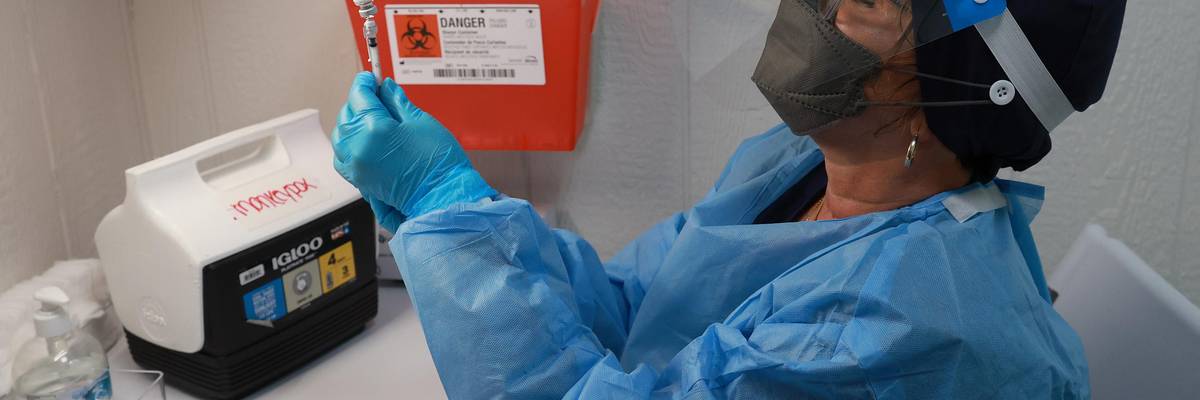
A registered nurse measures out a monkeypox vaccine shot at a vaccination site on August 15, 2022 in Miami, Florida. (Photo: Joe Raedle/Getty Images)
Experts on Wednesday voiced rising concern that the U.S. is on the verge of replicating the deadly failures of the Covid-19 pandemic after a review of public records revealed that the world's richest country currently possesses 80% of the global supply of monkeypox vaccines, leaving poor and vulnerable nations with little to no access.
"Once again, vaccines for an outbreak are not available in the vast majority of countries."
The watchdog group Public Citizen noted in a new analysis that the U.S. accounts for 36% of all global monkeypox cases recorded thus far but the country has secured the vast majority of the available vaccine supply.
As of August 25, Public Citizen found, the U.S. had obtained 1.1 million monkeypox vaccine doses--22 times more doses than the European Union and the United Kingdom and around 66 doses for every case recorded in the country to date.
In total, the U.S. has ordered 7 million monkeypox vaccine doses. Meanwhile, Public Citizen observed, "African countries where monkeypox is endemic, including the Democratic Republic of Congo, neither have access to doses nor orders secured, despite recording multiple deaths."
Peter Maybarduk, director of Public Citizen's Access to Medicines Program, said in a statement that "once again, vaccines for an outbreak are not available in the vast majority of countries, including in the African states that have fought monkeypox for years."
"We still are waiting for President Biden to put forward a plan to fight global monkeypox and avoid the tragic mistakes of the Covid crisis," Maybarduk added.
The group argued Wednesday that the Biden administration should deploy the Defense Production Act to convert stored vaccine bulk into millions of finished monkeypox vaccine doses "to help surge global supply."
"It should also work with partners to transfer technology and help shore up global vaccine production, including in Africa," Public Citizen added. "Last month, the director of the Africa CDC described the stakes for monkeypox: 'The solutions need to be global in nature,' he said. 'If we're not safe, the rest of the world is not safe.'"
Such massive inequities in vaccine access resemble the ongoing crisis of coronavirus vaccine distribution, which has been overwhelmingly concentrated in rich countries as pharmaceutical companies cling to monopoly control over production.
Though monkeypox--which the World Health Organization declared a global public health emergency last month--and Covid-19 are very different diseases, similar dynamics are marring countries' efforts to inoculate vulnerable populations.
Nick Dearden, director of the U.K.-based advocacy group Global Justice Now, wrote in a column for The Guardian earlier this month that development of the monkeypox vaccine "was funded, to the tune of $2 billion, by the U.S. government, but like most medicines, it was patented."
"Bavarian Nordic, which holds the patent, dictates who can make the vaccine, how many doses are made, who gets to buy them, and at what price," Dearden added. "How many more times must we approach public health emergencies with both hands tied behind our backs by this pharmaceutical monopoly model?"
More than 50,000 monkeypox infections and just around a dozen deaths have been reported in roughly 100 countries since the global outbreak began earlier this year. On Tuesday, Texas reported what is believed to be the first monkeypox death in the U.S.
"Alarm bells are ringing," said Zain Rizvi, a research director in Public Citizen's Access to Medicines program. "As we have learned all too painfully throughout the coronavirus pandemic, we can't solve a global public health emergency through national policies alone. A global plan is needed to curb this global crisis."
Dear Common Dreams reader, It’s been nearly 30 years since I co-founded Common Dreams with my late wife, Lina Newhouser. We had the radical notion that journalism should serve the public good, not corporate profits. It was clear to us from the outset what it would take to build such a project. No paid advertisements. No corporate sponsors. No millionaire publisher telling us what to think or do. Many people said we wouldn't last a year, but we proved those doubters wrong. Together with a tremendous team of journalists and dedicated staff, we built an independent media outlet free from the constraints of profits and corporate control. Our mission has always been simple: To inform. To inspire. To ignite change for the common good. Building Common Dreams was not easy. Our survival was never guaranteed. When you take on the most powerful forces—Wall Street greed, fossil fuel industry destruction, Big Tech lobbyists, and uber-rich oligarchs who have spent billions upon billions rigging the economy and democracy in their favor—the only bulwark you have is supporters who believe in your work. But here’s the urgent message from me today. It's never been this bad out there. And it's never been this hard to keep us going. At the very moment Common Dreams is most needed, the threats we face are intensifying. We need your support now more than ever. We don't accept corporate advertising and never will. We don't have a paywall because we don't think people should be blocked from critical news based on their ability to pay. Everything we do is funded by the donations of readers like you. When everyone does the little they can afford, we are strong. But if that support retreats or dries up, so do we. Will you donate now to make sure Common Dreams not only survives but thrives? —Craig Brown, Co-founder |
Experts on Wednesday voiced rising concern that the U.S. is on the verge of replicating the deadly failures of the Covid-19 pandemic after a review of public records revealed that the world's richest country currently possesses 80% of the global supply of monkeypox vaccines, leaving poor and vulnerable nations with little to no access.
"Once again, vaccines for an outbreak are not available in the vast majority of countries."
The watchdog group Public Citizen noted in a new analysis that the U.S. accounts for 36% of all global monkeypox cases recorded thus far but the country has secured the vast majority of the available vaccine supply.
As of August 25, Public Citizen found, the U.S. had obtained 1.1 million monkeypox vaccine doses--22 times more doses than the European Union and the United Kingdom and around 66 doses for every case recorded in the country to date.
In total, the U.S. has ordered 7 million monkeypox vaccine doses. Meanwhile, Public Citizen observed, "African countries where monkeypox is endemic, including the Democratic Republic of Congo, neither have access to doses nor orders secured, despite recording multiple deaths."
Peter Maybarduk, director of Public Citizen's Access to Medicines Program, said in a statement that "once again, vaccines for an outbreak are not available in the vast majority of countries, including in the African states that have fought monkeypox for years."
"We still are waiting for President Biden to put forward a plan to fight global monkeypox and avoid the tragic mistakes of the Covid crisis," Maybarduk added.
The group argued Wednesday that the Biden administration should deploy the Defense Production Act to convert stored vaccine bulk into millions of finished monkeypox vaccine doses "to help surge global supply."
"It should also work with partners to transfer technology and help shore up global vaccine production, including in Africa," Public Citizen added. "Last month, the director of the Africa CDC described the stakes for monkeypox: 'The solutions need to be global in nature,' he said. 'If we're not safe, the rest of the world is not safe.'"
Such massive inequities in vaccine access resemble the ongoing crisis of coronavirus vaccine distribution, which has been overwhelmingly concentrated in rich countries as pharmaceutical companies cling to monopoly control over production.
Though monkeypox--which the World Health Organization declared a global public health emergency last month--and Covid-19 are very different diseases, similar dynamics are marring countries' efforts to inoculate vulnerable populations.
Nick Dearden, director of the U.K.-based advocacy group Global Justice Now, wrote in a column for The Guardian earlier this month that development of the monkeypox vaccine "was funded, to the tune of $2 billion, by the U.S. government, but like most medicines, it was patented."
"Bavarian Nordic, which holds the patent, dictates who can make the vaccine, how many doses are made, who gets to buy them, and at what price," Dearden added. "How many more times must we approach public health emergencies with both hands tied behind our backs by this pharmaceutical monopoly model?"
More than 50,000 monkeypox infections and just around a dozen deaths have been reported in roughly 100 countries since the global outbreak began earlier this year. On Tuesday, Texas reported what is believed to be the first monkeypox death in the U.S.
"Alarm bells are ringing," said Zain Rizvi, a research director in Public Citizen's Access to Medicines program. "As we have learned all too painfully throughout the coronavirus pandemic, we can't solve a global public health emergency through national policies alone. A global plan is needed to curb this global crisis."
Experts on Wednesday voiced rising concern that the U.S. is on the verge of replicating the deadly failures of the Covid-19 pandemic after a review of public records revealed that the world's richest country currently possesses 80% of the global supply of monkeypox vaccines, leaving poor and vulnerable nations with little to no access.
"Once again, vaccines for an outbreak are not available in the vast majority of countries."
The watchdog group Public Citizen noted in a new analysis that the U.S. accounts for 36% of all global monkeypox cases recorded thus far but the country has secured the vast majority of the available vaccine supply.
As of August 25, Public Citizen found, the U.S. had obtained 1.1 million monkeypox vaccine doses--22 times more doses than the European Union and the United Kingdom and around 66 doses for every case recorded in the country to date.
In total, the U.S. has ordered 7 million monkeypox vaccine doses. Meanwhile, Public Citizen observed, "African countries where monkeypox is endemic, including the Democratic Republic of Congo, neither have access to doses nor orders secured, despite recording multiple deaths."
Peter Maybarduk, director of Public Citizen's Access to Medicines Program, said in a statement that "once again, vaccines for an outbreak are not available in the vast majority of countries, including in the African states that have fought monkeypox for years."
"We still are waiting for President Biden to put forward a plan to fight global monkeypox and avoid the tragic mistakes of the Covid crisis," Maybarduk added.
The group argued Wednesday that the Biden administration should deploy the Defense Production Act to convert stored vaccine bulk into millions of finished monkeypox vaccine doses "to help surge global supply."
"It should also work with partners to transfer technology and help shore up global vaccine production, including in Africa," Public Citizen added. "Last month, the director of the Africa CDC described the stakes for monkeypox: 'The solutions need to be global in nature,' he said. 'If we're not safe, the rest of the world is not safe.'"
Such massive inequities in vaccine access resemble the ongoing crisis of coronavirus vaccine distribution, which has been overwhelmingly concentrated in rich countries as pharmaceutical companies cling to monopoly control over production.
Though monkeypox--which the World Health Organization declared a global public health emergency last month--and Covid-19 are very different diseases, similar dynamics are marring countries' efforts to inoculate vulnerable populations.
Nick Dearden, director of the U.K.-based advocacy group Global Justice Now, wrote in a column for The Guardian earlier this month that development of the monkeypox vaccine "was funded, to the tune of $2 billion, by the U.S. government, but like most medicines, it was patented."
"Bavarian Nordic, which holds the patent, dictates who can make the vaccine, how many doses are made, who gets to buy them, and at what price," Dearden added. "How many more times must we approach public health emergencies with both hands tied behind our backs by this pharmaceutical monopoly model?"
More than 50,000 monkeypox infections and just around a dozen deaths have been reported in roughly 100 countries since the global outbreak began earlier this year. On Tuesday, Texas reported what is believed to be the first monkeypox death in the U.S.
"Alarm bells are ringing," said Zain Rizvi, a research director in Public Citizen's Access to Medicines program. "As we have learned all too painfully throughout the coronavirus pandemic, we can't solve a global public health emergency through national policies alone. A global plan is needed to curb this global crisis."

