SUBSCRIBE TO OUR FREE NEWSLETTER
Daily news & progressive opinion—funded by the people, not the corporations—delivered straight to your inbox.
5
#000000
#FFFFFF
To donate by check, phone, or other method, see our More Ways to Give page.
Daily news & progressive opinion—funded by the people, not the corporations—delivered straight to your inbox.
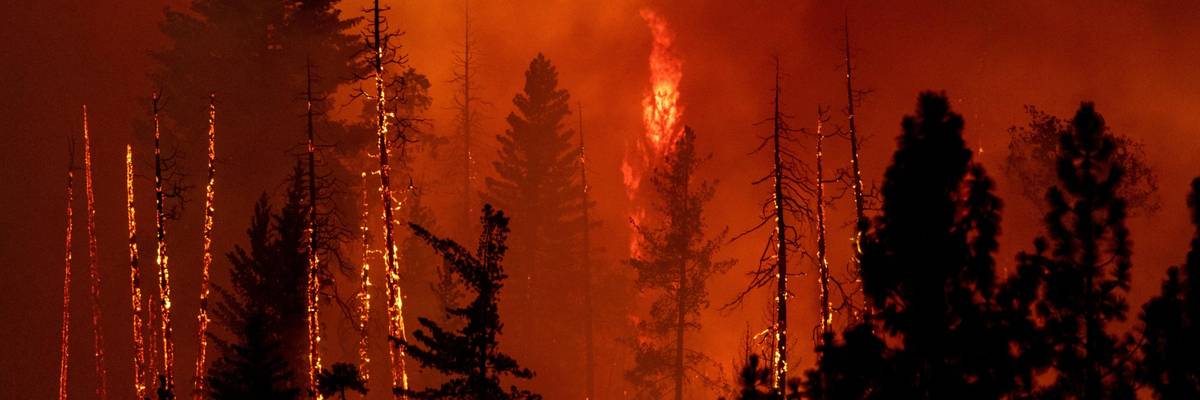
A forest is incinerated by the Oak Fire near Midpines, California on July 23, 2022. (Photo: David McNew/AFP via Getty Images)
Thousands of emergency workers in California struggled to fight a rapidly growing wildfire near Yosemite National Park on Sunday as President Joe Biden continued to mull whether to declare a national climate emergency, a move that campaigners say is needed to respond to the immediate threat of extreme weather and lay the groundwork for a livable future.
Dubbed the Oak Fire, the California blaze was completely uncontained as of Sunday afternoon, having tripled in size since it began on Friday. The fire has now burned more than 14,000 acres, making it California's largest wildfire of the season.
"Explosive fire behavior is challenging firefighters," Cal Fire said in a statement Saturday, characterizing the blaze as "extreme with frequent runs, spot fires, and group torching." Gov. Gavin Newsom declared a state of emergency for Mariposa County on Saturday as authorities urged thousands in the potential path of the fire to evacuate immediately.
Climate scientists have long warned that drought, extreme heat, and other conditions driven by planetary warming could make wildfires more frequent and intense. A United Nations report published earlier this year raised the specter of an ever-worsening "global wildfire crisis" if governments across the globe--particularly the rich nations most responsible for carbon emissions--don't radically alter their energy policies and phase out fossil fuel use.
California is hardly alone in experiencing devastating wildfires in the present. Reuters reported Sunday that "Greek firefighters battled wildfires on the island of Lesbos for a second day on Sunday as well as new fires in the western Peloponnese and in northern Greece, evacuating nearby settlements as a heatwave set in."
"Temperatures hit 40 degrees Celsius (104 Fahrenheit) in parts of Greece on Sunday as a heatwave that has hit other parts of Europe spread east and was expected to last for most of the coming week," the outlet noted. "In the north of the country, a wildfire continued to ravage a pristine forest near Dadia, a natural habitat for black vultures, burning for a fourth day as authorities struggled to contain its destruction."
Amid what experts have described as mounting real-time evidence of the dangers of climate inaction, Biden is still in the process of deciding whether to declare a national climate emergency, a step that would free up key federal authorities and resources to accelerate the country's renewable energy transition.
Last week, in a speech in front of a shuttered coal plant in Massachusetts, Biden pledged action to protect U.S. communities from scorching heat and other impacts of the climate crisis. The president also vowed to expand offshore wind development.
But while he said climate change represents "a clear and present danger," Biden did not use his speech to declare a climate emergency, sparking backlash from environmentalists who have been pushing him to do so since last year.
"The world's burning up from California to Croatia, and right now Biden's fighting fire with the trickle from a garden hose," lamented Jean Su, director of the Energy Justice Program at the Center for Biological Diversity. "Saying we're in a climate emergency and declaring one under the law are totally different things. Declaring a climate emergency will unleash the full force of Biden's executive powers to combat climate chaos and signal the climate leadership we so desperately need."
In an interview with the BBC on Sunday, U.S. climate envoy John Kerry said that Biden is weighing a climate emergency declaration as Congress--obstructed by a fossil fuel industry ally in the Senate--fails to act and as the U.S. Supreme Court takes aim at the federal government's regulatory capacity.
Facing growing pressure from progressive lawmakers and climate organizations, Biden said last week that he's "running the traps on the authority that I do have" and "will make a decision on [the emergency declaration] soon."
Sen. Elizabeth Warren (D-Mass.), one of nine senators who implored Biden to issue the declaration last week, said Sunday that the move would "unlock powerful tools to help safeguard our planet and make our economy stronger."
"Climate change is the biggest existential threat facing our planet," Warren added. "That's why I joined my colleagues in urging the president to declare the climate crisis the national emergency that it is."
Dear Common Dreams reader, It’s been nearly 30 years since I co-founded Common Dreams with my late wife, Lina Newhouser. We had the radical notion that journalism should serve the public good, not corporate profits. It was clear to us from the outset what it would take to build such a project. No paid advertisements. No corporate sponsors. No millionaire publisher telling us what to think or do. Many people said we wouldn't last a year, but we proved those doubters wrong. Together with a tremendous team of journalists and dedicated staff, we built an independent media outlet free from the constraints of profits and corporate control. Our mission has always been simple: To inform. To inspire. To ignite change for the common good. Building Common Dreams was not easy. Our survival was never guaranteed. When you take on the most powerful forces—Wall Street greed, fossil fuel industry destruction, Big Tech lobbyists, and uber-rich oligarchs who have spent billions upon billions rigging the economy and democracy in their favor—the only bulwark you have is supporters who believe in your work. But here’s the urgent message from me today. It's never been this bad out there. And it's never been this hard to keep us going. At the very moment Common Dreams is most needed, the threats we face are intensifying. We need your support now more than ever. We don't accept corporate advertising and never will. We don't have a paywall because we don't think people should be blocked from critical news based on their ability to pay. Everything we do is funded by the donations of readers like you. When everyone does the little they can afford, we are strong. But if that support retreats or dries up, so do we. Will you donate now to make sure Common Dreams not only survives but thrives? —Craig Brown, Co-founder |
Thousands of emergency workers in California struggled to fight a rapidly growing wildfire near Yosemite National Park on Sunday as President Joe Biden continued to mull whether to declare a national climate emergency, a move that campaigners say is needed to respond to the immediate threat of extreme weather and lay the groundwork for a livable future.
Dubbed the Oak Fire, the California blaze was completely uncontained as of Sunday afternoon, having tripled in size since it began on Friday. The fire has now burned more than 14,000 acres, making it California's largest wildfire of the season.
"Explosive fire behavior is challenging firefighters," Cal Fire said in a statement Saturday, characterizing the blaze as "extreme with frequent runs, spot fires, and group torching." Gov. Gavin Newsom declared a state of emergency for Mariposa County on Saturday as authorities urged thousands in the potential path of the fire to evacuate immediately.
Climate scientists have long warned that drought, extreme heat, and other conditions driven by planetary warming could make wildfires more frequent and intense. A United Nations report published earlier this year raised the specter of an ever-worsening "global wildfire crisis" if governments across the globe--particularly the rich nations most responsible for carbon emissions--don't radically alter their energy policies and phase out fossil fuel use.
California is hardly alone in experiencing devastating wildfires in the present. Reuters reported Sunday that "Greek firefighters battled wildfires on the island of Lesbos for a second day on Sunday as well as new fires in the western Peloponnese and in northern Greece, evacuating nearby settlements as a heatwave set in."
"Temperatures hit 40 degrees Celsius (104 Fahrenheit) in parts of Greece on Sunday as a heatwave that has hit other parts of Europe spread east and was expected to last for most of the coming week," the outlet noted. "In the north of the country, a wildfire continued to ravage a pristine forest near Dadia, a natural habitat for black vultures, burning for a fourth day as authorities struggled to contain its destruction."
Amid what experts have described as mounting real-time evidence of the dangers of climate inaction, Biden is still in the process of deciding whether to declare a national climate emergency, a step that would free up key federal authorities and resources to accelerate the country's renewable energy transition.
Last week, in a speech in front of a shuttered coal plant in Massachusetts, Biden pledged action to protect U.S. communities from scorching heat and other impacts of the climate crisis. The president also vowed to expand offshore wind development.
But while he said climate change represents "a clear and present danger," Biden did not use his speech to declare a climate emergency, sparking backlash from environmentalists who have been pushing him to do so since last year.
"The world's burning up from California to Croatia, and right now Biden's fighting fire with the trickle from a garden hose," lamented Jean Su, director of the Energy Justice Program at the Center for Biological Diversity. "Saying we're in a climate emergency and declaring one under the law are totally different things. Declaring a climate emergency will unleash the full force of Biden's executive powers to combat climate chaos and signal the climate leadership we so desperately need."
In an interview with the BBC on Sunday, U.S. climate envoy John Kerry said that Biden is weighing a climate emergency declaration as Congress--obstructed by a fossil fuel industry ally in the Senate--fails to act and as the U.S. Supreme Court takes aim at the federal government's regulatory capacity.
Facing growing pressure from progressive lawmakers and climate organizations, Biden said last week that he's "running the traps on the authority that I do have" and "will make a decision on [the emergency declaration] soon."
Sen. Elizabeth Warren (D-Mass.), one of nine senators who implored Biden to issue the declaration last week, said Sunday that the move would "unlock powerful tools to help safeguard our planet and make our economy stronger."
"Climate change is the biggest existential threat facing our planet," Warren added. "That's why I joined my colleagues in urging the president to declare the climate crisis the national emergency that it is."
Thousands of emergency workers in California struggled to fight a rapidly growing wildfire near Yosemite National Park on Sunday as President Joe Biden continued to mull whether to declare a national climate emergency, a move that campaigners say is needed to respond to the immediate threat of extreme weather and lay the groundwork for a livable future.
Dubbed the Oak Fire, the California blaze was completely uncontained as of Sunday afternoon, having tripled in size since it began on Friday. The fire has now burned more than 14,000 acres, making it California's largest wildfire of the season.
"Explosive fire behavior is challenging firefighters," Cal Fire said in a statement Saturday, characterizing the blaze as "extreme with frequent runs, spot fires, and group torching." Gov. Gavin Newsom declared a state of emergency for Mariposa County on Saturday as authorities urged thousands in the potential path of the fire to evacuate immediately.
Climate scientists have long warned that drought, extreme heat, and other conditions driven by planetary warming could make wildfires more frequent and intense. A United Nations report published earlier this year raised the specter of an ever-worsening "global wildfire crisis" if governments across the globe--particularly the rich nations most responsible for carbon emissions--don't radically alter their energy policies and phase out fossil fuel use.
California is hardly alone in experiencing devastating wildfires in the present. Reuters reported Sunday that "Greek firefighters battled wildfires on the island of Lesbos for a second day on Sunday as well as new fires in the western Peloponnese and in northern Greece, evacuating nearby settlements as a heatwave set in."
"Temperatures hit 40 degrees Celsius (104 Fahrenheit) in parts of Greece on Sunday as a heatwave that has hit other parts of Europe spread east and was expected to last for most of the coming week," the outlet noted. "In the north of the country, a wildfire continued to ravage a pristine forest near Dadia, a natural habitat for black vultures, burning for a fourth day as authorities struggled to contain its destruction."
Amid what experts have described as mounting real-time evidence of the dangers of climate inaction, Biden is still in the process of deciding whether to declare a national climate emergency, a step that would free up key federal authorities and resources to accelerate the country's renewable energy transition.
Last week, in a speech in front of a shuttered coal plant in Massachusetts, Biden pledged action to protect U.S. communities from scorching heat and other impacts of the climate crisis. The president also vowed to expand offshore wind development.
But while he said climate change represents "a clear and present danger," Biden did not use his speech to declare a climate emergency, sparking backlash from environmentalists who have been pushing him to do so since last year.
"The world's burning up from California to Croatia, and right now Biden's fighting fire with the trickle from a garden hose," lamented Jean Su, director of the Energy Justice Program at the Center for Biological Diversity. "Saying we're in a climate emergency and declaring one under the law are totally different things. Declaring a climate emergency will unleash the full force of Biden's executive powers to combat climate chaos and signal the climate leadership we so desperately need."
In an interview with the BBC on Sunday, U.S. climate envoy John Kerry said that Biden is weighing a climate emergency declaration as Congress--obstructed by a fossil fuel industry ally in the Senate--fails to act and as the U.S. Supreme Court takes aim at the federal government's regulatory capacity.
Facing growing pressure from progressive lawmakers and climate organizations, Biden said last week that he's "running the traps on the authority that I do have" and "will make a decision on [the emergency declaration] soon."
Sen. Elizabeth Warren (D-Mass.), one of nine senators who implored Biden to issue the declaration last week, said Sunday that the move would "unlock powerful tools to help safeguard our planet and make our economy stronger."
"Climate change is the biggest existential threat facing our planet," Warren added. "That's why I joined my colleagues in urging the president to declare the climate crisis the national emergency that it is."