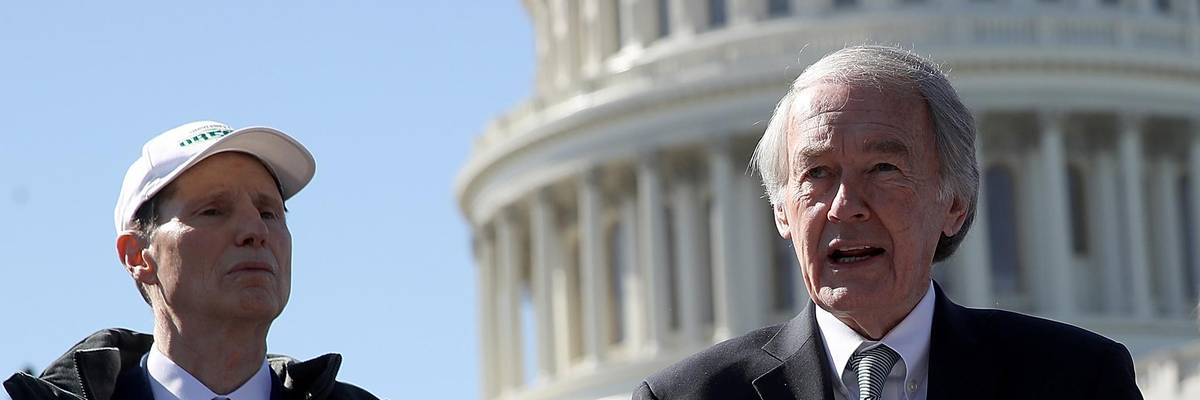
U.S. Sen. Ed Markey (D-Mass.), flanked by Sen. Ron Wyden (D-Ore.), speaks during a news conference about net neutrality at the U.S. Capitol on February 27, 2018.(Photo: Win McNamee/Getty Images)
Advocates Welcome New Push for 'Incredibly Important' Net Neutrality Bill
"Congress should pass the Net Neutrality and Broadband Justice Act and confirm Gigi Sohn to the FCC without further delay," said a Free Press Action campaigner.
Open internet advocates on Monday celebrated news of soon-to-be-unveiled legislation that "would reclassify broadband as a telecommunications service," exposing industry giants to stricter federal oversight.
"Broadband internet is a necessity, not a luxury."
"This bill is incredibly important right now," said Evan Greer, director of the advocacy group Fight for the Future, in a statement that noted the proposal comes as the Senate has stalled its confirmation of net neutrality defender Gigi Sohn, President Joe Biden's Federal Communications Commission (FCC) nominee.
The Washington Post reported Monday that Sens. Ed Markey (D-Mass.) and Ron Wyden (D-Ore.) are spearheading the fight for the forthcoming Net Neutrality and Broadband Justice Act, and Rep. Doris Matsui (D-Calif.) intends to introduce the House version.
According to the newspaper:
While the two-page bill is seemingly simple in scope, it would have massive implications in addition to reinstating net neutrality, the rules that bar internet service providers from blocking or throttling content. It would shift how aggressively the FCC can regulate issues like internet pricing, consumer privacy, and competition in the broadband market.
Lawmakers plan to introduce the bill in coming weeks, likely before the August recess, according to two people familiar with the negotiations, who spoke on the condition of anonymity to discuss private talks.
Representatives for the sponsors declined to comment on the bill, but Markey spokesperson Rosemary Boeglin told the Post that it is "more clear than ever that broadband internet is an essential utility" and he firmly believes the FCC's authority "should reflect that, so it can fulfill its obligations to the public by reinstating net neutrality rules, protecting consumers, and taking other critical steps to create a just digital future."
Wyden spokesperson Keith Chu took aim at Ajit Pai--the FCC commissioner under former President Donald Trump--stating that the ex-agency leader's 2017 "rollback of net neutrality was a huge loss for competition and privacy" and the senator "still believes that net neutrality is the foundation of an open internet that works for everyone--not just Big Cable and big incumbents."
Greer on Monday also highlighted the "disastrous repeal" under Pai and welcomed that the senators' bill would give the FCC "the authority it needs to restore net neutrality and address the digital divide."
"The Covid-19 pandemic has made it more clear than ever that broadband internet is a necessity, not a luxury," she said. "The FCC is supposed to ensure everyone has affordable access to broadband and prevent telecom companies from abusing their monopoly power or charging unfair fees."
Free Press Action vice president of policy and general counsel Matt Wood similarly said that "the pandemic has shown how absolutely crucial internet access is, and this bill gives Congress the opportunity to catch up with that reality."
"High-speed internet access should be open and affordable to everyone in the nation, just as the Communications Act commands for all basic communications services," he argued. "It's just commonsense for lawmakers to confirm the legal treatment of broadband as something that should be available to all--especially people in communities of color, rural regions, and other underserved and overcharged areas--on just, reasonable and nondiscriminatory terms."
Wood pointed out that "while broadband industry lobbyists and Beltway pundits tell lawmakers to think otherwise, this is not a partisan issue. Anyone who tells you internet users are better off when there's no oversight of cable and phone companies is just reciting AT&T's tired talking points and ignoring the overwhelming support for these policies among Democratic, Independent, and Republican voters."
"Congress should pass the Net Neutrality and Broadband Justice Act and confirm Gigi Sohn to the FCC without further delay," he concluded. "We've gone 544 days into the Biden administration without a fully functional agency. It's time for Senate leadership to end this senseless delay and get the agency back to full capacity."
Greer also called out the Senate for failing to advance Biden's nominee amid what critics have called a "rabid" telecom industry smear campaign against her, declaring that "we have no time to waste confirming Gigi Sohn."
Noting that "telecom giants and their friends in Congress are eager to take advantage of the situation and push for weak legislation that offers net neutrality in name only, while gutting the ability of the FCC to provide meaningful oversight," Greer added that "it's great to know that a true broadband justice champion like Sen. Markey will be introducing a bill so that it will be clear what's real net neutrality and what's an industry-backed fake."
We are at a crossroads
This country and this world are at a monumental crossroads. US voters have an opportunity to beat back the forces of fascism and confront the billionaires who are rigging the economy, our media system, and our democracy, making it increasingly impossible for ordinary people to get by. We’re not just talking about the election. We’re talking about what must be done once these fascist elements are vanquished from power. We need a bolder set of solutions than what either major party has so far been willing to offer and a working-class movement ready to fight like hell for it. Trump didn't emerge from nowhere. The conditions that fueled MAGA authoritarianism were created by decades of radical neoliberal economic policies and a corrupt political system dominated by corporate interests. They slashed taxes on the super-rich, promising that the benefits would trickle down. They said giveaways to the corporate titans would make life more affordable for the rest of us. It was all bullshit. And when a bitter, betrayed populace searches for someone to blame, right-wing demagogues have little trouble finding scapegoats. People know when they're being lied to, but you won't hear any of this from the corporate media. Only independent journalism—powered and funded by people who believe in building a better world—can deliver truly trustworthy daily news. Our Fall Campaign is underway, and we need your help. To power our newsroom through the rest of the year, we need to raise $125,000 by midnight on October 31. So if you share our vision, please contribute whatever you can to sustain our work. |
Open internet advocates on Monday celebrated news of soon-to-be-unveiled legislation that "would reclassify broadband as a telecommunications service," exposing industry giants to stricter federal oversight.
"Broadband internet is a necessity, not a luxury."
"This bill is incredibly important right now," said Evan Greer, director of the advocacy group Fight for the Future, in a statement that noted the proposal comes as the Senate has stalled its confirmation of net neutrality defender Gigi Sohn, President Joe Biden's Federal Communications Commission (FCC) nominee.
The Washington Post reported Monday that Sens. Ed Markey (D-Mass.) and Ron Wyden (D-Ore.) are spearheading the fight for the forthcoming Net Neutrality and Broadband Justice Act, and Rep. Doris Matsui (D-Calif.) intends to introduce the House version.
According to the newspaper:
While the two-page bill is seemingly simple in scope, it would have massive implications in addition to reinstating net neutrality, the rules that bar internet service providers from blocking or throttling content. It would shift how aggressively the FCC can regulate issues like internet pricing, consumer privacy, and competition in the broadband market.
Lawmakers plan to introduce the bill in coming weeks, likely before the August recess, according to two people familiar with the negotiations, who spoke on the condition of anonymity to discuss private talks.
Representatives for the sponsors declined to comment on the bill, but Markey spokesperson Rosemary Boeglin told the Post that it is "more clear than ever that broadband internet is an essential utility" and he firmly believes the FCC's authority "should reflect that, so it can fulfill its obligations to the public by reinstating net neutrality rules, protecting consumers, and taking other critical steps to create a just digital future."
Wyden spokesperson Keith Chu took aim at Ajit Pai--the FCC commissioner under former President Donald Trump--stating that the ex-agency leader's 2017 "rollback of net neutrality was a huge loss for competition and privacy" and the senator "still believes that net neutrality is the foundation of an open internet that works for everyone--not just Big Cable and big incumbents."
Greer on Monday also highlighted the "disastrous repeal" under Pai and welcomed that the senators' bill would give the FCC "the authority it needs to restore net neutrality and address the digital divide."
"The Covid-19 pandemic has made it more clear than ever that broadband internet is a necessity, not a luxury," she said. "The FCC is supposed to ensure everyone has affordable access to broadband and prevent telecom companies from abusing their monopoly power or charging unfair fees."
Free Press Action vice president of policy and general counsel Matt Wood similarly said that "the pandemic has shown how absolutely crucial internet access is, and this bill gives Congress the opportunity to catch up with that reality."
"High-speed internet access should be open and affordable to everyone in the nation, just as the Communications Act commands for all basic communications services," he argued. "It's just commonsense for lawmakers to confirm the legal treatment of broadband as something that should be available to all--especially people in communities of color, rural regions, and other underserved and overcharged areas--on just, reasonable and nondiscriminatory terms."
Wood pointed out that "while broadband industry lobbyists and Beltway pundits tell lawmakers to think otherwise, this is not a partisan issue. Anyone who tells you internet users are better off when there's no oversight of cable and phone companies is just reciting AT&T's tired talking points and ignoring the overwhelming support for these policies among Democratic, Independent, and Republican voters."
"Congress should pass the Net Neutrality and Broadband Justice Act and confirm Gigi Sohn to the FCC without further delay," he concluded. "We've gone 544 days into the Biden administration without a fully functional agency. It's time for Senate leadership to end this senseless delay and get the agency back to full capacity."
Greer also called out the Senate for failing to advance Biden's nominee amid what critics have called a "rabid" telecom industry smear campaign against her, declaring that "we have no time to waste confirming Gigi Sohn."
Noting that "telecom giants and their friends in Congress are eager to take advantage of the situation and push for weak legislation that offers net neutrality in name only, while gutting the ability of the FCC to provide meaningful oversight," Greer added that "it's great to know that a true broadband justice champion like Sen. Markey will be introducing a bill so that it will be clear what's real net neutrality and what's an industry-backed fake."