

SUBSCRIBE TO OUR FREE NEWSLETTER
Daily news & progressive opinion—funded by the people, not the corporations—delivered straight to your inbox.
5
#000000
#FFFFFF
To donate by check, phone, or other method, see our More Ways to Give page.
Daily news & progressive opinion—funded by the people, not the corporations—delivered straight to your inbox.
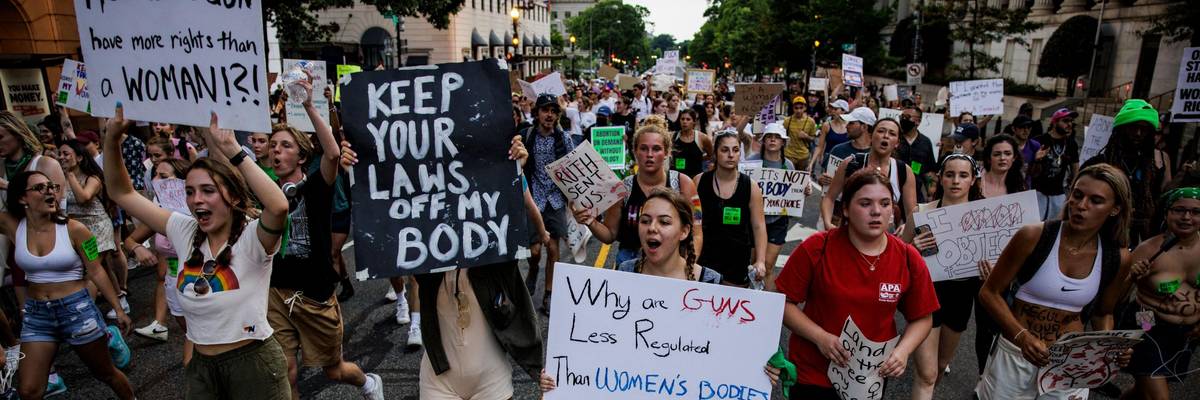
Abortion rights activists protest in Washington, D.C., on June 26, 2022, two days after the U.S. Supreme Court overruled Roe v. Wade. (Photo: Samuel Corum/AFP via Getty Images)
The U.S. Supreme Court's decision to overrule Roe v. Wade and strip away abortion rights for millions of women has left the majority of Americans opposing the ruling and fearing what the high court will do next.
Fifty-six percent of respondents in an NPR/PBS NewsHour/Marist poll taken after Friday's ruling said they disagreed with the court's decision, including 45% who said they strongly disagreed with it.
"What the court did is clearly outside the mainstream of public opinion."
Nine out of 10 Democrats and more than half of independent voters said they oppose the ruling, while only 20% of Republicans opposed it.
"What the court did is clearly outside the mainstream of public opinion, and that is reflected again in the NPR poll," wrote Domenico Montanaro at NPR.
The poll of 941 people, which had a margin of error of +/-4.9 percentage points, found that only 39% of respondents were left feeling confident in the court after the Dobbs v. Jackson Women's Health Organization ruling--a new low for the survey. As Common Dreams reported last week, a separate poll by Gallup taken just before the ruling found that only 25% of Americans had confidence in the court.
A majority of respondents expressed concern over possible rulings that could be in the court's future as the right-wing majority appears ready to overturn more of Americans' fundamental rights.
Fifty-six percent of people said they were concerned that the court will now reconsider the rulings that affirmed gay Americans have the right to marriage equality, that people can obtain contraceptives, and that state laws banning same-sex relationships are unconstitutional.
Justice Samuel Alito wrote in the majority opinion in Dobbs that the ruling should not "cast doubt on precedents that do not concern abortion," a statement Justice Clarence Thomas agreed with before saying in his concurring opinion that the court should now reconsider those precedents.
Fifty-seven percent of respondents said the right-wing majority ruled against Roe as a matter of politics, not out of respect for the rule of law.
The poll found that 48% of Americans are more likely to vote for Democrats in congressional races in November, while 41% said they would favor Republicans. The survey asked the same question of voters in April, before the ruling and the hearings on the January 6, 2021 insurrection, and found that more respondents favored the GOP.
Just over half of respondents said they would back a candidate who would support a federal law codifying the right to abortion care.
Dear Common Dreams reader, It’s been nearly 30 years since I co-founded Common Dreams with my late wife, Lina Newhouser. We had the radical notion that journalism should serve the public good, not corporate profits. It was clear to us from the outset what it would take to build such a project. No paid advertisements. No corporate sponsors. No millionaire publisher telling us what to think or do. Many people said we wouldn't last a year, but we proved those doubters wrong. Together with a tremendous team of journalists and dedicated staff, we built an independent media outlet free from the constraints of profits and corporate control. Our mission has always been simple: To inform. To inspire. To ignite change for the common good. Building Common Dreams was not easy. Our survival was never guaranteed. When you take on the most powerful forces—Wall Street greed, fossil fuel industry destruction, Big Tech lobbyists, and uber-rich oligarchs who have spent billions upon billions rigging the economy and democracy in their favor—the only bulwark you have is supporters who believe in your work. But here’s the urgent message from me today. It's never been this bad out there. And it's never been this hard to keep us going. At the very moment Common Dreams is most needed, the threats we face are intensifying. We need your support now more than ever. We don't accept corporate advertising and never will. We don't have a paywall because we don't think people should be blocked from critical news based on their ability to pay. Everything we do is funded by the donations of readers like you. When everyone does the little they can afford, we are strong. But if that support retreats or dries up, so do we. Will you donate now to make sure Common Dreams not only survives but thrives? —Craig Brown, Co-founder |
The U.S. Supreme Court's decision to overrule Roe v. Wade and strip away abortion rights for millions of women has left the majority of Americans opposing the ruling and fearing what the high court will do next.
Fifty-six percent of respondents in an NPR/PBS NewsHour/Marist poll taken after Friday's ruling said they disagreed with the court's decision, including 45% who said they strongly disagreed with it.
"What the court did is clearly outside the mainstream of public opinion."
Nine out of 10 Democrats and more than half of independent voters said they oppose the ruling, while only 20% of Republicans opposed it.
"What the court did is clearly outside the mainstream of public opinion, and that is reflected again in the NPR poll," wrote Domenico Montanaro at NPR.
The poll of 941 people, which had a margin of error of +/-4.9 percentage points, found that only 39% of respondents were left feeling confident in the court after the Dobbs v. Jackson Women's Health Organization ruling--a new low for the survey. As Common Dreams reported last week, a separate poll by Gallup taken just before the ruling found that only 25% of Americans had confidence in the court.
A majority of respondents expressed concern over possible rulings that could be in the court's future as the right-wing majority appears ready to overturn more of Americans' fundamental rights.
Fifty-six percent of people said they were concerned that the court will now reconsider the rulings that affirmed gay Americans have the right to marriage equality, that people can obtain contraceptives, and that state laws banning same-sex relationships are unconstitutional.
Justice Samuel Alito wrote in the majority opinion in Dobbs that the ruling should not "cast doubt on precedents that do not concern abortion," a statement Justice Clarence Thomas agreed with before saying in his concurring opinion that the court should now reconsider those precedents.
Fifty-seven percent of respondents said the right-wing majority ruled against Roe as a matter of politics, not out of respect for the rule of law.
The poll found that 48% of Americans are more likely to vote for Democrats in congressional races in November, while 41% said they would favor Republicans. The survey asked the same question of voters in April, before the ruling and the hearings on the January 6, 2021 insurrection, and found that more respondents favored the GOP.
Just over half of respondents said they would back a candidate who would support a federal law codifying the right to abortion care.
The U.S. Supreme Court's decision to overrule Roe v. Wade and strip away abortion rights for millions of women has left the majority of Americans opposing the ruling and fearing what the high court will do next.
Fifty-six percent of respondents in an NPR/PBS NewsHour/Marist poll taken after Friday's ruling said they disagreed with the court's decision, including 45% who said they strongly disagreed with it.
"What the court did is clearly outside the mainstream of public opinion."
Nine out of 10 Democrats and more than half of independent voters said they oppose the ruling, while only 20% of Republicans opposed it.
"What the court did is clearly outside the mainstream of public opinion, and that is reflected again in the NPR poll," wrote Domenico Montanaro at NPR.
The poll of 941 people, which had a margin of error of +/-4.9 percentage points, found that only 39% of respondents were left feeling confident in the court after the Dobbs v. Jackson Women's Health Organization ruling--a new low for the survey. As Common Dreams reported last week, a separate poll by Gallup taken just before the ruling found that only 25% of Americans had confidence in the court.
A majority of respondents expressed concern over possible rulings that could be in the court's future as the right-wing majority appears ready to overturn more of Americans' fundamental rights.
Fifty-six percent of people said they were concerned that the court will now reconsider the rulings that affirmed gay Americans have the right to marriage equality, that people can obtain contraceptives, and that state laws banning same-sex relationships are unconstitutional.
Justice Samuel Alito wrote in the majority opinion in Dobbs that the ruling should not "cast doubt on precedents that do not concern abortion," a statement Justice Clarence Thomas agreed with before saying in his concurring opinion that the court should now reconsider those precedents.
Fifty-seven percent of respondents said the right-wing majority ruled against Roe as a matter of politics, not out of respect for the rule of law.
The poll found that 48% of Americans are more likely to vote for Democrats in congressional races in November, while 41% said they would favor Republicans. The survey asked the same question of voters in April, before the ruling and the hearings on the January 6, 2021 insurrection, and found that more respondents favored the GOP.
Just over half of respondents said they would back a candidate who would support a federal law codifying the right to abortion care.

