SUBSCRIBE TO OUR FREE NEWSLETTER
Daily news & progressive opinion—funded by the people, not the corporations—delivered straight to your inbox.
5
#000000
#FFFFFF
To donate by check, phone, or other method, see our More Ways to Give page.
Daily news & progressive opinion—funded by the people, not the corporations—delivered straight to your inbox.
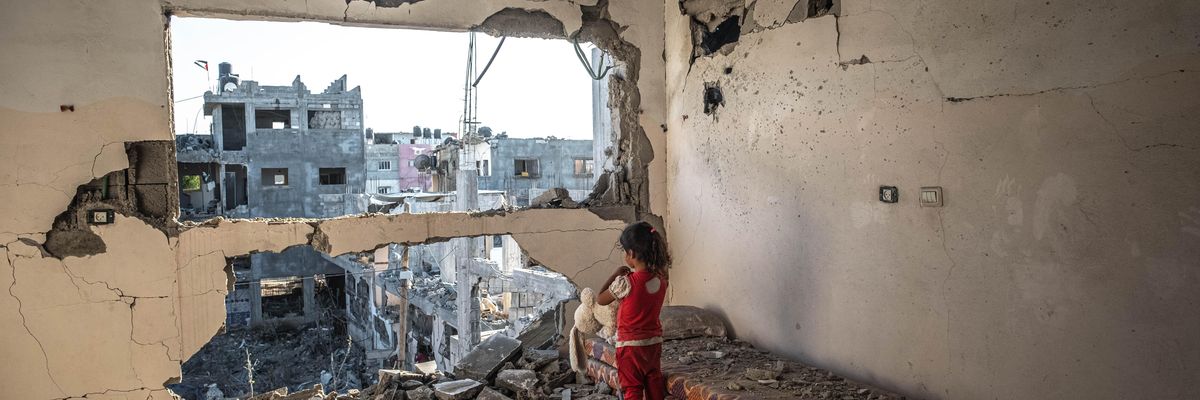
A Palestinian girl stands amid the rubble of her destroyed home on May 24, 2021 in Beit Hanoun, Gaza. (Photo: Fatima Shbair/Getty Images)
Marking 15 years since Israel began imposing its land, air, and sea blockade on Gaza, Oxfam International said Wednesday that the international community is complicit in Palestinians' ongoing suffering and demanded the United Nations and its member states "become the diplomatic power brokers needed to end this blockade now."
The international humanitarian group noted that governments have spent "an estimated $5.7 billion in Gaza just to help keep an incredibly resilient population afloat" as 2.1 million Palestinians face power cuts, undrinkable water, and restricted movement.
"The humanitarian relief effort has long become a permanent operation," said Oxfam International executive director Gabriela Bucher. "We are collectively forced into being de facto enablers of an open-air prison."
In a social media post, Oxfam campaign coordinator Fatima AbdulKarim bemoaned that humanitarian aid groups and their donors have been compelled to sustain a situation that has only prolonged and entrenched the suffering of people in Gaza.
Oxfam announced it was joining a campaign with other civil society groups, #OpenUpGaza15, which will feature the personal stories of 15 young people living in Gaza and discussing their hopes and aspirations.
"We need to stop the tragedy of Gaza from continuing to drain all the joy and aspiration of its youth, year upon year," Bucher said. "It is imperative that we help the next generation not to be lost to the blockade. Over 800,000 young Palestinians have spent their entire lives trapped within Gaza. They have known nothing else."
The campaign was announced as Save the Children released a report showing that four out of five children in the Gaza Strip suffer from depression, grief, and fear.
Compared to 2018, the group saw huge increases in the number of children who reported feeling sad or depressed--77% compared to 62% in 2018. More than half of the children there have contemplated suicide and three out of five have intentionally harmed themselves.
"It is imperative that we help the next generation not to be lost to the blockade. Over 800,000 young Palestinians have spent their entire lives trapped within Gaza. They have known nothing else."
"Five years ago, caregivers said that their capacity to support their children is being pushed to the limit by the blockade, chronic poverty, and insecurity, and would most likely be utterly destroyed in the event of another conflict. Our findings show that caregivers' concerns have sadly come true," said Jason Lee, the group's country director for the occupied Palestinian territories.
"We call on all sides to tackle the root causes of this conflict, and take steps to protect all children and families who deserve to live in safety and dignity," he added. "We need an immediate end to the conflict and economic deprivation that are huge stressors in children's lives, as well as action to support the coping potential and resilience of children and their families in the Gaza strip."
Young people growing up under the blockade face a 63% of not being able to find paid work after they finish school, according to Oxfam. Nearly all of the piped water in Gaza is unsafe to drink and electricity supply is restricted to just 12 hours per day.
Israel's government has found numerous other ways to deprive Palestinians in the Gaza Strip of living a normal life, said Shane Stevenson, Oxfam's country director for Palestine.
"Palestinian families in Gaza are being collectively and illegally punished," said Stevenson. "Israel bans the export of date paste, cookies, and French fries. It has forbidden 3G and 4G phone data and there's no PayPal. This is not a place where a young person can be expected to flourish and find happiness."
Currently, said Oxfam, there is "no diplomatic resolution in sight."
Oxfam demanded that the international community "commit to a time-bound plan with actions and strong accountability mechanisms" in order to secure justice for Palestinians.
"We refuse to accept that all the effort made to maintain the blockade for 15 years can't instead be harnessed for good and to consign it to history," said Stevenson.
Dear Common Dreams reader, It’s been nearly 30 years since I co-founded Common Dreams with my late wife, Lina Newhouser. We had the radical notion that journalism should serve the public good, not corporate profits. It was clear to us from the outset what it would take to build such a project. No paid advertisements. No corporate sponsors. No millionaire publisher telling us what to think or do. Many people said we wouldn't last a year, but we proved those doubters wrong. Together with a tremendous team of journalists and dedicated staff, we built an independent media outlet free from the constraints of profits and corporate control. Our mission has always been simple: To inform. To inspire. To ignite change for the common good. Building Common Dreams was not easy. Our survival was never guaranteed. When you take on the most powerful forces—Wall Street greed, fossil fuel industry destruction, Big Tech lobbyists, and uber-rich oligarchs who have spent billions upon billions rigging the economy and democracy in their favor—the only bulwark you have is supporters who believe in your work. But here’s the urgent message from me today. It's never been this bad out there. And it's never been this hard to keep us going. At the very moment Common Dreams is most needed, the threats we face are intensifying. We need your support now more than ever. We don't accept corporate advertising and never will. We don't have a paywall because we don't think people should be blocked from critical news based on their ability to pay. Everything we do is funded by the donations of readers like you. When everyone does the little they can afford, we are strong. But if that support retreats or dries up, so do we. Will you donate now to make sure Common Dreams not only survives but thrives? —Craig Brown, Co-founder |
Marking 15 years since Israel began imposing its land, air, and sea blockade on Gaza, Oxfam International said Wednesday that the international community is complicit in Palestinians' ongoing suffering and demanded the United Nations and its member states "become the diplomatic power brokers needed to end this blockade now."
The international humanitarian group noted that governments have spent "an estimated $5.7 billion in Gaza just to help keep an incredibly resilient population afloat" as 2.1 million Palestinians face power cuts, undrinkable water, and restricted movement.
"The humanitarian relief effort has long become a permanent operation," said Oxfam International executive director Gabriela Bucher. "We are collectively forced into being de facto enablers of an open-air prison."
In a social media post, Oxfam campaign coordinator Fatima AbdulKarim bemoaned that humanitarian aid groups and their donors have been compelled to sustain a situation that has only prolonged and entrenched the suffering of people in Gaza.
Oxfam announced it was joining a campaign with other civil society groups, #OpenUpGaza15, which will feature the personal stories of 15 young people living in Gaza and discussing their hopes and aspirations.
"We need to stop the tragedy of Gaza from continuing to drain all the joy and aspiration of its youth, year upon year," Bucher said. "It is imperative that we help the next generation not to be lost to the blockade. Over 800,000 young Palestinians have spent their entire lives trapped within Gaza. They have known nothing else."
The campaign was announced as Save the Children released a report showing that four out of five children in the Gaza Strip suffer from depression, grief, and fear.
Compared to 2018, the group saw huge increases in the number of children who reported feeling sad or depressed--77% compared to 62% in 2018. More than half of the children there have contemplated suicide and three out of five have intentionally harmed themselves.
"It is imperative that we help the next generation not to be lost to the blockade. Over 800,000 young Palestinians have spent their entire lives trapped within Gaza. They have known nothing else."
"Five years ago, caregivers said that their capacity to support their children is being pushed to the limit by the blockade, chronic poverty, and insecurity, and would most likely be utterly destroyed in the event of another conflict. Our findings show that caregivers' concerns have sadly come true," said Jason Lee, the group's country director for the occupied Palestinian territories.
"We call on all sides to tackle the root causes of this conflict, and take steps to protect all children and families who deserve to live in safety and dignity," he added. "We need an immediate end to the conflict and economic deprivation that are huge stressors in children's lives, as well as action to support the coping potential and resilience of children and their families in the Gaza strip."
Young people growing up under the blockade face a 63% of not being able to find paid work after they finish school, according to Oxfam. Nearly all of the piped water in Gaza is unsafe to drink and electricity supply is restricted to just 12 hours per day.
Israel's government has found numerous other ways to deprive Palestinians in the Gaza Strip of living a normal life, said Shane Stevenson, Oxfam's country director for Palestine.
"Palestinian families in Gaza are being collectively and illegally punished," said Stevenson. "Israel bans the export of date paste, cookies, and French fries. It has forbidden 3G and 4G phone data and there's no PayPal. This is not a place where a young person can be expected to flourish and find happiness."
Currently, said Oxfam, there is "no diplomatic resolution in sight."
Oxfam demanded that the international community "commit to a time-bound plan with actions and strong accountability mechanisms" in order to secure justice for Palestinians.
"We refuse to accept that all the effort made to maintain the blockade for 15 years can't instead be harnessed for good and to consign it to history," said Stevenson.
Marking 15 years since Israel began imposing its land, air, and sea blockade on Gaza, Oxfam International said Wednesday that the international community is complicit in Palestinians' ongoing suffering and demanded the United Nations and its member states "become the diplomatic power brokers needed to end this blockade now."
The international humanitarian group noted that governments have spent "an estimated $5.7 billion in Gaza just to help keep an incredibly resilient population afloat" as 2.1 million Palestinians face power cuts, undrinkable water, and restricted movement.
"The humanitarian relief effort has long become a permanent operation," said Oxfam International executive director Gabriela Bucher. "We are collectively forced into being de facto enablers of an open-air prison."
In a social media post, Oxfam campaign coordinator Fatima AbdulKarim bemoaned that humanitarian aid groups and their donors have been compelled to sustain a situation that has only prolonged and entrenched the suffering of people in Gaza.
Oxfam announced it was joining a campaign with other civil society groups, #OpenUpGaza15, which will feature the personal stories of 15 young people living in Gaza and discussing their hopes and aspirations.
"We need to stop the tragedy of Gaza from continuing to drain all the joy and aspiration of its youth, year upon year," Bucher said. "It is imperative that we help the next generation not to be lost to the blockade. Over 800,000 young Palestinians have spent their entire lives trapped within Gaza. They have known nothing else."
The campaign was announced as Save the Children released a report showing that four out of five children in the Gaza Strip suffer from depression, grief, and fear.
Compared to 2018, the group saw huge increases in the number of children who reported feeling sad or depressed--77% compared to 62% in 2018. More than half of the children there have contemplated suicide and three out of five have intentionally harmed themselves.
"It is imperative that we help the next generation not to be lost to the blockade. Over 800,000 young Palestinians have spent their entire lives trapped within Gaza. They have known nothing else."
"Five years ago, caregivers said that their capacity to support their children is being pushed to the limit by the blockade, chronic poverty, and insecurity, and would most likely be utterly destroyed in the event of another conflict. Our findings show that caregivers' concerns have sadly come true," said Jason Lee, the group's country director for the occupied Palestinian territories.
"We call on all sides to tackle the root causes of this conflict, and take steps to protect all children and families who deserve to live in safety and dignity," he added. "We need an immediate end to the conflict and economic deprivation that are huge stressors in children's lives, as well as action to support the coping potential and resilience of children and their families in the Gaza strip."
Young people growing up under the blockade face a 63% of not being able to find paid work after they finish school, according to Oxfam. Nearly all of the piped water in Gaza is unsafe to drink and electricity supply is restricted to just 12 hours per day.
Israel's government has found numerous other ways to deprive Palestinians in the Gaza Strip of living a normal life, said Shane Stevenson, Oxfam's country director for Palestine.
"Palestinian families in Gaza are being collectively and illegally punished," said Stevenson. "Israel bans the export of date paste, cookies, and French fries. It has forbidden 3G and 4G phone data and there's no PayPal. This is not a place where a young person can be expected to flourish and find happiness."
Currently, said Oxfam, there is "no diplomatic resolution in sight."
Oxfam demanded that the international community "commit to a time-bound plan with actions and strong accountability mechanisms" in order to secure justice for Palestinians.
"We refuse to accept that all the effort made to maintain the blockade for 15 years can't instead be harnessed for good and to consign it to history," said Stevenson.