SUBSCRIBE TO OUR FREE NEWSLETTER
Daily news & progressive opinion—funded by the people, not the corporations—delivered straight to your inbox.
5
#000000
#FFFFFF
To donate by check, phone, or other method, see our More Ways to Give page.
Daily news & progressive opinion—funded by the people, not the corporations—delivered straight to your inbox.
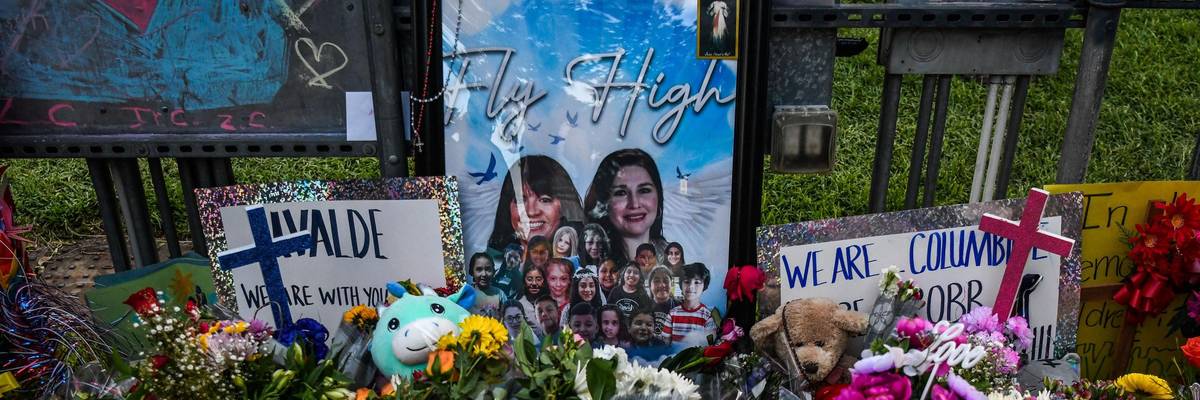
Flowers, candles, and pictures are seen at a makeshift memorial outside the Uvalde County Courthouse in Texas on May 28, 2022. (Photo: Chandan Khanna/AFP via Getty Images)
Principals whose schools have directly experienced mass shootings published an open letter Sunday with a desperate message for lawmakers at all levels of government: "Do something. Do anything."
"These horrific acts have compelled us to speak out. They compel us to act."
Gun laws in the U.S.--which are lax compared to other wealthy nations--have changed little in the decade since the Sandy Hook Elementary School massacre in Newtown, Connecticut as members of Congress beholden to the National Rifle Association have obstructed progress at every turn. In some states, gun regulations have gotten even weaker.
Observers, including school administrators, fear that they're seeing history repeat itself in the aftermath of the massacre in Uvalde, Texas, the second-deadliest shooting on record at a U.S. elementary, middle, or high school.
"We constantly relive one of the worst days of our lives because we have taken it upon ourselves to reach out to principals who have experienced a shooting at their schools and help them navigate a path we all unfortunately have been down," the Principal Recovery Network (PNR)--a group of school leaders that describes itself as "a club that no one wants to join"--wrote in its open letter, which was published as a full-page ad in the Washington Post on Sunday.
The network includes the former principal of Columbine High School and the current principal of Marjory Stoneman Douglas High School, where a gunman killed 17 students and staff with an AR-15-style rifle in 2018, sparking a wave of student activism.
"Our membership keeps growing," PNR's letter reads. "The tragedy at Robb Elementary in Uvalde, Texas was the 27th school shooting this year and one of hundreds since the massacre at Columbine High School 23 years ago. These horrific acts have compelled us to speak out. They compel us to act."
As with previous school shootings, state and federal lawmakers have expressed their condolences, attended memorial sites, met with grieving families, and--in some cases--issued rousing calls to action.
But while states such as New Jersey, New York, and California have moved in recent days to advance new gun-safety measures, the U.S. Congress appears poised for yet another legislative failure due to the GOP's opposition to even the most basic and popular firearm regulations.
Twice since 2019, the U.S. House has passed legislation to expand background checks for all firearm sales. Both times, the bills have died in the Senate, where the 60-vote filibuster remains a major obstacle to legislative progress.
While the Uvalde shooting prompted a small bipartisan effort to craft legislation with a chance of passage, the odds are long that enough Senate Republicans will cooperate. On Thursday--just 48 hours after the Uvalde massacre--senators left Washington, D.C. for a 10-day recess.
"To every elected leader at every level of government, you have a duty to do everything it takes to prevent our kids and educators from being murdered in school," the school principals wrote in their letter. "Time and time again, we have come to you to prevent future shootings. If you don't act now, this will happen again."
"We beg you: Do something. Do anything," they added. "This is a bipartisan issue. Protect our students. Protect our educators. Protect our schools. Violence extends well beyond our campuses. We ask you to act and to do the right thing--protect our communities."
Dear Common Dreams reader, It’s been nearly 30 years since I co-founded Common Dreams with my late wife, Lina Newhouser. We had the radical notion that journalism should serve the public good, not corporate profits. It was clear to us from the outset what it would take to build such a project. No paid advertisements. No corporate sponsors. No millionaire publisher telling us what to think or do. Many people said we wouldn't last a year, but we proved those doubters wrong. Together with a tremendous team of journalists and dedicated staff, we built an independent media outlet free from the constraints of profits and corporate control. Our mission has always been simple: To inform. To inspire. To ignite change for the common good. Building Common Dreams was not easy. Our survival was never guaranteed. When you take on the most powerful forces—Wall Street greed, fossil fuel industry destruction, Big Tech lobbyists, and uber-rich oligarchs who have spent billions upon billions rigging the economy and democracy in their favor—the only bulwark you have is supporters who believe in your work. But here’s the urgent message from me today. It's never been this bad out there. And it's never been this hard to keep us going. At the very moment Common Dreams is most needed, the threats we face are intensifying. We need your support now more than ever. We don't accept corporate advertising and never will. We don't have a paywall because we don't think people should be blocked from critical news based on their ability to pay. Everything we do is funded by the donations of readers like you. When everyone does the little they can afford, we are strong. But if that support retreats or dries up, so do we. Will you donate now to make sure Common Dreams not only survives but thrives? —Craig Brown, Co-founder |
Principals whose schools have directly experienced mass shootings published an open letter Sunday with a desperate message for lawmakers at all levels of government: "Do something. Do anything."
"These horrific acts have compelled us to speak out. They compel us to act."
Gun laws in the U.S.--which are lax compared to other wealthy nations--have changed little in the decade since the Sandy Hook Elementary School massacre in Newtown, Connecticut as members of Congress beholden to the National Rifle Association have obstructed progress at every turn. In some states, gun regulations have gotten even weaker.
Observers, including school administrators, fear that they're seeing history repeat itself in the aftermath of the massacre in Uvalde, Texas, the second-deadliest shooting on record at a U.S. elementary, middle, or high school.
"We constantly relive one of the worst days of our lives because we have taken it upon ourselves to reach out to principals who have experienced a shooting at their schools and help them navigate a path we all unfortunately have been down," the Principal Recovery Network (PNR)--a group of school leaders that describes itself as "a club that no one wants to join"--wrote in its open letter, which was published as a full-page ad in the Washington Post on Sunday.
The network includes the former principal of Columbine High School and the current principal of Marjory Stoneman Douglas High School, where a gunman killed 17 students and staff with an AR-15-style rifle in 2018, sparking a wave of student activism.
"Our membership keeps growing," PNR's letter reads. "The tragedy at Robb Elementary in Uvalde, Texas was the 27th school shooting this year and one of hundreds since the massacre at Columbine High School 23 years ago. These horrific acts have compelled us to speak out. They compel us to act."
As with previous school shootings, state and federal lawmakers have expressed their condolences, attended memorial sites, met with grieving families, and--in some cases--issued rousing calls to action.
But while states such as New Jersey, New York, and California have moved in recent days to advance new gun-safety measures, the U.S. Congress appears poised for yet another legislative failure due to the GOP's opposition to even the most basic and popular firearm regulations.
Twice since 2019, the U.S. House has passed legislation to expand background checks for all firearm sales. Both times, the bills have died in the Senate, where the 60-vote filibuster remains a major obstacle to legislative progress.
While the Uvalde shooting prompted a small bipartisan effort to craft legislation with a chance of passage, the odds are long that enough Senate Republicans will cooperate. On Thursday--just 48 hours after the Uvalde massacre--senators left Washington, D.C. for a 10-day recess.
"To every elected leader at every level of government, you have a duty to do everything it takes to prevent our kids and educators from being murdered in school," the school principals wrote in their letter. "Time and time again, we have come to you to prevent future shootings. If you don't act now, this will happen again."
"We beg you: Do something. Do anything," they added. "This is a bipartisan issue. Protect our students. Protect our educators. Protect our schools. Violence extends well beyond our campuses. We ask you to act and to do the right thing--protect our communities."
Principals whose schools have directly experienced mass shootings published an open letter Sunday with a desperate message for lawmakers at all levels of government: "Do something. Do anything."
"These horrific acts have compelled us to speak out. They compel us to act."
Gun laws in the U.S.--which are lax compared to other wealthy nations--have changed little in the decade since the Sandy Hook Elementary School massacre in Newtown, Connecticut as members of Congress beholden to the National Rifle Association have obstructed progress at every turn. In some states, gun regulations have gotten even weaker.
Observers, including school administrators, fear that they're seeing history repeat itself in the aftermath of the massacre in Uvalde, Texas, the second-deadliest shooting on record at a U.S. elementary, middle, or high school.
"We constantly relive one of the worst days of our lives because we have taken it upon ourselves to reach out to principals who have experienced a shooting at their schools and help them navigate a path we all unfortunately have been down," the Principal Recovery Network (PNR)--a group of school leaders that describes itself as "a club that no one wants to join"--wrote in its open letter, which was published as a full-page ad in the Washington Post on Sunday.
The network includes the former principal of Columbine High School and the current principal of Marjory Stoneman Douglas High School, where a gunman killed 17 students and staff with an AR-15-style rifle in 2018, sparking a wave of student activism.
"Our membership keeps growing," PNR's letter reads. "The tragedy at Robb Elementary in Uvalde, Texas was the 27th school shooting this year and one of hundreds since the massacre at Columbine High School 23 years ago. These horrific acts have compelled us to speak out. They compel us to act."
As with previous school shootings, state and federal lawmakers have expressed their condolences, attended memorial sites, met with grieving families, and--in some cases--issued rousing calls to action.
But while states such as New Jersey, New York, and California have moved in recent days to advance new gun-safety measures, the U.S. Congress appears poised for yet another legislative failure due to the GOP's opposition to even the most basic and popular firearm regulations.
Twice since 2019, the U.S. House has passed legislation to expand background checks for all firearm sales. Both times, the bills have died in the Senate, where the 60-vote filibuster remains a major obstacle to legislative progress.
While the Uvalde shooting prompted a small bipartisan effort to craft legislation with a chance of passage, the odds are long that enough Senate Republicans will cooperate. On Thursday--just 48 hours after the Uvalde massacre--senators left Washington, D.C. for a 10-day recess.
"To every elected leader at every level of government, you have a duty to do everything it takes to prevent our kids and educators from being murdered in school," the school principals wrote in their letter. "Time and time again, we have come to you to prevent future shootings. If you don't act now, this will happen again."
"We beg you: Do something. Do anything," they added. "This is a bipartisan issue. Protect our students. Protect our educators. Protect our schools. Violence extends well beyond our campuses. We ask you to act and to do the right thing--protect our communities."