SUBSCRIBE TO OUR FREE NEWSLETTER
Daily news & progressive opinion—funded by the people, not the corporations—delivered straight to your inbox.
5
#000000
#FFFFFF
To donate by check, phone, or other method, see our More Ways to Give page.
Daily news & progressive opinion—funded by the people, not the corporations—delivered straight to your inbox.
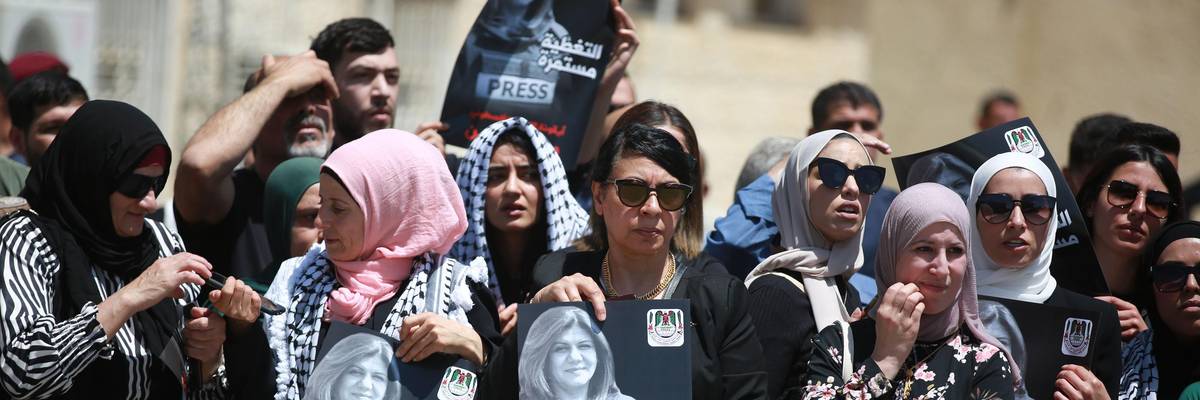
Mourners hold posters with Shireen Abu Akleh's image during the funeral procession for the slain Al Jazeera journalist in Ramallah in the occupied West Bank on May 12, 2022. (Photo: Issam Rimawi/Anadolu Agency via Getty Images)
As the funeral for slain journalist Shireen Abu Akleh began Thursday in the occupied West Bank, Palestinian Authority President Mahmoud Abbas said he will turn to the International Criminal Court to seek justice for the Al Jazeera reporter allegedly shot dead by Israeli forces while working on Wednesday.
"They committed the crime and we do not trust them."
Speaking during Abu Akleh's state memorial in Ramallah, Abbas told thousands of mourners gathered at the presidential palace that "Shireen was a voice of truth, a national voice, conveying the suffering of the mothers of martyrs and prisoners, of Jerusalem, and of refugee camps. Abu Akleh was killed conveying the message of the Palestinian people."
Abbas said that "we hold the Israeli occupation authorities totally responsible" for the 51-year-old Palestinian-American reporter's killing, and that "this crime cannot go unpunished."
"They committed the crime and we do not trust them," the Palestinian leader said of the Israelis, adding that he would "turn immediately to the International Criminal Court to prosecute the criminals."
The ICC is already investigating alleged Israeli war crimes, crimes against humanity, and apartheid in the illegally occupied West Bank and besieged Gaza Strip.
Abu Akleh--who was wearing a helmet and clearly marked press jacket--was fatally shot in the face by a sniper while covering an Israel Defense Forces (IDF) raid on the Jenin refugee camp in the West Bank early Wednesday. Another Palestinian journalist, Ali al-Samoudi, was shot in the back but is reportedly in stable condition.
Al-Samoudi said three shots were fired at them; the first round missed, the second bullet hit him in the back, and the third shot killed Abu Akleh.
As Al Jazeera condemned the well-known reporter's killing as "blatant murder," Israeli officials swiftly moved to blame Palestinian militants for her death before walking back the claim and saying it was unclear who fired the fatal shot.
According to The Times of Israel:
An initial autopsy of Abu Akleh's body by Palestinian coroners found that it was "not possible" to tell whether she was killed by Israeli or Palestinian gunfire.
Meanwhile, an initial internal IDF probe reportedly found that though she was likely standing near armed terrorists, Israeli troops did not fire at her.
Channel 12 reported that the bullet in question is a 5.56x45 mm NATO round, which is used by both Israeli troops and Palestinian terrorists for weapons, including M16 and M4 assault rifles.
The Israeli human rights group B'Tselem released a video Wednesday casting doubt on the IDF's findings and claiming that "documentation of Palestinian gunfire distributed by [the] Israeli military cannot be the gunfire that killed journalist Shireen Abu Akleh."
The Palestinian Authority is refusing to allow Israeli officials to examine the bullet that killed Abu Akleh and has dismissed Israel's calls for a joint investigation into the slaying.
Defending the Palestinian stance in an interview with Al Jazeera, U.S. Rep. Rashida Tlaib (D-Mich.), who is Palestinian-American, said it was unacceptable for "the same people committing those war crimes to do the investigation."
Officials from the United States, European Union, and various United Nations agencies are among those calling for investigations into Abu Akleh's death. Francesca Albanese, the U.N. special rapporteur on Palestine, said Wednesday that her killing "may constitute a war crime."
Saleh Hijazi, deputy director of Amnesty International's Middle East program, told Vox that Abu Akleh's death fits "a pattern of unlawful killing, and also a pattern of targeting journalists and human rights defenders."
According to the Palestinian Journalism Syndicate, Israeli forces have killed more than 50 Palestinian journalists since 2001. During last year's Operation Guardian of the Walls assault on Gaza, the IDF bombed a media center hosting outlets including Al Jazeera, the Associated Press, and Middle East Eye.
In 2019, a U.N. Human Rights Council commission said it "found reasonable grounds to believe that Israeli snipers shot journalists intentionally, despite seeing that they were clearly marked as such" during the Great March of Return demonstrations along the Gaza-Israel border. Two Palestinian journalists, Yaser Murtaja and Ahmed Abu Hussein, were killed by Israeli forces while covering the protests.
Abu Akleh--who was hailed by the Arab and Middle Eastern Journalists Association as "full of grace, kindness, and... gentleness" and "one of the most renowned Palestinian voices in journalism"--is set to be buried Friday in her hometown of Jerusalem.
Dear Common Dreams reader, It’s been nearly 30 years since I co-founded Common Dreams with my late wife, Lina Newhouser. We had the radical notion that journalism should serve the public good, not corporate profits. It was clear to us from the outset what it would take to build such a project. No paid advertisements. No corporate sponsors. No millionaire publisher telling us what to think or do. Many people said we wouldn't last a year, but we proved those doubters wrong. Together with a tremendous team of journalists and dedicated staff, we built an independent media outlet free from the constraints of profits and corporate control. Our mission has always been simple: To inform. To inspire. To ignite change for the common good. Building Common Dreams was not easy. Our survival was never guaranteed. When you take on the most powerful forces—Wall Street greed, fossil fuel industry destruction, Big Tech lobbyists, and uber-rich oligarchs who have spent billions upon billions rigging the economy and democracy in their favor—the only bulwark you have is supporters who believe in your work. But here’s the urgent message from me today. It's never been this bad out there. And it's never been this hard to keep us going. At the very moment Common Dreams is most needed, the threats we face are intensifying. We need your support now more than ever. We don't accept corporate advertising and never will. We don't have a paywall because we don't think people should be blocked from critical news based on their ability to pay. Everything we do is funded by the donations of readers like you. When everyone does the little they can afford, we are strong. But if that support retreats or dries up, so do we. Will you donate now to make sure Common Dreams not only survives but thrives? —Craig Brown, Co-founder |
As the funeral for slain journalist Shireen Abu Akleh began Thursday in the occupied West Bank, Palestinian Authority President Mahmoud Abbas said he will turn to the International Criminal Court to seek justice for the Al Jazeera reporter allegedly shot dead by Israeli forces while working on Wednesday.
"They committed the crime and we do not trust them."
Speaking during Abu Akleh's state memorial in Ramallah, Abbas told thousands of mourners gathered at the presidential palace that "Shireen was a voice of truth, a national voice, conveying the suffering of the mothers of martyrs and prisoners, of Jerusalem, and of refugee camps. Abu Akleh was killed conveying the message of the Palestinian people."
Abbas said that "we hold the Israeli occupation authorities totally responsible" for the 51-year-old Palestinian-American reporter's killing, and that "this crime cannot go unpunished."
"They committed the crime and we do not trust them," the Palestinian leader said of the Israelis, adding that he would "turn immediately to the International Criminal Court to prosecute the criminals."
The ICC is already investigating alleged Israeli war crimes, crimes against humanity, and apartheid in the illegally occupied West Bank and besieged Gaza Strip.
Abu Akleh--who was wearing a helmet and clearly marked press jacket--was fatally shot in the face by a sniper while covering an Israel Defense Forces (IDF) raid on the Jenin refugee camp in the West Bank early Wednesday. Another Palestinian journalist, Ali al-Samoudi, was shot in the back but is reportedly in stable condition.
Al-Samoudi said three shots were fired at them; the first round missed, the second bullet hit him in the back, and the third shot killed Abu Akleh.
As Al Jazeera condemned the well-known reporter's killing as "blatant murder," Israeli officials swiftly moved to blame Palestinian militants for her death before walking back the claim and saying it was unclear who fired the fatal shot.
According to The Times of Israel:
An initial autopsy of Abu Akleh's body by Palestinian coroners found that it was "not possible" to tell whether she was killed by Israeli or Palestinian gunfire.
Meanwhile, an initial internal IDF probe reportedly found that though she was likely standing near armed terrorists, Israeli troops did not fire at her.
Channel 12 reported that the bullet in question is a 5.56x45 mm NATO round, which is used by both Israeli troops and Palestinian terrorists for weapons, including M16 and M4 assault rifles.
The Israeli human rights group B'Tselem released a video Wednesday casting doubt on the IDF's findings and claiming that "documentation of Palestinian gunfire distributed by [the] Israeli military cannot be the gunfire that killed journalist Shireen Abu Akleh."
The Palestinian Authority is refusing to allow Israeli officials to examine the bullet that killed Abu Akleh and has dismissed Israel's calls for a joint investigation into the slaying.
Defending the Palestinian stance in an interview with Al Jazeera, U.S. Rep. Rashida Tlaib (D-Mich.), who is Palestinian-American, said it was unacceptable for "the same people committing those war crimes to do the investigation."
Officials from the United States, European Union, and various United Nations agencies are among those calling for investigations into Abu Akleh's death. Francesca Albanese, the U.N. special rapporteur on Palestine, said Wednesday that her killing "may constitute a war crime."
Saleh Hijazi, deputy director of Amnesty International's Middle East program, told Vox that Abu Akleh's death fits "a pattern of unlawful killing, and also a pattern of targeting journalists and human rights defenders."
According to the Palestinian Journalism Syndicate, Israeli forces have killed more than 50 Palestinian journalists since 2001. During last year's Operation Guardian of the Walls assault on Gaza, the IDF bombed a media center hosting outlets including Al Jazeera, the Associated Press, and Middle East Eye.
In 2019, a U.N. Human Rights Council commission said it "found reasonable grounds to believe that Israeli snipers shot journalists intentionally, despite seeing that they were clearly marked as such" during the Great March of Return demonstrations along the Gaza-Israel border. Two Palestinian journalists, Yaser Murtaja and Ahmed Abu Hussein, were killed by Israeli forces while covering the protests.
Abu Akleh--who was hailed by the Arab and Middle Eastern Journalists Association as "full of grace, kindness, and... gentleness" and "one of the most renowned Palestinian voices in journalism"--is set to be buried Friday in her hometown of Jerusalem.
As the funeral for slain journalist Shireen Abu Akleh began Thursday in the occupied West Bank, Palestinian Authority President Mahmoud Abbas said he will turn to the International Criminal Court to seek justice for the Al Jazeera reporter allegedly shot dead by Israeli forces while working on Wednesday.
"They committed the crime and we do not trust them."
Speaking during Abu Akleh's state memorial in Ramallah, Abbas told thousands of mourners gathered at the presidential palace that "Shireen was a voice of truth, a national voice, conveying the suffering of the mothers of martyrs and prisoners, of Jerusalem, and of refugee camps. Abu Akleh was killed conveying the message of the Palestinian people."
Abbas said that "we hold the Israeli occupation authorities totally responsible" for the 51-year-old Palestinian-American reporter's killing, and that "this crime cannot go unpunished."
"They committed the crime and we do not trust them," the Palestinian leader said of the Israelis, adding that he would "turn immediately to the International Criminal Court to prosecute the criminals."
The ICC is already investigating alleged Israeli war crimes, crimes against humanity, and apartheid in the illegally occupied West Bank and besieged Gaza Strip.
Abu Akleh--who was wearing a helmet and clearly marked press jacket--was fatally shot in the face by a sniper while covering an Israel Defense Forces (IDF) raid on the Jenin refugee camp in the West Bank early Wednesday. Another Palestinian journalist, Ali al-Samoudi, was shot in the back but is reportedly in stable condition.
Al-Samoudi said three shots were fired at them; the first round missed, the second bullet hit him in the back, and the third shot killed Abu Akleh.
As Al Jazeera condemned the well-known reporter's killing as "blatant murder," Israeli officials swiftly moved to blame Palestinian militants for her death before walking back the claim and saying it was unclear who fired the fatal shot.
According to The Times of Israel:
An initial autopsy of Abu Akleh's body by Palestinian coroners found that it was "not possible" to tell whether she was killed by Israeli or Palestinian gunfire.
Meanwhile, an initial internal IDF probe reportedly found that though she was likely standing near armed terrorists, Israeli troops did not fire at her.
Channel 12 reported that the bullet in question is a 5.56x45 mm NATO round, which is used by both Israeli troops and Palestinian terrorists for weapons, including M16 and M4 assault rifles.
The Israeli human rights group B'Tselem released a video Wednesday casting doubt on the IDF's findings and claiming that "documentation of Palestinian gunfire distributed by [the] Israeli military cannot be the gunfire that killed journalist Shireen Abu Akleh."
The Palestinian Authority is refusing to allow Israeli officials to examine the bullet that killed Abu Akleh and has dismissed Israel's calls for a joint investigation into the slaying.
Defending the Palestinian stance in an interview with Al Jazeera, U.S. Rep. Rashida Tlaib (D-Mich.), who is Palestinian-American, said it was unacceptable for "the same people committing those war crimes to do the investigation."
Officials from the United States, European Union, and various United Nations agencies are among those calling for investigations into Abu Akleh's death. Francesca Albanese, the U.N. special rapporteur on Palestine, said Wednesday that her killing "may constitute a war crime."
Saleh Hijazi, deputy director of Amnesty International's Middle East program, told Vox that Abu Akleh's death fits "a pattern of unlawful killing, and also a pattern of targeting journalists and human rights defenders."
According to the Palestinian Journalism Syndicate, Israeli forces have killed more than 50 Palestinian journalists since 2001. During last year's Operation Guardian of the Walls assault on Gaza, the IDF bombed a media center hosting outlets including Al Jazeera, the Associated Press, and Middle East Eye.
In 2019, a U.N. Human Rights Council commission said it "found reasonable grounds to believe that Israeli snipers shot journalists intentionally, despite seeing that they were clearly marked as such" during the Great March of Return demonstrations along the Gaza-Israel border. Two Palestinian journalists, Yaser Murtaja and Ahmed Abu Hussein, were killed by Israeli forces while covering the protests.
Abu Akleh--who was hailed by the Arab and Middle Eastern Journalists Association as "full of grace, kindness, and... gentleness" and "one of the most renowned Palestinian voices in journalism"--is set to be buried Friday in her hometown of Jerusalem.