SUBSCRIBE TO OUR FREE NEWSLETTER
Daily news & progressive opinion—funded by the people, not the corporations—delivered straight to your inbox.
5
#000000
#FFFFFF
To donate by check, phone, or other method, see our More Ways to Give page.
Daily news & progressive opinion—funded by the people, not the corporations—delivered straight to your inbox.
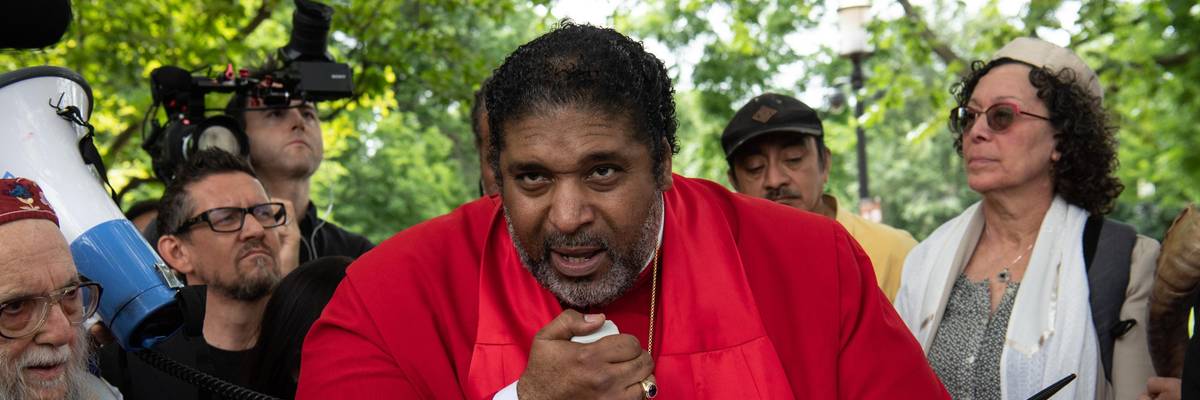
Rev. Dr. William Barber, president of Repairers of the Breach, speaks during a rally in Washington, D.C., on June 12, 2019. (Photo: Nicholas Kamm//AFP via Getty Images)
Rev. Dr. William Barber on Tuesday slammed the North Carolina Supreme Court for declining to hear his appeal of a conviction stemming from a May 2017 protest at the state Legislative Building in support of Medicaid expansion.
"In essence, we were arrested because someone said our message bothered them."
During a press conference about the high court's recent decision, Barber--a leader at Repairers of the Breach and the Poor People's Campaign--laid out how the case relates to free speech and the First Amendment of the U.S. Constitution.
"Even though the highest court won't hear us," he said, "we must continue to ask... 'Who determines whether the authorities are 'disturbed,' and that protestors are too loud, and that protestors have to cease their protest in a public building?'"
Detailing his encounter with police five years ago, Barber recalled that at the protest, for which he led call-and-response chants, "I asked the officers this question: 'How loud can we be? And we'll do that.'"
"The basic answer was, 'Somebody says it's disturbing them,'" Barber continued. "The Constitution says freedom of speech and the press are two of the great bulwarks of liberty and therefore shall never be restrained."
"The officers that day said they did not know how loud free speech could be, so we asked the court to decide," he explained. "In essence, we were arrested because someone said our message bothered them. The answer to the question of what was allowable was never answered. None of the work of the General Assembly suffered that day, but the rights of the people did."
The North Carolina Supreme Court's decision last week follows a state Court of Appeals ruling from December which concluded that "the First Amendment is not implicated in the conduct" for which Barber was charged and "this is not a case about free speech--it is a case about loud speech."
Barber, the court said, "was not expelled from the General Assembly for the content of his words. He was removed for their volume."
The appellate court also determined that even if Barber's First Amendment rights were implicated, "his rights were not violated as a matter of law," adding that the building's rules--which state that visitors "may not disturb or act in a manner that will imminently disturb the General Assembly"--are "reasonable 'time, place, and manner' restrictions."
"If I'm charged and convicted with using my preaching voice to demand Medicaid expansion for thousands of poor and low-wage workers... it is an honor to stand and be named even in the courts of having done so."
In his speech Tuesday, Barber pointed out that half a decade after the protest in question, North Carolina's elected officials have still refused to expand Medicaid.
"If I'm charged and convicted with using my preaching voice to demand Medicaid expansion for thousands of poor and low-wage workers--regardless of their color, their sexuality, their gender--while Republican legislators block it, or if I'm charged and convicted for standing with others... speaking out with the poor and low-wage people and demanding a minimum living wage of $15 an hour, it is an honor to stand and be named even in the courts of having done so," said Barber, who was convicted of second-degree trespass.
"I will always, with others, fight for the right to stand for voting rights, to stand for immigrant rights, to stand for healthcare rights, to stand for living wages rights, to stand for LGBTQ rights, to stand for women's rights, to stand for equal protection under the law," Barber vowed, "and I'll even fight for the free speech of my opponents."
"The Bible actually tells us raise my voice with others like a trumpet--not like a harmonica, like a trumpet; not quiet, not whispering, but like a trumpet," he bellowed. "And if it means I'm charged and eventually have to even spend time in prison, it's a small price to pay. I cannot remain silent, I will not remain silent, while God's children suffer for no reason other than the poor choices of elected officials that hurt, destroy, and even cause the demise of poor and low-wealth people."
Barber and others are planning the Mass Poor People's & Low-Wage Workers' Assembly and Moral March on Washington and to the Polls for June 18, 2022. According to organizers, the event "will be a generationally transformative and disruptive gathering of poor and low-wealth people, state leaders, faith communities, moral allies, unions, and partnering organizations."
Dear Common Dreams reader, It’s been nearly 30 years since I co-founded Common Dreams with my late wife, Lina Newhouser. We had the radical notion that journalism should serve the public good, not corporate profits. It was clear to us from the outset what it would take to build such a project. No paid advertisements. No corporate sponsors. No millionaire publisher telling us what to think or do. Many people said we wouldn't last a year, but we proved those doubters wrong. Together with a tremendous team of journalists and dedicated staff, we built an independent media outlet free from the constraints of profits and corporate control. Our mission has always been simple: To inform. To inspire. To ignite change for the common good. Building Common Dreams was not easy. Our survival was never guaranteed. When you take on the most powerful forces—Wall Street greed, fossil fuel industry destruction, Big Tech lobbyists, and uber-rich oligarchs who have spent billions upon billions rigging the economy and democracy in their favor—the only bulwark you have is supporters who believe in your work. But here’s the urgent message from me today. It's never been this bad out there. And it's never been this hard to keep us going. At the very moment Common Dreams is most needed, the threats we face are intensifying. We need your support now more than ever. We don't accept corporate advertising and never will. We don't have a paywall because we don't think people should be blocked from critical news based on their ability to pay. Everything we do is funded by the donations of readers like you. When everyone does the little they can afford, we are strong. But if that support retreats or dries up, so do we. Will you donate now to make sure Common Dreams not only survives but thrives? —Craig Brown, Co-founder |
Rev. Dr. William Barber on Tuesday slammed the North Carolina Supreme Court for declining to hear his appeal of a conviction stemming from a May 2017 protest at the state Legislative Building in support of Medicaid expansion.
"In essence, we were arrested because someone said our message bothered them."
During a press conference about the high court's recent decision, Barber--a leader at Repairers of the Breach and the Poor People's Campaign--laid out how the case relates to free speech and the First Amendment of the U.S. Constitution.
"Even though the highest court won't hear us," he said, "we must continue to ask... 'Who determines whether the authorities are 'disturbed,' and that protestors are too loud, and that protestors have to cease their protest in a public building?'"
Detailing his encounter with police five years ago, Barber recalled that at the protest, for which he led call-and-response chants, "I asked the officers this question: 'How loud can we be? And we'll do that.'"
"The basic answer was, 'Somebody says it's disturbing them,'" Barber continued. "The Constitution says freedom of speech and the press are two of the great bulwarks of liberty and therefore shall never be restrained."
"The officers that day said they did not know how loud free speech could be, so we asked the court to decide," he explained. "In essence, we were arrested because someone said our message bothered them. The answer to the question of what was allowable was never answered. None of the work of the General Assembly suffered that day, but the rights of the people did."
The North Carolina Supreme Court's decision last week follows a state Court of Appeals ruling from December which concluded that "the First Amendment is not implicated in the conduct" for which Barber was charged and "this is not a case about free speech--it is a case about loud speech."
Barber, the court said, "was not expelled from the General Assembly for the content of his words. He was removed for their volume."
The appellate court also determined that even if Barber's First Amendment rights were implicated, "his rights were not violated as a matter of law," adding that the building's rules--which state that visitors "may not disturb or act in a manner that will imminently disturb the General Assembly"--are "reasonable 'time, place, and manner' restrictions."
"If I'm charged and convicted with using my preaching voice to demand Medicaid expansion for thousands of poor and low-wage workers... it is an honor to stand and be named even in the courts of having done so."
In his speech Tuesday, Barber pointed out that half a decade after the protest in question, North Carolina's elected officials have still refused to expand Medicaid.
"If I'm charged and convicted with using my preaching voice to demand Medicaid expansion for thousands of poor and low-wage workers--regardless of their color, their sexuality, their gender--while Republican legislators block it, or if I'm charged and convicted for standing with others... speaking out with the poor and low-wage people and demanding a minimum living wage of $15 an hour, it is an honor to stand and be named even in the courts of having done so," said Barber, who was convicted of second-degree trespass.
"I will always, with others, fight for the right to stand for voting rights, to stand for immigrant rights, to stand for healthcare rights, to stand for living wages rights, to stand for LGBTQ rights, to stand for women's rights, to stand for equal protection under the law," Barber vowed, "and I'll even fight for the free speech of my opponents."
"The Bible actually tells us raise my voice with others like a trumpet--not like a harmonica, like a trumpet; not quiet, not whispering, but like a trumpet," he bellowed. "And if it means I'm charged and eventually have to even spend time in prison, it's a small price to pay. I cannot remain silent, I will not remain silent, while God's children suffer for no reason other than the poor choices of elected officials that hurt, destroy, and even cause the demise of poor and low-wealth people."
Barber and others are planning the Mass Poor People's & Low-Wage Workers' Assembly and Moral March on Washington and to the Polls for June 18, 2022. According to organizers, the event "will be a generationally transformative and disruptive gathering of poor and low-wealth people, state leaders, faith communities, moral allies, unions, and partnering organizations."
Rev. Dr. William Barber on Tuesday slammed the North Carolina Supreme Court for declining to hear his appeal of a conviction stemming from a May 2017 protest at the state Legislative Building in support of Medicaid expansion.
"In essence, we were arrested because someone said our message bothered them."
During a press conference about the high court's recent decision, Barber--a leader at Repairers of the Breach and the Poor People's Campaign--laid out how the case relates to free speech and the First Amendment of the U.S. Constitution.
"Even though the highest court won't hear us," he said, "we must continue to ask... 'Who determines whether the authorities are 'disturbed,' and that protestors are too loud, and that protestors have to cease their protest in a public building?'"
Detailing his encounter with police five years ago, Barber recalled that at the protest, for which he led call-and-response chants, "I asked the officers this question: 'How loud can we be? And we'll do that.'"
"The basic answer was, 'Somebody says it's disturbing them,'" Barber continued. "The Constitution says freedom of speech and the press are two of the great bulwarks of liberty and therefore shall never be restrained."
"The officers that day said they did not know how loud free speech could be, so we asked the court to decide," he explained. "In essence, we were arrested because someone said our message bothered them. The answer to the question of what was allowable was never answered. None of the work of the General Assembly suffered that day, but the rights of the people did."
The North Carolina Supreme Court's decision last week follows a state Court of Appeals ruling from December which concluded that "the First Amendment is not implicated in the conduct" for which Barber was charged and "this is not a case about free speech--it is a case about loud speech."
Barber, the court said, "was not expelled from the General Assembly for the content of his words. He was removed for their volume."
The appellate court also determined that even if Barber's First Amendment rights were implicated, "his rights were not violated as a matter of law," adding that the building's rules--which state that visitors "may not disturb or act in a manner that will imminently disturb the General Assembly"--are "reasonable 'time, place, and manner' restrictions."
"If I'm charged and convicted with using my preaching voice to demand Medicaid expansion for thousands of poor and low-wage workers... it is an honor to stand and be named even in the courts of having done so."
In his speech Tuesday, Barber pointed out that half a decade after the protest in question, North Carolina's elected officials have still refused to expand Medicaid.
"If I'm charged and convicted with using my preaching voice to demand Medicaid expansion for thousands of poor and low-wage workers--regardless of their color, their sexuality, their gender--while Republican legislators block it, or if I'm charged and convicted for standing with others... speaking out with the poor and low-wage people and demanding a minimum living wage of $15 an hour, it is an honor to stand and be named even in the courts of having done so," said Barber, who was convicted of second-degree trespass.
"I will always, with others, fight for the right to stand for voting rights, to stand for immigrant rights, to stand for healthcare rights, to stand for living wages rights, to stand for LGBTQ rights, to stand for women's rights, to stand for equal protection under the law," Barber vowed, "and I'll even fight for the free speech of my opponents."
"The Bible actually tells us raise my voice with others like a trumpet--not like a harmonica, like a trumpet; not quiet, not whispering, but like a trumpet," he bellowed. "And if it means I'm charged and eventually have to even spend time in prison, it's a small price to pay. I cannot remain silent, I will not remain silent, while God's children suffer for no reason other than the poor choices of elected officials that hurt, destroy, and even cause the demise of poor and low-wealth people."
Barber and others are planning the Mass Poor People's & Low-Wage Workers' Assembly and Moral March on Washington and to the Polls for June 18, 2022. According to organizers, the event "will be a generationally transformative and disruptive gathering of poor and low-wealth people, state leaders, faith communities, moral allies, unions, and partnering organizations."