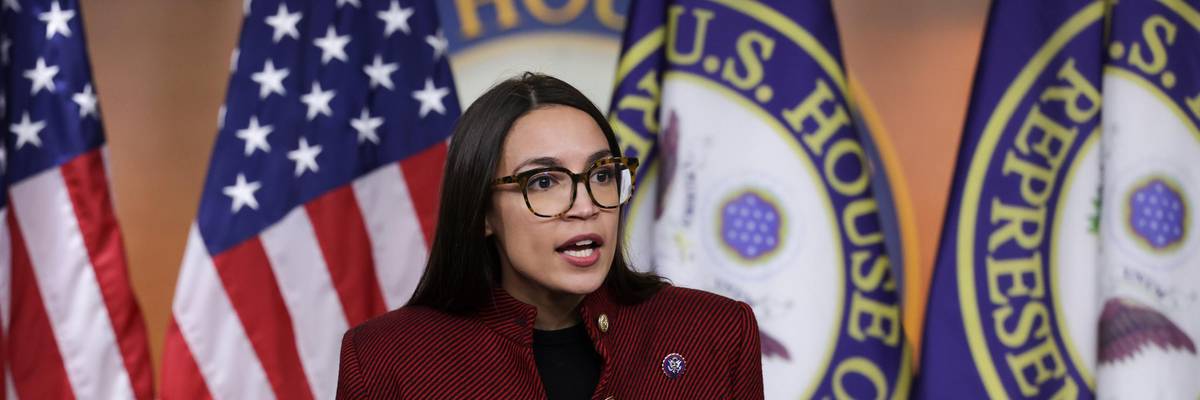
Rep. Alexandria Ocasio-Cortez warned over the weekend that means tests and other limits on student debt cancellation that Biden administration officials are reportedly considering risk denying relief to a significant number of vulnerable people, a potential moral and political disaster.
"Canceling $50,000 in debt is where you really make a dent in inequality and the racial wealth gap. $10,000 isn't."
"I don't believe in a cutoff, especially for so many of the frontline workers who are drowning in debt and would likely be excluded from relief," Ocasio-Cortez (D-N.Y.) told the Washington Post in response to the newspaper's story detailing internal White House discussions of income caps to restrict who is eligible for any federal student debt cancellation.
Ocasio-Cortez stressed that a uniform nationwide income cap would not account for higher costs of living in some areas of the United States. The Post reported that the Biden administration has examined limiting relief to individuals who earned less than either $125,000 or $150,000 the previous year and couples who earned less than either $250,000 or $300,000
In her comments to the Post, the New York Democrat also urged the administration to cancel at least $50,000 in student loan debt per borrower, well beyond the $10,000 level that President Joe Biden pledged on the campaign trail. Forgiving $50,000 in student loan debt would wipe out the entire student debt burden for 80% of federal borrowers--roughly 36 million people.
"Canceling $50,000 in debt is where you really make a dent in inequality and the racial wealth gap," said Ocasio-Cortez. "$10,000 isn't." According to the People's Policy Project, the least wealthy fifth of the U.S. population "owes over half of the student debt while every other fifth owes 7 to 14% of it."
The Wall Street Journal reported last week that in addition to an income threshold, the Biden administration is weighing non-income-specific limitations on student debt relief, such as restricting eligibility to those with undergraduate loans--a move critics warned would leave out many teachers, social workers, public defenders, and others struggling under the weight of student debt.
Research published last year by the National Education Association (NEA) found that nearly half of all U.S. educators "took out student loans to pay for college, and they still owe $58,700, on average."
"Among them," the NEA noted, "one in seven still owes more than $105,000."
The White House has not yet reached a decision on whether to enact broad-based student debt cancellation through executive action, or on any restrictions on potential relief. The Biden administration has extended the moratorium on student loan repayments and interest four times since taking power in 2021.
Related Content

'Pausing a Crisis Doesn't End It': Biden to Extend Student Loan Payment Freeze Again
More than 40 million people across the U.S. hold over $1.8 trillion combined in federal student loan debt. While the Biden administration has unilaterally canceled billions of dollars in student debt for select groups of borrowers, he has thus far resisted pressure to enact relief on a massive scale despite the popularity of the move.
A recent survey conducted by Data for Progress found that 63% of U.S. voters want the federal government to cancel at least some student loan debt for all borrowers.
The polling outfit also showed in a March survey that 46% of voters in the battleground states of Arizona, Georgia, Pennsylvania, and Wisconsin would be more likely to turn out in the pivotal midterm elections in November if Biden cancels $50,000 in student loan debt per borrower.
"If we cancel student debt, that is enormously popular across the country with Republicans, Independents, and Democrats because 99% of the people that hold student debt did not go to Ivy League schools," Rep. Pramila Jayapal (D-Wash.), the chair of the Congressional Progressive Caucus, said in an interview on Sunday.
"Almost 40% of them didn't even [finish their degree]," Jayapal added, "and yet they're being crushed by this student debt."
Rep. Alexandria Ocasio-Cortez warned over the weekend that means tests and other limits on student debt cancellation that Biden administration officials are reportedly considering risk denying relief to a significant number of vulnerable people, a potential moral and political disaster.
"Canceling $50,000 in debt is where you really make a dent in inequality and the racial wealth gap. $10,000 isn't."
"I don't believe in a cutoff, especially for so many of the frontline workers who are drowning in debt and would likely be excluded from relief," Ocasio-Cortez (D-N.Y.) told the Washington Post in response to the newspaper's story detailing internal White House discussions of income caps to restrict who is eligible for any federal student debt cancellation.
Ocasio-Cortez stressed that a uniform nationwide income cap would not account for higher costs of living in some areas of the United States. The Post reported that the Biden administration has examined limiting relief to individuals who earned less than either $125,000 or $150,000 the previous year and couples who earned less than either $250,000 or $300,000
In her comments to the Post, the New York Democrat also urged the administration to cancel at least $50,000 in student loan debt per borrower, well beyond the $10,000 level that President Joe Biden pledged on the campaign trail. Forgiving $50,000 in student loan debt would wipe out the entire student debt burden for 80% of federal borrowers--roughly 36 million people.
"Canceling $50,000 in debt is where you really make a dent in inequality and the racial wealth gap," said Ocasio-Cortez. "$10,000 isn't." According to the People's Policy Project, the least wealthy fifth of the U.S. population "owes over half of the student debt while every other fifth owes 7 to 14% of it."
The Wall Street Journal reported last week that in addition to an income threshold, the Biden administration is weighing non-income-specific limitations on student debt relief, such as restricting eligibility to those with undergraduate loans--a move critics warned would leave out many teachers, social workers, public defenders, and others struggling under the weight of student debt.
Research published last year by the National Education Association (NEA) found that nearly half of all U.S. educators "took out student loans to pay for college, and they still owe $58,700, on average."
"Among them," the NEA noted, "one in seven still owes more than $105,000."
The White House has not yet reached a decision on whether to enact broad-based student debt cancellation through executive action, or on any restrictions on potential relief. The Biden administration has extended the moratorium on student loan repayments and interest four times since taking power in 2021.
Related Content
'Pausing a Crisis Doesn't End It': Biden to Extend Student Loan Payment Freeze Again
More than 40 million people across the U.S. hold over $1.8 trillion combined in federal student loan debt. While the Biden administration has unilaterally canceled billions of dollars in student debt for select groups of borrowers, he has thus far resisted pressure to enact relief on a massive scale despite the popularity of the move.
A recent survey conducted by Data for Progress found that 63% of U.S. voters want the federal government to cancel at least some student loan debt for all borrowers.
The polling outfit also showed in a March survey that 46% of voters in the battleground states of Arizona, Georgia, Pennsylvania, and Wisconsin would be more likely to turn out in the pivotal midterm elections in November if Biden cancels $50,000 in student loan debt per borrower.
"If we cancel student debt, that is enormously popular across the country with Republicans, Independents, and Democrats because 99% of the people that hold student debt did not go to Ivy League schools," Rep. Pramila Jayapal (D-Wash.), the chair of the Congressional Progressive Caucus, said in an interview on Sunday.
"Almost 40% of them didn't even [finish their degree]," Jayapal added, "and yet they're being crushed by this student debt."
Rep. Alexandria Ocasio-Cortez warned over the weekend that means tests and other limits on student debt cancellation that Biden administration officials are reportedly considering risk denying relief to a significant number of vulnerable people, a potential moral and political disaster.
"Canceling $50,000 in debt is where you really make a dent in inequality and the racial wealth gap. $10,000 isn't."
"I don't believe in a cutoff, especially for so many of the frontline workers who are drowning in debt and would likely be excluded from relief," Ocasio-Cortez (D-N.Y.) told the Washington Post in response to the newspaper's story detailing internal White House discussions of income caps to restrict who is eligible for any federal student debt cancellation.
Ocasio-Cortez stressed that a uniform nationwide income cap would not account for higher costs of living in some areas of the United States. The Post reported that the Biden administration has examined limiting relief to individuals who earned less than either $125,000 or $150,000 the previous year and couples who earned less than either $250,000 or $300,000
In her comments to the Post, the New York Democrat also urged the administration to cancel at least $50,000 in student loan debt per borrower, well beyond the $10,000 level that President Joe Biden pledged on the campaign trail. Forgiving $50,000 in student loan debt would wipe out the entire student debt burden for 80% of federal borrowers--roughly 36 million people.
"Canceling $50,000 in debt is where you really make a dent in inequality and the racial wealth gap," said Ocasio-Cortez. "$10,000 isn't." According to the People's Policy Project, the least wealthy fifth of the U.S. population "owes over half of the student debt while every other fifth owes 7 to 14% of it."
The Wall Street Journal reported last week that in addition to an income threshold, the Biden administration is weighing non-income-specific limitations on student debt relief, such as restricting eligibility to those with undergraduate loans--a move critics warned would leave out many teachers, social workers, public defenders, and others struggling under the weight of student debt.
Research published last year by the National Education Association (NEA) found that nearly half of all U.S. educators "took out student loans to pay for college, and they still owe $58,700, on average."
"Among them," the NEA noted, "one in seven still owes more than $105,000."
The White House has not yet reached a decision on whether to enact broad-based student debt cancellation through executive action, or on any restrictions on potential relief. The Biden administration has extended the moratorium on student loan repayments and interest four times since taking power in 2021.
Related Content
'Pausing a Crisis Doesn't End It': Biden to Extend Student Loan Payment Freeze Again
More than 40 million people across the U.S. hold over $1.8 trillion combined in federal student loan debt. While the Biden administration has unilaterally canceled billions of dollars in student debt for select groups of borrowers, he has thus far resisted pressure to enact relief on a massive scale despite the popularity of the move.
A recent survey conducted by Data for Progress found that 63% of U.S. voters want the federal government to cancel at least some student loan debt for all borrowers.
The polling outfit also showed in a March survey that 46% of voters in the battleground states of Arizona, Georgia, Pennsylvania, and Wisconsin would be more likely to turn out in the pivotal midterm elections in November if Biden cancels $50,000 in student loan debt per borrower.
"If we cancel student debt, that is enormously popular across the country with Republicans, Independents, and Democrats because 99% of the people that hold student debt did not go to Ivy League schools," Rep. Pramila Jayapal (D-Wash.), the chair of the Congressional Progressive Caucus, said in an interview on Sunday.
"Almost 40% of them didn't even [finish their degree]," Jayapal added, "and yet they're being crushed by this student debt."