
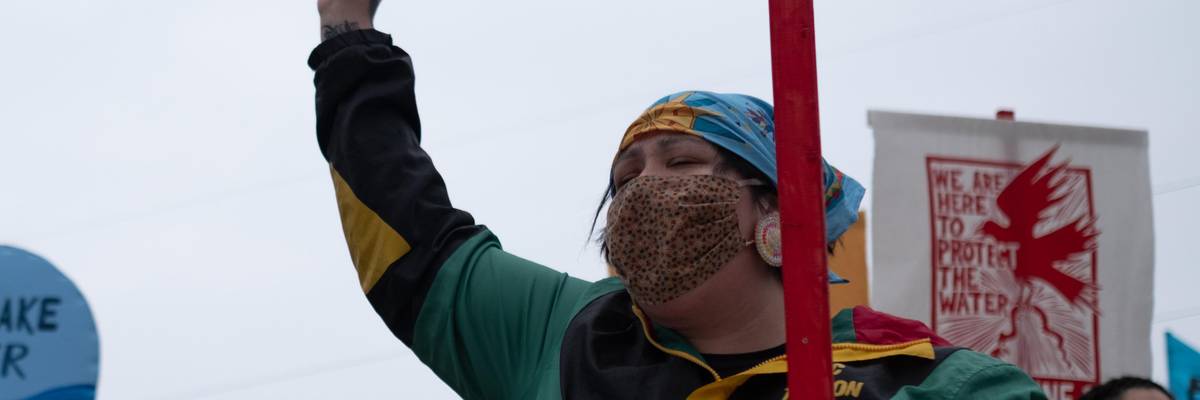
A water protector attends a demonstration against the Line 3 pipeline in St. Paul, Minnesota on January 29, 2021. (Photo: Tim Evans/NurPhoto via Getty Images)
'We Don't Trust Enbridge': Indigenous Women Push Biden to Block Line 5 Expansion
"The construction of this pipeline will bring massive risk and destruction. We do not want to see irreversible damage to our land, water, and wild rice. We do not want our lifeways destroyed."
Indigenous women leaders and more than 200 advocacy organizations sent a letter Wednesday demanding that the U.S. Army Corps of Engineers block federal permits for an expansion of Enbridge's Line 5, a 645-mile-long pipeline that currently transports millions of gallons of crude oil and natural gas liquids per day from Wisconsin to Ontario, Canada.
"The Army Corps and Biden administration must put people over profits."
The proposed expansion, Indigenous leaders and environmentalists warn, would route the pipeline through hundreds of waterways and further threaten tribal lands in Wisconsin and Michigan. Over the past 50 years, Line 5 has spilled at least 1.1 million gallons of oil in 29 separate incidents.
"Both the current Line 5 and the proposed Line 5 expansion threaten to irreversibly damage our drinking water, our ecosystems, and manoomin," the new letter reads. "Both the existing and proposed pipelines violate our tribal usufructuary rights. They endanger the Great Lakes' waters and fisheries important to many people. They exacerbate the climate crisis that affects the whole planet."
Enbridge's pipeline has been a source of heated disputes in the state of Michigan in recent months as Democratic Gov. Gretchen Whitmer attempts to shut Line 5 down, citing the "very real threat of a catastrophic oil spill in the Great Lakes." Whitmer's efforts have sparked pushback from Enbridge--headquartered in Calgary--and the Canadian government, as well as Republican lawmakers.
A state-level court battle over the pipeline is ongoing.
In their letter on Wednesday, the Indigenous leaders and advocacy organizations implored the Biden administration to step in and "reject permits for the expansion of Line 5 in northern Wisconsin":
This plan places massive risk squarely upon the Bad River Tribe and the Red Cliff Tribe against their will. Furthermore, we consider the pipeline construction an act of cultural genocide. Damage to the land and water destroys food and cultural lifeways that are core to our identity and survival. The pipeline would cut through more than 900 waterways upstream of the Bad River Reservation. The U.S. EPA determined that the plan "may result in substantial and unacceptable adverse impacts" to the Kakagon and Bad River slough complex. This is unacceptable...
We don't trust Enbridge, and with good reason. Just look to the west to see Enbridge's troubling permit violations during Line 3 construction though northern Minnesota.
In 2020, during the final months of the Trump administration, the Army Corps approved the final federal permit for Enbridge Line 3 expansion project. Despite massive public pressure, the Biden administration has defended the permits in court.
The Army Corps is currently reviewing Enbridge's application for the expansion of Line 5, which has been operating since 1953.
"When it comes to extractive industry, the Army Corps has historically chosen not to use every tool at their disposal to ensure meaningful consultation with Tribal Nations occurs and to listen when Tribes say 'no,'" Jaime Arsenault, tribal historic preservation officer with the White Earth Band of the Minnesota Chippewa Tribe, said in a statement. "We saw a multitude of preventable environmental tragedies occur in Minnesota with the destruction brought by Line 3."
"As a result, wild rice, watersheds, traditional lifeways, and the wellbeing of Indigenous communities are still under constant threat," Arsenault added. "And so, what will the Army Corps do about that? Right now, the Army Corps has the opportunity to protect waterways, rice, and lands in the destructive pathway of the Line 5 pipeline."
Jannan Cornstalk, citizen of the Little Traverse Bay Bands of Odawa Indians, warned that "our very lifeways and cultures hang in the balance as pipelines like Line 5 get rammed through our territories and water."
"The Army Corps and Biden administration must put people over profits," said Cornstalk. "Allowing Line 5 to proceed is cultural genocide. The disturbances go deeper than you are hearing. That water is our relative, and we will do whatever it takes to protect our water."
We are at a crossroads
This country and this world are at a monumental crossroads. US voters have an opportunity to beat back the forces of fascism and confront the billionaires who are rigging the economy, our media system, and our democracy, making it increasingly impossible for ordinary people to get by. We’re not just talking about the election. We’re talking about what must be done once these fascist elements are vanquished from power. We need a bolder set of solutions than what either major party has so far been willing to offer and a working-class movement ready to fight like hell for it. Trump didn't emerge from nowhere. The conditions that fueled MAGA authoritarianism were created by decades of radical neoliberal economic policies and a corrupt political system dominated by corporate interests. They slashed taxes on the super-rich, promising that the benefits would trickle down. They said giveaways to the corporate titans would make life more affordable for the rest of us. It was all bullshit. And when a bitter, betrayed populace searches for someone to blame, right-wing demagogues have little trouble finding scapegoats. People know when they're being lied to, but you won't hear any of this from the corporate media. Only independent journalism—powered and funded by people who believe in building a better world—can deliver truly trustworthy daily news. Our Fall Campaign is underway, and we need your help. To power our newsroom through the rest of the year, we need to raise $125,000 by midnight on October 31. So if you share our vision, please contribute whatever you can to sustain our work. |
Indigenous women leaders and more than 200 advocacy organizations sent a letter Wednesday demanding that the U.S. Army Corps of Engineers block federal permits for an expansion of Enbridge's Line 5, a 645-mile-long pipeline that currently transports millions of gallons of crude oil and natural gas liquids per day from Wisconsin to Ontario, Canada.
"The Army Corps and Biden administration must put people over profits."
The proposed expansion, Indigenous leaders and environmentalists warn, would route the pipeline through hundreds of waterways and further threaten tribal lands in Wisconsin and Michigan. Over the past 50 years, Line 5 has spilled at least 1.1 million gallons of oil in 29 separate incidents.
"Both the current Line 5 and the proposed Line 5 expansion threaten to irreversibly damage our drinking water, our ecosystems, and manoomin," the new letter reads. "Both the existing and proposed pipelines violate our tribal usufructuary rights. They endanger the Great Lakes' waters and fisheries important to many people. They exacerbate the climate crisis that affects the whole planet."
Enbridge's pipeline has been a source of heated disputes in the state of Michigan in recent months as Democratic Gov. Gretchen Whitmer attempts to shut Line 5 down, citing the "very real threat of a catastrophic oil spill in the Great Lakes." Whitmer's efforts have sparked pushback from Enbridge--headquartered in Calgary--and the Canadian government, as well as Republican lawmakers.
A state-level court battle over the pipeline is ongoing.
In their letter on Wednesday, the Indigenous leaders and advocacy organizations implored the Biden administration to step in and "reject permits for the expansion of Line 5 in northern Wisconsin":
This plan places massive risk squarely upon the Bad River Tribe and the Red Cliff Tribe against their will. Furthermore, we consider the pipeline construction an act of cultural genocide. Damage to the land and water destroys food and cultural lifeways that are core to our identity and survival. The pipeline would cut through more than 900 waterways upstream of the Bad River Reservation. The U.S. EPA determined that the plan "may result in substantial and unacceptable adverse impacts" to the Kakagon and Bad River slough complex. This is unacceptable...
We don't trust Enbridge, and with good reason. Just look to the west to see Enbridge's troubling permit violations during Line 3 construction though northern Minnesota.
In 2020, during the final months of the Trump administration, the Army Corps approved the final federal permit for Enbridge Line 3 expansion project. Despite massive public pressure, the Biden administration has defended the permits in court.
The Army Corps is currently reviewing Enbridge's application for the expansion of Line 5, which has been operating since 1953.
"When it comes to extractive industry, the Army Corps has historically chosen not to use every tool at their disposal to ensure meaningful consultation with Tribal Nations occurs and to listen when Tribes say 'no,'" Jaime Arsenault, tribal historic preservation officer with the White Earth Band of the Minnesota Chippewa Tribe, said in a statement. "We saw a multitude of preventable environmental tragedies occur in Minnesota with the destruction brought by Line 3."
"As a result, wild rice, watersheds, traditional lifeways, and the wellbeing of Indigenous communities are still under constant threat," Arsenault added. "And so, what will the Army Corps do about that? Right now, the Army Corps has the opportunity to protect waterways, rice, and lands in the destructive pathway of the Line 5 pipeline."
Jannan Cornstalk, citizen of the Little Traverse Bay Bands of Odawa Indians, warned that "our very lifeways and cultures hang in the balance as pipelines like Line 5 get rammed through our territories and water."
"The Army Corps and Biden administration must put people over profits," said Cornstalk. "Allowing Line 5 to proceed is cultural genocide. The disturbances go deeper than you are hearing. That water is our relative, and we will do whatever it takes to protect our water."