SUBSCRIBE TO OUR FREE NEWSLETTER
Daily news & progressive opinion—funded by the people, not the corporations—delivered straight to your inbox.
5
#000000
#FFFFFF
To donate by check, phone, or other method, see our More Ways to Give page.
Daily news & progressive opinion—funded by the people, not the corporations—delivered straight to your inbox.
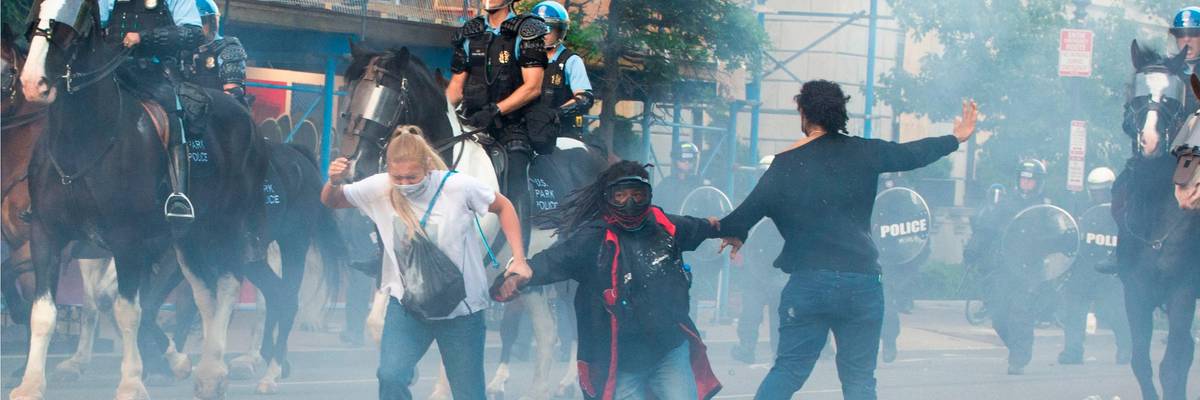
Racial justice protestors are tear gassed as the police disperse them near the White House on June 1, 2020. (Photo: Roberto Schmidt/AFP via Getty Images)
In what one rights advocate called "a win for the ongoing resistance" against police brutality, the U.S. Department of Justice and the ACLU of Washington, D.C. on Wednesday announed a partial settlement that will require law enforcement officers to significantly reform the tactics they use to disperse crowds.
"It sounded like bombs were exploding, and the scene quickly resembled a war zone."
The settlement was reached in a case brought by the ACLU on behalf of Black Lives Matter organizers and individual protesters who faced a militarized police response to their racial justice demonstration on June 1, 2020 in Lafayette Square in the nation's capital.
The Trump administration reportedly ordered the clearing of the square so former President Donald Trump could walk to St. John's Church to have his picture taken with a Bible amid a nationwide uprising over racial justice, and law enforcement agents used flash-band grenades, tear gas, and rubber bullets to disperse the crowd.
"The use of tear gas and rubber bullets will never be enough to silence our voices or diminish our duty to demand an end to police violence against Black communities," said April Goggans, a leader of Black Lives Matter D.C., after the settlement and new policies were announced Wednesday.
"Today marks a win for the ongoing resistance against all attempts to subvert dissent," Goggans added. "These attempts to disrupt the ability to organize for an end to the recurring trauma caused to Black communities by police attacks will not go unchallenged."
According to the ACLU, under the settlement, the U.S. Park Police and the Secret Service will be:
Authorities will be required to enact the changes within 30 days.
"These changes to agency policies for protest responses will strengthen our commitment to protecting and respecting constitutionally protected rights," said Associate Attorney General Vanita Gupta.
Protesters who faced the violent clearing of Lafayette Square two years ago reported that police fired rubber bullets directly at them, pushed them down with their shields, and released tear gas in the middle of the crowd. The use of tear gas caused vomiting in some of the participants.
"It sounded like bombs were exploding, and the scene quickly resembled a war zone," plaintiff Radiya Buchanan said in a statement Wednesday. "People were running over each other, looking for anything to pour into their eyes to stop the burning all while trying to dodge flares and gas canisters."
Kaitlin Banner, deputy legal director for the Washington Lawyers' Committee for Civil Rights and Urban Affairs, noted that the protesters in Lafayette Square were gathering to condemn police violence when they themselves "were attacked by federal and local police with batons and tear gas."
"This country has a history of responding to racial justice protests with violent and abusive policing," said Banner. "This settlement is an important step towards protecting future protests from police attacks like the one on June 1."
Dear Common Dreams reader, It’s been nearly 30 years since I co-founded Common Dreams with my late wife, Lina Newhouser. We had the radical notion that journalism should serve the public good, not corporate profits. It was clear to us from the outset what it would take to build such a project. No paid advertisements. No corporate sponsors. No millionaire publisher telling us what to think or do. Many people said we wouldn't last a year, but we proved those doubters wrong. Together with a tremendous team of journalists and dedicated staff, we built an independent media outlet free from the constraints of profits and corporate control. Our mission has always been simple: To inform. To inspire. To ignite change for the common good. Building Common Dreams was not easy. Our survival was never guaranteed. When you take on the most powerful forces—Wall Street greed, fossil fuel industry destruction, Big Tech lobbyists, and uber-rich oligarchs who have spent billions upon billions rigging the economy and democracy in their favor—the only bulwark you have is supporters who believe in your work. But here’s the urgent message from me today. It's never been this bad out there. And it's never been this hard to keep us going. At the very moment Common Dreams is most needed, the threats we face are intensifying. We need your support now more than ever. We don't accept corporate advertising and never will. We don't have a paywall because we don't think people should be blocked from critical news based on their ability to pay. Everything we do is funded by the donations of readers like you. When everyone does the little they can afford, we are strong. But if that support retreats or dries up, so do we. Will you donate now to make sure Common Dreams not only survives but thrives? —Craig Brown, Co-founder |
In what one rights advocate called "a win for the ongoing resistance" against police brutality, the U.S. Department of Justice and the ACLU of Washington, D.C. on Wednesday announed a partial settlement that will require law enforcement officers to significantly reform the tactics they use to disperse crowds.
"It sounded like bombs were exploding, and the scene quickly resembled a war zone."
The settlement was reached in a case brought by the ACLU on behalf of Black Lives Matter organizers and individual protesters who faced a militarized police response to their racial justice demonstration on June 1, 2020 in Lafayette Square in the nation's capital.
The Trump administration reportedly ordered the clearing of the square so former President Donald Trump could walk to St. John's Church to have his picture taken with a Bible amid a nationwide uprising over racial justice, and law enforcement agents used flash-band grenades, tear gas, and rubber bullets to disperse the crowd.
"The use of tear gas and rubber bullets will never be enough to silence our voices or diminish our duty to demand an end to police violence against Black communities," said April Goggans, a leader of Black Lives Matter D.C., after the settlement and new policies were announced Wednesday.
"Today marks a win for the ongoing resistance against all attempts to subvert dissent," Goggans added. "These attempts to disrupt the ability to organize for an end to the recurring trauma caused to Black communities by police attacks will not go unchallenged."
According to the ACLU, under the settlement, the U.S. Park Police and the Secret Service will be:
Authorities will be required to enact the changes within 30 days.
"These changes to agency policies for protest responses will strengthen our commitment to protecting and respecting constitutionally protected rights," said Associate Attorney General Vanita Gupta.
Protesters who faced the violent clearing of Lafayette Square two years ago reported that police fired rubber bullets directly at them, pushed them down with their shields, and released tear gas in the middle of the crowd. The use of tear gas caused vomiting in some of the participants.
"It sounded like bombs were exploding, and the scene quickly resembled a war zone," plaintiff Radiya Buchanan said in a statement Wednesday. "People were running over each other, looking for anything to pour into their eyes to stop the burning all while trying to dodge flares and gas canisters."
Kaitlin Banner, deputy legal director for the Washington Lawyers' Committee for Civil Rights and Urban Affairs, noted that the protesters in Lafayette Square were gathering to condemn police violence when they themselves "were attacked by federal and local police with batons and tear gas."
"This country has a history of responding to racial justice protests with violent and abusive policing," said Banner. "This settlement is an important step towards protecting future protests from police attacks like the one on June 1."
In what one rights advocate called "a win for the ongoing resistance" against police brutality, the U.S. Department of Justice and the ACLU of Washington, D.C. on Wednesday announed a partial settlement that will require law enforcement officers to significantly reform the tactics they use to disperse crowds.
"It sounded like bombs were exploding, and the scene quickly resembled a war zone."
The settlement was reached in a case brought by the ACLU on behalf of Black Lives Matter organizers and individual protesters who faced a militarized police response to their racial justice demonstration on June 1, 2020 in Lafayette Square in the nation's capital.
The Trump administration reportedly ordered the clearing of the square so former President Donald Trump could walk to St. John's Church to have his picture taken with a Bible amid a nationwide uprising over racial justice, and law enforcement agents used flash-band grenades, tear gas, and rubber bullets to disperse the crowd.
"The use of tear gas and rubber bullets will never be enough to silence our voices or diminish our duty to demand an end to police violence against Black communities," said April Goggans, a leader of Black Lives Matter D.C., after the settlement and new policies were announced Wednesday.
"Today marks a win for the ongoing resistance against all attempts to subvert dissent," Goggans added. "These attempts to disrupt the ability to organize for an end to the recurring trauma caused to Black communities by police attacks will not go unchallenged."
According to the ACLU, under the settlement, the U.S. Park Police and the Secret Service will be:
Authorities will be required to enact the changes within 30 days.
"These changes to agency policies for protest responses will strengthen our commitment to protecting and respecting constitutionally protected rights," said Associate Attorney General Vanita Gupta.
Protesters who faced the violent clearing of Lafayette Square two years ago reported that police fired rubber bullets directly at them, pushed them down with their shields, and released tear gas in the middle of the crowd. The use of tear gas caused vomiting in some of the participants.
"It sounded like bombs were exploding, and the scene quickly resembled a war zone," plaintiff Radiya Buchanan said in a statement Wednesday. "People were running over each other, looking for anything to pour into their eyes to stop the burning all while trying to dodge flares and gas canisters."
Kaitlin Banner, deputy legal director for the Washington Lawyers' Committee for Civil Rights and Urban Affairs, noted that the protesters in Lafayette Square were gathering to condemn police violence when they themselves "were attacked by federal and local police with batons and tear gas."
"This country has a history of responding to racial justice protests with violent and abusive policing," said Banner. "This settlement is an important step towards protecting future protests from police attacks like the one on June 1."