SUBSCRIBE TO OUR FREE NEWSLETTER
Daily news & progressive opinion—funded by the people, not the corporations—delivered straight to your inbox.
5
#000000
#FFFFFF
To donate by check, phone, or other method, see our More Ways to Give page.
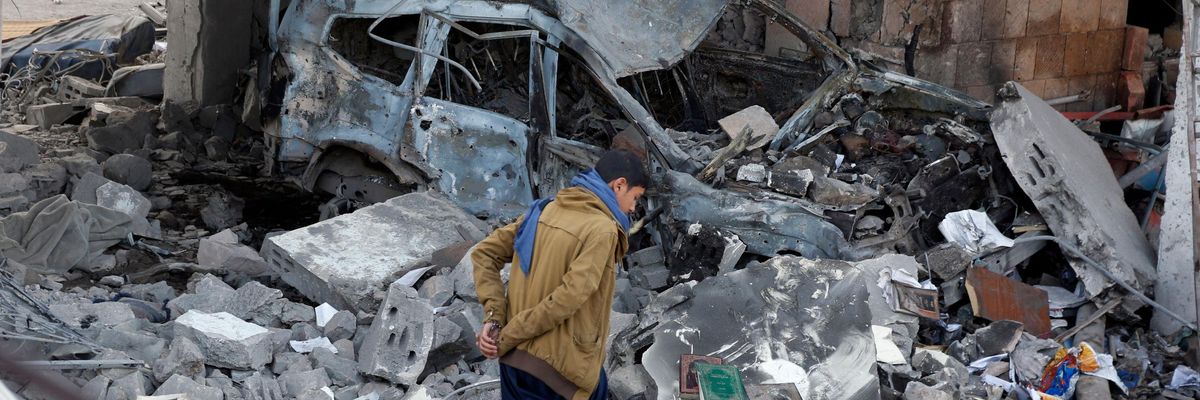
During a televised interview late Sunday, journalist Mehdi Hasan pressed a State Department official on U.S. President Joe Biden's willingness to call Russian President Vladimir Putin a "war criminal" while sending weapons to Saudi Arabia as the kingdom wages war on Yemen.
"How come Joe Biden can call Vladimir Putin a war criminal but not others, for example, the crown prince?"
"Ambassador, it is good to see the U.S. government calling out war crimes in Ukraine and assisting in the documenting of those war crimes, but I do wonder, and I'm sure many others wonder too, where is that same kind of commitment when it comes to other conflicts?" Hasan asked.
"For example, the war in Yemen, where multiple atrocities have been documented by both sides, but one of those sides is our ally, the Kingdom of Saudi Arabia," he added. "Wouldn't we have more credibility if we condemned war crimes by our friends and not just by our enemies?"
Beth Van Schaack, the U.S. ambassador-at-large for global criminal justice, responded that "the United States has worked tirelessly to promote accountability and documentation of abuses all across the world."
"There's a number of situations" at the International Criminal Court (ICC)--which probes and prosecutes genocide, war crimes, crimes against humanity, and aggression--that the Biden administration has been "very supportive of," Van Schaack said. "The standards apply to all parties and we are looking at all conflicts around the world with an eye toward bringing the parties better into compliance with international law."
The exchange on Hasan's show--which airs on MSNBC and the streaming service Peacock--continued with the host pointing out that Van Schaack "didn't address the Yemen war example."
Citing 2016 reporting that the Obama administration--for which Biden served as vice president--allowed a massive arms sale to Yemen despite concerns that the United States could be implicated in war crimes for supporting the Saudi-led air assault on Yemen, Hasan again raised the issue of credibility.
"Wouldn't we have more credibility if we called out war crimes by our own allies instead of selling them weapons?" he asked.
Describing the president's failure to criticize Saudi Crown Prince Mohammed bin Salman, or MBS, as "the most obvious example in the world" of the unequal treatment of leaders accused of atrocities, he added, "How come Joe Biden can call Vladimir Putin a war criminal but not others, for example, the crown prince?"
In response, Van Schaack noted that the Biden administration has diminished the amount of support it is providing to the Saudi-led campaign in Yemen and is working to ensure that those involved in that conflict comply with international humanitarian law, reiterating that "the standards apply to all parties."
Related Content

The exchange on Hasan's show came as Biden's recent declarations of Putin as a war criminal and his call for a war crimes trial focused on Russian forces' actions in Bucha and other Ukrainian cities since late February have fueled speculation about how his administration may reconsider U.S. policy with regard to the ICC, which is already investigating recent allegations in Ukraine.
The New York Times reported Monday that the administration "is vigorously debating" how much it can or should aid the probe of alleged Russian war crimes given federal law and longtime U.S. government objection to the ICC exercising jurisdiction over nations that aren't part of the treaty that created the court--including the United States.
After denouncing a Russian rocket attack on a train station in eastern Ukraine as yet another "war crime" on Friday, Ukrainian President Volodymyr Zelenskyy claimed Monday that tens of thousands have been killed in the port city of Mariupol and "the Russians are not stopping their offensive."
Meanwhile, world leaders and campaigners continue to sound the alarm over how Putin's war is affecting not only Ukrainians who have been killed, wounded, and trapped by the war, or fled to neighboring countries, but also the global food supply--particularly in some Middle Eastern and North African nations including war-torn Yemen.
"The number of malnourished children is likely to drastically increase," the United Nations Children's Fund (UNICEF) regional director said last week, echoing warnings from other U.N. leaders in mid-March that "we need to act now" to feed Yemeni youth because "lives are at stake."
During a televised interview late Sunday, journalist Mehdi Hasan pressed a State Department official on U.S. President Joe Biden's willingness to call Russian President Vladimir Putin a "war criminal" while sending weapons to Saudi Arabia as the kingdom wages war on Yemen.
"How come Joe Biden can call Vladimir Putin a war criminal but not others, for example, the crown prince?"
"Ambassador, it is good to see the U.S. government calling out war crimes in Ukraine and assisting in the documenting of those war crimes, but I do wonder, and I'm sure many others wonder too, where is that same kind of commitment when it comes to other conflicts?" Hasan asked.
"For example, the war in Yemen, where multiple atrocities have been documented by both sides, but one of those sides is our ally, the Kingdom of Saudi Arabia," he added. "Wouldn't we have more credibility if we condemned war crimes by our friends and not just by our enemies?"
Beth Van Schaack, the U.S. ambassador-at-large for global criminal justice, responded that "the United States has worked tirelessly to promote accountability and documentation of abuses all across the world."
"There's a number of situations" at the International Criminal Court (ICC)--which probes and prosecutes genocide, war crimes, crimes against humanity, and aggression--that the Biden administration has been "very supportive of," Van Schaack said. "The standards apply to all parties and we are looking at all conflicts around the world with an eye toward bringing the parties better into compliance with international law."
The exchange on Hasan's show--which airs on MSNBC and the streaming service Peacock--continued with the host pointing out that Van Schaack "didn't address the Yemen war example."
Citing 2016 reporting that the Obama administration--for which Biden served as vice president--allowed a massive arms sale to Yemen despite concerns that the United States could be implicated in war crimes for supporting the Saudi-led air assault on Yemen, Hasan again raised the issue of credibility.
"Wouldn't we have more credibility if we called out war crimes by our own allies instead of selling them weapons?" he asked.
Describing the president's failure to criticize Saudi Crown Prince Mohammed bin Salman, or MBS, as "the most obvious example in the world" of the unequal treatment of leaders accused of atrocities, he added, "How come Joe Biden can call Vladimir Putin a war criminal but not others, for example, the crown prince?"
In response, Van Schaack noted that the Biden administration has diminished the amount of support it is providing to the Saudi-led campaign in Yemen and is working to ensure that those involved in that conflict comply with international humanitarian law, reiterating that "the standards apply to all parties."
Related Content
The exchange on Hasan's show came as Biden's recent declarations of Putin as a war criminal and his call for a war crimes trial focused on Russian forces' actions in Bucha and other Ukrainian cities since late February have fueled speculation about how his administration may reconsider U.S. policy with regard to the ICC, which is already investigating recent allegations in Ukraine.
The New York Times reported Monday that the administration "is vigorously debating" how much it can or should aid the probe of alleged Russian war crimes given federal law and longtime U.S. government objection to the ICC exercising jurisdiction over nations that aren't part of the treaty that created the court--including the United States.
After denouncing a Russian rocket attack on a train station in eastern Ukraine as yet another "war crime" on Friday, Ukrainian President Volodymyr Zelenskyy claimed Monday that tens of thousands have been killed in the port city of Mariupol and "the Russians are not stopping their offensive."
Meanwhile, world leaders and campaigners continue to sound the alarm over how Putin's war is affecting not only Ukrainians who have been killed, wounded, and trapped by the war, or fled to neighboring countries, but also the global food supply--particularly in some Middle Eastern and North African nations including war-torn Yemen.
"The number of malnourished children is likely to drastically increase," the United Nations Children's Fund (UNICEF) regional director said last week, echoing warnings from other U.N. leaders in mid-March that "we need to act now" to feed Yemeni youth because "lives are at stake."
During a televised interview late Sunday, journalist Mehdi Hasan pressed a State Department official on U.S. President Joe Biden's willingness to call Russian President Vladimir Putin a "war criminal" while sending weapons to Saudi Arabia as the kingdom wages war on Yemen.
"How come Joe Biden can call Vladimir Putin a war criminal but not others, for example, the crown prince?"
"Ambassador, it is good to see the U.S. government calling out war crimes in Ukraine and assisting in the documenting of those war crimes, but I do wonder, and I'm sure many others wonder too, where is that same kind of commitment when it comes to other conflicts?" Hasan asked.
"For example, the war in Yemen, where multiple atrocities have been documented by both sides, but one of those sides is our ally, the Kingdom of Saudi Arabia," he added. "Wouldn't we have more credibility if we condemned war crimes by our friends and not just by our enemies?"
Beth Van Schaack, the U.S. ambassador-at-large for global criminal justice, responded that "the United States has worked tirelessly to promote accountability and documentation of abuses all across the world."
"There's a number of situations" at the International Criminal Court (ICC)--which probes and prosecutes genocide, war crimes, crimes against humanity, and aggression--that the Biden administration has been "very supportive of," Van Schaack said. "The standards apply to all parties and we are looking at all conflicts around the world with an eye toward bringing the parties better into compliance with international law."
The exchange on Hasan's show--which airs on MSNBC and the streaming service Peacock--continued with the host pointing out that Van Schaack "didn't address the Yemen war example."
Citing 2016 reporting that the Obama administration--for which Biden served as vice president--allowed a massive arms sale to Yemen despite concerns that the United States could be implicated in war crimes for supporting the Saudi-led air assault on Yemen, Hasan again raised the issue of credibility.
"Wouldn't we have more credibility if we called out war crimes by our own allies instead of selling them weapons?" he asked.
Describing the president's failure to criticize Saudi Crown Prince Mohammed bin Salman, or MBS, as "the most obvious example in the world" of the unequal treatment of leaders accused of atrocities, he added, "How come Joe Biden can call Vladimir Putin a war criminal but not others, for example, the crown prince?"
In response, Van Schaack noted that the Biden administration has diminished the amount of support it is providing to the Saudi-led campaign in Yemen and is working to ensure that those involved in that conflict comply with international humanitarian law, reiterating that "the standards apply to all parties."
Related Content
The exchange on Hasan's show came as Biden's recent declarations of Putin as a war criminal and his call for a war crimes trial focused on Russian forces' actions in Bucha and other Ukrainian cities since late February have fueled speculation about how his administration may reconsider U.S. policy with regard to the ICC, which is already investigating recent allegations in Ukraine.
The New York Times reported Monday that the administration "is vigorously debating" how much it can or should aid the probe of alleged Russian war crimes given federal law and longtime U.S. government objection to the ICC exercising jurisdiction over nations that aren't part of the treaty that created the court--including the United States.
After denouncing a Russian rocket attack on a train station in eastern Ukraine as yet another "war crime" on Friday, Ukrainian President Volodymyr Zelenskyy claimed Monday that tens of thousands have been killed in the port city of Mariupol and "the Russians are not stopping their offensive."
Meanwhile, world leaders and campaigners continue to sound the alarm over how Putin's war is affecting not only Ukrainians who have been killed, wounded, and trapped by the war, or fled to neighboring countries, but also the global food supply--particularly in some Middle Eastern and North African nations including war-torn Yemen.
"The number of malnourished children is likely to drastically increase," the United Nations Children's Fund (UNICEF) regional director said last week, echoing warnings from other U.N. leaders in mid-March that "we need to act now" to feed Yemeni youth because "lives are at stake."