SUBSCRIBE TO OUR FREE NEWSLETTER
Daily news & progressive opinion—funded by the people, not the corporations—delivered straight to your inbox.
5
#000000
#FFFFFF
To donate by check, phone, or other method, see our More Ways to Give page.
Daily news & progressive opinion—funded by the people, not the corporations—delivered straight to your inbox.
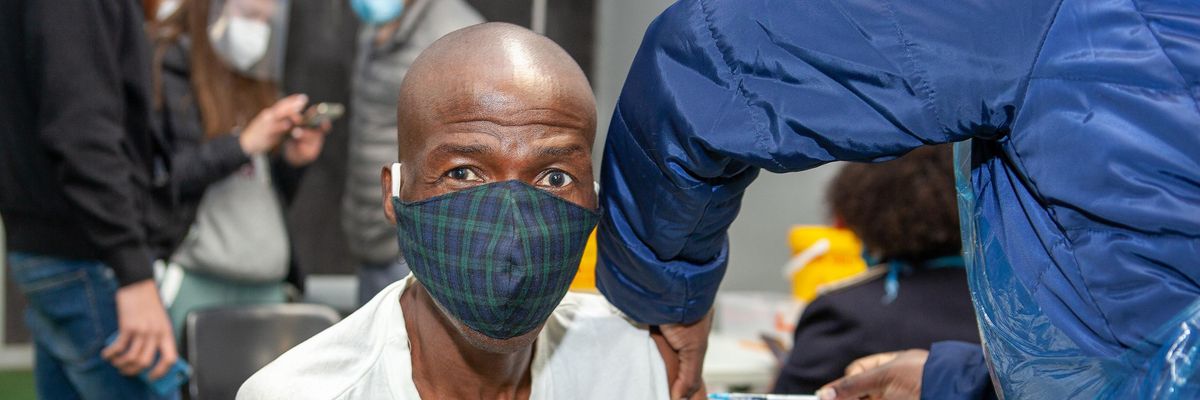
Citizens receive the Covid-19 vaccine on July 6, 2021 in Soweto, South Africa. (Photo: Papi Morake/Gallo Images via Getty Images)
The highly uneven global distribution of Covid-19 vaccines is exacerbating deadly inequalities between--and within--countries, threatening to undermine socio-economic gains throughout the developing world, the United Nations warned Monday.
"The speed with which the world gets vaccinated in 2022 is critical to avoid more lost ground in contexts where progress is needed the most."
Two years into a pandemic that has killed millions, 2.8 billion people--91% of whom reside in low-income nations--have yet to receive their first lifesaving shot, according to a new analysis released this month by the U.N. Development Programme (UNDP).
Although there has been a substantial increase in the total number of Covid-19 vaccines administered over the past several months, the allocation of doses remains starkly unequal. Of the 10.7 billion jabs given out worldwide, just 1% have gone into the arms of people in low-income countries, the UNDP found.
In addition to giving the coronavirus more opportunities to circulate among unprotected populations--increasing the likelihood of new, potentially vaccine-resistant variants emerging and further prolonging the global public health emergency--vaccine inequity has harmed national economic recovery efforts, thereby widening "the poverty gap between rich and poor countries" and worsening inequalities within them, said the UNDP.
As of last month, 50 out of 54 countries in Africa were not on track to reach the World Health Organization's (WHO) target of inoculating 70% of their populations by mid-2022.
"Most of the vulnerable countries are found in Sub-Saharan Africa, including Burundi, the Democratic Republic of the Congo, and Chad, where less than 1% of the populations are fully vaccinated," said the UNDP. "And outside of Africa, Haiti and Yemen are still to reach 2% coverage."
Inside each nation, "the pandemic is hitting vulnerable and marginalized groups hardest," the UNDP continued. "Progress in education completion is expected to be reversed, especially among children from the poorest households. Gender disparities are increasing, with spikes in gender-based violence and less than 20% of countries' pandemic support geared towards women. And informal workers have been disproportionally hit by extended lockdowns."
Using data from the Global Dashboard of Vaccine Equity, developed by the UNDP, WHO, and the University of Oxford, the analysis shows how inequitable access to Covid-19 vaccination "will not only affect poorer countries disproportionally in terms of health, but also have a profound and lasting impact on their socio-economic recovery."
Lamenting numerous "lost opportunities," the UNDP found that "if low-income countries had the same vaccination rate as high-income countries in September last year (54%), they would have increased their GDP by US$16.27 billion in 2021, which could have been used to address other pressing development challenges--education, healthcare, [and] energy for all, for example."
Ethiopia, the Democratic Republic of the Congo, and Uganda have lost the most potential income as a result of what global health justice campaigners have called "vaccine apartheid" during the pandemic, according to the U.N.
While governments in wealthy nations have been better able to soften the financial impact of the pandemic by providing vaccines and "more comprehensive and longer-lasting economic support" to various kinds of workers, the world's 1.6 billion informal workers "saw their earnings decline by 60% in 2020," and in "some countries with a large informal sector, like Uganda, Bangladesh and Colombia, experienced a significant increase in the number of days of complete lockdown in 2021, before reaching higher vaccination coverage," the UNDP pointed out.
"The speed with which the world gets vaccinated in 2022 is critical to avoid more lost ground in contexts where progress is needed the most," the agency wrote. "As many as 19 million people need to be inoculated each week in low-income countries to reach the 70% target by mid-2022, which represents an increase by over 800% compared to current rates."
"As many as 19 million people need to be inoculated each week in low-income countries to reach the 70% target by mid-2022, which represents an increase by over 800% compared to current rates."
As the UNDP explained, "reaching the 70% target means that countries that can least afford it will have to boost health spending by a disproportionate amount compared to richer countries." Whereas high-income nations have to increase healthcare spending by an average of just 0.8% to vaccinate 70% of their populations, their impoverished counterparts have to scale up expenditures by an average of 56.6% to achieve the same goal.
"For low-income countries, the spending required on vaccines equals 59% of the annual average investment needs to end extreme poverty by 2030 (SDG 1.1) or 89% of the average expenditure needs per year to ensure that all girls and boys can complete free, equitable, and quality primary and secondary education (SDG 4.1)," said the UNDP, alluding to Sustainable Development Goals (SDGs) that are being put on the back burner, possibly leading to what U.N. High Commissioner for Human Rights Michelle Bachelet earlier this month described as a "lost decade for development."
To prevent developing countries from accumulating more debt in the process, the UNDP endorsed financing vaccination campaigns through grants and concessions as recently proposed by the International Monetary Fund (IMF). The agency also emphasized the need to pay greater attention to the "logistics and planning needed to effectively distribute vaccines on the ground, especially in low-resource settings."
Although the UNDP has called for "urgent action to boost supply, share vaccines, and ensure they're accessible to everyone," the agency's new analysis doesn't mention potential solutions proposed by vaccine equity campaigners.
For instance, many experts, including former U.N. Secretary-General Ban Ki-moon, have demanded the temporary suspension of coronavirus-related intellectual property restrictions, which they say will enable qualified manufacturers around the world to boost the supply of generic tests, jabs, and treatments, paving the way for more equitable distribution.
Others have argued that while the fight for a robust patent waiver continues, the United States and other rich governments should invest in the creation of regional manufacturing hubs to ramp up the public production of vaccines. The U.S., for instance, owns a patent underlying mRNA technology, giving it significant leverage to share knowledge over the objections of profit-maximizing pharmaceutical companies.
The UNDP estimates that the cost of vaccinating 70% of the world's population by mid-2022 to be $18 billion, while Public Citizen has developed a blueprint showing how the U.S. could produce enough doses to protect the world from Covid-19 for $25 billion, or roughly 3% of President Joe Biden's latest military budget request of $813 billion.
Dear Common Dreams reader, It’s been nearly 30 years since I co-founded Common Dreams with my late wife, Lina Newhouser. We had the radical notion that journalism should serve the public good, not corporate profits. It was clear to us from the outset what it would take to build such a project. No paid advertisements. No corporate sponsors. No millionaire publisher telling us what to think or do. Many people said we wouldn't last a year, but we proved those doubters wrong. Together with a tremendous team of journalists and dedicated staff, we built an independent media outlet free from the constraints of profits and corporate control. Our mission has always been simple: To inform. To inspire. To ignite change for the common good. Building Common Dreams was not easy. Our survival was never guaranteed. When you take on the most powerful forces—Wall Street greed, fossil fuel industry destruction, Big Tech lobbyists, and uber-rich oligarchs who have spent billions upon billions rigging the economy and democracy in their favor—the only bulwark you have is supporters who believe in your work. But here’s the urgent message from me today. It's never been this bad out there. And it's never been this hard to keep us going. At the very moment Common Dreams is most needed, the threats we face are intensifying. We need your support now more than ever. We don't accept corporate advertising and never will. We don't have a paywall because we don't think people should be blocked from critical news based on their ability to pay. Everything we do is funded by the donations of readers like you. When everyone does the little they can afford, we are strong. But if that support retreats or dries up, so do we. Will you donate now to make sure Common Dreams not only survives but thrives? —Craig Brown, Co-founder |
The highly uneven global distribution of Covid-19 vaccines is exacerbating deadly inequalities between--and within--countries, threatening to undermine socio-economic gains throughout the developing world, the United Nations warned Monday.
"The speed with which the world gets vaccinated in 2022 is critical to avoid more lost ground in contexts where progress is needed the most."
Two years into a pandemic that has killed millions, 2.8 billion people--91% of whom reside in low-income nations--have yet to receive their first lifesaving shot, according to a new analysis released this month by the U.N. Development Programme (UNDP).
Although there has been a substantial increase in the total number of Covid-19 vaccines administered over the past several months, the allocation of doses remains starkly unequal. Of the 10.7 billion jabs given out worldwide, just 1% have gone into the arms of people in low-income countries, the UNDP found.
In addition to giving the coronavirus more opportunities to circulate among unprotected populations--increasing the likelihood of new, potentially vaccine-resistant variants emerging and further prolonging the global public health emergency--vaccine inequity has harmed national economic recovery efforts, thereby widening "the poverty gap between rich and poor countries" and worsening inequalities within them, said the UNDP.
As of last month, 50 out of 54 countries in Africa were not on track to reach the World Health Organization's (WHO) target of inoculating 70% of their populations by mid-2022.
"Most of the vulnerable countries are found in Sub-Saharan Africa, including Burundi, the Democratic Republic of the Congo, and Chad, where less than 1% of the populations are fully vaccinated," said the UNDP. "And outside of Africa, Haiti and Yemen are still to reach 2% coverage."
Inside each nation, "the pandemic is hitting vulnerable and marginalized groups hardest," the UNDP continued. "Progress in education completion is expected to be reversed, especially among children from the poorest households. Gender disparities are increasing, with spikes in gender-based violence and less than 20% of countries' pandemic support geared towards women. And informal workers have been disproportionally hit by extended lockdowns."
Using data from the Global Dashboard of Vaccine Equity, developed by the UNDP, WHO, and the University of Oxford, the analysis shows how inequitable access to Covid-19 vaccination "will not only affect poorer countries disproportionally in terms of health, but also have a profound and lasting impact on their socio-economic recovery."
Lamenting numerous "lost opportunities," the UNDP found that "if low-income countries had the same vaccination rate as high-income countries in September last year (54%), they would have increased their GDP by US$16.27 billion in 2021, which could have been used to address other pressing development challenges--education, healthcare, [and] energy for all, for example."
Ethiopia, the Democratic Republic of the Congo, and Uganda have lost the most potential income as a result of what global health justice campaigners have called "vaccine apartheid" during the pandemic, according to the U.N.
While governments in wealthy nations have been better able to soften the financial impact of the pandemic by providing vaccines and "more comprehensive and longer-lasting economic support" to various kinds of workers, the world's 1.6 billion informal workers "saw their earnings decline by 60% in 2020," and in "some countries with a large informal sector, like Uganda, Bangladesh and Colombia, experienced a significant increase in the number of days of complete lockdown in 2021, before reaching higher vaccination coverage," the UNDP pointed out.
"The speed with which the world gets vaccinated in 2022 is critical to avoid more lost ground in contexts where progress is needed the most," the agency wrote. "As many as 19 million people need to be inoculated each week in low-income countries to reach the 70% target by mid-2022, which represents an increase by over 800% compared to current rates."
"As many as 19 million people need to be inoculated each week in low-income countries to reach the 70% target by mid-2022, which represents an increase by over 800% compared to current rates."
As the UNDP explained, "reaching the 70% target means that countries that can least afford it will have to boost health spending by a disproportionate amount compared to richer countries." Whereas high-income nations have to increase healthcare spending by an average of just 0.8% to vaccinate 70% of their populations, their impoverished counterparts have to scale up expenditures by an average of 56.6% to achieve the same goal.
"For low-income countries, the spending required on vaccines equals 59% of the annual average investment needs to end extreme poverty by 2030 (SDG 1.1) or 89% of the average expenditure needs per year to ensure that all girls and boys can complete free, equitable, and quality primary and secondary education (SDG 4.1)," said the UNDP, alluding to Sustainable Development Goals (SDGs) that are being put on the back burner, possibly leading to what U.N. High Commissioner for Human Rights Michelle Bachelet earlier this month described as a "lost decade for development."
To prevent developing countries from accumulating more debt in the process, the UNDP endorsed financing vaccination campaigns through grants and concessions as recently proposed by the International Monetary Fund (IMF). The agency also emphasized the need to pay greater attention to the "logistics and planning needed to effectively distribute vaccines on the ground, especially in low-resource settings."
Although the UNDP has called for "urgent action to boost supply, share vaccines, and ensure they're accessible to everyone," the agency's new analysis doesn't mention potential solutions proposed by vaccine equity campaigners.
For instance, many experts, including former U.N. Secretary-General Ban Ki-moon, have demanded the temporary suspension of coronavirus-related intellectual property restrictions, which they say will enable qualified manufacturers around the world to boost the supply of generic tests, jabs, and treatments, paving the way for more equitable distribution.
Others have argued that while the fight for a robust patent waiver continues, the United States and other rich governments should invest in the creation of regional manufacturing hubs to ramp up the public production of vaccines. The U.S., for instance, owns a patent underlying mRNA technology, giving it significant leverage to share knowledge over the objections of profit-maximizing pharmaceutical companies.
The UNDP estimates that the cost of vaccinating 70% of the world's population by mid-2022 to be $18 billion, while Public Citizen has developed a blueprint showing how the U.S. could produce enough doses to protect the world from Covid-19 for $25 billion, or roughly 3% of President Joe Biden's latest military budget request of $813 billion.
The highly uneven global distribution of Covid-19 vaccines is exacerbating deadly inequalities between--and within--countries, threatening to undermine socio-economic gains throughout the developing world, the United Nations warned Monday.
"The speed with which the world gets vaccinated in 2022 is critical to avoid more lost ground in contexts where progress is needed the most."
Two years into a pandemic that has killed millions, 2.8 billion people--91% of whom reside in low-income nations--have yet to receive their first lifesaving shot, according to a new analysis released this month by the U.N. Development Programme (UNDP).
Although there has been a substantial increase in the total number of Covid-19 vaccines administered over the past several months, the allocation of doses remains starkly unequal. Of the 10.7 billion jabs given out worldwide, just 1% have gone into the arms of people in low-income countries, the UNDP found.
In addition to giving the coronavirus more opportunities to circulate among unprotected populations--increasing the likelihood of new, potentially vaccine-resistant variants emerging and further prolonging the global public health emergency--vaccine inequity has harmed national economic recovery efforts, thereby widening "the poverty gap between rich and poor countries" and worsening inequalities within them, said the UNDP.
As of last month, 50 out of 54 countries in Africa were not on track to reach the World Health Organization's (WHO) target of inoculating 70% of their populations by mid-2022.
"Most of the vulnerable countries are found in Sub-Saharan Africa, including Burundi, the Democratic Republic of the Congo, and Chad, where less than 1% of the populations are fully vaccinated," said the UNDP. "And outside of Africa, Haiti and Yemen are still to reach 2% coverage."
Inside each nation, "the pandemic is hitting vulnerable and marginalized groups hardest," the UNDP continued. "Progress in education completion is expected to be reversed, especially among children from the poorest households. Gender disparities are increasing, with spikes in gender-based violence and less than 20% of countries' pandemic support geared towards women. And informal workers have been disproportionally hit by extended lockdowns."
Using data from the Global Dashboard of Vaccine Equity, developed by the UNDP, WHO, and the University of Oxford, the analysis shows how inequitable access to Covid-19 vaccination "will not only affect poorer countries disproportionally in terms of health, but also have a profound and lasting impact on their socio-economic recovery."
Lamenting numerous "lost opportunities," the UNDP found that "if low-income countries had the same vaccination rate as high-income countries in September last year (54%), they would have increased their GDP by US$16.27 billion in 2021, which could have been used to address other pressing development challenges--education, healthcare, [and] energy for all, for example."
Ethiopia, the Democratic Republic of the Congo, and Uganda have lost the most potential income as a result of what global health justice campaigners have called "vaccine apartheid" during the pandemic, according to the U.N.
While governments in wealthy nations have been better able to soften the financial impact of the pandemic by providing vaccines and "more comprehensive and longer-lasting economic support" to various kinds of workers, the world's 1.6 billion informal workers "saw their earnings decline by 60% in 2020," and in "some countries with a large informal sector, like Uganda, Bangladesh and Colombia, experienced a significant increase in the number of days of complete lockdown in 2021, before reaching higher vaccination coverage," the UNDP pointed out.
"The speed with which the world gets vaccinated in 2022 is critical to avoid more lost ground in contexts where progress is needed the most," the agency wrote. "As many as 19 million people need to be inoculated each week in low-income countries to reach the 70% target by mid-2022, which represents an increase by over 800% compared to current rates."
"As many as 19 million people need to be inoculated each week in low-income countries to reach the 70% target by mid-2022, which represents an increase by over 800% compared to current rates."
As the UNDP explained, "reaching the 70% target means that countries that can least afford it will have to boost health spending by a disproportionate amount compared to richer countries." Whereas high-income nations have to increase healthcare spending by an average of just 0.8% to vaccinate 70% of their populations, their impoverished counterparts have to scale up expenditures by an average of 56.6% to achieve the same goal.
"For low-income countries, the spending required on vaccines equals 59% of the annual average investment needs to end extreme poverty by 2030 (SDG 1.1) or 89% of the average expenditure needs per year to ensure that all girls and boys can complete free, equitable, and quality primary and secondary education (SDG 4.1)," said the UNDP, alluding to Sustainable Development Goals (SDGs) that are being put on the back burner, possibly leading to what U.N. High Commissioner for Human Rights Michelle Bachelet earlier this month described as a "lost decade for development."
To prevent developing countries from accumulating more debt in the process, the UNDP endorsed financing vaccination campaigns through grants and concessions as recently proposed by the International Monetary Fund (IMF). The agency also emphasized the need to pay greater attention to the "logistics and planning needed to effectively distribute vaccines on the ground, especially in low-resource settings."
Although the UNDP has called for "urgent action to boost supply, share vaccines, and ensure they're accessible to everyone," the agency's new analysis doesn't mention potential solutions proposed by vaccine equity campaigners.
For instance, many experts, including former U.N. Secretary-General Ban Ki-moon, have demanded the temporary suspension of coronavirus-related intellectual property restrictions, which they say will enable qualified manufacturers around the world to boost the supply of generic tests, jabs, and treatments, paving the way for more equitable distribution.
Others have argued that while the fight for a robust patent waiver continues, the United States and other rich governments should invest in the creation of regional manufacturing hubs to ramp up the public production of vaccines. The U.S., for instance, owns a patent underlying mRNA technology, giving it significant leverage to share knowledge over the objections of profit-maximizing pharmaceutical companies.
The UNDP estimates that the cost of vaccinating 70% of the world's population by mid-2022 to be $18 billion, while Public Citizen has developed a blueprint showing how the U.S. could produce enough doses to protect the world from Covid-19 for $25 billion, or roughly 3% of President Joe Biden's latest military budget request of $813 billion.