

SUBSCRIBE TO OUR FREE NEWSLETTER
Daily news & progressive opinion—funded by the people, not the corporations—delivered straight to your inbox.
5
#000000
#FFFFFF
To donate by check, phone, or other method, see our More Ways to Give page.
Daily news & progressive opinion—funded by the people, not the corporations—delivered straight to your inbox.
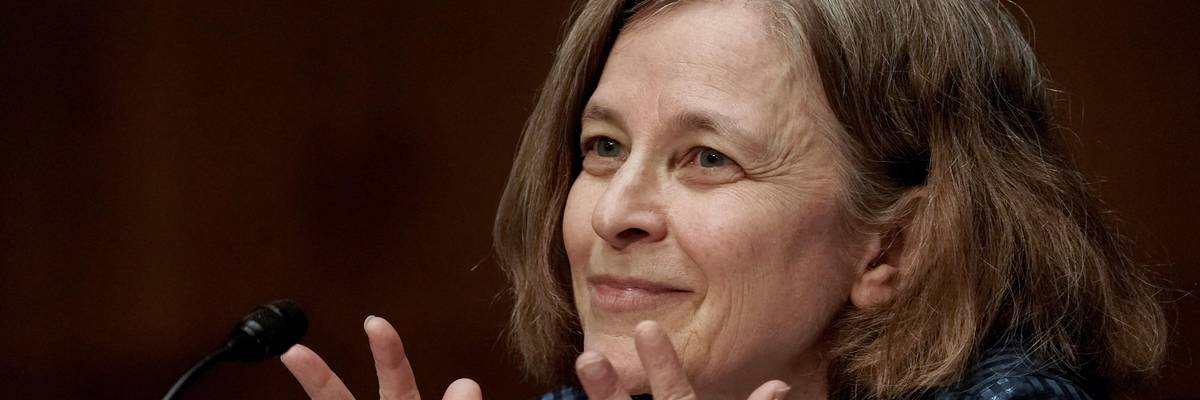
U.S. Federal Reserve vice chair of supervision nominee Sarah Bloom Raskin testifies before the Senate Banking, Housing, and Urban Affairs Committee on February 3, 2022, in Washington, D.C.
Sarah Bloom Raskin withdrew her nomination as Federal Reserve vice chair for supervision on Tuesday, prompting progressive condemnation of the fossil fuel-funded U.S. senators--especially right-wing West Virginia Democrat Joe Manchin--who fiercely opposed her prospective appointment.
"Days before helping Republicans sink Sarah Bloom Raskin's Fed nomination, Joe Manchin told fossil fuel executives that they should seek a 'return on investment' from the politicians they fund."
The Washington Post reports that the White House confirmed Bloom Raskin--a former deputy secretary at the U.S. Treasury Department and member of the Federal Reserve's governing board during the Obama administration--would decline her nomination amid what she has described as "relentless attacks by special interests" spooked by her candid admissions that the climate emergency threatens economic stability.
"It was--and is--my considered view that the perils of climate change must be added to the list of serious risks that the Federal Reserve considers as it works to ensure the stability and resiliency of our economy and financial system," Bloom Raskin wrote in a letter to U.S. President Joe Biden explaining her decision.
"This is not a novel or radical position," she continued. "Any vice chair for supervision who ignored these realities--which are manifesting every day across this country--would be guilty of gross dereliction of duty."
Bloom Raskin's stance is in line with official policy statements from various U.S. government agencies including the Department of Defense, as well as central banks around the world and a growing number of corporations.
In a statement addressing accusations that Bloom Raskin is too "radical" for the job, Biden said that "unfortunately, Senate Republicans are more focused on amplifying these false claims and protecting special interests than taking important steps toward addressing inflation and lowering costs for the American people."
However, it was opposition from Manchin--who has taken hundreds of thousands of dollars in fossil fuel industry campaign contributions and made at least hundreds of thousands more from his family's coal business--in an evenly divided Senate that proved fatal to Bloom Raskin's confirmation prospects.
"Days before helping Republicans sink Sarah Bloom Raskin's Fed nomination, Joe Manchin told fossil fuel executives that they should seek a 'return on investment' from the politicians they fund," The New Republic's Kate Aronoff tweeted. "Guess they listened!"
The progressive group Indivisible lamented, "It's absurd that a qualified nominee who had been unanimously confirmed by the Senate to a similar role can't get confirmed now simply for acknowledging climate change."
David Arkush, climate program managing director at the consumer advocacy group Public Citizen, said in a statement that "as climate harms push into an ever-larger proportion of our social and economic lives, so too does climate denial."
"At the behest of the oil and gas industry, Senate Republicans and Sen. Manchin smeared and killed the nomination of the most qualified person in the country to lead the U.S. through our present economic and financial stability challenges as vice chair for supervision because she had the temerity to voice aloud simple realities around climate change that most regulators agree with," he asserted. "Their behavior is disgraceful."
Arkush continued:
A mainstream nominee if there ever was one, Bloom Raskin has the support of consumers, civil rights groups, unions, businesses, and banks. She was confirmed twice by the Senate unanimously and has widespread, bipartisan support in the real world. But not in today's U.S. Senate, where the fossil fuel industry gives new meaning to the phrase scorched earth.
"It is no surprise that people who are destroying humanity's livable habitat are also willing to imperil financial stability and the broader economy by depriving the country of outstanding leadership in a time of multiple overlapping crises just to make a point," Arkush added. "But it is a new low."
Dear Common Dreams reader, It’s been nearly 30 years since I co-founded Common Dreams with my late wife, Lina Newhouser. We had the radical notion that journalism should serve the public good, not corporate profits. It was clear to us from the outset what it would take to build such a project. No paid advertisements. No corporate sponsors. No millionaire publisher telling us what to think or do. Many people said we wouldn't last a year, but we proved those doubters wrong. Together with a tremendous team of journalists and dedicated staff, we built an independent media outlet free from the constraints of profits and corporate control. Our mission has always been simple: To inform. To inspire. To ignite change for the common good. Building Common Dreams was not easy. Our survival was never guaranteed. When you take on the most powerful forces—Wall Street greed, fossil fuel industry destruction, Big Tech lobbyists, and uber-rich oligarchs who have spent billions upon billions rigging the economy and democracy in their favor—the only bulwark you have is supporters who believe in your work. But here’s the urgent message from me today. It's never been this bad out there. And it's never been this hard to keep us going. At the very moment Common Dreams is most needed, the threats we face are intensifying. We need your support now more than ever. We don't accept corporate advertising and never will. We don't have a paywall because we don't think people should be blocked from critical news based on their ability to pay. Everything we do is funded by the donations of readers like you. When everyone does the little they can afford, we are strong. But if that support retreats or dries up, so do we. Will you donate now to make sure Common Dreams not only survives but thrives? —Craig Brown, Co-founder |
Sarah Bloom Raskin withdrew her nomination as Federal Reserve vice chair for supervision on Tuesday, prompting progressive condemnation of the fossil fuel-funded U.S. senators--especially right-wing West Virginia Democrat Joe Manchin--who fiercely opposed her prospective appointment.
"Days before helping Republicans sink Sarah Bloom Raskin's Fed nomination, Joe Manchin told fossil fuel executives that they should seek a 'return on investment' from the politicians they fund."
The Washington Post reports that the White House confirmed Bloom Raskin--a former deputy secretary at the U.S. Treasury Department and member of the Federal Reserve's governing board during the Obama administration--would decline her nomination amid what she has described as "relentless attacks by special interests" spooked by her candid admissions that the climate emergency threatens economic stability.
"It was--and is--my considered view that the perils of climate change must be added to the list of serious risks that the Federal Reserve considers as it works to ensure the stability and resiliency of our economy and financial system," Bloom Raskin wrote in a letter to U.S. President Joe Biden explaining her decision.
"This is not a novel or radical position," she continued. "Any vice chair for supervision who ignored these realities--which are manifesting every day across this country--would be guilty of gross dereliction of duty."
Bloom Raskin's stance is in line with official policy statements from various U.S. government agencies including the Department of Defense, as well as central banks around the world and a growing number of corporations.
In a statement addressing accusations that Bloom Raskin is too "radical" for the job, Biden said that "unfortunately, Senate Republicans are more focused on amplifying these false claims and protecting special interests than taking important steps toward addressing inflation and lowering costs for the American people."
However, it was opposition from Manchin--who has taken hundreds of thousands of dollars in fossil fuel industry campaign contributions and made at least hundreds of thousands more from his family's coal business--in an evenly divided Senate that proved fatal to Bloom Raskin's confirmation prospects.
"Days before helping Republicans sink Sarah Bloom Raskin's Fed nomination, Joe Manchin told fossil fuel executives that they should seek a 'return on investment' from the politicians they fund," The New Republic's Kate Aronoff tweeted. "Guess they listened!"
The progressive group Indivisible lamented, "It's absurd that a qualified nominee who had been unanimously confirmed by the Senate to a similar role can't get confirmed now simply for acknowledging climate change."
David Arkush, climate program managing director at the consumer advocacy group Public Citizen, said in a statement that "as climate harms push into an ever-larger proportion of our social and economic lives, so too does climate denial."
"At the behest of the oil and gas industry, Senate Republicans and Sen. Manchin smeared and killed the nomination of the most qualified person in the country to lead the U.S. through our present economic and financial stability challenges as vice chair for supervision because she had the temerity to voice aloud simple realities around climate change that most regulators agree with," he asserted. "Their behavior is disgraceful."
Arkush continued:
A mainstream nominee if there ever was one, Bloom Raskin has the support of consumers, civil rights groups, unions, businesses, and banks. She was confirmed twice by the Senate unanimously and has widespread, bipartisan support in the real world. But not in today's U.S. Senate, where the fossil fuel industry gives new meaning to the phrase scorched earth.
"It is no surprise that people who are destroying humanity's livable habitat are also willing to imperil financial stability and the broader economy by depriving the country of outstanding leadership in a time of multiple overlapping crises just to make a point," Arkush added. "But it is a new low."
Sarah Bloom Raskin withdrew her nomination as Federal Reserve vice chair for supervision on Tuesday, prompting progressive condemnation of the fossil fuel-funded U.S. senators--especially right-wing West Virginia Democrat Joe Manchin--who fiercely opposed her prospective appointment.
"Days before helping Republicans sink Sarah Bloom Raskin's Fed nomination, Joe Manchin told fossil fuel executives that they should seek a 'return on investment' from the politicians they fund."
The Washington Post reports that the White House confirmed Bloom Raskin--a former deputy secretary at the U.S. Treasury Department and member of the Federal Reserve's governing board during the Obama administration--would decline her nomination amid what she has described as "relentless attacks by special interests" spooked by her candid admissions that the climate emergency threatens economic stability.
"It was--and is--my considered view that the perils of climate change must be added to the list of serious risks that the Federal Reserve considers as it works to ensure the stability and resiliency of our economy and financial system," Bloom Raskin wrote in a letter to U.S. President Joe Biden explaining her decision.
"This is not a novel or radical position," she continued. "Any vice chair for supervision who ignored these realities--which are manifesting every day across this country--would be guilty of gross dereliction of duty."
Bloom Raskin's stance is in line with official policy statements from various U.S. government agencies including the Department of Defense, as well as central banks around the world and a growing number of corporations.
In a statement addressing accusations that Bloom Raskin is too "radical" for the job, Biden said that "unfortunately, Senate Republicans are more focused on amplifying these false claims and protecting special interests than taking important steps toward addressing inflation and lowering costs for the American people."
However, it was opposition from Manchin--who has taken hundreds of thousands of dollars in fossil fuel industry campaign contributions and made at least hundreds of thousands more from his family's coal business--in an evenly divided Senate that proved fatal to Bloom Raskin's confirmation prospects.
"Days before helping Republicans sink Sarah Bloom Raskin's Fed nomination, Joe Manchin told fossil fuel executives that they should seek a 'return on investment' from the politicians they fund," The New Republic's Kate Aronoff tweeted. "Guess they listened!"
The progressive group Indivisible lamented, "It's absurd that a qualified nominee who had been unanimously confirmed by the Senate to a similar role can't get confirmed now simply for acknowledging climate change."
David Arkush, climate program managing director at the consumer advocacy group Public Citizen, said in a statement that "as climate harms push into an ever-larger proportion of our social and economic lives, so too does climate denial."
"At the behest of the oil and gas industry, Senate Republicans and Sen. Manchin smeared and killed the nomination of the most qualified person in the country to lead the U.S. through our present economic and financial stability challenges as vice chair for supervision because she had the temerity to voice aloud simple realities around climate change that most regulators agree with," he asserted. "Their behavior is disgraceful."
Arkush continued:
A mainstream nominee if there ever was one, Bloom Raskin has the support of consumers, civil rights groups, unions, businesses, and banks. She was confirmed twice by the Senate unanimously and has widespread, bipartisan support in the real world. But not in today's U.S. Senate, where the fossil fuel industry gives new meaning to the phrase scorched earth.
"It is no surprise that people who are destroying humanity's livable habitat are also willing to imperil financial stability and the broader economy by depriving the country of outstanding leadership in a time of multiple overlapping crises just to make a point," Arkush added. "But it is a new low."

