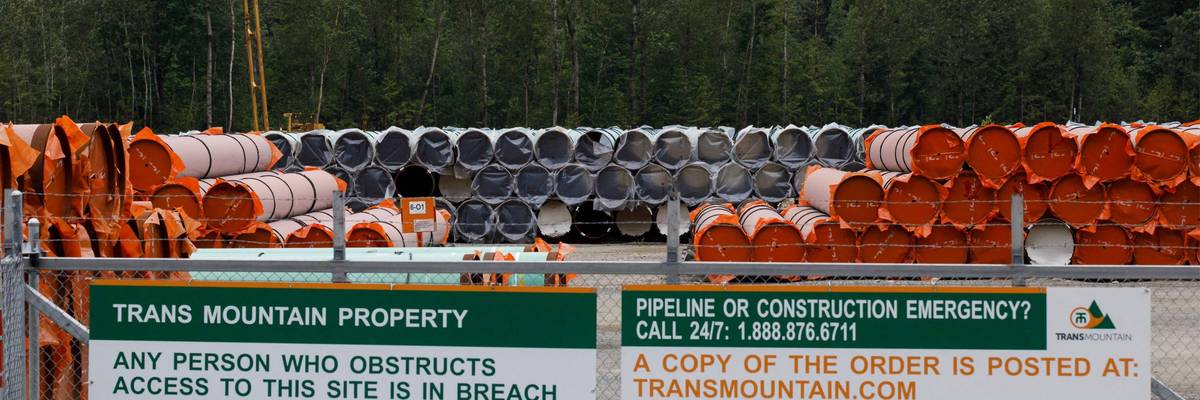
Pieces of the Trans Mountain oil pipeline project sit in a storage lot outside of Hope, British Columbia, Canada, on June 6, 2021.
Trans Mountain Pipeline Canada Bought Will Cost Over $25 Billion and Never Turn Profit
"Guaranteeing another $8.8 billion to complete the project will simply be throwing good money after bad," says a new analysis, "for a total taxpayer loss of $26.1 billion."
Climate activists on Wednesday reiterated calls to cancel Canada's expansion of the Trans Mountain oil pipeline after a new analysis found that a recent pledge to not put any public money into the project "is a promise that the government can't keep."
"The only solution is to cancel it."
"The only solution is to cancel it," tweeted Wilderness Committee campaigner Peter McCartney in response to new research by the Institute for Energy Economics and Financial Analysis (IEEFA).
Not long after an updated cost estimate for the Trans Mountain expansion (TMX) was unveiled last month, Deputy Prime Minister Chrystia Freeland said that rather than relying on more public money, the government would "secure the funding necessary to complete the project with third-party financing, either in the public debt markets or with financial institutions."
The government--which controversially bought the embattled pipeline from Kinder Morgan in 2018--"does not intend to be the long-term owner" and plans to "launch a divestment process" after completing the long-delayed expansion, added Freeland, who is also the finance minister.
"Freeland's assertion that Canada will invest no more public money in TMX is grossly misleading to the public. Any new money poured into the pipeline will be backed by the Canadian taxpayer," said Tom Sanzillo, IEEFA's director of financial analysis, in a statement. "Private money cannot be raised without a government guarantee."
As the institute's report explains:
IEEFA's analysis finds that the government, which owns the project, would not be able to generate an adequate profit for investors because the tolls it would charge for the completed project's use cannot be raised high enough to support new debt on the pipeline plus operational costs. To do so would raise the cost of exporting oil through TMX to a price that would not be competitive in international oil markets. To compete, the government would have to maintain toll rates so low that it would be operating TMX at a loss for its investors.
To attract private money to complete the TMX project, IEEFA concludes, the Canadian government will have to protect investors by guaranteeing the debt. The investors will be protected. The taxpayers will not.
Between the $4.7 billion purchase price and the reported $12.6 billion construction costs, Canadian taxpayers have already funded $17.3 billion on the project. These funds will never be recovered, and guaranteeing another $8.8 billion to complete the project will simply be throwing good money after bad, for a total taxpayer loss of $26.1 billion.
"Kinder Morgan quit the project because it was a bad bet for investors," said Sanzillo. "On its own, this project is not profitable. No amount of fiscal gimmickry can hide the fact that Canadian taxpayers must stand behind another estimated $8.8 billion. Investors won't finance it without a guarantee."
Omar Mawji, IEEFA's energy finance analyst for Canada, emphasized that "we have carefully reviewed the Trans Mountain project's balance sheet."
"The project is unbankable," he said. "To make a go of it, TMX would need to hike shipping tolls by 100%, raising the price of Canadian oil way beyond the level it needs to compete in the global market. Without substantial governmental support, the pipeline is unsustainable."
The IEEFA analysis comes after Canada's financial watchdog warned last week that the government is "very unlikely" to recoup its investment.
As Canada's Parliamentary Budget Officer Yves Giroux put it to Canada's National Observer: "Now that we're talking about over $20 billion in construction costs, it is clearly non-profitable."
While warning about the financial impacts of killing TMX now, he said that "it will probably mean losses for Canadian taxpayers whenever the government decides to sell the pipeline to a private-sector entity."
Noting the Observer's report, Torrance Coste of Wilderness Committee tweeted last week that "trampling Indigenous rights and making the climate crisis worse wouldn't be worth it if we got hundreds of billions of dollars in return."
"The fact we might get nothing," he added, "just underscores what a tacky, shameful mistake this is."
We are at a crossroads
This country and this world are at a monumental crossroads. In a few short weeks, US voters will have an opportunity to beat back the forces of fascism and confront the billionaires who are rigging the economy, our media system, and our democracy, making it increasingly impossible for ordinary people to get by. We’re not just talking about the election. We’re talking about what must be done once these fascist elements are vanquished from power. We need a bolder set of solutions than what either major party has so far been willing to offer and a working-class movement ready to fight like hell for it. Trump didn't emerge from nowhere. The conditions that fueled MAGA authoritarianism were created by decades of radical neoliberal economic policies and a corrupt political system dominated by corporate interests. They slashed taxes on the super-rich, promising that the benefits would trickle down. They said giveaways to the corporate titans would make life more affordable for the rest of us. It was all bullshit. And when a bitter, betrayed populace searches for someone to blame, right-wing demagogues have little trouble finding scapegoats. People know when they're being lied to, but you won't hear any of this from the corporate media. Only independent journalism—powered and funded by people who believe in building a better world—can deliver truly trustworthy daily news. Our Fall Campaign is underway, and we need your help. To power our newsroom through the rest of the year, we need to raise $125,000 by midnight on October 31. So if you share our vision, please contribute whatever you can to sustain our work. |
Climate activists on Wednesday reiterated calls to cancel Canada's expansion of the Trans Mountain oil pipeline after a new analysis found that a recent pledge to not put any public money into the project "is a promise that the government can't keep."
"The only solution is to cancel it."
"The only solution is to cancel it," tweeted Wilderness Committee campaigner Peter McCartney in response to new research by the Institute for Energy Economics and Financial Analysis (IEEFA).
Not long after an updated cost estimate for the Trans Mountain expansion (TMX) was unveiled last month, Deputy Prime Minister Chrystia Freeland said that rather than relying on more public money, the government would "secure the funding necessary to complete the project with third-party financing, either in the public debt markets or with financial institutions."
The government--which controversially bought the embattled pipeline from Kinder Morgan in 2018--"does not intend to be the long-term owner" and plans to "launch a divestment process" after completing the long-delayed expansion, added Freeland, who is also the finance minister.
"Freeland's assertion that Canada will invest no more public money in TMX is grossly misleading to the public. Any new money poured into the pipeline will be backed by the Canadian taxpayer," said Tom Sanzillo, IEEFA's director of financial analysis, in a statement. "Private money cannot be raised without a government guarantee."
As the institute's report explains:
IEEFA's analysis finds that the government, which owns the project, would not be able to generate an adequate profit for investors because the tolls it would charge for the completed project's use cannot be raised high enough to support new debt on the pipeline plus operational costs. To do so would raise the cost of exporting oil through TMX to a price that would not be competitive in international oil markets. To compete, the government would have to maintain toll rates so low that it would be operating TMX at a loss for its investors.
To attract private money to complete the TMX project, IEEFA concludes, the Canadian government will have to protect investors by guaranteeing the debt. The investors will be protected. The taxpayers will not.
Between the $4.7 billion purchase price and the reported $12.6 billion construction costs, Canadian taxpayers have already funded $17.3 billion on the project. These funds will never be recovered, and guaranteeing another $8.8 billion to complete the project will simply be throwing good money after bad, for a total taxpayer loss of $26.1 billion.
"Kinder Morgan quit the project because it was a bad bet for investors," said Sanzillo. "On its own, this project is not profitable. No amount of fiscal gimmickry can hide the fact that Canadian taxpayers must stand behind another estimated $8.8 billion. Investors won't finance it without a guarantee."
Omar Mawji, IEEFA's energy finance analyst for Canada, emphasized that "we have carefully reviewed the Trans Mountain project's balance sheet."
"The project is unbankable," he said. "To make a go of it, TMX would need to hike shipping tolls by 100%, raising the price of Canadian oil way beyond the level it needs to compete in the global market. Without substantial governmental support, the pipeline is unsustainable."
The IEEFA analysis comes after Canada's financial watchdog warned last week that the government is "very unlikely" to recoup its investment.
As Canada's Parliamentary Budget Officer Yves Giroux put it to Canada's National Observer: "Now that we're talking about over $20 billion in construction costs, it is clearly non-profitable."
While warning about the financial impacts of killing TMX now, he said that "it will probably mean losses for Canadian taxpayers whenever the government decides to sell the pipeline to a private-sector entity."
Noting the Observer's report, Torrance Coste of Wilderness Committee tweeted last week that "trampling Indigenous rights and making the climate crisis worse wouldn't be worth it if we got hundreds of billions of dollars in return."
"The fact we might get nothing," he added, "just underscores what a tacky, shameful mistake this is."
Climate activists on Wednesday reiterated calls to cancel Canada's expansion of the Trans Mountain oil pipeline after a new analysis found that a recent pledge to not put any public money into the project "is a promise that the government can't keep."
"The only solution is to cancel it."
"The only solution is to cancel it," tweeted Wilderness Committee campaigner Peter McCartney in response to new research by the Institute for Energy Economics and Financial Analysis (IEEFA).
Not long after an updated cost estimate for the Trans Mountain expansion (TMX) was unveiled last month, Deputy Prime Minister Chrystia Freeland said that rather than relying on more public money, the government would "secure the funding necessary to complete the project with third-party financing, either in the public debt markets or with financial institutions."
The government--which controversially bought the embattled pipeline from Kinder Morgan in 2018--"does not intend to be the long-term owner" and plans to "launch a divestment process" after completing the long-delayed expansion, added Freeland, who is also the finance minister.
"Freeland's assertion that Canada will invest no more public money in TMX is grossly misleading to the public. Any new money poured into the pipeline will be backed by the Canadian taxpayer," said Tom Sanzillo, IEEFA's director of financial analysis, in a statement. "Private money cannot be raised without a government guarantee."
As the institute's report explains:
IEEFA's analysis finds that the government, which owns the project, would not be able to generate an adequate profit for investors because the tolls it would charge for the completed project's use cannot be raised high enough to support new debt on the pipeline plus operational costs. To do so would raise the cost of exporting oil through TMX to a price that would not be competitive in international oil markets. To compete, the government would have to maintain toll rates so low that it would be operating TMX at a loss for its investors.
To attract private money to complete the TMX project, IEEFA concludes, the Canadian government will have to protect investors by guaranteeing the debt. The investors will be protected. The taxpayers will not.
Between the $4.7 billion purchase price and the reported $12.6 billion construction costs, Canadian taxpayers have already funded $17.3 billion on the project. These funds will never be recovered, and guaranteeing another $8.8 billion to complete the project will simply be throwing good money after bad, for a total taxpayer loss of $26.1 billion.
"Kinder Morgan quit the project because it was a bad bet for investors," said Sanzillo. "On its own, this project is not profitable. No amount of fiscal gimmickry can hide the fact that Canadian taxpayers must stand behind another estimated $8.8 billion. Investors won't finance it without a guarantee."
Omar Mawji, IEEFA's energy finance analyst for Canada, emphasized that "we have carefully reviewed the Trans Mountain project's balance sheet."
"The project is unbankable," he said. "To make a go of it, TMX would need to hike shipping tolls by 100%, raising the price of Canadian oil way beyond the level it needs to compete in the global market. Without substantial governmental support, the pipeline is unsustainable."
The IEEFA analysis comes after Canada's financial watchdog warned last week that the government is "very unlikely" to recoup its investment.
As Canada's Parliamentary Budget Officer Yves Giroux put it to Canada's National Observer: "Now that we're talking about over $20 billion in construction costs, it is clearly non-profitable."
While warning about the financial impacts of killing TMX now, he said that "it will probably mean losses for Canadian taxpayers whenever the government decides to sell the pipeline to a private-sector entity."
Noting the Observer's report, Torrance Coste of Wilderness Committee tweeted last week that "trampling Indigenous rights and making the climate crisis worse wouldn't be worth it if we got hundreds of billions of dollars in return."
"The fact we might get nothing," he added, "just underscores what a tacky, shameful mistake this is."