

SUBSCRIBE TO OUR FREE NEWSLETTER
Daily news & progressive opinion—funded by the people, not the corporations—delivered straight to your inbox.
5
#000000
#FFFFFF
To donate by check, phone, or other method, see our More Ways to Give page.
Daily news & progressive opinion—funded by the people, not the corporations—delivered straight to your inbox.
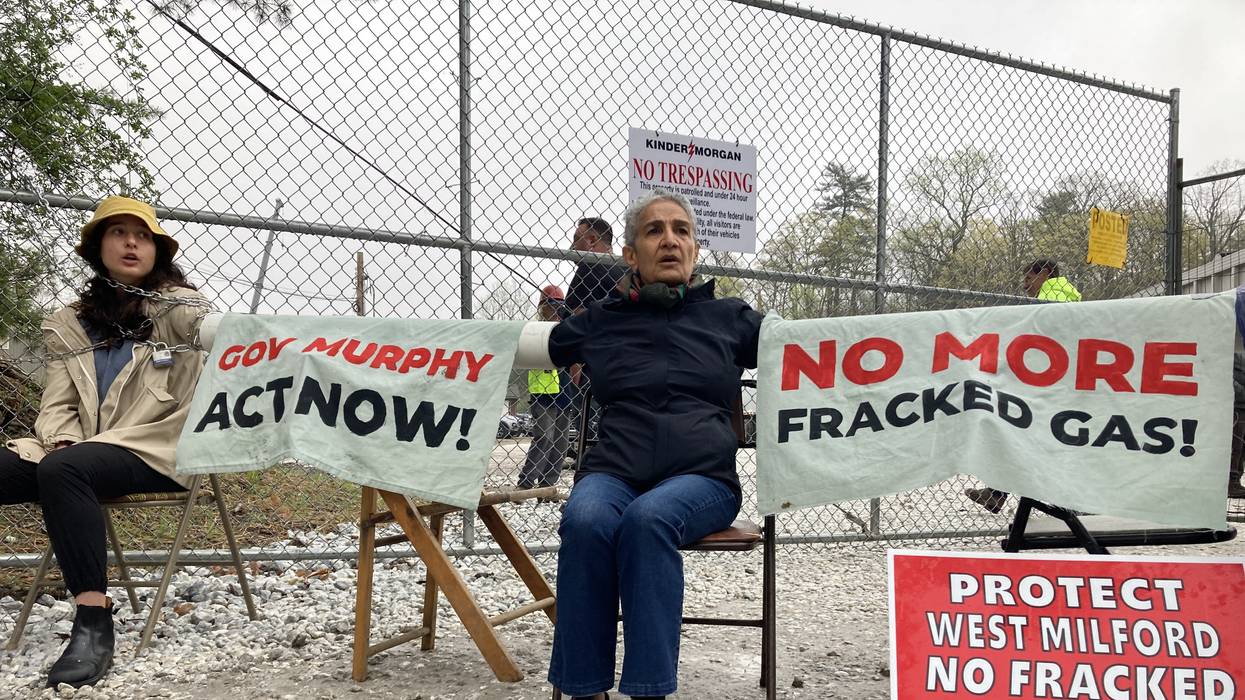
"My grandchild and all grandchildren deserve a future. So I'm out here today, risking arrest, to demand that Gov. Murphy stop fossil fuel buildout across N.J. which will only dig us deeper into the climate crisis!"
On the heels of a weekend rally, opponents of a fracked gas expansion project risked arrest Monday by blocking a construction site for a compressor station in New Jersey with signs calling on Democratic Gov. Phil Murphy to "protect West Milford."
"My grandchild and all grandchildren deserve a future," declared Ted Glick, president of 350 NJ-Rockland. "So I'm out here today, risking arrest, to demand that Gov. Murphy stop fossil fuel buildout across N.J. which will only dig us deeper into the climate crisis!"
"We need bold action NOW if we want to avoid the most disastrous impacts of the climate crisis, and that needs to start with the political courage to halt the buildout of the same dirty industries that got us here!" Glick added. "If Gov. Murphy means what he says about addressing the climate emergency, then he MUST act now to prevent this dangerous and completely unnecessary pipeline expansion project from moving forward."
The new compressor station is part of the East 300 Upgrade Project, which would increase the capacity of Kinder Morgan's Tennessee Gas Pipeline (TGP) system, parts of which are 65 years old. The project, which also involves modifying a pair of existing compressor stations in New Jersey and Pennsylvania, was initiated to send gas to Con Edison in New York.
"Who is this development even for? As New Yorkers, we reject the claim that any new dirty energy is 'needed' in our state, where gas from this pipeline is destined. There is literally no demand for more fracked gas in New York," said Reclaim Our Tomorrow organizer Teddy Ogbor.
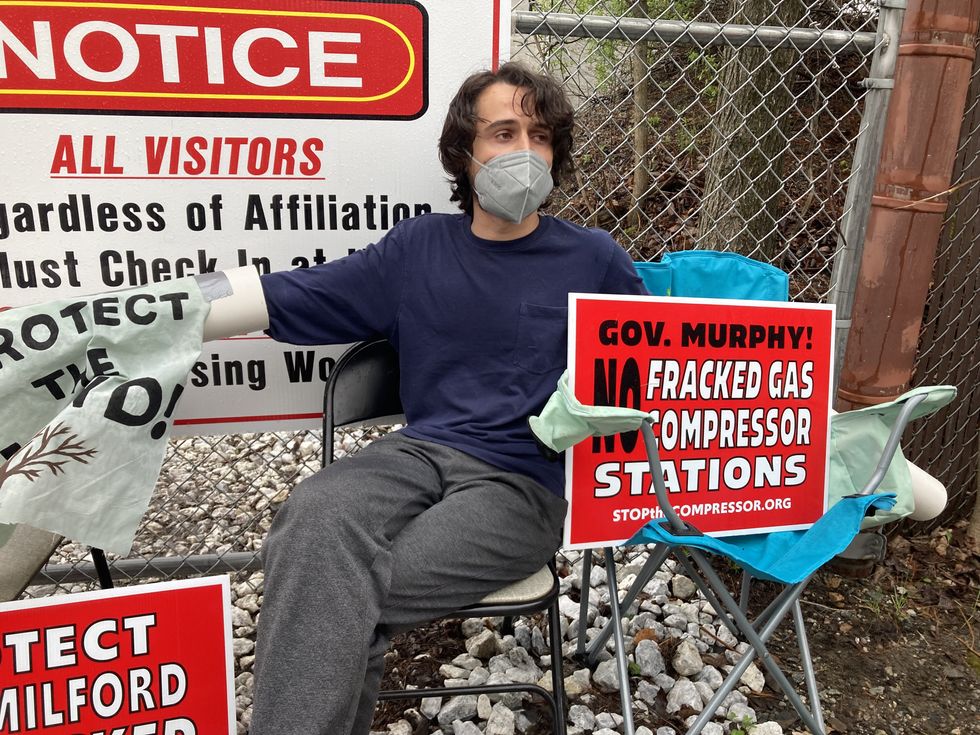
"The only purpose of any new fossil fuel infrastructure is the same as it always has been: To line the pockets of billionaires who are selling our future for profit," Obgor argued. "Gov. Murphy has got to stop taking such massive steps backwards while our planet burns."
Scientists continue to stress that humanity must stop extracting and burning fossil fuels to prevent global climate catastrophe—including in the most recent Intergovernmental Panel on Climate Change report, which warned last month that without dramatic cuts to planet-heating emissions, the world could hit the Paris agreement's 1.5°C threshold by the first half of the 2030s.
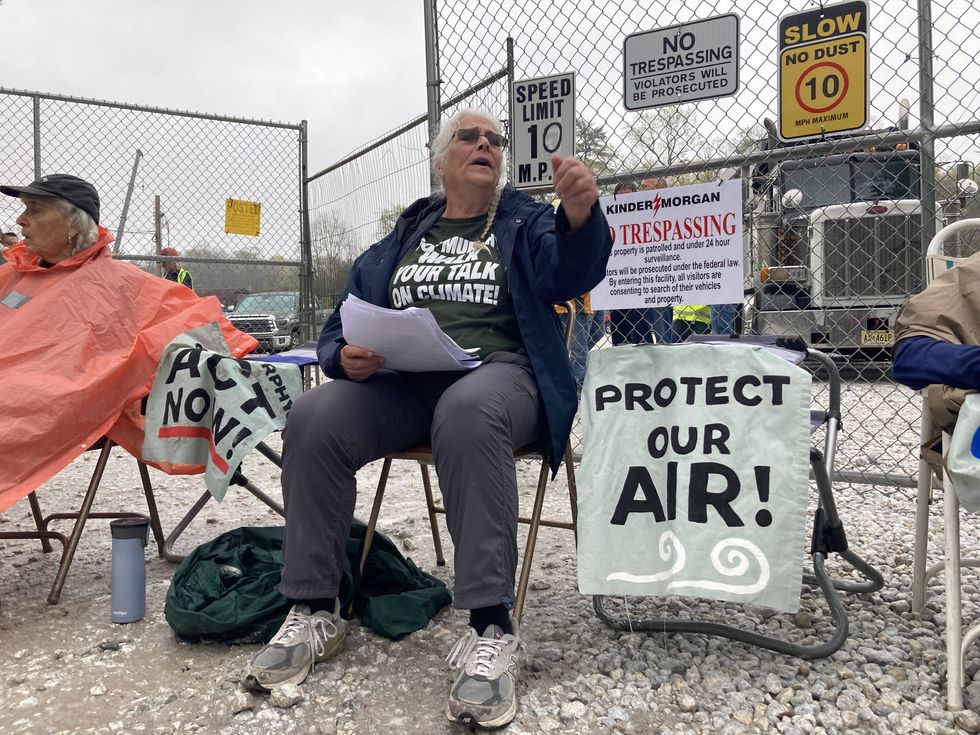
"Gov. Murphy can't seriously claim to be a climate leader if he keeps approving dirty energy expansion projects like this one," Food & Water Watch organizer Sam DiFalco said Monday. "We are in court challenging two of the permits for East 300, but Gov. Murphy could put a stop to this project himself."
Noting that the governor "regularly issues lofty rhetoric about the urgent need to address the climate crisis" and yet, with this project, his administration "has approved permit after permit," DiFalco and Brian D. Scanlan, a former mayor and council member from Wyckoff, also called him out in a November opinion piece for NorthJersey.com:
Murphy can still live up to his environmental commitments and stop this project. In his first term, he championed his Energy Master Plan to address what he called our state's "century-old addiction to fossil fuels," setting a goal of 100% clean energy by 2040. More recently, the governor signed an executive order calling for a 50% reduction in emissions by 2030, and a requirement for builders to consider climate change impacts if they want their projects approved. New Jersey is already not on track to meet these goals, and things could get worse if Murphy continues to approve dirty energy expansion schemes. There are seven major new fossil fuels projects proposed in our state, which could create a substantial increase in climate pollution.
With his promises to ramp up offshore wind, along with introducing the country's first climate curriculum for public schools and signing the strongest environmental justice law in the country, Murphy can leave a strong legacy as a climate champion. But he can't have it both ways. If Murphy allows TGP to proceed with this pipeline expansion, he will be sacrificing the health and safety of his constituents and our shared responsibility to rapidly confront the climate crisis.
"Climate change is a threat to New Jersey. We are seeing it in real time," said Renee Allessio, a 45-year resident of West Milford and co-chair of the Franciscan Response to Fossil Fuels. "This has been one of the driest winters on record, and this week we saw the biggest forest fire in over a decade right here in West Milford."
The blaze burned nearly 1,000 acres but was fully contained as of early Saturday, according to the New Jersey Forest Fire Service. The cause of the fire is under investigation.
Allessio said that "this fire underscores the major risk to the densely wooded highlands brought by piping higher volumes of flammable and toxic fracked gas through this pipeline system well beyond its useful life running through our region."
"Our firefighters who heroically fought last week's blaze will be at greater risk because of this project," she continued. "A leak or explosion could be the spark that devastates our region. In fact, last summer a fire caused by this very same pipeline in Pennsylvania caused a fire that burned through five acres before it could be contained. If Gov. Murphy wants to build a state resilient to the impacts of climate change, then he must stop this reckless pipeline expansion."
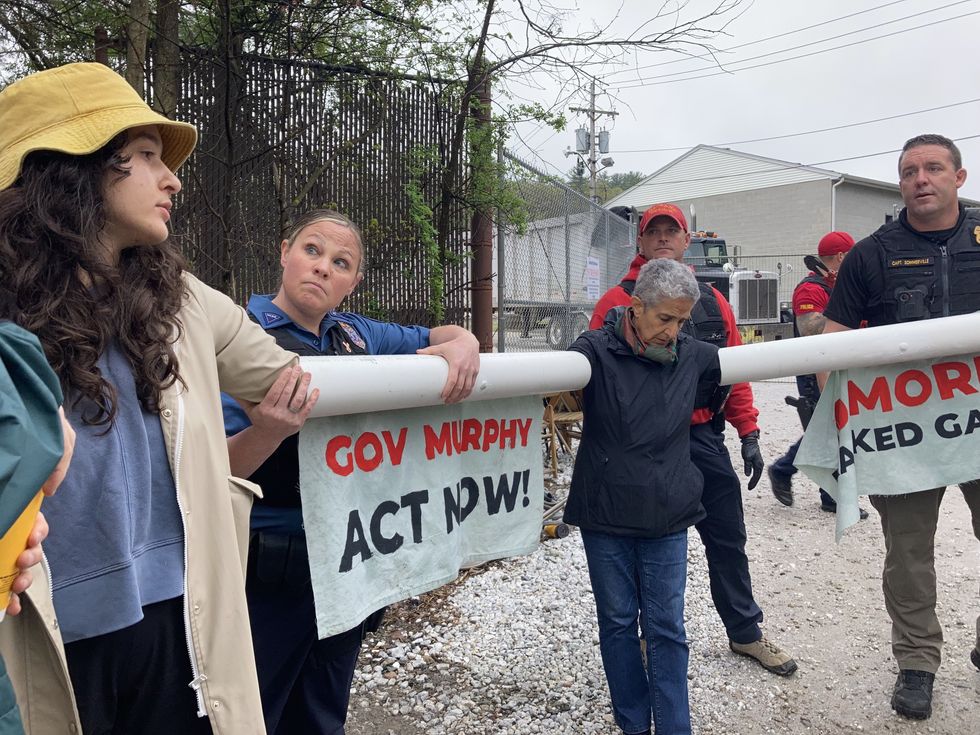
Paula Rogovin, a grandmother and longtime activist who risked arrest Monday, noted that the project also endangers local waters.
"If completed, this compressor station will sit less than 1,200 feet from the Monksville Reservoir, part of a system that provides clean drinking water to millions of N.J. residents," Rogovin said. "A leak or accident involving one of the chemicals stored on-site could be disastrous to our water supply!"
"The N.J. Highlands Act was passed to protect this region from development to protect the critical water resources here," she added. "That this toxic project is allowed to be built here is shameful! Gov. Murphy must STOP this project now!"
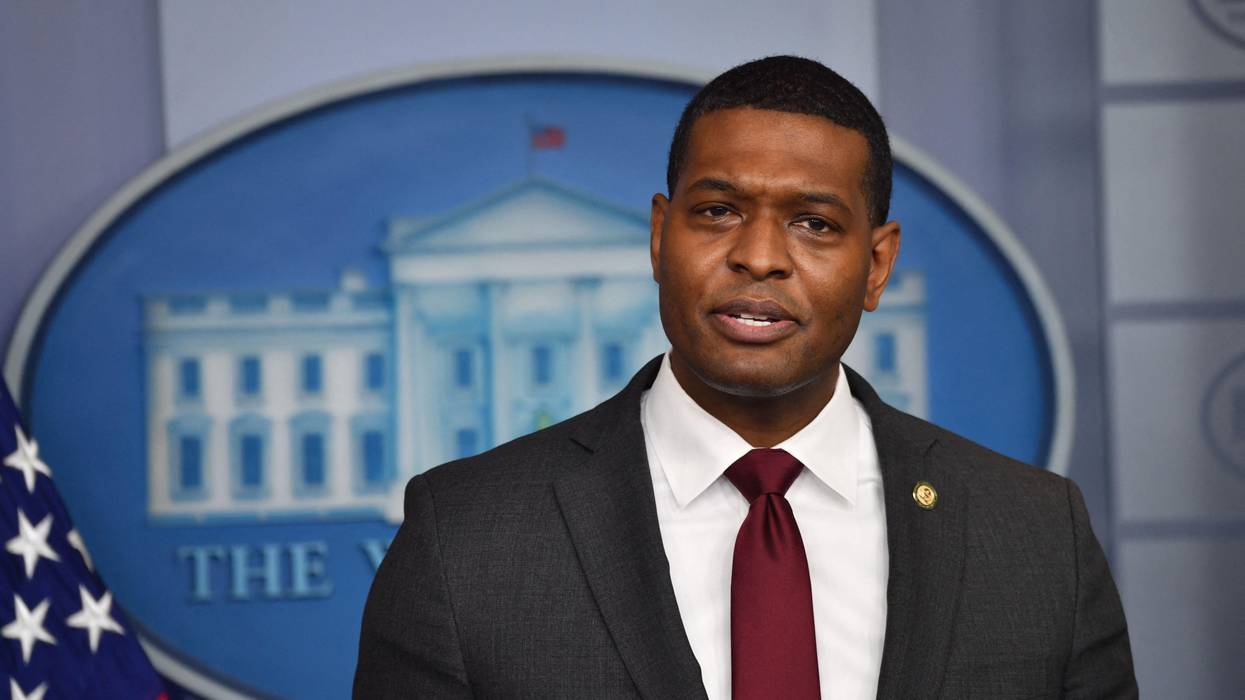
"This is a matter in which the Biden administration has power—and no required 50th Senate vote as a roadblock—to make good on its promises to tackle the global climate emergency," 112 advocacy groups said.
A coalition of more than 100 environmental advocacy groups on Wednesday urged the Biden administration to take executive action to stop the Tennessee Valley Authority from building a new fossil gas plant and pipeline to replace a key coal-fired facility.
The TVA, which serves around 10 million people in seven states, announced last October that it would replace its aging coal-fired plant in Cumberland City, Tennessee. Generating enough electricity to power more than a million homes each year, Cumberland is the TVA's largest coal-fired plant. Closing it is part of the agency's plan to shutter all five of its coal-fired facilities by 2035.
"The EPA can either use its legal power to advance the clean energy economy or, given the alternative of no action, can needlessly sign off on dangerous fossil fuel expansion."
To replace Cumberland, TVA plans to build a fossil gas plant in Stewart County that will be supplied by a 32-mile fracked gas pipeline running through three Tennessee counties. Pipeline builder Kinder Morgan has a lengthy history of leaks, pollution, labor violations, and other offenses against the public and nature. Many local residents warily recall a 1992 pipeline explosion that injured five people and burned 400 acres of land less than a mile from the proposed pipeline's route.
The 112 groups argued in a letter to Environmental Protection Agency Administrator Michael Regan and a trio of White House advisers that Section 309 of the Clean Air Act stipulates that if the EPA chief "determines that any such legislation, action, or regulation is unsatisfactory from the standpoint of public health or welfare or environmental quality, he shall publish his determination and the matter shall be referred to the Council on Environmental Quality."
Therefore, the letter's signatories want the EPA to refer TVA's proposed plant and pipeline to the council, which is part of the Executive Office of the President.
"This is a matter in which the Biden administration has power—and no required 50th Senate vote as a roadblock—to make good on its promises to tackle the global climate emergency," the letter argues. "It is an issue of legacy where the EPA can either use its legal power to advance the clean energy economy or, given the alternative of no action, can needlessly sign off on dangerous fossil fuel expansion."
According to the watchdog group Revolving Door Project:
The decision to replace two TVA coal plants with a new gas plant and pipeline was made by TVA CEO Jeff Lyash, who was a fossil fuel CEO for 17 years before joining the TVA. Under his leadership, Duke Energy leaked toxic chemicals into the sole source of drinking water for nearly one million North Carolina residents. Lyash's TVA still generates 21% of its energy from coal and 26% from methane gas. It projects that it will emit over 34 million tons of carbon dioxide into the atmosphere by 2038.
"The enormous response to this letter from the TVA's own customers, and across the country, shows that Jeff Lyash does not have anything like a popular mandate to expand fossil fuels at the TVA," Revolving Door Project climate research director Dorothy Slater said in a statement. "Administrator Regan needs to step up and faithfully execute the laws, as is his mandate."
TVA is a federally owned electric utility established by Congress 90 years ago during Democratic then-President Franklin D. Roosevelt's New Deal programs aimed at tackling the Great Depression. Based in Knoxville, Tennessee, it is the nation's sixth-largest power supplier.
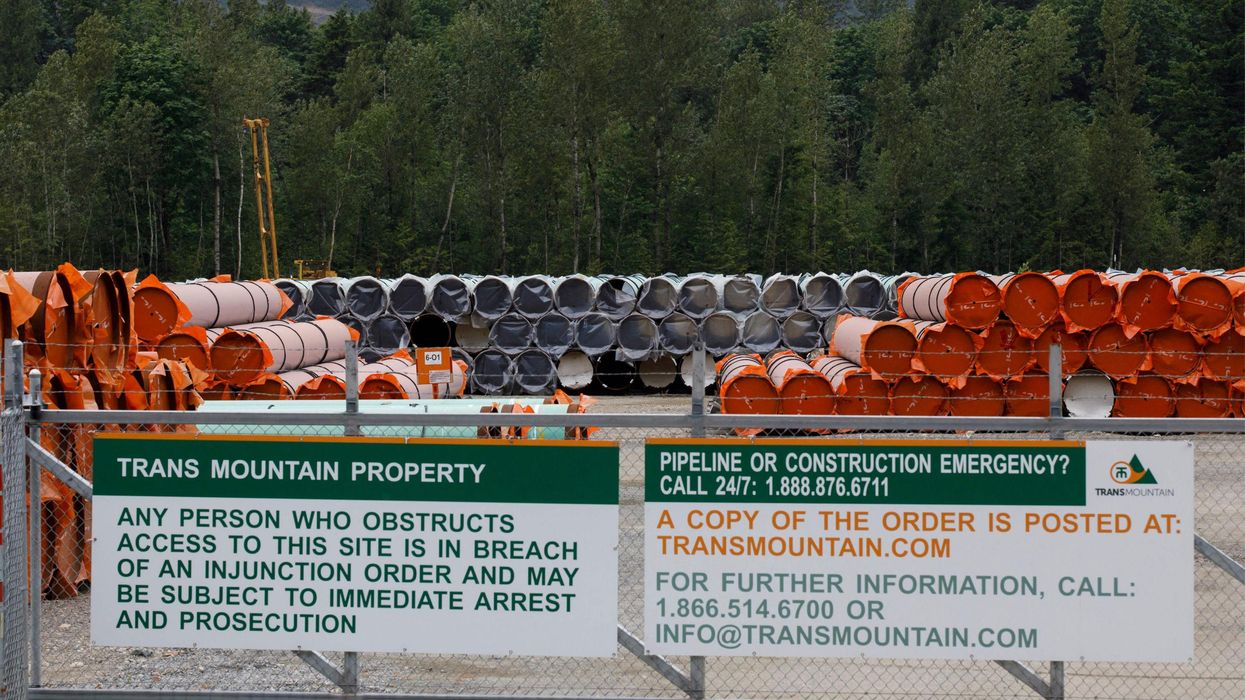
Climate activists on Wednesday reiterated calls to cancel Canada's expansion of the Trans Mountain oil pipeline after a new analysis found that a recent pledge to not put any public money into the project "is a promise that the government can't keep."
"The only solution is to cancel it."
"The only solution is to cancel it," tweeted Wilderness Committee campaigner Peter McCartney in response to new research by the Institute for Energy Economics and Financial Analysis (IEEFA).
Not long after an updated cost estimate for the Trans Mountain expansion (TMX) was unveiled last month, Deputy Prime Minister Chrystia Freeland said that rather than relying on more public money, the government would "secure the funding necessary to complete the project with third-party financing, either in the public debt markets or with financial institutions."
The government--which controversially bought the embattled pipeline from Kinder Morgan in 2018--"does not intend to be the long-term owner" and plans to "launch a divestment process" after completing the long-delayed expansion, added Freeland, who is also the finance minister.
"Freeland's assertion that Canada will invest no more public money in TMX is grossly misleading to the public. Any new money poured into the pipeline will be backed by the Canadian taxpayer," said Tom Sanzillo, IEEFA's director of financial analysis, in a statement. "Private money cannot be raised without a government guarantee."
As the institute's report explains:
IEEFA's analysis finds that the government, which owns the project, would not be able to generate an adequate profit for investors because the tolls it would charge for the completed project's use cannot be raised high enough to support new debt on the pipeline plus operational costs. To do so would raise the cost of exporting oil through TMX to a price that would not be competitive in international oil markets. To compete, the government would have to maintain toll rates so low that it would be operating TMX at a loss for its investors.
To attract private money to complete the TMX project, IEEFA concludes, the Canadian government will have to protect investors by guaranteeing the debt. The investors will be protected. The taxpayers will not.
Between the $4.7 billion purchase price and the reported $12.6 billion construction costs, Canadian taxpayers have already funded $17.3 billion on the project. These funds will never be recovered, and guaranteeing another $8.8 billion to complete the project will simply be throwing good money after bad, for a total taxpayer loss of $26.1 billion.
"Kinder Morgan quit the project because it was a bad bet for investors," said Sanzillo. "On its own, this project is not profitable. No amount of fiscal gimmickry can hide the fact that Canadian taxpayers must stand behind another estimated $8.8 billion. Investors won't finance it without a guarantee."
Omar Mawji, IEEFA's energy finance analyst for Canada, emphasized that "we have carefully reviewed the Trans Mountain project's balance sheet."
"The project is unbankable," he said. "To make a go of it, TMX would need to hike shipping tolls by 100%, raising the price of Canadian oil way beyond the level it needs to compete in the global market. Without substantial governmental support, the pipeline is unsustainable."
The IEEFA analysis comes after Canada's financial watchdog warned last week that the government is "very unlikely" to recoup its investment.
As Canada's Parliamentary Budget Officer Yves Giroux put it to Canada's National Observer: "Now that we're talking about over $20 billion in construction costs, it is clearly non-profitable."
While warning about the financial impacts of killing TMX now, he said that "it will probably mean losses for Canadian taxpayers whenever the government decides to sell the pipeline to a private-sector entity."
Noting the Observer's report, Torrance Coste of Wilderness Committee tweeted last week that "trampling Indigenous rights and making the climate crisis worse wouldn't be worth it if we got hundreds of billions of dollars in return."
"The fact we might get nothing," he added, "just underscores what a tacky, shameful mistake this is."
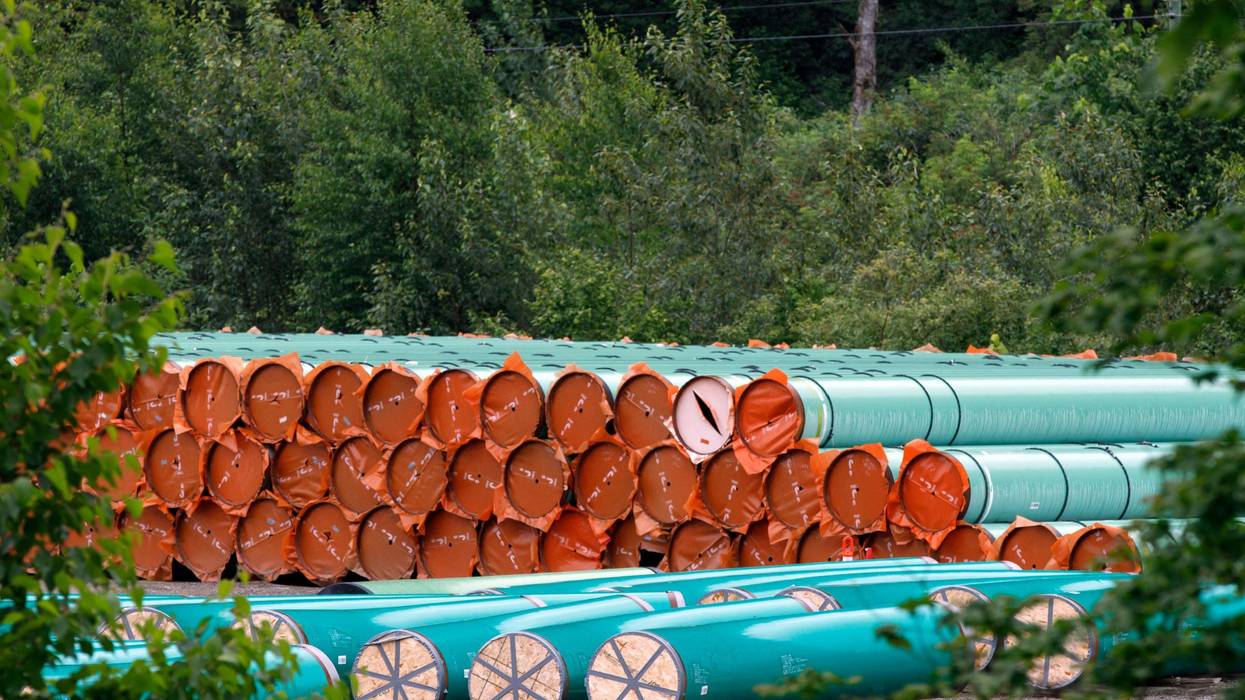
Canada's Minister of Environment and Climate Change Jonathan Wilkinson attracted fury and ridicule when he said Monday--just hours after the United Nations warned in no uncertain terms that continuing to burn fossil fuels will result in catastrophic consequences--that the country needs to secure more revenue from the Trans Mountain pipeline to achieve its long-term decarbonization goals.
"The IPCC was clear yesterday: we must accelerate our transition off fossil fuels. Millions of lives are at stake. Knowing this, and still sinking billions into expanding the Trans Mountain pipeline, is criminal."
--350 Canada
The Canadian government purchased the pipeline from Kinder Morgan in 2018 for $4.5 billion, and a planned expansion of the project would nearly triple the amount of oil moving through the pipeline.
According to Wilkinson, sending 890,000 barrels of crude per day from Alberta to British Columbia--where, earlier this summer, a heatwave killed hundreds of people and a wildfire incinerated the town of Lytton--would be a good thing because it would help finance Canada's clean energy transition.
"Canada needs to ensure that in the context of that transition, it's extracting full value for its resources and using that money to push forward in terms of reducing emissions," Wilkinson told guest host Katie Simpson during an interview on CBC's "Power & Politics."
The Trans Mountain pipeline expansion has "got to be part of the transition," Wilkinson said, because "part of the transition is being able to raise the revenues that enable you to actually make the investments that are required" to achieve net-zero emissions by mid-century.
Observers were quick to point out the absurdity of Wilkinson's comments--made just hours after he issued a statement in response to Monday's report from the Intergovernmental Panel on Climate Change, which stated unequivocally that failing to rapidly slash greenhouse gas emissions will endanger vulnerable populations and future generations.
One critic compared Wilkinson's defense of maximizing oil pipeline revenue to address the fossil fuel-driven climate emergency to something an official might say in one of the fictional dystopias described by Franz Kafka or George Orwell.
Environmental justice advocates from 350 Canada said Tuesday that "this is climate denial. From Canada's Environment Minister no less."
The group emphasized that the IPCC's report was clear about the need to "accelerate our transition off fossil fuels" to save millions of lives.
"Knowing this, and still sinking billions into expanding the Trans Mountain pipeline, is criminal," 350 Canada added.
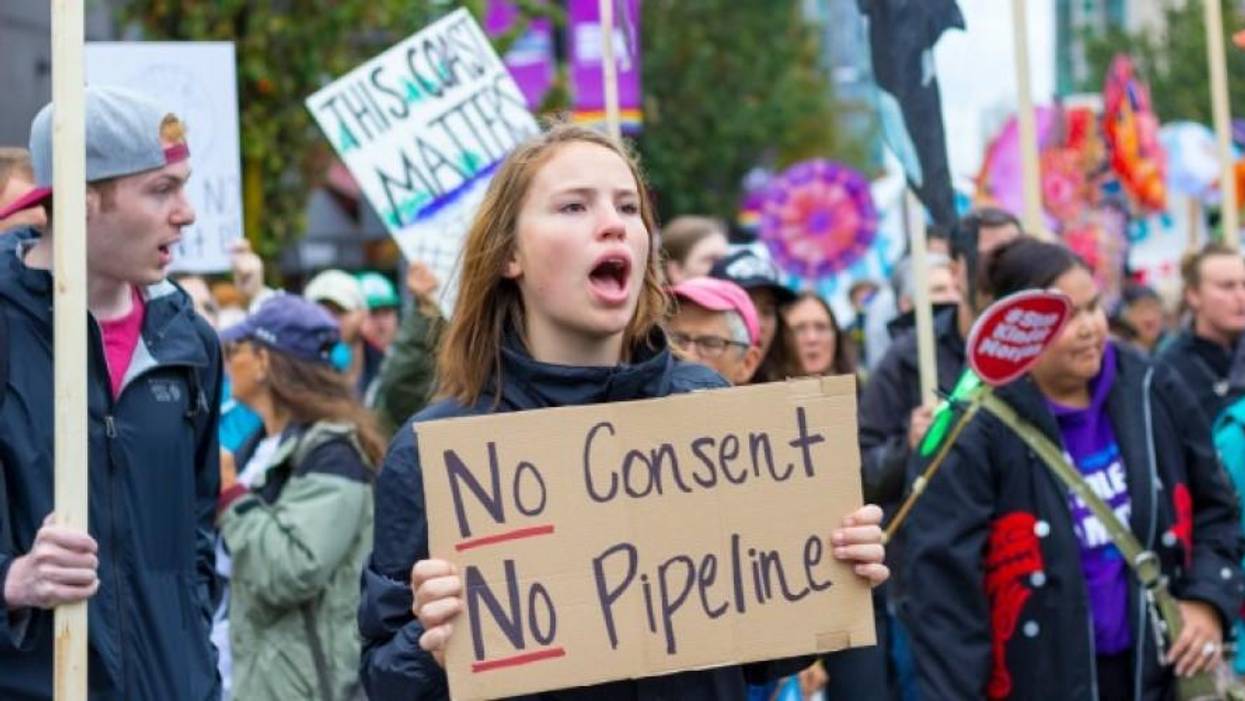
An investigative report released Wednesday by international environmental group Stand.earth details "fundamental problems" with Canada's Trans Mountain oil pipeline, outlines the long history of delays for its planned expansion, and highlights the anticipated social and ecological impacts at seven of the "most troubling hot spots."
"Canadians taxpayers... deserve to know the realities of these dangerous construction hot spots that could push the cost of this project even higher."
--Tzeporah Berman, Stand.earth
The report, Trans Mountain Pipeline: The Truth About Construction (pdf), is based on thousands of documents and interviews with experts and local residents tracking a proposed expansion. Along with warning of the project's expected consequences for local communities and ecosystems, the report calls into question the government's three-year construction timeline.
Under the leadership of Prime Minister Justin Trudeau--who is facing a tough general election next month--the Canadian federal government infuriated residents along the route, Indigenous groups, and environmentalists last year when it purchased the existing Trans Mountain pipeline and expansion project from Texas-based Kinder Morgan, after the company faced a series of delays.
"As detailed in Stand.earth's new investigative report, this project continues to face several permitting delays," Sven Biggs, climate and energy campaigner with the environmental group, said Wednesday. "This project is dangerously close to becoming financially unviable according to the Parliamentary Budget Office's own projections. It's time for the federal government to pull the plug."
In July, Canada's National Energy Board (NEB)--which was replaced with the Canadian Energy Regulator (CER) in late August--revoked all previous route approvals for the Trans Mountain pipeline and ordered a new hearing process for the entire route. No segment of the project currently has the full approval required.
"In addition to the outstanding NEB conditions, the project needs 1,187 permits from the Province of [British Columbia]," the report says. "As of June 2019, the province was still reviewing 658 of these permits and a further 243 have not even been applied for yet."
There are also ongoing appeals filed by six First Nations challenging the government's approval of the project as well as unresolved objections from the Coldwater First Nation and the City of Chilliwack in British Columbia, which have raised concerns about how the pipeline could endanger drinking water.
Last month, Trans Mountain CEO and president Ian Anderson announced that the project wouldn't be completed until mid-2022--which, the report notes, "is a six-month delay from the previous timeline released by the federal government."
Stand.earth livestreamed a press conference Wednesday featuring medical experts, Indigenous peoples, and local residents who shared their worries about the project. Watch:
Stand.earth's international program director Tzeporah Berman said Wednesday that "although this pipeline is now owned by the government, there remains an air of secrecy and lack of transparency about the dangerous risks at several construction hot spots along the route.
"Canadians taxpayers--who are the ones paying for this multi-billion dollar pipeline--have a right to know the impacts that construction will have on communities and the environment," Berman said. "They deserve to know the realities of these dangerous construction hot spots that could push the cost of this project even higher."
"We have a right to say no to these resource extraction projects which are a threat to Indigenous women. We do not consent to Trans Mountain building pipelines or man camps on our unceded territory."
--Beverly Manuel, Tiny House Warriors
"These construction risks include drilling under the Fraser River and through Burnaby Mountain, and the expansion of infrastructure at tank farms in Burnaby and Abbotsford," Berman noted, listing some of the hot spots. The report also spotlights concerns about the risks of the pipeline crossing the Coquihalla River at five different locations.
Another hot spot, the Westride Tanker Terminal at the Burrard Inlet, would see a seven-fold increase in oil tanker traffic under the proposed expansion. Residents are worried not only that the tankers would make the area unsafe for recreational use but also that a vessel carrying oil could collide with nearby bridges, leading to a spill. Citing a pair of local researchers, the report warns that if the expansion project goes through, there is a 79-87 percent chance of a spill in the next 50 years.
The final concern the report points to is the establishment of temporary work camps, or "man camps," in at least five communities in British Columbia during the pipeline construction. "Historically, these man camps have been strongly correlated with dramatic increases in rates of sexual violence towards women in the communities surrounding the camp," the report says, noting that this is especially true for Indigenous females.
As Common Dreams reported in June, the Canadian government concluded with a National Inquiry that violence against First Nations, Inuit, and Metis women, girls, and 2SLGBTQQIA (Two-Spirit, lesbian, gay, bisexual, transgender, queer, questioning, intersex, and asexual) people "amounts to a race-based genocide of Indigenous Peoples."
"We have a right to say no to these resource extraction projects which are a threat to Indigenous women. We do not consent to Trans Mountain building pipelines or man camps on our unceded territory where we hold title," Beverly Manuel of the Tiny House Warriors said Wednesday. "We have six tiny houses built and ready to launch. Five are already blockading Trans Mountain's man camp in Blue River."
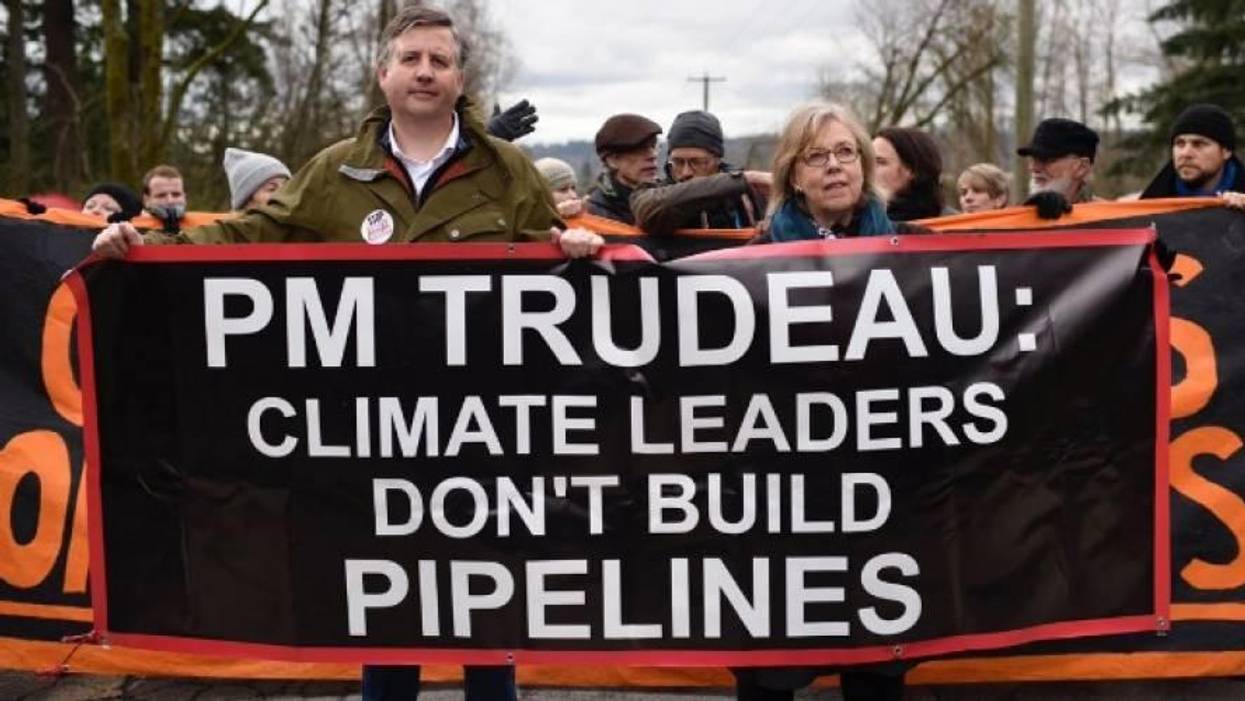
Indigenous tribes and green campaigners were angered but not surprised Friday when Canada's National Energy Board (NEB) recommended that the government move ahead with its planned expansion of the Trans Mountain Pipeline--despite acknowledging that the project will negatively affect the environment.
The decision paved the way for Prime Minister Justin Trudeau's administration to increase fossil fuel emissions, endanger wildlife, and threaten the lives and livelihoods of the eight million people who live in the pipeline's path.
The NEB argued that the pipeline is in the public interest and provided the government with a list of 16 conditions that it must meet as it prepares to expand the 1,150 kilometer (714 mile) pipeline, tripling the amount of oil the tar sands pipeline will carry from Edmonton, Alberta to Burnaby, British Columbia--but critics including Burnaby mayor Mike Hurley argued that the NEB has no intention of protecting the environment or wildlife by enforcing strict regulations on the construction.
"This is the problem with drinking the Kool-Aid served by politicians who are masters of progressive symbolism but evade substance. Once in power, they can be counted on to do substantive harm." --Naomi Klein
The conditions will not "prevent significant public safety risks and harms to marine life and other environmental impacts," Hurley told the Vancouver Sun.
The board noted that the Trans Mountain pipeline is likely to have a significant negative impact on the Southern resident orca, whose population in the Salish Sea off the coast of British Columbia is rapidly dwindling; on the Indigenous population in the area, especially in the event of an oil spill; and on the environment, with fossil fuel emissions rising as cargo ships carry the oil after it travels from Edmonton.
Outcry from First Nations and campaigners ensued when the NEB initially approved the project in 2016, and opponents rejoiced last summer when the Federal Court of Appeals temporarily blocked construction. The court argued that Trudeau's administration and Kinder Morgan, which sold the pipeline to the government for $4.5 billion last year, had not sufficiently considered its effects on Southern orcas and indigenous tribes.
But Friday's approval--which came after what one campaigner called a rushed process with a "compressed hearing schedule" that allowed for little input from the public--was not unexpected among critics.
"This entire process is a joke," Peter McCartney of the Wilderness Committee told the Sun. "I don't think anybody's surprised to see the NEB green lighting this pipeline--it's what they were designed to do."
Kwikwasut'inuxw Haxwa'mis Chief Bob Chamberlin, vice-president of the Union of B.C. Indian Chiefs, said Trudeau has indicated his government will stop at nothing to complete the project.
"The troubling part for me and First Nations concerned about their water and their territories is the fact that Trudeau has stated this pipeline will be built, full stop. It makes an absolute mockery of the consultation process that was court ordered and has been accomplished today," Chamberlin told the Sun.
In a press conference, Grand Chief Stewart Philip also said indigenous tribes will not relent in their "deeply entrenched opposition" to the pipeline, which will threaten food sources of the 29 tribes that live in the path of the proposed route.
"We are proud British Columbians and we have a duty to protect what we've all been blessed with in British Columbia in regard to the pristine beauty of the environment," Philip said. "We will rise to the challenge."
"I understand in British Columbia, this pipeline will provide a way of having an income," said Noel Purser of the Suquamish Tribe, which joined four other Northwest U.S. tribes in challenging the project in 2013. "But is it worth the potential of a spill, that risk? Is it really worth that? Because that will impact everybody, not just here in British Columbia. It will impact us in Suquamish; it will impact our relatives in Alaska."
"Once again, Canada's NEB has sided with short-term Big Oil profits instead of the long-term health of the Pacific Northwest's people, climate and orcas," said Marcie Keever of Friends of the Earth. "Shame on Prime Minister Trudeau, his government, and the National Energy Board of Canada for ignoring widespread opposition and serious concerns in favor of this destructive pipeline. Canada's decision will likely bring about the extinction of the Northwest's iconic killer whales and drive us further towards the brink of climate chaos."
Author Naomi Klein argued that the Trans Mountain pipeline project should offer a lesson to voters who have been convinced by politicians who exude "progressive symbolism" while campaigning "but evade substance" when asked how they will initiate a bold, ambitious agenda to protect the planet and human rights.
This is the problem with drinking the Kool-Aid served by politicians who are masters of progressive symbolism but evade substance. Once in power, they can be counted on to do substantive harm. On climate (and much else) we do not have even 1 more year to waste on these imposters. https://t.co/7mDUnhoKCa
-- Naomi Klein (@NaomiAKlein) February 22, 2019
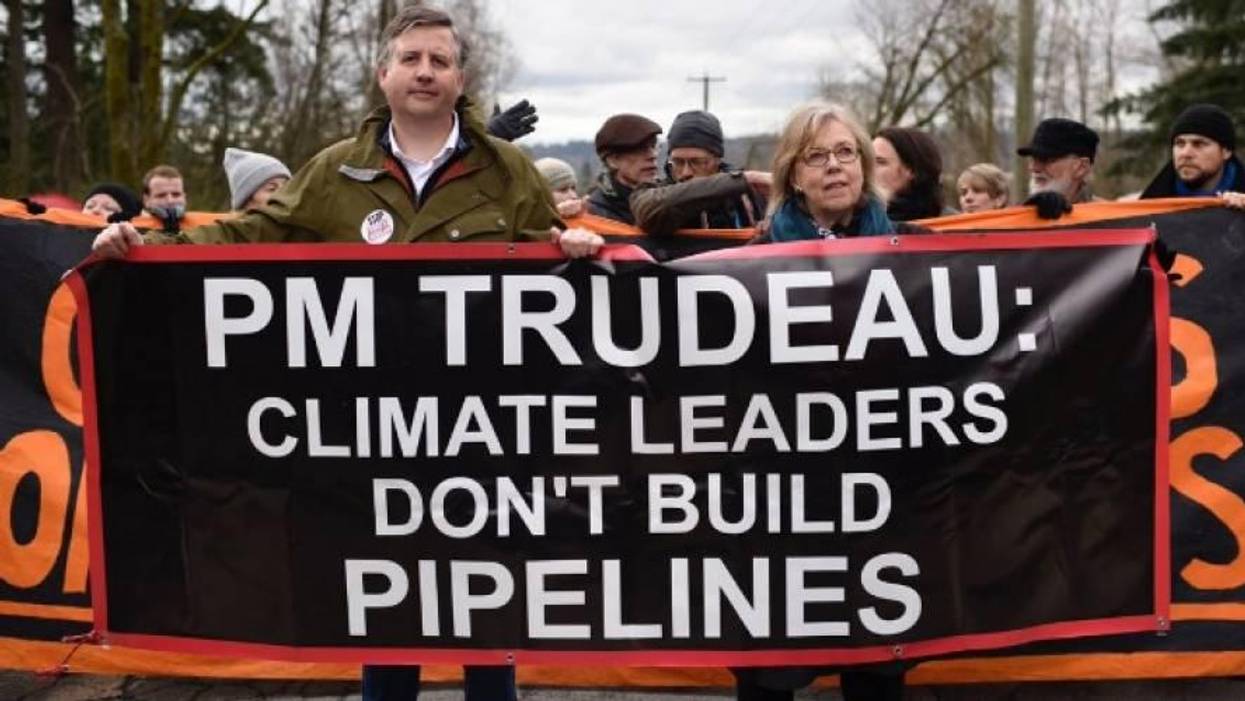
Climate action groups are denouncing Canadian Prime Minister Justin Trudeau's determination to forge ahead with expanding the Trans Mountain tar sands pipeline, the purchase of which by the Canadian government was finalized on Friday just a day after current owner, the energy giant Kinder Morgan, hit a major legal obstacle for its construction.
The company's final approval of the sale came just after a huge courtroom victory for First Nations and environmental advocates on Thursday who have fought against the expansion of the pipeline, which the Canadian government wants to use to carry 890,000 barrels of tar sands from Alberta to British Columbia's southern coast.
On Thursday, the Federal Court of Appeals ruled that Kinder Morgan and the Trudeau administration had not adequately consulted with the First Nations tribes whose land the pipeline is set to pass through--moments before the $4.5 billion sale was approved by Kinder Morgan's shareholders.
"Kinder Morgan Canada Limited today announced that the Trans Mountain Pipeline system and the Trans Mountain Expansion Project (TMEP) have been indirectly acquired by the Government of Canada," the company said in a press release (pdf) on Friday.
After the two decisions were reached, Trudeau told reporters that he was looking forward to proceeding in the "right way" to complete the expansion project, which is expected to raise oil tanker traffic off British Columbia's coast from five tankers per month to 34 per month--threatening the already endangered killer whales who live there.
"We believe the Trans Mountain pipeline expansion is in the best interest of all Canadians. We are committed to upholding the national interests," Trudeau said.
Meanwhile, after the expansion plan fell apart in court, Alberta Premier Rachel Notley announced her decision to pull out of the country's climate change framework in protest of the project's delay--claiming the halting of the project is "a threat to Canadian sovereignty and Canadian economic security."
Some climate action groups expressed hope that the stalling of the project would force Canadian officials to reconsider moving forward with the pipeline expansion.
"This is a watershed moment for a troubled and controversial project," Jan Hasselman of Earthjustice told the Seattle Times. "You have to make a choice. Is it going to be orcas, or is it going to be tar sands?"
Despite the final approval of the sale, opponents issued reminders that the deal will not actually be closed until next week and urged Canadians to speak out against Trudeau's decision before it was truly too late.
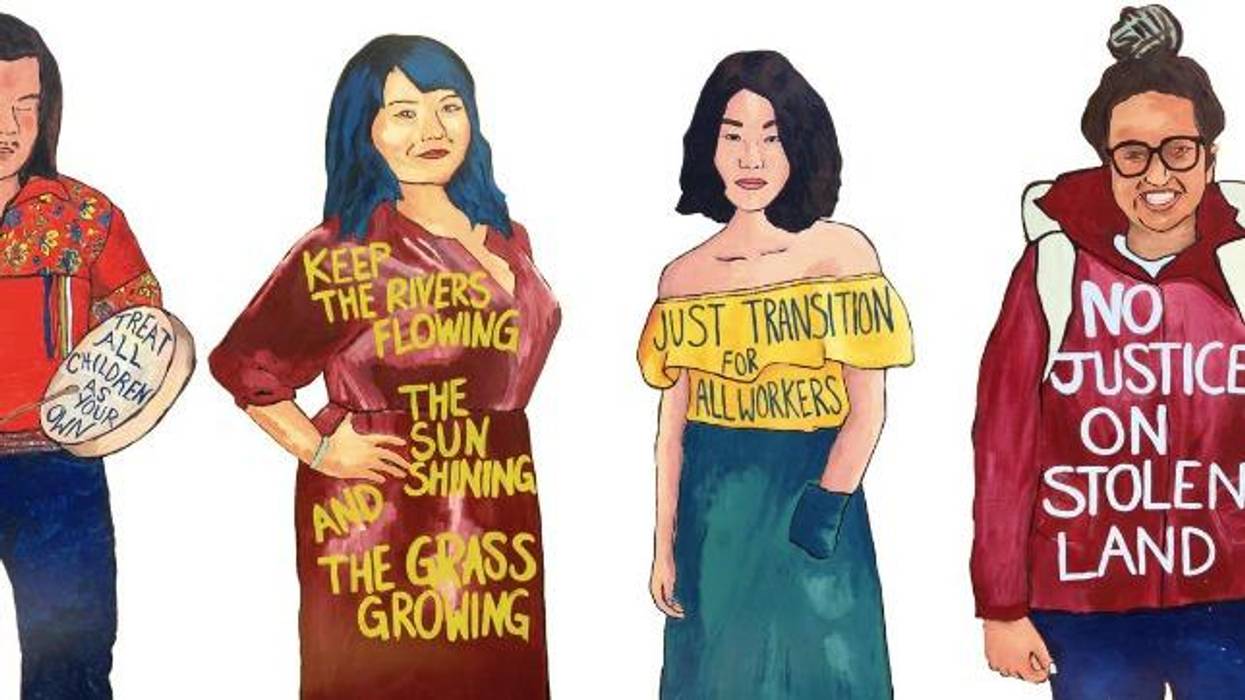
To put forth a "hopeful vision for the future" that includes bold climate action, a new installation project is to be erected along the controversial Trans Mountain pipeline expansion route to harnesses art's ability to be a force for social change and highlight the fossil fuel project's increased threats to indigenous rights and a safe climate.
Called "People on the Path" and launched Sunday, the project organized by Climate Justice Edmonton features larger-than-life portraits of numerous Albertans from varying walks of life, with their bodies displaying messages such as "No justice on stolen land" and "For my daughter 100% renewable energy."
Part of the goal, organizers explained at the launch at Whitemud Park in Edmonton, is also to "dismantle the myth that everyone in this province is pro-oil."
The Edmonton Journal reported that the full series, which will include 25 portraits, will go up this fall. CBC added that it "will be exhibited around the city and then placed along the route of the proposed Trans Mountain pipeline expansion--through Edmonton, under the river, and west to Jasper."
"Together," the Climate Justice Edmonton stated on its Facebook page, "these portraits are a powerful statement of the future we want to build--one which respects Indigenous rights, puts workers first, and honors our international climate commitments. We can't build this future if we build new pipelines."
This is a developing story and may be updated...
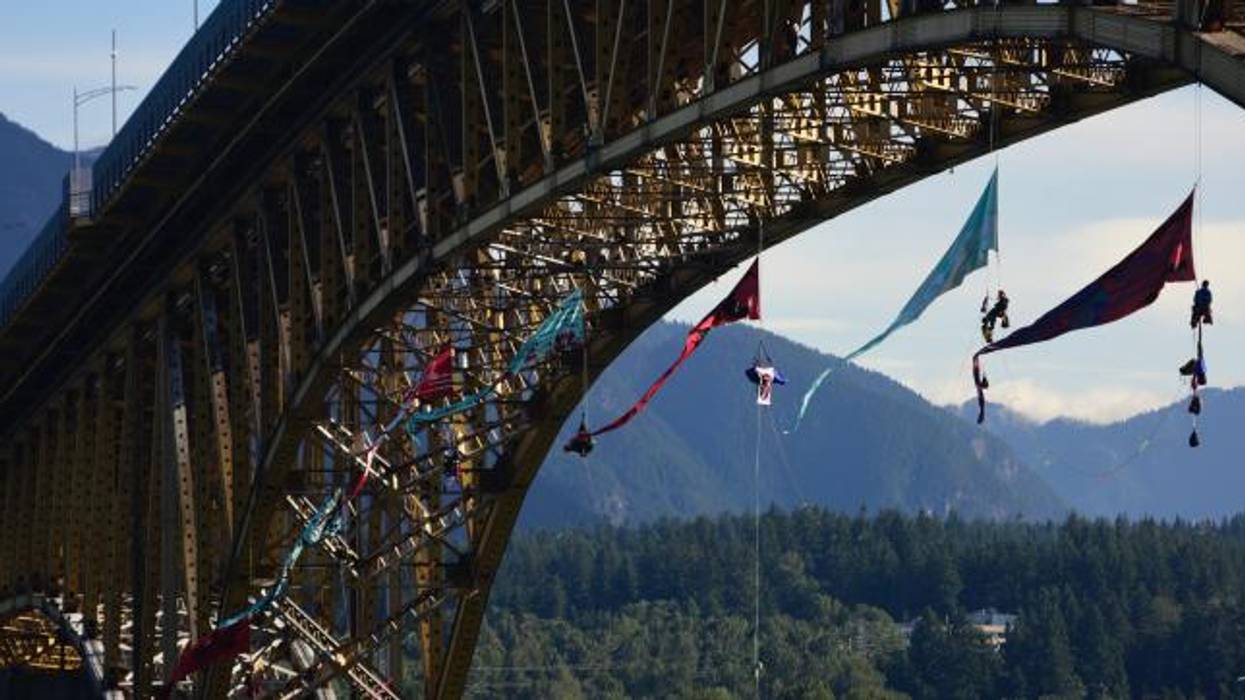
As green groups and Indigenous leaders continue to raise alarm about the ecological and economic threats of the Trans Mountain pipeline expansion project--which Canadian Prime Minister Justin Trudeau recently announced the government is taking over after protests led Kinder Morgan to halt construction--12 activists on Tuesday launched an aerial blockade at the Ironworkers Memorial Bridge in Vancouver to stop an oil tanker from leaving the pipeline's terminal.
Opponents of the expansion project are especially concerned that, if completed, it would trigger a nearly seven-fold increase in the number of tar sands tankers that depart from the company's terminal in Burnaby, British Columbia, increasing the risk of a major oil spill and degrading marine conditions along the "tanker superhighway."
Greenpeace Canada's Mary Lovell, a climber from Seattle, Washington, said in a statement: "We urgently need to protect water because this tanker superhighway threatens the entire coast down to California. We are taking action today to defend water, health, and the climate--and we aren't alone. Hundreds of thousands of people from around the world are standing with us."
"I will remain the fierce opposition. It is in my blood to protect the water," declared Will George, one of the climbers and the leader of Kwekwecnewtxw. "Our Indigenous rights are being completely ignored, the safety of our water is being ignored, and most of all, my son's future is at stake. I will do whatever it takes to protect the water and my family and your family."
Greenpeace Canada's Mike Hudema, another climber based in Vancouver, specifically called out Trudeau for ignoring the widespread protests and attempting to save the pipeline project. "Trudeau is standing on the wrong side of history. Climate leaders don't choose to buy pipelines," he said. "World leaders cannot be allowed to approve projects that violate the rights of Indigenous peoples."
Hudema tweeted his view from the bridge, adding, "It's always a good day to protect the things you love."
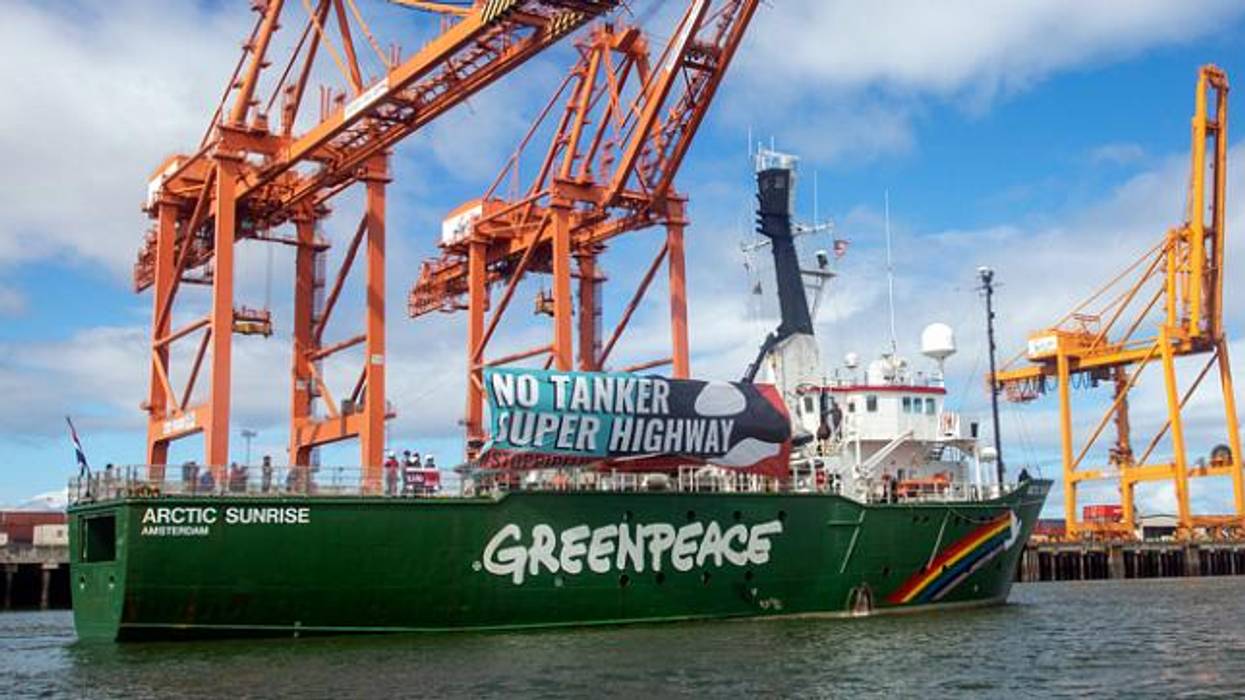
Just a few weeks after Canadian Prime Minister Justin Trudeau was widely condemned for announcing his government's plans to buy Kinder Morgan's Trans Mountain pipeline for $4.5 billion, two reports released Tuesday detail the massive environmental and economic costs of a contentious expansion project that would extend the pipeline to the Pacific Coast.
"They should expect resistance from a united Pacific Coast coming together to protect our collective health and safety, as well as the sustainability of coastal economies, ocean life, and our climate."
--Mike Hudema, Greenpeace
Greenpeace's report, Tar Sands Tanker Superhighway Threatens Pacific Coast Waters, outlines the threats the project poses to marine life as well as the coastal communities and economies of Canada and the United States.
The expansion would lead to a nearly seven-fold increase in the number of tankers that depart from the company's terminal in Burnaby, British Columbia, "creating an oil tanker superhighway and ratcheting up the risk of a tar sands oil spill to unacceptably high levels," noted Mike Hudema of Greenpeace Canada.
Pointing to the 1989 Exxon Valdez and the 2010 Deepwater Horizon disasters--and considering the heightened risk of a large oil spill or multiple smaller ones--the report warns of the high stakes for North American communities along the Pacific Coast that would accompany the spike in tanker traffic. Citing several studies, the report estimates that in additional to environmental impacts, a large spill would cost the U.S. and Canada several billion dollars and hundreds of thousands of fishing and tourism jobs.
Even without a catastrophic spill, "a seven-fold increase in tanker traffic will most certainly impact the entire coastal ecosystem of the area," concluded Dr. Lindy Weilgart, a marine biologist at Dalhousie University. "Marine life will struggle to cope with the underwater noise on top of the other risks and pollutants associated with shipping dirty oil, including spills, ship strikes killing whales, and emissions."
While opposition to the pipeline project has been strong enough to force Kinder Morgan to repeatedly slow or halt construction, Hudema added, "Should Prime Minister Trudeau nationalize this pipeline or sell it to any other buyer, they should expect resistance from a united Pacific Coast coming together to protect our collective health and safety, as well as the sustainability of coastal economies, ocean life, and our climate."
Greenpeace's new analysis comes as the group's Arctic Sunrise ship travels the route that oil tankers would take if the expansion project continues and is completed.
The second report, Canada's Folly (pdf) by the Ohio-based Institute for Energy Economics and Financial Analysis (IEEFA), focused primarily on the financial risks of Trudeau's purchase of the unfinished pipeline.
IEEFA researchers estimate that while Kinder Morgan will see a 637 percent return on its investment in the project, it will cost the Canadian government a full $6.5 billion for the transfer plus construction, which would increase the country's national deficit by 36 percent.
In other words, "Canada is weakening its finances by taking on unlimited costs to buy an unneeded pipeline with an uncertain future and giving an unusual profit to a U.S. company," explained Tom Sanzillo, IEEFA's director of finance and the former first deputy comptroller for New York State.
Responding to that report, 350.org co-founder Bill McKibben tweeted, "That's Trump-caliber dealmaking!"