
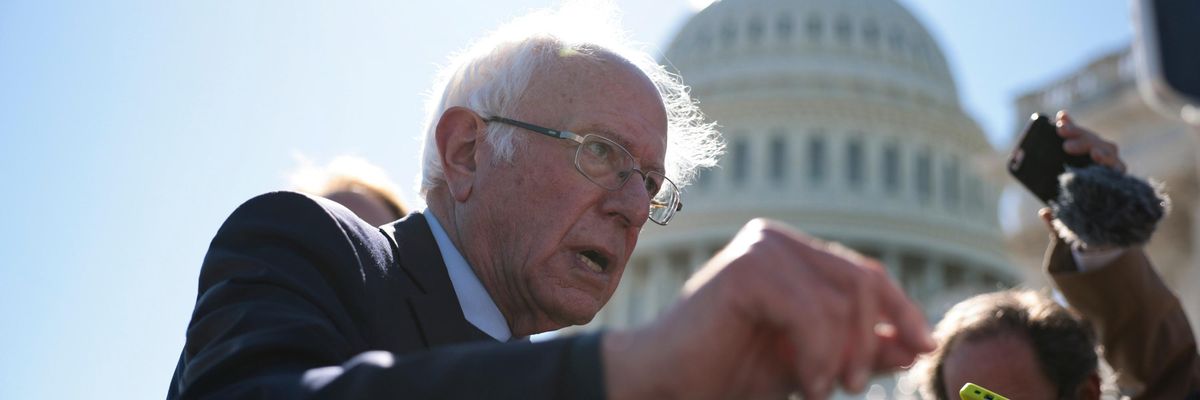
As the tense standoff over Ukraine showed no signs of defusing, U.S. Sen. Bernie Sanders took the Senate floor Thursday to deliver an impassioned plea for a diplomatic solution to the crisis involving the United States and Russia, the world's two nuclear superpowers.
Sanders (I-Vt.) warned that Europe "for the first time in almost 80 years is faced with the threat of a major invasion" as Russian troops mass along Ukraine's border, while echoing his Tuesday Guardian editorial by stressing that rushing to war with Moscow would have potentially catastrophic "unintended consequences."
"We must do everything possible to find a diplomatic resolution to prevent what would be an enormously destructive war in Ukraine."
The democratic socialist senator recalled numerous American wars and their human costs, from the "almost incalculable" loss of Vietnamese, Cambodian, and Laotian life during a 21-year U.S. engagement in Indochina, to the equally protracted so-called War on Terror--conflicts in which "millions of innocent people paid the price" for what were, in both cases, dubious casus belli.
"That is why we must do everything possible to find a diplomatic resolution to prevent what would be an enormously destructive war in Ukraine," stressed Sanders, who voted to authorize the war in Afghanistan but against invading Iraq.
The two-time Democratic presidential candidate cited estimates that war in Ukraine might result in "over 50,000 civilian casualties" and spark a massive refugee crisis that could be the worst on the continent since World War II, while warning of the "even more horrifying" possibility of the conflict embroiling other nations in the region.
Additionally, Western sanctions targeting Russia "could result in massive economic upheaval," adversely impacting everything from food and energy supplies to the financial system and other vital goods and services. The effects, said Sanders, "would be felt in Europe, they would be felt here in the United States, and around the world."
While acknowledging Russian President Vladimir Putin's "unacceptable" aggression toward Ukraine, Sanders asserted that "it is good to know some history"--namely, the provocative expansion of the NATO to Russia's doorstep.
Related Content

'Needlessly Provocative': Austin Rebuked for Again Opening NATO Door to Ukraine and Georgia
Sanders also decried the "hypocritical" U.S. refusal to recognize the Russian geopolitical axiom of the near-abroad--Moscow's "sphere of influence"--given nearly 200 years of the United States' own hegemonic Monroe Doctrine.
Reiterating his plea for all interested parties to "work hard to achieve a realistic and mutually agreeable resolution" to the unabating crisis, Sanders argued that the diplomatic path "is not weakness."
"That is not appeasement," he insisted. "Bringing people together to resolve conflicts nonviolently is strength, and it is the right thing to do."
As the tense standoff over Ukraine showed no signs of defusing, U.S. Sen. Bernie Sanders took the Senate floor Thursday to deliver an impassioned plea for a diplomatic solution to the crisis involving the United States and Russia, the world's two nuclear superpowers.
Sanders (I-Vt.) warned that Europe "for the first time in almost 80 years is faced with the threat of a major invasion" as Russian troops mass along Ukraine's border, while echoing his Tuesday Guardian editorial by stressing that rushing to war with Moscow would have potentially catastrophic "unintended consequences."
"We must do everything possible to find a diplomatic resolution to prevent what would be an enormously destructive war in Ukraine."
The democratic socialist senator recalled numerous American wars and their human costs, from the "almost incalculable" loss of Vietnamese, Cambodian, and Laotian life during a 21-year U.S. engagement in Indochina, to the equally protracted so-called War on Terror--conflicts in which "millions of innocent people paid the price" for what were, in both cases, dubious casus belli.
"That is why we must do everything possible to find a diplomatic resolution to prevent what would be an enormously destructive war in Ukraine," stressed Sanders, who voted to authorize the war in Afghanistan but against invading Iraq.
The two-time Democratic presidential candidate cited estimates that war in Ukraine might result in "over 50,000 civilian casualties" and spark a massive refugee crisis that could be the worst on the continent since World War II, while warning of the "even more horrifying" possibility of the conflict embroiling other nations in the region.
Additionally, Western sanctions targeting Russia "could result in massive economic upheaval," adversely impacting everything from food and energy supplies to the financial system and other vital goods and services. The effects, said Sanders, "would be felt in Europe, they would be felt here in the United States, and around the world."
While acknowledging Russian President Vladimir Putin's "unacceptable" aggression toward Ukraine, Sanders asserted that "it is good to know some history"--namely, the provocative expansion of the NATO to Russia's doorstep.
Related Content
'Needlessly Provocative': Austin Rebuked for Again Opening NATO Door to Ukraine and Georgia
Sanders also decried the "hypocritical" U.S. refusal to recognize the Russian geopolitical axiom of the near-abroad--Moscow's "sphere of influence"--given nearly 200 years of the United States' own hegemonic Monroe Doctrine.
Reiterating his plea for all interested parties to "work hard to achieve a realistic and mutually agreeable resolution" to the unabating crisis, Sanders argued that the diplomatic path "is not weakness."
"That is not appeasement," he insisted. "Bringing people together to resolve conflicts nonviolently is strength, and it is the right thing to do."
As the tense standoff over Ukraine showed no signs of defusing, U.S. Sen. Bernie Sanders took the Senate floor Thursday to deliver an impassioned plea for a diplomatic solution to the crisis involving the United States and Russia, the world's two nuclear superpowers.
Sanders (I-Vt.) warned that Europe "for the first time in almost 80 years is faced with the threat of a major invasion" as Russian troops mass along Ukraine's border, while echoing his Tuesday Guardian editorial by stressing that rushing to war with Moscow would have potentially catastrophic "unintended consequences."
"We must do everything possible to find a diplomatic resolution to prevent what would be an enormously destructive war in Ukraine."
The democratic socialist senator recalled numerous American wars and their human costs, from the "almost incalculable" loss of Vietnamese, Cambodian, and Laotian life during a 21-year U.S. engagement in Indochina, to the equally protracted so-called War on Terror--conflicts in which "millions of innocent people paid the price" for what were, in both cases, dubious casus belli.
"That is why we must do everything possible to find a diplomatic resolution to prevent what would be an enormously destructive war in Ukraine," stressed Sanders, who voted to authorize the war in Afghanistan but against invading Iraq.
The two-time Democratic presidential candidate cited estimates that war in Ukraine might result in "over 50,000 civilian casualties" and spark a massive refugee crisis that could be the worst on the continent since World War II, while warning of the "even more horrifying" possibility of the conflict embroiling other nations in the region.
Additionally, Western sanctions targeting Russia "could result in massive economic upheaval," adversely impacting everything from food and energy supplies to the financial system and other vital goods and services. The effects, said Sanders, "would be felt in Europe, they would be felt here in the United States, and around the world."
While acknowledging Russian President Vladimir Putin's "unacceptable" aggression toward Ukraine, Sanders asserted that "it is good to know some history"--namely, the provocative expansion of the NATO to Russia's doorstep.
Related Content
'Needlessly Provocative': Austin Rebuked for Again Opening NATO Door to Ukraine and Georgia
Sanders also decried the "hypocritical" U.S. refusal to recognize the Russian geopolitical axiom of the near-abroad--Moscow's "sphere of influence"--given nearly 200 years of the United States' own hegemonic Monroe Doctrine.
Reiterating his plea for all interested parties to "work hard to achieve a realistic and mutually agreeable resolution" to the unabating crisis, Sanders argued that the diplomatic path "is not weakness."
"That is not appeasement," he insisted. "Bringing people together to resolve conflicts nonviolently is strength, and it is the right thing to do."