SUBSCRIBE TO OUR FREE NEWSLETTER
Daily news & progressive opinion—funded by the people, not the corporations—delivered straight to your inbox.
5
#000000
#FFFFFF
To donate by check, phone, or other method, see our More Ways to Give page.
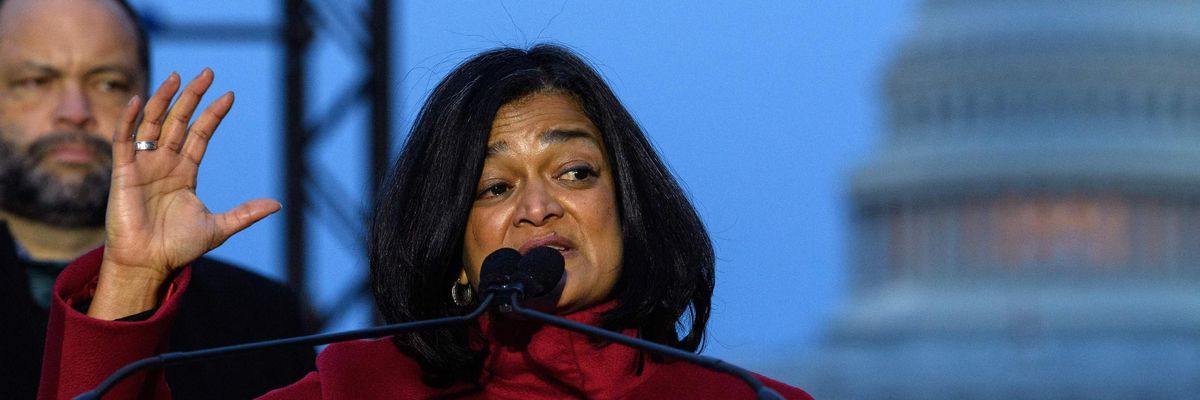
Congresswoman Pramila Jayapal stressed Thursday that the stakes couldn't be higher for U.S. democracy as House and Senate Democrats pushed ahead with their last-ditch effort to pass voting rights legislation in the face of relentless GOP opposition.
"Our democracy doesn't survive without this," Japayal (D-Wash.), the chair of the Congressional Progressive Caucus (CDC), said during a morning press call with fellow lawmakers from the Congressional Black Caucus, the Congressional Asian Pacific American Caucus, and the House Democratic Caucus.
"Reform the Senate rules, end the tyranny of the minority, protect your right to vote, and save our democracy."
"The reality is we have been talking about this for too long with no action," Jayapal added. "This is a moment that we cannot let slip by... We are already late, frankly, in working to reverse a long-held Republican agenda to suppress the vote."
Rep. Judy Chu (D-Calif.), the chair of the Congressional Asian Pacific American Caucus, expressed a similar sense of urgency, warning that the Republican Party and other right-wing forces have shown a willingness to use "violence and repression" to seize and cling to power.
"Today, Republicans are trying to take us backward," said Chu.
The call was convened Thursday morning as the House of Representatives moved to pass legislation that has been amended to include language from the Freedom to Vote Act and the John R. Lewis Voting Rights Advancement Act, measures that the Senate GOP has blocked using the chamber's 60-vote filibuster rule.
Democrats' obscure procedural maneuver--outlined in a memo authored by Senate Majority Leader Chuck Schumer (D-N.Y.)--will allow the upper chamber to receive the newly amended bill from the House and begin debate without needing 60 votes, temporarily bypassing the legislative filibuster.
But to cut off debate and advance to a final vote, Senate Democrats will still need support from at least 10 Republicans. If the GOP opts to continue obstructing the popular voting rights legislation, Schumer said he will pursue a motion that would change the filibuster rule and allow the measure to pass with a simple majority.
With right-wing Sens. Joe Manchin (D-W.Va.), Kyrsten Sinema (D-Ariz.), and several others refusing to support filibuster reform, Democrats do not yet have the 51 votes they need to change Senate rules.
The Senate is expected to vote on the Democratic legislation and, if necessary, the rule change on January 17, Martin Luther King Jr. Day.
Related Content

During Thursday's press call, Jayapal said House Democrats "are 100% behind Leader Schumer's strategy" and argued that, even if it fails, holding a floor debate will force Republicans "into a conversation about why they would be opposed to voting rights at this critical juncture."
"At this very moment, there is an ongoing, dangerous, and coordinated attack against democracy being waged by GOP-led legislatures across the country," she noted. "Republican lawmakers in 49 states--from Texas and Georgia to Florida and Michigan--have introduced more than 400 voter suppression bills in 2021 alone, and 19 states have successfully passed 34 of them into law."
"Let's remember that the 50 Democratic senators in office right now represent 41,549,808 more people than the 50 Republican senators who filibustered the [Freedom to Vote Act and the John R. Lewis Voting Rights Advancement Act]," Jayapal continued. "Today, we're joining the calls of people around the country and decades of civil rights activists. Our Senate colleagues must act. Reform the Senate rules, end the tyranny of the minority, protect your right to vote, and save our democracy. Non-action is simply a non-starter."
Congresswoman Pramila Jayapal stressed Thursday that the stakes couldn't be higher for U.S. democracy as House and Senate Democrats pushed ahead with their last-ditch effort to pass voting rights legislation in the face of relentless GOP opposition.
"Our democracy doesn't survive without this," Japayal (D-Wash.), the chair of the Congressional Progressive Caucus (CDC), said during a morning press call with fellow lawmakers from the Congressional Black Caucus, the Congressional Asian Pacific American Caucus, and the House Democratic Caucus.
"Reform the Senate rules, end the tyranny of the minority, protect your right to vote, and save our democracy."
"The reality is we have been talking about this for too long with no action," Jayapal added. "This is a moment that we cannot let slip by... We are already late, frankly, in working to reverse a long-held Republican agenda to suppress the vote."
Rep. Judy Chu (D-Calif.), the chair of the Congressional Asian Pacific American Caucus, expressed a similar sense of urgency, warning that the Republican Party and other right-wing forces have shown a willingness to use "violence and repression" to seize and cling to power.
"Today, Republicans are trying to take us backward," said Chu.
The call was convened Thursday morning as the House of Representatives moved to pass legislation that has been amended to include language from the Freedom to Vote Act and the John R. Lewis Voting Rights Advancement Act, measures that the Senate GOP has blocked using the chamber's 60-vote filibuster rule.
Democrats' obscure procedural maneuver--outlined in a memo authored by Senate Majority Leader Chuck Schumer (D-N.Y.)--will allow the upper chamber to receive the newly amended bill from the House and begin debate without needing 60 votes, temporarily bypassing the legislative filibuster.
But to cut off debate and advance to a final vote, Senate Democrats will still need support from at least 10 Republicans. If the GOP opts to continue obstructing the popular voting rights legislation, Schumer said he will pursue a motion that would change the filibuster rule and allow the measure to pass with a simple majority.
With right-wing Sens. Joe Manchin (D-W.Va.), Kyrsten Sinema (D-Ariz.), and several others refusing to support filibuster reform, Democrats do not yet have the 51 votes they need to change Senate rules.
The Senate is expected to vote on the Democratic legislation and, if necessary, the rule change on January 17, Martin Luther King Jr. Day.
Related Content
During Thursday's press call, Jayapal said House Democrats "are 100% behind Leader Schumer's strategy" and argued that, even if it fails, holding a floor debate will force Republicans "into a conversation about why they would be opposed to voting rights at this critical juncture."
"At this very moment, there is an ongoing, dangerous, and coordinated attack against democracy being waged by GOP-led legislatures across the country," she noted. "Republican lawmakers in 49 states--from Texas and Georgia to Florida and Michigan--have introduced more than 400 voter suppression bills in 2021 alone, and 19 states have successfully passed 34 of them into law."
"Let's remember that the 50 Democratic senators in office right now represent 41,549,808 more people than the 50 Republican senators who filibustered the [Freedom to Vote Act and the John R. Lewis Voting Rights Advancement Act]," Jayapal continued. "Today, we're joining the calls of people around the country and decades of civil rights activists. Our Senate colleagues must act. Reform the Senate rules, end the tyranny of the minority, protect your right to vote, and save our democracy. Non-action is simply a non-starter."
Congresswoman Pramila Jayapal stressed Thursday that the stakes couldn't be higher for U.S. democracy as House and Senate Democrats pushed ahead with their last-ditch effort to pass voting rights legislation in the face of relentless GOP opposition.
"Our democracy doesn't survive without this," Japayal (D-Wash.), the chair of the Congressional Progressive Caucus (CDC), said during a morning press call with fellow lawmakers from the Congressional Black Caucus, the Congressional Asian Pacific American Caucus, and the House Democratic Caucus.
"Reform the Senate rules, end the tyranny of the minority, protect your right to vote, and save our democracy."
"The reality is we have been talking about this for too long with no action," Jayapal added. "This is a moment that we cannot let slip by... We are already late, frankly, in working to reverse a long-held Republican agenda to suppress the vote."
Rep. Judy Chu (D-Calif.), the chair of the Congressional Asian Pacific American Caucus, expressed a similar sense of urgency, warning that the Republican Party and other right-wing forces have shown a willingness to use "violence and repression" to seize and cling to power.
"Today, Republicans are trying to take us backward," said Chu.
The call was convened Thursday morning as the House of Representatives moved to pass legislation that has been amended to include language from the Freedom to Vote Act and the John R. Lewis Voting Rights Advancement Act, measures that the Senate GOP has blocked using the chamber's 60-vote filibuster rule.
Democrats' obscure procedural maneuver--outlined in a memo authored by Senate Majority Leader Chuck Schumer (D-N.Y.)--will allow the upper chamber to receive the newly amended bill from the House and begin debate without needing 60 votes, temporarily bypassing the legislative filibuster.
But to cut off debate and advance to a final vote, Senate Democrats will still need support from at least 10 Republicans. If the GOP opts to continue obstructing the popular voting rights legislation, Schumer said he will pursue a motion that would change the filibuster rule and allow the measure to pass with a simple majority.
With right-wing Sens. Joe Manchin (D-W.Va.), Kyrsten Sinema (D-Ariz.), and several others refusing to support filibuster reform, Democrats do not yet have the 51 votes they need to change Senate rules.
The Senate is expected to vote on the Democratic legislation and, if necessary, the rule change on January 17, Martin Luther King Jr. Day.
Related Content
During Thursday's press call, Jayapal said House Democrats "are 100% behind Leader Schumer's strategy" and argued that, even if it fails, holding a floor debate will force Republicans "into a conversation about why they would be opposed to voting rights at this critical juncture."
"At this very moment, there is an ongoing, dangerous, and coordinated attack against democracy being waged by GOP-led legislatures across the country," she noted. "Republican lawmakers in 49 states--from Texas and Georgia to Florida and Michigan--have introduced more than 400 voter suppression bills in 2021 alone, and 19 states have successfully passed 34 of them into law."
"Let's remember that the 50 Democratic senators in office right now represent 41,549,808 more people than the 50 Republican senators who filibustered the [Freedom to Vote Act and the John R. Lewis Voting Rights Advancement Act]," Jayapal continued. "Today, we're joining the calls of people around the country and decades of civil rights activists. Our Senate colleagues must act. Reform the Senate rules, end the tyranny of the minority, protect your right to vote, and save our democracy. Non-action is simply a non-starter."