

SUBSCRIBE TO OUR FREE NEWSLETTER
Daily news & progressive opinion—funded by the people, not the corporations—delivered straight to your inbox.
5
#000000
#FFFFFF
To donate by check, phone, or other method, see our More Ways to Give page.
Daily news & progressive opinion—funded by the people, not the corporations—delivered straight to your inbox.
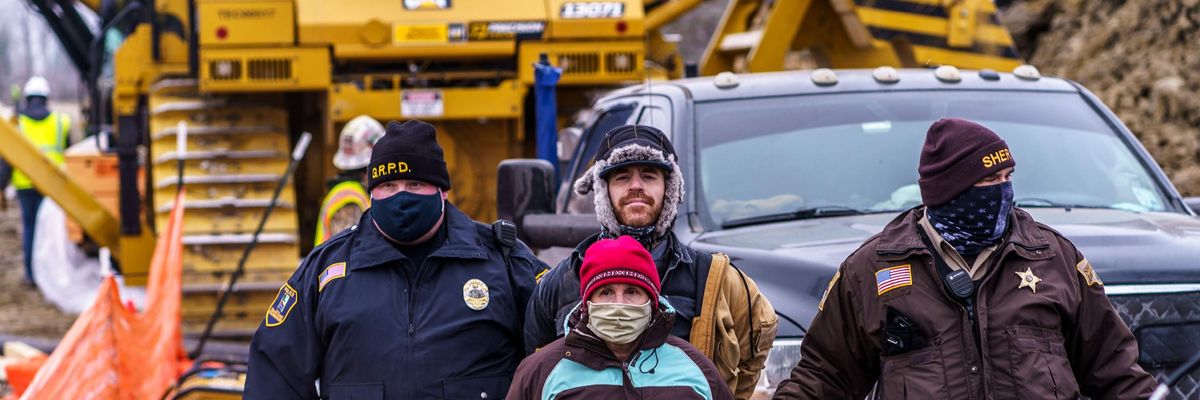
Aitkin County sheriffs arrest water protectors during a protest at the construction site of the Line 3 oil pipeline near Palisade, Minnesota on January 9, 2021. (Photo: Kerem Yucel / AFP via Getty Images)
With Canadian oil giant Enbridge pouring more than $4 million into a fund that was used by the law enforcement agencies which have arrested hundreds of people for protesting the company's thousand-mile-long tar sands pipeline, the prosecutor who is bringing charges against the environmental defenders believed he was also entitled to benefit from the fund, according to an independent investigation.
The Center for Protest Law and Litigation (CPLL) revealed Thursday that Jonathan Frieden, the lead prosecutor seeking to jail hundreds of opponents to the Line 3 pipeline, sought more than $12,000 last July from the so-called Line 3 Public Safety Escrow Trust, which the Minnesota Public Utilities Commission (PUC) ordered Enbridge to pay into as a condition of the pipeline's construction.
According to documents obtained by the center, Frieden wrote to Rick Hart, manager for the escrow account at the Minnesota PUC, with a bill for the hours he and his support staff worked preparing the case against Indigenous groups and other climate campaigners.
" Big Oil should not be allowed to use police officers and county attorneys as their personal security."
Hart later informed Frieden that "prosecution expenses are not an allowable reimbursable expense for the Line 3 Public Safety Escrow Account."
Enbridge--whose Line 3 pipeline transports tar sands across Indigenous lands and violates Anishinaabe treaty rights as well as threatening water safety in Minnesota--has acknowledged that it funneled $2.9 million into the fund which benefited sheriffs' departments and other law enforcement agencies as they cracked down on anti-pipeline protests.
The money has been used to conduct patrols along the pipeline and to reimburse law enforcement agencies for protective gear, transportation, lodging, and meals while they've made hundreds of arrests.
As Frieden pursued charges for trespassing, theft, "unlawful assembly," and other misdemeanors and felonies--which are "meant to intimidate and dissuade free speech and to dissuade further protests" rather than protect public safety, according to campaigners--he sought funding from the oil giant.
The prosecutor pushed back when he was informed the escrow account couldn't be used by him and his staff, saying their work "to charge the individuals endangering the public" should "qualify under public safety."
Frieden's "expectation of funding incentivized the wrongful charging of hundreds," said CPLL.
"Who's next to violate [the] constitutional rights of water protectors and ask Big Oil to pay for it?" asked Katie Redford, co-founder of Earth Rights International.
The state-run account to which Enbridge has contributed millions of dollars "essentially privatizes public police forces to act in service to the private pecuniary interests of this foreign corporation against its political opponents and the Indigenous community and to stop and disrupt peaceful organizing and expression that would educate the larger community and national audience about the environmental devastation and danger posed by the Line 3 pipeline," said CPLL.
Frieden's request suggests he believed that the company was also using "county attorneys as their personal security," said Jane Fleming Kleeb, chair of the Nebraska Democratic Party.
"This should never be happening," tweeted Kleeb.
Dear Common Dreams reader, It’s been nearly 30 years since I co-founded Common Dreams with my late wife, Lina Newhouser. We had the radical notion that journalism should serve the public good, not corporate profits. It was clear to us from the outset what it would take to build such a project. No paid advertisements. No corporate sponsors. No millionaire publisher telling us what to think or do. Many people said we wouldn't last a year, but we proved those doubters wrong. Together with a tremendous team of journalists and dedicated staff, we built an independent media outlet free from the constraints of profits and corporate control. Our mission has always been simple: To inform. To inspire. To ignite change for the common good. Building Common Dreams was not easy. Our survival was never guaranteed. When you take on the most powerful forces—Wall Street greed, fossil fuel industry destruction, Big Tech lobbyists, and uber-rich oligarchs who have spent billions upon billions rigging the economy and democracy in their favor—the only bulwark you have is supporters who believe in your work. But here’s the urgent message from me today. It's never been this bad out there. And it's never been this hard to keep us going. At the very moment Common Dreams is most needed, the threats we face are intensifying. We need your support now more than ever. We don't accept corporate advertising and never will. We don't have a paywall because we don't think people should be blocked from critical news based on their ability to pay. Everything we do is funded by the donations of readers like you. When everyone does the little they can afford, we are strong. But if that support retreats or dries up, so do we. Will you donate now to make sure Common Dreams not only survives but thrives? —Craig Brown, Co-founder |
With Canadian oil giant Enbridge pouring more than $4 million into a fund that was used by the law enforcement agencies which have arrested hundreds of people for protesting the company's thousand-mile-long tar sands pipeline, the prosecutor who is bringing charges against the environmental defenders believed he was also entitled to benefit from the fund, according to an independent investigation.
The Center for Protest Law and Litigation (CPLL) revealed Thursday that Jonathan Frieden, the lead prosecutor seeking to jail hundreds of opponents to the Line 3 pipeline, sought more than $12,000 last July from the so-called Line 3 Public Safety Escrow Trust, which the Minnesota Public Utilities Commission (PUC) ordered Enbridge to pay into as a condition of the pipeline's construction.
According to documents obtained by the center, Frieden wrote to Rick Hart, manager for the escrow account at the Minnesota PUC, with a bill for the hours he and his support staff worked preparing the case against Indigenous groups and other climate campaigners.
" Big Oil should not be allowed to use police officers and county attorneys as their personal security."
Hart later informed Frieden that "prosecution expenses are not an allowable reimbursable expense for the Line 3 Public Safety Escrow Account."
Enbridge--whose Line 3 pipeline transports tar sands across Indigenous lands and violates Anishinaabe treaty rights as well as threatening water safety in Minnesota--has acknowledged that it funneled $2.9 million into the fund which benefited sheriffs' departments and other law enforcement agencies as they cracked down on anti-pipeline protests.
The money has been used to conduct patrols along the pipeline and to reimburse law enforcement agencies for protective gear, transportation, lodging, and meals while they've made hundreds of arrests.
As Frieden pursued charges for trespassing, theft, "unlawful assembly," and other misdemeanors and felonies--which are "meant to intimidate and dissuade free speech and to dissuade further protests" rather than protect public safety, according to campaigners--he sought funding from the oil giant.
The prosecutor pushed back when he was informed the escrow account couldn't be used by him and his staff, saying their work "to charge the individuals endangering the public" should "qualify under public safety."
Frieden's "expectation of funding incentivized the wrongful charging of hundreds," said CPLL.
"Who's next to violate [the] constitutional rights of water protectors and ask Big Oil to pay for it?" asked Katie Redford, co-founder of Earth Rights International.
The state-run account to which Enbridge has contributed millions of dollars "essentially privatizes public police forces to act in service to the private pecuniary interests of this foreign corporation against its political opponents and the Indigenous community and to stop and disrupt peaceful organizing and expression that would educate the larger community and national audience about the environmental devastation and danger posed by the Line 3 pipeline," said CPLL.
Frieden's request suggests he believed that the company was also using "county attorneys as their personal security," said Jane Fleming Kleeb, chair of the Nebraska Democratic Party.
"This should never be happening," tweeted Kleeb.
With Canadian oil giant Enbridge pouring more than $4 million into a fund that was used by the law enforcement agencies which have arrested hundreds of people for protesting the company's thousand-mile-long tar sands pipeline, the prosecutor who is bringing charges against the environmental defenders believed he was also entitled to benefit from the fund, according to an independent investigation.
The Center for Protest Law and Litigation (CPLL) revealed Thursday that Jonathan Frieden, the lead prosecutor seeking to jail hundreds of opponents to the Line 3 pipeline, sought more than $12,000 last July from the so-called Line 3 Public Safety Escrow Trust, which the Minnesota Public Utilities Commission (PUC) ordered Enbridge to pay into as a condition of the pipeline's construction.
According to documents obtained by the center, Frieden wrote to Rick Hart, manager for the escrow account at the Minnesota PUC, with a bill for the hours he and his support staff worked preparing the case against Indigenous groups and other climate campaigners.
" Big Oil should not be allowed to use police officers and county attorneys as their personal security."
Hart later informed Frieden that "prosecution expenses are not an allowable reimbursable expense for the Line 3 Public Safety Escrow Account."
Enbridge--whose Line 3 pipeline transports tar sands across Indigenous lands and violates Anishinaabe treaty rights as well as threatening water safety in Minnesota--has acknowledged that it funneled $2.9 million into the fund which benefited sheriffs' departments and other law enforcement agencies as they cracked down on anti-pipeline protests.
The money has been used to conduct patrols along the pipeline and to reimburse law enforcement agencies for protective gear, transportation, lodging, and meals while they've made hundreds of arrests.
As Frieden pursued charges for trespassing, theft, "unlawful assembly," and other misdemeanors and felonies--which are "meant to intimidate and dissuade free speech and to dissuade further protests" rather than protect public safety, according to campaigners--he sought funding from the oil giant.
The prosecutor pushed back when he was informed the escrow account couldn't be used by him and his staff, saying their work "to charge the individuals endangering the public" should "qualify under public safety."
Frieden's "expectation of funding incentivized the wrongful charging of hundreds," said CPLL.
"Who's next to violate [the] constitutional rights of water protectors and ask Big Oil to pay for it?" asked Katie Redford, co-founder of Earth Rights International.
The state-run account to which Enbridge has contributed millions of dollars "essentially privatizes public police forces to act in service to the private pecuniary interests of this foreign corporation against its political opponents and the Indigenous community and to stop and disrupt peaceful organizing and expression that would educate the larger community and national audience about the environmental devastation and danger posed by the Line 3 pipeline," said CPLL.
Frieden's request suggests he believed that the company was also using "county attorneys as their personal security," said Jane Fleming Kleeb, chair of the Nebraska Democratic Party.
"This should never be happening," tweeted Kleeb.

