SUBSCRIBE TO OUR FREE NEWSLETTER
Daily news & progressive opinion—funded by the people, not the corporations—delivered straight to your inbox.
5
#000000
#FFFFFF
To donate by check, phone, or other method, see our More Ways to Give page.
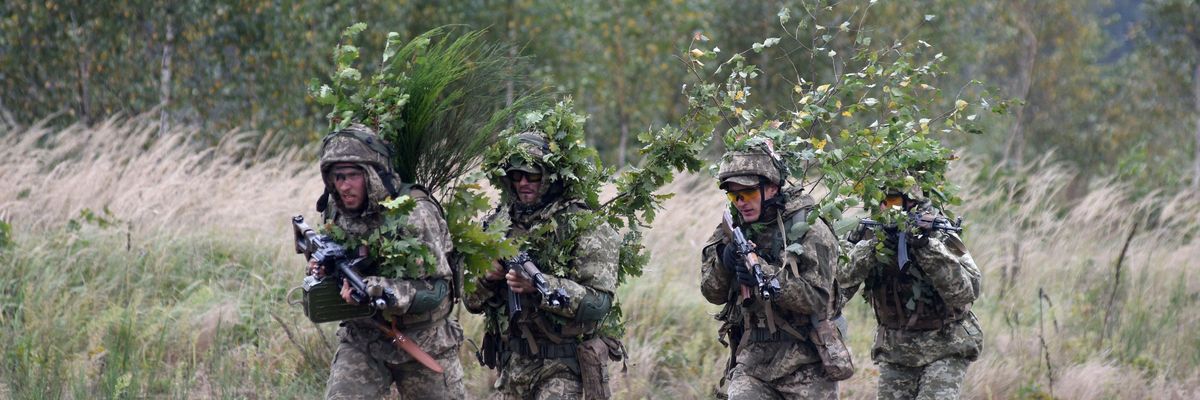
As President Joe Biden ratchets up tensions with Moscow by assuring Ukraine that "the United States and its allies and partners will respond decisively" to a Russian invasion, experts warned Monday that there is no military solution to the seven-year war between neighbors with so much shared history and culture.
"What is essentially a civil war has become a proxy war, a site of dangerous geopolitical focus."
"The hawkish outcry for more sanctions, more weapons, NATO membership for Ukraine, and an even more confrontational stance toward Russia is exceedingly dangerous and is not in our security or national interests," said Katrina vanden Heuvel, president of the American Committee for U.S.-Russia Accord, referring to the North Atlantic Treaty Organization, the anti-Russian alliance founded during the Cold War.
The statement from vanden Heuvel, who is also publisher and editorial director of The Nation, came a day after Biden's provocative assurance and days after the U.S. president spoke by phone with President Vladimir Putin of Russia, which according to Ukrainian and Western leaders has amassed around 100,000 troops along its border with Ukraine in recent months.
Biden said he told Putin during the call that "we will have severe sanctions, we will increase our presence in Europe, with NATO allies" if Russia invades Ukraine. Russian officials in turn warned such moves could lead to a "complete rupture of relations" between Moscow and Washington.
"While there is no question that Russia has contributed to tensions, the West should have understood that an attempt to bring Ukraine into NATO would spark deep, historical divisions within Ukraine and escalate Russian concerns," said vanden Heuvel. "What is essentially a civil war has become a proxy war, a site of dangerous geopolitical focus."
Experts have long warned that from Moscow's perspective, NATO's eastward enlargement--there are now 10 former Soviet or Warsaw Pact republics in the alliance, including four sharing land borders with Russia--constitutes a palpable threat to Russian leaders.
"The notion that the West could pursue an eastward expansion of NATO without pushback was always pure folly," Project Syndicate contributing editor and New School international affairs professor Nina L. Khrushcheva wrote last week.
Related Content

Khrushcheva continued:
The West has consistently dismissed the Kremlin's security concerns relating to ex-Soviet countries and portrayed Russian resistance to NATO's eastward expansion as paranoid revanchism. No one is threatening Russia, the logic goes; it is Russia that is threatening its neighbors, including by invading Georgia in 2008 and Ukraine in 2014.
But the West cannot reasonably expect the Kremlin to accept at face value NATO's claim that it is a purely defensive alliance. After all, since the end of the Cold War, NATO has edged closer and closer to Russia's borders, embracing lands to which Russia is bound by history, geography, and security interests.
"While the 'exceptional' U.S. has long been able to act in its own strategic interest without, as one author put it, 'the consequences that come with doing so,' the time may have come for it to account for new variables," Khrushcheva said, "namely, that Russians, too, view their country as exceptional."
She added that "until the West changes its approach, the cycle of crises will continue, with escalating risks."
Anatol Lieven, a senior research fellow on Russia and Europe at the Quincy Institute for Responsible Statecraft, sees a possible "golden bridge" by which further conflict may be averted: Ukrainian neutrality.
"The Russian demand that Ukraine be excluded from NATO and that NATO and Washington promise not to station troops or conduct military exercises near Russia's borders is clearly unacceptable as it stands," Lieven wrote Monday. "It asks for concessions from the West without offering anything in return. It is also, however, only an initial bargaining move. If the West in return proposes Ukrainian neutrality, it will be very difficult for Russia to refuse."
Lieven contends that the Austrian State Treaty of 1955, which created an independent and neutral Austria that also served as a buffer zone between NATO and the Soviet-dominated Warsaw Pact, offers a possible template.
"The Biden administration, either directly or through German and French mediation, should seek to 'own' the idea of Ukrainian neutrality as its response to Russia's demands," he wrote.
Vanden Heuvel stressed the need for such a negotiated political settlement to the Ukraine crisis.
"It is imperative that we embrace sober reasoning and diplomacy to end the conflict--more than 14,000 lives have already been taken," she said.
"Make no mistake," she added, "there is no military solution to this conflict. Only reasoned dialogue and political settlement can put Ukraine on the path to long term stability and some semblance of peace."
With the 2024 presidential campaign just around the corner, there is another reason for Biden to ensure that the United States does not get drawn further into the Ukraine morass: It could cost him on Election Day. According to a 2021 survey conducted by YouGov and the right-wing Charles Koch Institute, only 27% of U.S. voters somewhat or strongly favor going to war with Russia to protect Ukraine's territorial integrity.
By contrast, 73% of respondents said the U.S. should prioritize domestic issues over foreign policy.
As President Joe Biden ratchets up tensions with Moscow by assuring Ukraine that "the United States and its allies and partners will respond decisively" to a Russian invasion, experts warned Monday that there is no military solution to the seven-year war between neighbors with so much shared history and culture.
"What is essentially a civil war has become a proxy war, a site of dangerous geopolitical focus."
"The hawkish outcry for more sanctions, more weapons, NATO membership for Ukraine, and an even more confrontational stance toward Russia is exceedingly dangerous and is not in our security or national interests," said Katrina vanden Heuvel, president of the American Committee for U.S.-Russia Accord, referring to the North Atlantic Treaty Organization, the anti-Russian alliance founded during the Cold War.
The statement from vanden Heuvel, who is also publisher and editorial director of The Nation, came a day after Biden's provocative assurance and days after the U.S. president spoke by phone with President Vladimir Putin of Russia, which according to Ukrainian and Western leaders has amassed around 100,000 troops along its border with Ukraine in recent months.
Biden said he told Putin during the call that "we will have severe sanctions, we will increase our presence in Europe, with NATO allies" if Russia invades Ukraine. Russian officials in turn warned such moves could lead to a "complete rupture of relations" between Moscow and Washington.
"While there is no question that Russia has contributed to tensions, the West should have understood that an attempt to bring Ukraine into NATO would spark deep, historical divisions within Ukraine and escalate Russian concerns," said vanden Heuvel. "What is essentially a civil war has become a proxy war, a site of dangerous geopolitical focus."
Experts have long warned that from Moscow's perspective, NATO's eastward enlargement--there are now 10 former Soviet or Warsaw Pact republics in the alliance, including four sharing land borders with Russia--constitutes a palpable threat to Russian leaders.
"The notion that the West could pursue an eastward expansion of NATO without pushback was always pure folly," Project Syndicate contributing editor and New School international affairs professor Nina L. Khrushcheva wrote last week.
Related Content
Khrushcheva continued:
The West has consistently dismissed the Kremlin's security concerns relating to ex-Soviet countries and portrayed Russian resistance to NATO's eastward expansion as paranoid revanchism. No one is threatening Russia, the logic goes; it is Russia that is threatening its neighbors, including by invading Georgia in 2008 and Ukraine in 2014.
But the West cannot reasonably expect the Kremlin to accept at face value NATO's claim that it is a purely defensive alliance. After all, since the end of the Cold War, NATO has edged closer and closer to Russia's borders, embracing lands to which Russia is bound by history, geography, and security interests.
"While the 'exceptional' U.S. has long been able to act in its own strategic interest without, as one author put it, 'the consequences that come with doing so,' the time may have come for it to account for new variables," Khrushcheva said, "namely, that Russians, too, view their country as exceptional."
She added that "until the West changes its approach, the cycle of crises will continue, with escalating risks."
Anatol Lieven, a senior research fellow on Russia and Europe at the Quincy Institute for Responsible Statecraft, sees a possible "golden bridge" by which further conflict may be averted: Ukrainian neutrality.
"The Russian demand that Ukraine be excluded from NATO and that NATO and Washington promise not to station troops or conduct military exercises near Russia's borders is clearly unacceptable as it stands," Lieven wrote Monday. "It asks for concessions from the West without offering anything in return. It is also, however, only an initial bargaining move. If the West in return proposes Ukrainian neutrality, it will be very difficult for Russia to refuse."
Lieven contends that the Austrian State Treaty of 1955, which created an independent and neutral Austria that also served as a buffer zone between NATO and the Soviet-dominated Warsaw Pact, offers a possible template.
"The Biden administration, either directly or through German and French mediation, should seek to 'own' the idea of Ukrainian neutrality as its response to Russia's demands," he wrote.
Vanden Heuvel stressed the need for such a negotiated political settlement to the Ukraine crisis.
"It is imperative that we embrace sober reasoning and diplomacy to end the conflict--more than 14,000 lives have already been taken," she said.
"Make no mistake," she added, "there is no military solution to this conflict. Only reasoned dialogue and political settlement can put Ukraine on the path to long term stability and some semblance of peace."
With the 2024 presidential campaign just around the corner, there is another reason for Biden to ensure that the United States does not get drawn further into the Ukraine morass: It could cost him on Election Day. According to a 2021 survey conducted by YouGov and the right-wing Charles Koch Institute, only 27% of U.S. voters somewhat or strongly favor going to war with Russia to protect Ukraine's territorial integrity.
By contrast, 73% of respondents said the U.S. should prioritize domestic issues over foreign policy.