SUBSCRIBE TO OUR FREE NEWSLETTER
Daily news & progressive opinion—funded by the people, not the corporations—delivered straight to your inbox.
5
#000000
#FFFFFF
To donate by check, phone, or other method, see our More Ways to Give page.
Daily news & progressive opinion—funded by the people, not the corporations—delivered straight to your inbox.
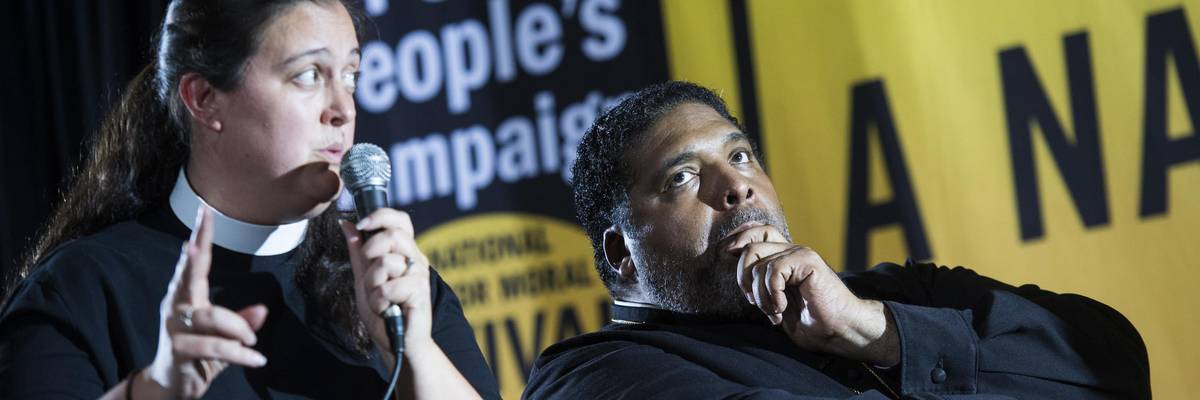
The Rev. Drs. Liz Theoharis and William Barber appeared on stage at the Poor People's Moral Action Congress forum for presidential candidates at Trinity Washington University on June 17, 2019. (Photo: Tom Williams/CQ Roll Call)
The Rev. William Barber vowed Wednesday to continue fighting for people's right to free speech after the North Carolina appeals court upheld the anti-poverty activist's trespassing conviction that stemmed from a 2017 protest at the General Assembly.
In a Twitter thread indicating his attorneys were weighing next steps, Barber said that "how this case is set up is not about any individual" but is instead "about the rights of all people under the First Amendment of the Constitution. And we will continue to press for those rights in North Carolina and the rest of the country."
The Moral Monday movement leader and president of Repairers of the Breach was convicted in 2019 for actions related to a sit-in and call-and-response demonstration he led outside lawmakers' offices as he and dozens of fellow protesters called for Medicaid expansion in the state.
As WRAL reported at the time:
General Assembly Police said the protest prompted calls from legislative staffers who said the noise from the protest was making it hard to work. Police Chief Martin Brock used a bullhorn to order the group to quiet down or move. After several warnings, he told his officers to start arresting people.
Barber disputed the protest was that loud, saying Brock's characterization that he was "yelling at the top of my lungs" was offensive.
"It was my preaching voice," he said. "I would never characterize call-and-response, preaching, reading the constitution, reading scripture as yelling."
In its Tuesday ruling, the appeals court upheld the conviction.
Judge Chris Dillon wrote that the case wasn't about "free speech" but "loud speech." The inside of the General Assembly, he said, was "not an unlimited public forum" or "quintessential community venue, such as a public street, sidewalk, or park."
After the trial, Barber insisted the case had broad implications for the exercise of free speech and the right to protest.
"This is literally about opening up Southern legislatures to the light of day," he said, "and to the people's voice and to the people's protests."
Barber could bring the case to the state Supreme Court, though, as the Carolina Journal reported, it would not be required to take up the challenge because there was no dissenting opinion from the appeals court's three judges.
Dear Common Dreams reader, It’s been nearly 30 years since I co-founded Common Dreams with my late wife, Lina Newhouser. We had the radical notion that journalism should serve the public good, not corporate profits. It was clear to us from the outset what it would take to build such a project. No paid advertisements. No corporate sponsors. No millionaire publisher telling us what to think or do. Many people said we wouldn't last a year, but we proved those doubters wrong. Together with a tremendous team of journalists and dedicated staff, we built an independent media outlet free from the constraints of profits and corporate control. Our mission has always been simple: To inform. To inspire. To ignite change for the common good. Building Common Dreams was not easy. Our survival was never guaranteed. When you take on the most powerful forces—Wall Street greed, fossil fuel industry destruction, Big Tech lobbyists, and uber-rich oligarchs who have spent billions upon billions rigging the economy and democracy in their favor—the only bulwark you have is supporters who believe in your work. But here’s the urgent message from me today. It's never been this bad out there. And it's never been this hard to keep us going. At the very moment Common Dreams is most needed, the threats we face are intensifying. We need your support now more than ever. We don't accept corporate advertising and never will. We don't have a paywall because we don't think people should be blocked from critical news based on their ability to pay. Everything we do is funded by the donations of readers like you. When everyone does the little they can afford, we are strong. But if that support retreats or dries up, so do we. Will you donate now to make sure Common Dreams not only survives but thrives? —Craig Brown, Co-founder |
The Rev. William Barber vowed Wednesday to continue fighting for people's right to free speech after the North Carolina appeals court upheld the anti-poverty activist's trespassing conviction that stemmed from a 2017 protest at the General Assembly.
In a Twitter thread indicating his attorneys were weighing next steps, Barber said that "how this case is set up is not about any individual" but is instead "about the rights of all people under the First Amendment of the Constitution. And we will continue to press for those rights in North Carolina and the rest of the country."
The Moral Monday movement leader and president of Repairers of the Breach was convicted in 2019 for actions related to a sit-in and call-and-response demonstration he led outside lawmakers' offices as he and dozens of fellow protesters called for Medicaid expansion in the state.
As WRAL reported at the time:
General Assembly Police said the protest prompted calls from legislative staffers who said the noise from the protest was making it hard to work. Police Chief Martin Brock used a bullhorn to order the group to quiet down or move. After several warnings, he told his officers to start arresting people.
Barber disputed the protest was that loud, saying Brock's characterization that he was "yelling at the top of my lungs" was offensive.
"It was my preaching voice," he said. "I would never characterize call-and-response, preaching, reading the constitution, reading scripture as yelling."
In its Tuesday ruling, the appeals court upheld the conviction.
Judge Chris Dillon wrote that the case wasn't about "free speech" but "loud speech." The inside of the General Assembly, he said, was "not an unlimited public forum" or "quintessential community venue, such as a public street, sidewalk, or park."
After the trial, Barber insisted the case had broad implications for the exercise of free speech and the right to protest.
"This is literally about opening up Southern legislatures to the light of day," he said, "and to the people's voice and to the people's protests."
Barber could bring the case to the state Supreme Court, though, as the Carolina Journal reported, it would not be required to take up the challenge because there was no dissenting opinion from the appeals court's three judges.
The Rev. William Barber vowed Wednesday to continue fighting for people's right to free speech after the North Carolina appeals court upheld the anti-poverty activist's trespassing conviction that stemmed from a 2017 protest at the General Assembly.
In a Twitter thread indicating his attorneys were weighing next steps, Barber said that "how this case is set up is not about any individual" but is instead "about the rights of all people under the First Amendment of the Constitution. And we will continue to press for those rights in North Carolina and the rest of the country."
The Moral Monday movement leader and president of Repairers of the Breach was convicted in 2019 for actions related to a sit-in and call-and-response demonstration he led outside lawmakers' offices as he and dozens of fellow protesters called for Medicaid expansion in the state.
As WRAL reported at the time:
General Assembly Police said the protest prompted calls from legislative staffers who said the noise from the protest was making it hard to work. Police Chief Martin Brock used a bullhorn to order the group to quiet down or move. After several warnings, he told his officers to start arresting people.
Barber disputed the protest was that loud, saying Brock's characterization that he was "yelling at the top of my lungs" was offensive.
"It was my preaching voice," he said. "I would never characterize call-and-response, preaching, reading the constitution, reading scripture as yelling."
In its Tuesday ruling, the appeals court upheld the conviction.
Judge Chris Dillon wrote that the case wasn't about "free speech" but "loud speech." The inside of the General Assembly, he said, was "not an unlimited public forum" or "quintessential community venue, such as a public street, sidewalk, or park."
After the trial, Barber insisted the case had broad implications for the exercise of free speech and the right to protest.
"This is literally about opening up Southern legislatures to the light of day," he said, "and to the people's voice and to the people's protests."
Barber could bring the case to the state Supreme Court, though, as the Carolina Journal reported, it would not be required to take up the challenge because there was no dissenting opinion from the appeals court's three judges.