SUBSCRIBE TO OUR FREE NEWSLETTER
Daily news & progressive opinion—funded by the people, not the corporations—delivered straight to your inbox.
5
#000000
#FFFFFF
To donate by check, phone, or other method, see our More Ways to Give page.
Daily news & progressive opinion—funded by the people, not the corporations—delivered straight to your inbox.
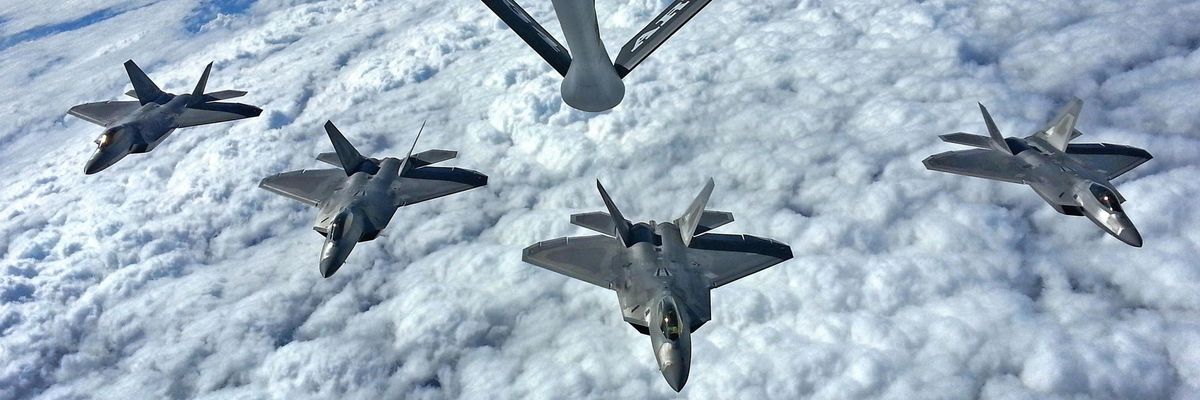
More than $1.2 billion worth of Lockheed Martin F-22 Raptor fighter jets fly in formation above Indiana. (Photo: Col. Hiram Gates/USAF)
In a move they say will save $1 trillion over five years "to fight planetary emergencies" like "pandemics, climate change, and extreme poverty," a group of over 50 Nobel laureates this week published an open letter calling on countries to generate a "global peace dividend" by reducing their military spending by 2%.
"Humankind faces risks that can only be averted through cooperation. Let us cooperate, instead of fighting among ourselves."
"World military spending has doubled since 2000. It is approaching $2 trillion U.S. dollars per year, and is increasing in all regions of the world," the letter--which is being coordinated by physicists Carlo Rovelli and Matteo Smerlak--states.
"Individual governments are under pressure to increase military spending because others do so," the signers continue. "The feedback mechanism sustains a spiraling arms race--a colossal waste of resources that could be used far more wisely."
The letter's signatories include mostly Nobel science and medicine laureates, as well as a handful of winners in the peace, economics, and literature categories. The heads of several national academies also signed, and Tibetan spiritual leader and Nobel Peace Prize winner the Dalai Lama expressed his "appreciation and support" for the initiative.
"Past arms races have often had the same outcome: deadly and destructive conflicts," the signers note. "We have a simple proposal for humankind: The governments of all U.N. member-states should negotiate a joint reduction of their military expenditure by 2% every year for five years."
"We propose that half of the resources freed up by this agreement are allocated to a global fund, under U.N. supervision, to address humanity's grave common problems: pandemics, climate change, and extreme poverty."
"The other half remains at the disposal of individual governments," the signers explain. "All countries will therefore have significant new resources. Some of these can be used to redirect the strong research capacities of military industries towards urgently needed peaceful applications."
"History shows that agreements to limit the proliferation of weapons are achievable: thanks to the SALT and START [Strategic Arms Limitation Talks and Strategic Arms Reduction] treaties, the United States and the Soviet Union have reduced their nuclear arsenals by 90% since the 1980s," the letter states--its only reference to specific countries.
With a military budget of $778 billion, the United States spends more annually on its armed forces than the next 11 nations combined, according to the Stockholm International Peace Research Institute. The U.S. is followed by China ($252 billion), India ($72.9 billion), Russia ($61.7 billion), and the United Kingdom ($59.2 billion)--all of which increased their military spending in 2020.
"Such negotiations can succeed because they are rational: each actor benefits from its adversaries' armaments reduction, and so does humanity as a whole," the letter's signatories assert. "Humankind faces risks that can only be averted through cooperation. Let us cooperate, instead of fighting among ourselves."
Dear Common Dreams reader, It’s been nearly 30 years since I co-founded Common Dreams with my late wife, Lina Newhouser. We had the radical notion that journalism should serve the public good, not corporate profits. It was clear to us from the outset what it would take to build such a project. No paid advertisements. No corporate sponsors. No millionaire publisher telling us what to think or do. Many people said we wouldn't last a year, but we proved those doubters wrong. Together with a tremendous team of journalists and dedicated staff, we built an independent media outlet free from the constraints of profits and corporate control. Our mission has always been simple: To inform. To inspire. To ignite change for the common good. Building Common Dreams was not easy. Our survival was never guaranteed. When you take on the most powerful forces—Wall Street greed, fossil fuel industry destruction, Big Tech lobbyists, and uber-rich oligarchs who have spent billions upon billions rigging the economy and democracy in their favor—the only bulwark you have is supporters who believe in your work. But here’s the urgent message from me today. It's never been this bad out there. And it's never been this hard to keep us going. At the very moment Common Dreams is most needed, the threats we face are intensifying. We need your support now more than ever. We don't accept corporate advertising and never will. We don't have a paywall because we don't think people should be blocked from critical news based on their ability to pay. Everything we do is funded by the donations of readers like you. When everyone does the little they can afford, we are strong. But if that support retreats or dries up, so do we. Will you donate now to make sure Common Dreams not only survives but thrives? —Craig Brown, Co-founder |
In a move they say will save $1 trillion over five years "to fight planetary emergencies" like "pandemics, climate change, and extreme poverty," a group of over 50 Nobel laureates this week published an open letter calling on countries to generate a "global peace dividend" by reducing their military spending by 2%.
"Humankind faces risks that can only be averted through cooperation. Let us cooperate, instead of fighting among ourselves."
"World military spending has doubled since 2000. It is approaching $2 trillion U.S. dollars per year, and is increasing in all regions of the world," the letter--which is being coordinated by physicists Carlo Rovelli and Matteo Smerlak--states.
"Individual governments are under pressure to increase military spending because others do so," the signers continue. "The feedback mechanism sustains a spiraling arms race--a colossal waste of resources that could be used far more wisely."
The letter's signatories include mostly Nobel science and medicine laureates, as well as a handful of winners in the peace, economics, and literature categories. The heads of several national academies also signed, and Tibetan spiritual leader and Nobel Peace Prize winner the Dalai Lama expressed his "appreciation and support" for the initiative.
"Past arms races have often had the same outcome: deadly and destructive conflicts," the signers note. "We have a simple proposal for humankind: The governments of all U.N. member-states should negotiate a joint reduction of their military expenditure by 2% every year for five years."
"We propose that half of the resources freed up by this agreement are allocated to a global fund, under U.N. supervision, to address humanity's grave common problems: pandemics, climate change, and extreme poverty."
"The other half remains at the disposal of individual governments," the signers explain. "All countries will therefore have significant new resources. Some of these can be used to redirect the strong research capacities of military industries towards urgently needed peaceful applications."
"History shows that agreements to limit the proliferation of weapons are achievable: thanks to the SALT and START [Strategic Arms Limitation Talks and Strategic Arms Reduction] treaties, the United States and the Soviet Union have reduced their nuclear arsenals by 90% since the 1980s," the letter states--its only reference to specific countries.
With a military budget of $778 billion, the United States spends more annually on its armed forces than the next 11 nations combined, according to the Stockholm International Peace Research Institute. The U.S. is followed by China ($252 billion), India ($72.9 billion), Russia ($61.7 billion), and the United Kingdom ($59.2 billion)--all of which increased their military spending in 2020.
"Such negotiations can succeed because they are rational: each actor benefits from its adversaries' armaments reduction, and so does humanity as a whole," the letter's signatories assert. "Humankind faces risks that can only be averted through cooperation. Let us cooperate, instead of fighting among ourselves."
In a move they say will save $1 trillion over five years "to fight planetary emergencies" like "pandemics, climate change, and extreme poverty," a group of over 50 Nobel laureates this week published an open letter calling on countries to generate a "global peace dividend" by reducing their military spending by 2%.
"Humankind faces risks that can only be averted through cooperation. Let us cooperate, instead of fighting among ourselves."
"World military spending has doubled since 2000. It is approaching $2 trillion U.S. dollars per year, and is increasing in all regions of the world," the letter--which is being coordinated by physicists Carlo Rovelli and Matteo Smerlak--states.
"Individual governments are under pressure to increase military spending because others do so," the signers continue. "The feedback mechanism sustains a spiraling arms race--a colossal waste of resources that could be used far more wisely."
The letter's signatories include mostly Nobel science and medicine laureates, as well as a handful of winners in the peace, economics, and literature categories. The heads of several national academies also signed, and Tibetan spiritual leader and Nobel Peace Prize winner the Dalai Lama expressed his "appreciation and support" for the initiative.
"Past arms races have often had the same outcome: deadly and destructive conflicts," the signers note. "We have a simple proposal for humankind: The governments of all U.N. member-states should negotiate a joint reduction of their military expenditure by 2% every year for five years."
"We propose that half of the resources freed up by this agreement are allocated to a global fund, under U.N. supervision, to address humanity's grave common problems: pandemics, climate change, and extreme poverty."
"The other half remains at the disposal of individual governments," the signers explain. "All countries will therefore have significant new resources. Some of these can be used to redirect the strong research capacities of military industries towards urgently needed peaceful applications."
"History shows that agreements to limit the proliferation of weapons are achievable: thanks to the SALT and START [Strategic Arms Limitation Talks and Strategic Arms Reduction] treaties, the United States and the Soviet Union have reduced their nuclear arsenals by 90% since the 1980s," the letter states--its only reference to specific countries.
With a military budget of $778 billion, the United States spends more annually on its armed forces than the next 11 nations combined, according to the Stockholm International Peace Research Institute. The U.S. is followed by China ($252 billion), India ($72.9 billion), Russia ($61.7 billion), and the United Kingdom ($59.2 billion)--all of which increased their military spending in 2020.
"Such negotiations can succeed because they are rational: each actor benefits from its adversaries' armaments reduction, and so does humanity as a whole," the letter's signatories assert. "Humankind faces risks that can only be averted through cooperation. Let us cooperate, instead of fighting among ourselves."