SUBSCRIBE TO OUR FREE NEWSLETTER
Daily news & progressive opinion—funded by the people, not the corporations—delivered straight to your inbox.
5
#000000
#FFFFFF
To donate by check, phone, or other method, see our More Ways to Give page.
Daily news & progressive opinion—funded by the people, not the corporations—delivered straight to your inbox.
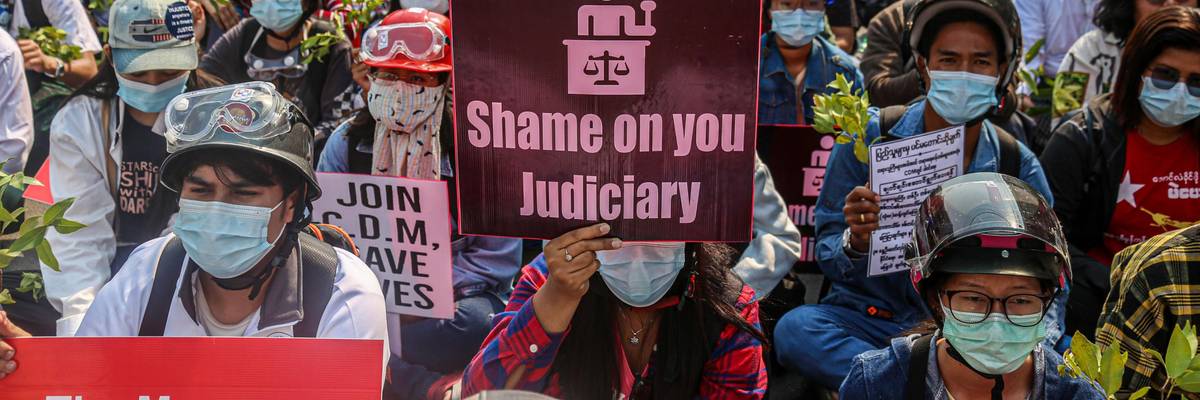
A protester holds a placard that reads "Shame on You Judiciary" during an anti-military coup demonstration in Mandalay, Myanmar on March 7, 2021. (Photo: Kaung Zaw Hein/SOPA Images/LightRocket via Getty Images)
A Myanmar court on Monday sentenced the nation's ousted civilian leader Aung San Suu Kyi to four years in prison on charges that human rights groups and the United Nations condemned as "politically motivated" and "corrupt."
The verdict--under which the former leader was convicted of incitement and violating Covid-19 restrictions--came more than 10 months after Myanmar's armed forces arrested Suu Kyi and took control of the country's government, imperiling the nation's recent, tenuous steps toward democracy after decades of military dictatorship.
"The military is attempting to instrumentalize the courts to remove all political opposition."
The military justified its latest seizure of power by claiming widespread fraud in 2020 parliamentary elections, which Suu Kyi's National League for Democracy party won handily.
While Suu Kyi has been accused of complicity in the Myanmar military's genocidal assault on the country's Rohingya Muslim minority, her arrest and sentencing were condemned by human rights organizations as "the latest example of the military's determination to eliminate all opposition and suffocate freedoms in Myanmar."
"The court's farcical and corrupt decision is part of a devastating pattern of arbitrary punishment that has seen more than 1,300 people killed and thousands arrested since the military coup in February," Ming Yu Hah, deputy regional director for campaigns at Amnesty International, said in a statement. "There are many detainees without the profile of Aung San Suu Kyi who currently face the terrifying prospect of years behind bars simply for peacefully exercising their human rights. They must not be forgotten and left to their fate."
Michelle Bachelet, the United Nations' high commissioner for human rights, said Monday that "the conviction of the state counselor following a sham trial in secretive proceedings before a military-controlled court is nothing but politically motivated."
"It is not only about arbitrary denial of her freedom--it closes yet another door to political dialogue," Bachelet added. "The military is attempting to instrumentalize the courts to remove all political opposition. But these cases cannot provide a legal veneer to the illegitimacy of the coup and military rule."
The U.N.'s special rapporteur on Myanmar, Tom Andrews, also weighed in on Twitter:
The Associated Press reported that "if found guilty of all the charges she faces, Suu Kyi could be sentenced to more than 100 years in prison."
"She is being held by the military at an unknown location, and the court did not make clear Monday whether she would be moved to a prison or kept under some form of house arrest, according to a legal official," the outlet noted.
Myanmar's ousted President Win Myint was also sentenced to four years in prison on Monday.
Since taking control of Myanmar's government, the coup regime has been accused of a number of crimes against humanity, including the indiscriminate brutalization and murder of peaceful demonstrators.
On Sunday, several people were reportedly killed and more were wounded after Myanmar's armed forces rammed a vehicle into an anti-coup demonstration in the country's largest city. First-hand accounts and media reports indicate that the military also opened fire on the protesters.
Bachelet called the attack "vicious" and "utterly reprehensible."
This story has been updated to include comment from Tom Andrews, the United Nations' special rapporteur on the situation of human rights in Myanmar.
Dear Common Dreams reader, It’s been nearly 30 years since I co-founded Common Dreams with my late wife, Lina Newhouser. We had the radical notion that journalism should serve the public good, not corporate profits. It was clear to us from the outset what it would take to build such a project. No paid advertisements. No corporate sponsors. No millionaire publisher telling us what to think or do. Many people said we wouldn't last a year, but we proved those doubters wrong. Together with a tremendous team of journalists and dedicated staff, we built an independent media outlet free from the constraints of profits and corporate control. Our mission has always been simple: To inform. To inspire. To ignite change for the common good. Building Common Dreams was not easy. Our survival was never guaranteed. When you take on the most powerful forces—Wall Street greed, fossil fuel industry destruction, Big Tech lobbyists, and uber-rich oligarchs who have spent billions upon billions rigging the economy and democracy in their favor—the only bulwark you have is supporters who believe in your work. But here’s the urgent message from me today. It's never been this bad out there. And it's never been this hard to keep us going. At the very moment Common Dreams is most needed, the threats we face are intensifying. We need your support now more than ever. We don't accept corporate advertising and never will. We don't have a paywall because we don't think people should be blocked from critical news based on their ability to pay. Everything we do is funded by the donations of readers like you. When everyone does the little they can afford, we are strong. But if that support retreats or dries up, so do we. Will you donate now to make sure Common Dreams not only survives but thrives? —Craig Brown, Co-founder |
A Myanmar court on Monday sentenced the nation's ousted civilian leader Aung San Suu Kyi to four years in prison on charges that human rights groups and the United Nations condemned as "politically motivated" and "corrupt."
The verdict--under which the former leader was convicted of incitement and violating Covid-19 restrictions--came more than 10 months after Myanmar's armed forces arrested Suu Kyi and took control of the country's government, imperiling the nation's recent, tenuous steps toward democracy after decades of military dictatorship.
"The military is attempting to instrumentalize the courts to remove all political opposition."
The military justified its latest seizure of power by claiming widespread fraud in 2020 parliamentary elections, which Suu Kyi's National League for Democracy party won handily.
While Suu Kyi has been accused of complicity in the Myanmar military's genocidal assault on the country's Rohingya Muslim minority, her arrest and sentencing were condemned by human rights organizations as "the latest example of the military's determination to eliminate all opposition and suffocate freedoms in Myanmar."
"The court's farcical and corrupt decision is part of a devastating pattern of arbitrary punishment that has seen more than 1,300 people killed and thousands arrested since the military coup in February," Ming Yu Hah, deputy regional director for campaigns at Amnesty International, said in a statement. "There are many detainees without the profile of Aung San Suu Kyi who currently face the terrifying prospect of years behind bars simply for peacefully exercising their human rights. They must not be forgotten and left to their fate."
Michelle Bachelet, the United Nations' high commissioner for human rights, said Monday that "the conviction of the state counselor following a sham trial in secretive proceedings before a military-controlled court is nothing but politically motivated."
"It is not only about arbitrary denial of her freedom--it closes yet another door to political dialogue," Bachelet added. "The military is attempting to instrumentalize the courts to remove all political opposition. But these cases cannot provide a legal veneer to the illegitimacy of the coup and military rule."
The U.N.'s special rapporteur on Myanmar, Tom Andrews, also weighed in on Twitter:
The Associated Press reported that "if found guilty of all the charges she faces, Suu Kyi could be sentenced to more than 100 years in prison."
"She is being held by the military at an unknown location, and the court did not make clear Monday whether she would be moved to a prison or kept under some form of house arrest, according to a legal official," the outlet noted.
Myanmar's ousted President Win Myint was also sentenced to four years in prison on Monday.
Since taking control of Myanmar's government, the coup regime has been accused of a number of crimes against humanity, including the indiscriminate brutalization and murder of peaceful demonstrators.
On Sunday, several people were reportedly killed and more were wounded after Myanmar's armed forces rammed a vehicle into an anti-coup demonstration in the country's largest city. First-hand accounts and media reports indicate that the military also opened fire on the protesters.
Bachelet called the attack "vicious" and "utterly reprehensible."
This story has been updated to include comment from Tom Andrews, the United Nations' special rapporteur on the situation of human rights in Myanmar.
A Myanmar court on Monday sentenced the nation's ousted civilian leader Aung San Suu Kyi to four years in prison on charges that human rights groups and the United Nations condemned as "politically motivated" and "corrupt."
The verdict--under which the former leader was convicted of incitement and violating Covid-19 restrictions--came more than 10 months after Myanmar's armed forces arrested Suu Kyi and took control of the country's government, imperiling the nation's recent, tenuous steps toward democracy after decades of military dictatorship.
"The military is attempting to instrumentalize the courts to remove all political opposition."
The military justified its latest seizure of power by claiming widespread fraud in 2020 parliamentary elections, which Suu Kyi's National League for Democracy party won handily.
While Suu Kyi has been accused of complicity in the Myanmar military's genocidal assault on the country's Rohingya Muslim minority, her arrest and sentencing were condemned by human rights organizations as "the latest example of the military's determination to eliminate all opposition and suffocate freedoms in Myanmar."
"The court's farcical and corrupt decision is part of a devastating pattern of arbitrary punishment that has seen more than 1,300 people killed and thousands arrested since the military coup in February," Ming Yu Hah, deputy regional director for campaigns at Amnesty International, said in a statement. "There are many detainees without the profile of Aung San Suu Kyi who currently face the terrifying prospect of years behind bars simply for peacefully exercising their human rights. They must not be forgotten and left to their fate."
Michelle Bachelet, the United Nations' high commissioner for human rights, said Monday that "the conviction of the state counselor following a sham trial in secretive proceedings before a military-controlled court is nothing but politically motivated."
"It is not only about arbitrary denial of her freedom--it closes yet another door to political dialogue," Bachelet added. "The military is attempting to instrumentalize the courts to remove all political opposition. But these cases cannot provide a legal veneer to the illegitimacy of the coup and military rule."
The U.N.'s special rapporteur on Myanmar, Tom Andrews, also weighed in on Twitter:
The Associated Press reported that "if found guilty of all the charges she faces, Suu Kyi could be sentenced to more than 100 years in prison."
"She is being held by the military at an unknown location, and the court did not make clear Monday whether she would be moved to a prison or kept under some form of house arrest, according to a legal official," the outlet noted.
Myanmar's ousted President Win Myint was also sentenced to four years in prison on Monday.
Since taking control of Myanmar's government, the coup regime has been accused of a number of crimes against humanity, including the indiscriminate brutalization and murder of peaceful demonstrators.
On Sunday, several people were reportedly killed and more were wounded after Myanmar's armed forces rammed a vehicle into an anti-coup demonstration in the country's largest city. First-hand accounts and media reports indicate that the military also opened fire on the protesters.
Bachelet called the attack "vicious" and "utterly reprehensible."
This story has been updated to include comment from Tom Andrews, the United Nations' special rapporteur on the situation of human rights in Myanmar.