SUBSCRIBE TO OUR FREE NEWSLETTER
Daily news & progressive opinion—funded by the people, not the corporations—delivered straight to your inbox.
5
#000000
#FFFFFF
To donate by check, phone, or other method, see our More Ways to Give page.
Daily news & progressive opinion—funded by the people, not the corporations—delivered straight to your inbox.
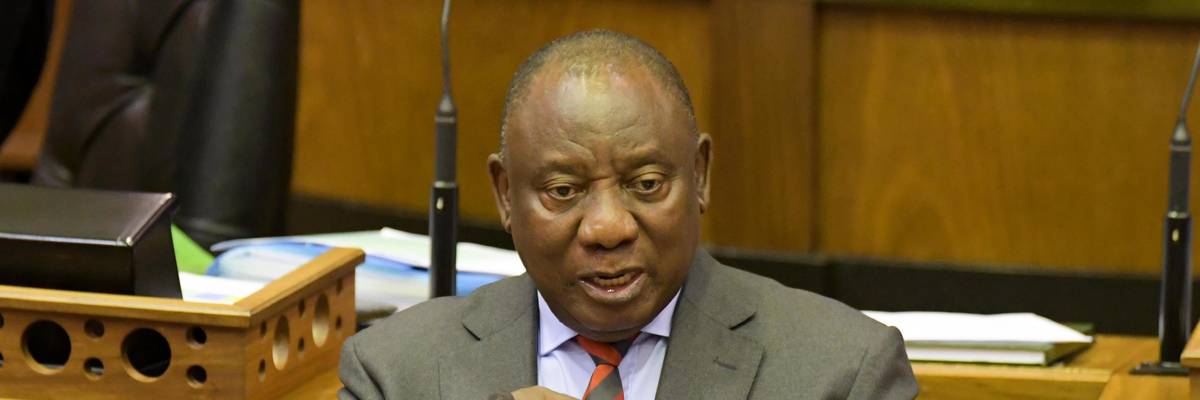
South African President Cyril Ramaphosa speaks in the National Assembly on November 25, 2021 in Cape Town. (Photo: Jeffrey Abrahams/Gallo Images via Getty Images)
The World Health Organization on Sunday echoed calls by South Africa's president for countries to eschew travel bans targeting southern Africans amid the spread of the heavily mutated Omicron variant of the coronavirus.
"The cat's already out of the bag, so to speak."
"Travel restrictions may play a role in slightly reducing the spread of Covid-19 but place a heavy burden on lives and livelihoods," the WHO said in a statement calling for borders to remain open. "If restrictions are implemented, they should not be unnecessarily invasive or intrusive, and should be scientifically based, according to the International Health Regulations, which is a legally binding instrument of international law recognized by over 190 nations."
Dr. Matshidiso Moeti, the WHO's regional director for Africa, added that "the speed and transparency of the South African and Botswana governments in informing the world of the new variant is to be commended. WHO stands with African countries which had the courage to boldly share lifesaving public health information, helping protect the world against the spread of Covid-19."
In recent days, dozens of nations including the United States have prohibited travelers from numerous nations in southern Africa due to concerns about the Omicron variant, which was first identified in Botswana earlier this month. On Friday, the WHO classified the new strain as a "variant of concern."
On Sunday, South African President Cyril Ramaphosa urged nations that have imposed bans on African travelers to rescind what he called the "scientifically unjustified" restrictions.
"The only thing the prohibition on travel will do is to further damage the economies of the affected countries and undermine their ability to respond to, and recover from, the pandemic," Ramaphosa said. "These restrictions are unjustified and unfairly discriminate against our country and our southern African sister countries."
South African vaccinologist Shabir Madhi told Al Jazeera that it is "naive" for world leaders "to believe they can stop the spread of this variant with a blanket ban on countries in southern Africa."
"The virus has already found its way into these societies from individuals that haven't even traveled to or come into contact with anyone from southern Africa," he said. "In South Africa, we have one of the globe's best Covid sequencing capacities based on our experience with treating HIV and TB. We have been ahead of the game for a while now and we are thus a victim of our success."
Nicole A. Errett, a professor of public health at the University of Washington, told The Washington Post that by the time countries enact pandemic travel bans, "the cat's already out of the bag, so to speak."
"Omicron has already been detected in other continents," she noted. "A travel ban could in theory buy some time by reducing the spread of new seed cases, but we are talking on the order of days to weeks."
Sunday's World Health Organization statement and Ramaphosa's call follow an admonition by WHO Health Emergencies Program executive director Dr. Michael Ryan to avoid "knee-jerk reactions" to the Omicron variant.
"It's really important that we remain open, and stay focused," Ryan said on Friday.
Dear Common Dreams reader, It’s been nearly 30 years since I co-founded Common Dreams with my late wife, Lina Newhouser. We had the radical notion that journalism should serve the public good, not corporate profits. It was clear to us from the outset what it would take to build such a project. No paid advertisements. No corporate sponsors. No millionaire publisher telling us what to think or do. Many people said we wouldn't last a year, but we proved those doubters wrong. Together with a tremendous team of journalists and dedicated staff, we built an independent media outlet free from the constraints of profits and corporate control. Our mission has always been simple: To inform. To inspire. To ignite change for the common good. Building Common Dreams was not easy. Our survival was never guaranteed. When you take on the most powerful forces—Wall Street greed, fossil fuel industry destruction, Big Tech lobbyists, and uber-rich oligarchs who have spent billions upon billions rigging the economy and democracy in their favor—the only bulwark you have is supporters who believe in your work. But here’s the urgent message from me today. It's never been this bad out there. And it's never been this hard to keep us going. At the very moment Common Dreams is most needed, the threats we face are intensifying. We need your support now more than ever. We don't accept corporate advertising and never will. We don't have a paywall because we don't think people should be blocked from critical news based on their ability to pay. Everything we do is funded by the donations of readers like you. When everyone does the little they can afford, we are strong. But if that support retreats or dries up, so do we. Will you donate now to make sure Common Dreams not only survives but thrives? —Craig Brown, Co-founder |
The World Health Organization on Sunday echoed calls by South Africa's president for countries to eschew travel bans targeting southern Africans amid the spread of the heavily mutated Omicron variant of the coronavirus.
"The cat's already out of the bag, so to speak."
"Travel restrictions may play a role in slightly reducing the spread of Covid-19 but place a heavy burden on lives and livelihoods," the WHO said in a statement calling for borders to remain open. "If restrictions are implemented, they should not be unnecessarily invasive or intrusive, and should be scientifically based, according to the International Health Regulations, which is a legally binding instrument of international law recognized by over 190 nations."
Dr. Matshidiso Moeti, the WHO's regional director for Africa, added that "the speed and transparency of the South African and Botswana governments in informing the world of the new variant is to be commended. WHO stands with African countries which had the courage to boldly share lifesaving public health information, helping protect the world against the spread of Covid-19."
In recent days, dozens of nations including the United States have prohibited travelers from numerous nations in southern Africa due to concerns about the Omicron variant, which was first identified in Botswana earlier this month. On Friday, the WHO classified the new strain as a "variant of concern."
On Sunday, South African President Cyril Ramaphosa urged nations that have imposed bans on African travelers to rescind what he called the "scientifically unjustified" restrictions.
"The only thing the prohibition on travel will do is to further damage the economies of the affected countries and undermine their ability to respond to, and recover from, the pandemic," Ramaphosa said. "These restrictions are unjustified and unfairly discriminate against our country and our southern African sister countries."
South African vaccinologist Shabir Madhi told Al Jazeera that it is "naive" for world leaders "to believe they can stop the spread of this variant with a blanket ban on countries in southern Africa."
"The virus has already found its way into these societies from individuals that haven't even traveled to or come into contact with anyone from southern Africa," he said. "In South Africa, we have one of the globe's best Covid sequencing capacities based on our experience with treating HIV and TB. We have been ahead of the game for a while now and we are thus a victim of our success."
Nicole A. Errett, a professor of public health at the University of Washington, told The Washington Post that by the time countries enact pandemic travel bans, "the cat's already out of the bag, so to speak."
"Omicron has already been detected in other continents," she noted. "A travel ban could in theory buy some time by reducing the spread of new seed cases, but we are talking on the order of days to weeks."
Sunday's World Health Organization statement and Ramaphosa's call follow an admonition by WHO Health Emergencies Program executive director Dr. Michael Ryan to avoid "knee-jerk reactions" to the Omicron variant.
"It's really important that we remain open, and stay focused," Ryan said on Friday.
The World Health Organization on Sunday echoed calls by South Africa's president for countries to eschew travel bans targeting southern Africans amid the spread of the heavily mutated Omicron variant of the coronavirus.
"The cat's already out of the bag, so to speak."
"Travel restrictions may play a role in slightly reducing the spread of Covid-19 but place a heavy burden on lives and livelihoods," the WHO said in a statement calling for borders to remain open. "If restrictions are implemented, they should not be unnecessarily invasive or intrusive, and should be scientifically based, according to the International Health Regulations, which is a legally binding instrument of international law recognized by over 190 nations."
Dr. Matshidiso Moeti, the WHO's regional director for Africa, added that "the speed and transparency of the South African and Botswana governments in informing the world of the new variant is to be commended. WHO stands with African countries which had the courage to boldly share lifesaving public health information, helping protect the world against the spread of Covid-19."
In recent days, dozens of nations including the United States have prohibited travelers from numerous nations in southern Africa due to concerns about the Omicron variant, which was first identified in Botswana earlier this month. On Friday, the WHO classified the new strain as a "variant of concern."
On Sunday, South African President Cyril Ramaphosa urged nations that have imposed bans on African travelers to rescind what he called the "scientifically unjustified" restrictions.
"The only thing the prohibition on travel will do is to further damage the economies of the affected countries and undermine their ability to respond to, and recover from, the pandemic," Ramaphosa said. "These restrictions are unjustified and unfairly discriminate against our country and our southern African sister countries."
South African vaccinologist Shabir Madhi told Al Jazeera that it is "naive" for world leaders "to believe they can stop the spread of this variant with a blanket ban on countries in southern Africa."
"The virus has already found its way into these societies from individuals that haven't even traveled to or come into contact with anyone from southern Africa," he said. "In South Africa, we have one of the globe's best Covid sequencing capacities based on our experience with treating HIV and TB. We have been ahead of the game for a while now and we are thus a victim of our success."
Nicole A. Errett, a professor of public health at the University of Washington, told The Washington Post that by the time countries enact pandemic travel bans, "the cat's already out of the bag, so to speak."
"Omicron has already been detected in other continents," she noted. "A travel ban could in theory buy some time by reducing the spread of new seed cases, but we are talking on the order of days to weeks."
Sunday's World Health Organization statement and Ramaphosa's call follow an admonition by WHO Health Emergencies Program executive director Dr. Michael Ryan to avoid "knee-jerk reactions" to the Omicron variant.
"It's really important that we remain open, and stay focused," Ryan said on Friday.