SUBSCRIBE TO OUR FREE NEWSLETTER
Daily news & progressive opinion—funded by the people, not the corporations—delivered straight to your inbox.
5
#000000
#FFFFFF
To donate by check, phone, or other method, see our More Ways to Give page.
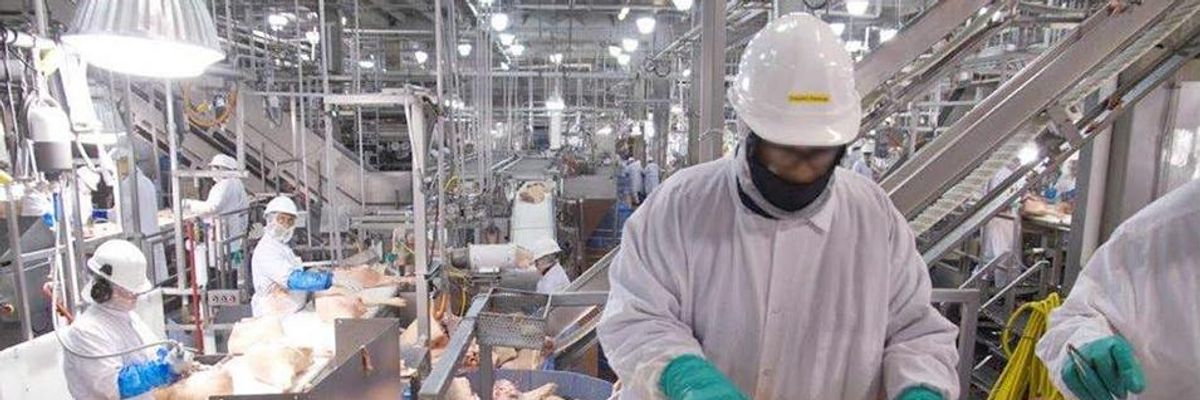
The Biden administration's Wednesday announcement allowing several pork processing plants to speed up production was well-received by livestock traders--pleased to see an immediate spike in hog futures--but progressive critics warned that the move will make slaughterhouses, and the nation's food supply, more dangerous.
"The Biden administration is caving to industry pressure."
After the U.S. Department of Agriculture (USDA) unveiled a pilot program that permits nine pork processing plants to apply to accelerate slaughter-line speeds, lean hog futures rose on the Chicago Mercantile Exchange, Reuters reported Wednesday.
"The announcement eased concerns that slower processing speeds had slowed meatpackers' demand for pigs to slaughter," the news outlet noted, citing traders.
Earlier this year, a federal judge invalidated part of the Trump administration's New Swine Slaughter Inspection System (NSIS), a 2019 rule that removed slaughter-line speed limits and weakened inspection procedures, which economic justice and food safety advocates warned would have devastating consequences for plant workers and public health.
Related Content

The court found that "the Trump administration acted unlawfully in 2019 when it eliminated limits on pork plant line speeds without considering the increased risk of injury to workers," the Washington Post reported. The ruling did not, however, affect the part of NSIS that "gave pork plant owners greater control over their facilities by allowing them to replace some USDA inspectors on slaughter-lines with their own employees."
The White House said in May that it would comply with the court order, but with its new USDA pilot program for faster processing speeds, "the Biden administration is caving to industry pressure," Food & Water Watch senior staff attorney Zach Corrigan said in a Wednesday statement.
"We already know that industry-friendly hog inspection rules create significantly more food safety problems than rules that require strong federal oversight," said Corrigan.
In addition to causing higher rates of fecal and digestive matter contamination, forcing slaughterhouse employees--who have been hit particularly hard by the Covid-19 pandemic--to cut hogs at a faster pace has resulted in a surge in worker injuries.
The Biden administration "was right to accept a court decision throwing out the awful Trump administration rules that allowed slaughterhouses to ramp up their slaughter-line speeds," said Corrigan. "Unfortunately, they are now reversing course on this with a pilot program that continues to put industry profits over protecting the safety of our food supply."
The Biden administration's Wednesday announcement allowing several pork processing plants to speed up production was well-received by livestock traders--pleased to see an immediate spike in hog futures--but progressive critics warned that the move will make slaughterhouses, and the nation's food supply, more dangerous.
"The Biden administration is caving to industry pressure."
After the U.S. Department of Agriculture (USDA) unveiled a pilot program that permits nine pork processing plants to apply to accelerate slaughter-line speeds, lean hog futures rose on the Chicago Mercantile Exchange, Reuters reported Wednesday.
"The announcement eased concerns that slower processing speeds had slowed meatpackers' demand for pigs to slaughter," the news outlet noted, citing traders.
Earlier this year, a federal judge invalidated part of the Trump administration's New Swine Slaughter Inspection System (NSIS), a 2019 rule that removed slaughter-line speed limits and weakened inspection procedures, which economic justice and food safety advocates warned would have devastating consequences for plant workers and public health.
Related Content
The court found that "the Trump administration acted unlawfully in 2019 when it eliminated limits on pork plant line speeds without considering the increased risk of injury to workers," the Washington Post reported. The ruling did not, however, affect the part of NSIS that "gave pork plant owners greater control over their facilities by allowing them to replace some USDA inspectors on slaughter-lines with their own employees."
The White House said in May that it would comply with the court order, but with its new USDA pilot program for faster processing speeds, "the Biden administration is caving to industry pressure," Food & Water Watch senior staff attorney Zach Corrigan said in a Wednesday statement.
"We already know that industry-friendly hog inspection rules create significantly more food safety problems than rules that require strong federal oversight," said Corrigan.
In addition to causing higher rates of fecal and digestive matter contamination, forcing slaughterhouse employees--who have been hit particularly hard by the Covid-19 pandemic--to cut hogs at a faster pace has resulted in a surge in worker injuries.
The Biden administration "was right to accept a court decision throwing out the awful Trump administration rules that allowed slaughterhouses to ramp up their slaughter-line speeds," said Corrigan. "Unfortunately, they are now reversing course on this with a pilot program that continues to put industry profits over protecting the safety of our food supply."
The Biden administration's Wednesday announcement allowing several pork processing plants to speed up production was well-received by livestock traders--pleased to see an immediate spike in hog futures--but progressive critics warned that the move will make slaughterhouses, and the nation's food supply, more dangerous.
"The Biden administration is caving to industry pressure."
After the U.S. Department of Agriculture (USDA) unveiled a pilot program that permits nine pork processing plants to apply to accelerate slaughter-line speeds, lean hog futures rose on the Chicago Mercantile Exchange, Reuters reported Wednesday.
"The announcement eased concerns that slower processing speeds had slowed meatpackers' demand for pigs to slaughter," the news outlet noted, citing traders.
Earlier this year, a federal judge invalidated part of the Trump administration's New Swine Slaughter Inspection System (NSIS), a 2019 rule that removed slaughter-line speed limits and weakened inspection procedures, which economic justice and food safety advocates warned would have devastating consequences for plant workers and public health.
Related Content
The court found that "the Trump administration acted unlawfully in 2019 when it eliminated limits on pork plant line speeds without considering the increased risk of injury to workers," the Washington Post reported. The ruling did not, however, affect the part of NSIS that "gave pork plant owners greater control over their facilities by allowing them to replace some USDA inspectors on slaughter-lines with their own employees."
The White House said in May that it would comply with the court order, but with its new USDA pilot program for faster processing speeds, "the Biden administration is caving to industry pressure," Food & Water Watch senior staff attorney Zach Corrigan said in a Wednesday statement.
"We already know that industry-friendly hog inspection rules create significantly more food safety problems than rules that require strong federal oversight," said Corrigan.
In addition to causing higher rates of fecal and digestive matter contamination, forcing slaughterhouse employees--who have been hit particularly hard by the Covid-19 pandemic--to cut hogs at a faster pace has resulted in a surge in worker injuries.
The Biden administration "was right to accept a court decision throwing out the awful Trump administration rules that allowed slaughterhouses to ramp up their slaughter-line speeds," said Corrigan. "Unfortunately, they are now reversing course on this with a pilot program that continues to put industry profits over protecting the safety of our food supply."