
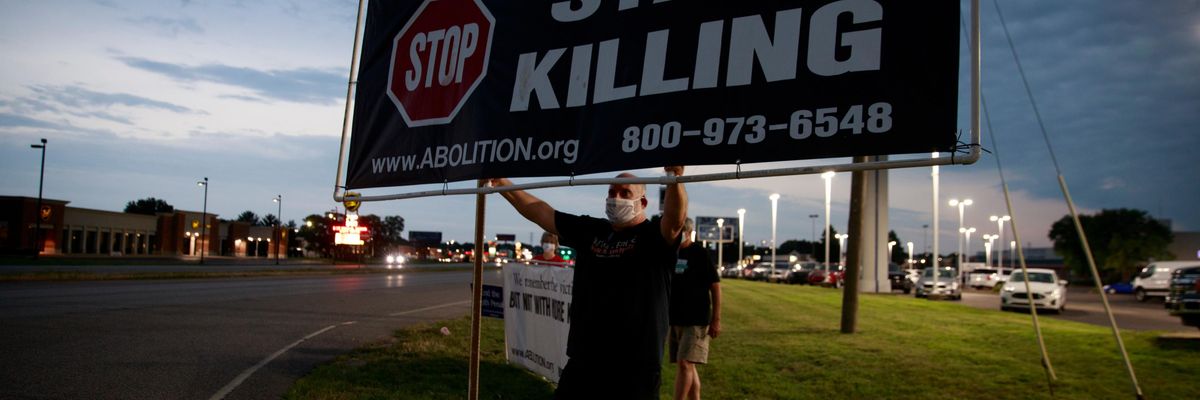
Death penalty abolitionist Abe Bonowitz of Death Penalty Action protests near the Terre Haute Federal Correctional Complex in Indiana on July 15, 2020. (Photo by Jeremy Hogan/SOPA Images/LightRocket via Getty Images)
'This Wasn't Justice. This Was Cruelty': Calls to Abolish Death Penalty Follow Ernest Lee Johnson Execution
"Ernest was a human being. He committed a terrible crime and was deeply remorseful. This was not justice."
Human rights defenders renewed calls for the abolition of capital punishment in the United States after the state of Missouri on Tuesday executed Ernest Lee Johnson, an intellectually disabled man.
"A disabled Black man was killed by the state of Missouri tonight. We must #EndTheDeathPenalty."
Johnson, who was 61 years old, was killed by a lethal injection of pentobarbital Tuesday evening at a state prison in Bonne Terre as witnesses including relatives of the three people he murdered during a 1994 convenience store robbery watched.
According to an Associated Press reporter who witnessed the execution, Johnson "silently mouthed words to relatives as the process began. His breathing became labored, he puffed out his cheeks, then swallowed hard. Within seconds, all movement stopped."
Johnson had exhausted all of his appeals, including to the U.S. Supreme Court. His lawyers argued the justices should have blocked the execution due to Johnson's intellectual disability. Attorney Jeremy Weis said his client was born with fetal alcohol syndrome and had consistently scored in the 60s and 70s on IQ tests over the course of his lifetime. Johnson also lost around one-fifth of his brain tissue during a 2008 tumor removal.
The Eighth Amendment prohibits the execution of intellectually disabled people, according to a 2002 Supreme Court ruling.
Prominent figures including Pope Francis, U.S. Reps. Cori Bush (D-Mo.) and Emanuel Cleaver (D-Mo.), and St. Louis Mayor Tishaura O. Jones had joined human rights advocates from around the world in demanding clemency for Johnson.
Republican Missouri Gov. Mike Parson ignored their pleas and the Constitution and denied clemency.
Death penalty abolitionists condemned what many called "state-sanctioned murder" following Johnson's execution.
"This wasn't justice. This was cruelty," Bush tweeted. "Abolish the death penalty."
"A disabled Black man was killed by the state of Missouri tonight," tweeted Rep. Ayanna Pressley (D-Mass.). "We must #EndTheDeathPenalty."
Rita Linhardt of the Missouri Catholic Conference said Johnson's execution "speaks more about who we are than who he is."
Many advocates tweeted photos of Johnson's final written statement, in which he wrote, in part, "I am soory (sic) and have remorse for what i do (sic)."
"We must abolish the death penalty in this country," former federal prosecutor Elizabeth de la Vega tweeted following Johnson's death.
Johnson was the first person executed in Missouri since May 2020 and the seventh in the United States this year.
According to the most recently available figures from the Death Penalty Information Center, only China, Iran, Saudi Arabia, Iraq, and Egypt executed more people than the United States in 2019. Last year, 17 people were killed by lethal injection or electrocution by five U.S. states and the federal government under former President Donald Trump.
Despite a campaign promise by President Joe Biden to "work to pass legislation to eliminate the death penalty at the federal level," his administration earlier this year asked the Supreme Court to reinstate the death sentence of Boston Marathon bomber Dzhokhar Tsarnaev.
We are at a crossroads
This country and this world are at a monumental crossroads. In a few short weeks, US voters will have an opportunity to beat back the forces of fascism and confront the billionaires who are rigging the economy, our media system, and our democracy, making it increasingly impossible for ordinary people to get by. We’re not just talking about the election. We’re talking about what must be done once these fascist elements are vanquished from power. We need a bolder set of solutions than what either major party has so far been willing to offer and a working-class movement ready to fight like hell for it. Trump didn't emerge from nowhere. The conditions that fueled MAGA authoritarianism were created by decades of radical neoliberal economic policies and a corrupt political system dominated by corporate interests. They slashed taxes on the super-rich, promising that the benefits would trickle down. They said giveaways to the corporate titans would make life more affordable for the rest of us. It was all bullshit. And when a bitter, betrayed populace searches for someone to blame, right-wing demagogues have little trouble finding scapegoats. People know when they're being lied to, but you won't hear any of this from the corporate media. Only independent journalism—powered and funded by people who believe in building a better world—can deliver truly trustworthy daily news. Our Fall Campaign is underway, and we need your help. To power our newsroom through the rest of the year, we need to raise $125,000 by midnight on October 31. So if you share our vision, please contribute whatever you can to sustain our work. |
Human rights defenders renewed calls for the abolition of capital punishment in the United States after the state of Missouri on Tuesday executed Ernest Lee Johnson, an intellectually disabled man.
"A disabled Black man was killed by the state of Missouri tonight. We must #EndTheDeathPenalty."
Johnson, who was 61 years old, was killed by a lethal injection of pentobarbital Tuesday evening at a state prison in Bonne Terre as witnesses including relatives of the three people he murdered during a 1994 convenience store robbery watched.
According to an Associated Press reporter who witnessed the execution, Johnson "silently mouthed words to relatives as the process began. His breathing became labored, he puffed out his cheeks, then swallowed hard. Within seconds, all movement stopped."
Johnson had exhausted all of his appeals, including to the U.S. Supreme Court. His lawyers argued the justices should have blocked the execution due to Johnson's intellectual disability. Attorney Jeremy Weis said his client was born with fetal alcohol syndrome and had consistently scored in the 60s and 70s on IQ tests over the course of his lifetime. Johnson also lost around one-fifth of his brain tissue during a 2008 tumor removal.
The Eighth Amendment prohibits the execution of intellectually disabled people, according to a 2002 Supreme Court ruling.
Prominent figures including Pope Francis, U.S. Reps. Cori Bush (D-Mo.) and Emanuel Cleaver (D-Mo.), and St. Louis Mayor Tishaura O. Jones had joined human rights advocates from around the world in demanding clemency for Johnson.
Republican Missouri Gov. Mike Parson ignored their pleas and the Constitution and denied clemency.
Death penalty abolitionists condemned what many called "state-sanctioned murder" following Johnson's execution.
"This wasn't justice. This was cruelty," Bush tweeted. "Abolish the death penalty."
"A disabled Black man was killed by the state of Missouri tonight," tweeted Rep. Ayanna Pressley (D-Mass.). "We must #EndTheDeathPenalty."
Rita Linhardt of the Missouri Catholic Conference said Johnson's execution "speaks more about who we are than who he is."
Many advocates tweeted photos of Johnson's final written statement, in which he wrote, in part, "I am soory (sic) and have remorse for what i do (sic)."
"We must abolish the death penalty in this country," former federal prosecutor Elizabeth de la Vega tweeted following Johnson's death.
Johnson was the first person executed in Missouri since May 2020 and the seventh in the United States this year.
According to the most recently available figures from the Death Penalty Information Center, only China, Iran, Saudi Arabia, Iraq, and Egypt executed more people than the United States in 2019. Last year, 17 people were killed by lethal injection or electrocution by five U.S. states and the federal government under former President Donald Trump.
Despite a campaign promise by President Joe Biden to "work to pass legislation to eliminate the death penalty at the federal level," his administration earlier this year asked the Supreme Court to reinstate the death sentence of Boston Marathon bomber Dzhokhar Tsarnaev.
Human rights defenders renewed calls for the abolition of capital punishment in the United States after the state of Missouri on Tuesday executed Ernest Lee Johnson, an intellectually disabled man.
"A disabled Black man was killed by the state of Missouri tonight. We must #EndTheDeathPenalty."
Johnson, who was 61 years old, was killed by a lethal injection of pentobarbital Tuesday evening at a state prison in Bonne Terre as witnesses including relatives of the three people he murdered during a 1994 convenience store robbery watched.
According to an Associated Press reporter who witnessed the execution, Johnson "silently mouthed words to relatives as the process began. His breathing became labored, he puffed out his cheeks, then swallowed hard. Within seconds, all movement stopped."
Johnson had exhausted all of his appeals, including to the U.S. Supreme Court. His lawyers argued the justices should have blocked the execution due to Johnson's intellectual disability. Attorney Jeremy Weis said his client was born with fetal alcohol syndrome and had consistently scored in the 60s and 70s on IQ tests over the course of his lifetime. Johnson also lost around one-fifth of his brain tissue during a 2008 tumor removal.
The Eighth Amendment prohibits the execution of intellectually disabled people, according to a 2002 Supreme Court ruling.
Prominent figures including Pope Francis, U.S. Reps. Cori Bush (D-Mo.) and Emanuel Cleaver (D-Mo.), and St. Louis Mayor Tishaura O. Jones had joined human rights advocates from around the world in demanding clemency for Johnson.
Republican Missouri Gov. Mike Parson ignored their pleas and the Constitution and denied clemency.
Death penalty abolitionists condemned what many called "state-sanctioned murder" following Johnson's execution.
"This wasn't justice. This was cruelty," Bush tweeted. "Abolish the death penalty."
"A disabled Black man was killed by the state of Missouri tonight," tweeted Rep. Ayanna Pressley (D-Mass.). "We must #EndTheDeathPenalty."
Rita Linhardt of the Missouri Catholic Conference said Johnson's execution "speaks more about who we are than who he is."
Many advocates tweeted photos of Johnson's final written statement, in which he wrote, in part, "I am soory (sic) and have remorse for what i do (sic)."
"We must abolish the death penalty in this country," former federal prosecutor Elizabeth de la Vega tweeted following Johnson's death.
Johnson was the first person executed in Missouri since May 2020 and the seventh in the United States this year.
According to the most recently available figures from the Death Penalty Information Center, only China, Iran, Saudi Arabia, Iraq, and Egypt executed more people than the United States in 2019. Last year, 17 people were killed by lethal injection or electrocution by five U.S. states and the federal government under former President Donald Trump.
Despite a campaign promise by President Joe Biden to "work to pass legislation to eliminate the death penalty at the federal level," his administration earlier this year asked the Supreme Court to reinstate the death sentence of Boston Marathon bomber Dzhokhar Tsarnaev.