SUBSCRIBE TO OUR FREE NEWSLETTER
Daily news & progressive opinion—funded by the people, not the corporations—delivered straight to your inbox.
5
#000000
#FFFFFF
To donate by check, phone, or other method, see our More Ways to Give page.
Daily news & progressive opinion—funded by the people, not the corporations—delivered straight to your inbox.
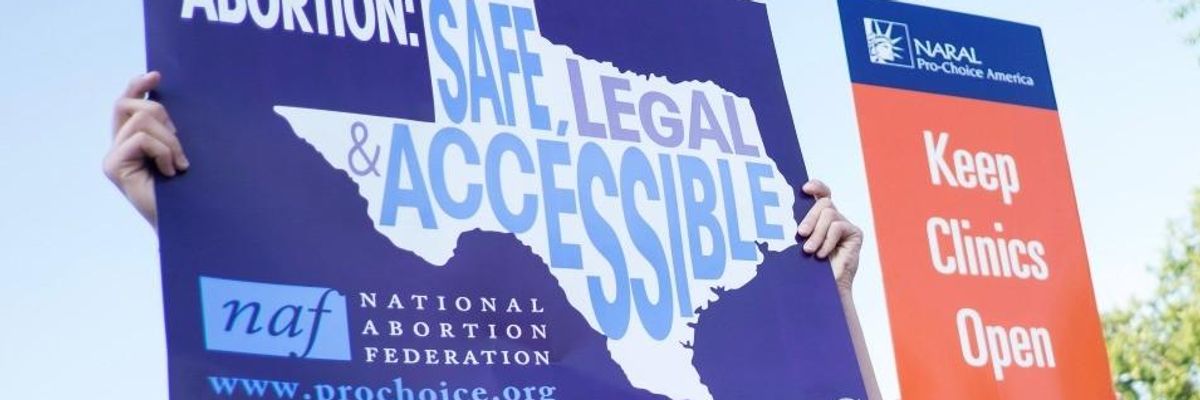
Protesters gathered in Washington, D.C. on June 2016 to demonstrate against restrictions on abortion access in Texas. (Photo: Pete Marovich/Getty Images)
While Republican lawmakers in several states are working to replicate an abortion ban recently enacted in Texas, healthcare providers and reproductive rights advocates on Thursday asked the U.S. Supreme Court to reconsider blocking the "patently unconstitutional" measure.
"For 23 days, we've been forced to deny essential abortion care for the vast majority of patients who come to us," said Amy Hagstrom Miller, president and CEO of Whole Woman's Health and Whole Woman's Health Alliance, in a statement about the new request (pdf).
"Most of those we've turned away told us they would not be able to make it out of Texas for care," she said. "I don't know what happened to these patients after they left our clinics, but I can't stop thinking about them. Forcing our staff to tell patients 'no' day after day is cruel. This chaos must come to an end, and that is why we are going back to the Supreme Court today."
Alexis McGill Johnson, president and CEO of Planned Parenthood Federation of America (PPFA), also emphasized the urgent need for an intervention to ensure access to essential healthcare.
"Planned Parenthood call centers have become crisis hotlines and health center staff have become crisis counselors," said the PPFA leader, whose group is representing Texas healthcare providers, abortion funds, and other plaintiffs alongside the Center for Reproductive Rights (CRR), the Lawyering Project, the national ACLU, the ACLU of Texas, and Morrison & Foerster LLP.
"For half a century, the Supreme Court has upheld the fundamental right to end a pregnancy. But for the past three weeks, five justices have shrugged their shoulders while Texas politicians do an end run around the Constitution and impose devastating harm on countless Texans, especially people of color," said Julia Kaye, a staff attorney at the ACLU Reproductive Freedom Project. "It is past time for the Supreme Court to step in and right this grave injustice."
The high court allowed Texas' Senate Bill 8 to take effect earlier this month in a 5-4 ruling for which Chief Justice John Roberts joined the three liberals. Though some critics say that move effectively overturned Roe v. Wade--the 1973 case that affirmed the right to abortion--the justices did not consider the constitutionality of the ban in their decision.
S.B. 8 not only bans abortion after six weeks--before many people know they are pregnant--without exceptions for rape or incest, it also empowers anti-choice vigilantes to enforce the law with the offer of a $10,000 "bounty," which the U.S. Department of Justice has noted is part of an "unprecedented scheme" to make the law harder to challenge in court.
Thursday's filing points out that since the justices' decision to refrain from blocking the law and let it move through the judicial system, the U.S. Court of Appeals for the 5th Circuit Circuit has indicated that its position is "under circuit precedent, federal courts are powerless to preemptively block enforcement of a privately enforced state-law prohibition."
The filing further notes that "although the 5th Circuit expedited the appeal, it will not hold argument until December at the earliest," and asserts quicker action is needed, given that S.B. 8 is already interfering with the healthcare and rights of Texans and residents of neighboring states, whose clinics have seen an increase in demand since the law took effect.
As CRR president and CEO Nancy Northup put it: "We're asking the Supreme Court for this expedited appeal because the 5th Circuit has done nothing to change the dire circumstances on the ground in Texas. We need this case to move as quickly as possible."
The filing highlights that "already, legislators in other states are taking notice and vowing to adopt copycat laws," and says there is no "reason to think abortion is the only constitutional right that will be targeted," echoing widespread warnings about other fundamental rights.
HuffPost reported that House Bill 167, introduced Wednesday by Florida Rep. Webster Barnaby (R-27), would go even further than S.B. 8--expanding the window of time in which lawsuits by private citizens could be brought against anyone who "aids or abets" an abortion beyond the six-week limit "from four years under the Texas law to six years in the Sunshine State."
At least two cases have already kicked off under Texas' law; they both target Dr. Alan Braid, a longtime abortion provider in San Antonio who over the weekend publicly admitted to violating S.B. 8, in hopes that the disclosure would help overturn the state's new ban.
The threat to reproductive rights posed by the Texas law, copycat legislation, and an upcoming Supreme Court case----a challenge to a Mississippi abortion ban that experts warn could reverse Roe--have collectively elevated calls for the Democrat-controlled Congress to take action.
Earlier this month, House Speaker Nancy Pelsoi (D-Calif.) announced the chamber will soon vote on the Women's Health Protection Act (WHPA), legislation to codify Roe that is broadly backed by rights advocates.
The Leadership Conference on Civil and Human Rights and 60 other organizations on Thursday sent a letter to lawmakers detailing the devastating impacts of state-level attacks on abortion rights like S.B. 8 and urging them to pass WHPA (H.R. 3755/S. 1975).
"The Women's Health Protection Act is an important step in ending these harmful laws," the groups argued, "and promoting the health, economic security, and well-being of those whom we have forced through law and policy to live at the margins."
Dear Common Dreams reader, It’s been nearly 30 years since I co-founded Common Dreams with my late wife, Lina Newhouser. We had the radical notion that journalism should serve the public good, not corporate profits. It was clear to us from the outset what it would take to build such a project. No paid advertisements. No corporate sponsors. No millionaire publisher telling us what to think or do. Many people said we wouldn't last a year, but we proved those doubters wrong. Together with a tremendous team of journalists and dedicated staff, we built an independent media outlet free from the constraints of profits and corporate control. Our mission has always been simple: To inform. To inspire. To ignite change for the common good. Building Common Dreams was not easy. Our survival was never guaranteed. When you take on the most powerful forces—Wall Street greed, fossil fuel industry destruction, Big Tech lobbyists, and uber-rich oligarchs who have spent billions upon billions rigging the economy and democracy in their favor—the only bulwark you have is supporters who believe in your work. But here’s the urgent message from me today. It's never been this bad out there. And it's never been this hard to keep us going. At the very moment Common Dreams is most needed, the threats we face are intensifying. We need your support now more than ever. We don't accept corporate advertising and never will. We don't have a paywall because we don't think people should be blocked from critical news based on their ability to pay. Everything we do is funded by the donations of readers like you. When everyone does the little they can afford, we are strong. But if that support retreats or dries up, so do we. Will you donate now to make sure Common Dreams not only survives but thrives? —Craig Brown, Co-founder |
While Republican lawmakers in several states are working to replicate an abortion ban recently enacted in Texas, healthcare providers and reproductive rights advocates on Thursday asked the U.S. Supreme Court to reconsider blocking the "patently unconstitutional" measure.
"For 23 days, we've been forced to deny essential abortion care for the vast majority of patients who come to us," said Amy Hagstrom Miller, president and CEO of Whole Woman's Health and Whole Woman's Health Alliance, in a statement about the new request (pdf).
"Most of those we've turned away told us they would not be able to make it out of Texas for care," she said. "I don't know what happened to these patients after they left our clinics, but I can't stop thinking about them. Forcing our staff to tell patients 'no' day after day is cruel. This chaos must come to an end, and that is why we are going back to the Supreme Court today."
Alexis McGill Johnson, president and CEO of Planned Parenthood Federation of America (PPFA), also emphasized the urgent need for an intervention to ensure access to essential healthcare.
"Planned Parenthood call centers have become crisis hotlines and health center staff have become crisis counselors," said the PPFA leader, whose group is representing Texas healthcare providers, abortion funds, and other plaintiffs alongside the Center for Reproductive Rights (CRR), the Lawyering Project, the national ACLU, the ACLU of Texas, and Morrison & Foerster LLP.
"For half a century, the Supreme Court has upheld the fundamental right to end a pregnancy. But for the past three weeks, five justices have shrugged their shoulders while Texas politicians do an end run around the Constitution and impose devastating harm on countless Texans, especially people of color," said Julia Kaye, a staff attorney at the ACLU Reproductive Freedom Project. "It is past time for the Supreme Court to step in and right this grave injustice."
The high court allowed Texas' Senate Bill 8 to take effect earlier this month in a 5-4 ruling for which Chief Justice John Roberts joined the three liberals. Though some critics say that move effectively overturned Roe v. Wade--the 1973 case that affirmed the right to abortion--the justices did not consider the constitutionality of the ban in their decision.
S.B. 8 not only bans abortion after six weeks--before many people know they are pregnant--without exceptions for rape or incest, it also empowers anti-choice vigilantes to enforce the law with the offer of a $10,000 "bounty," which the U.S. Department of Justice has noted is part of an "unprecedented scheme" to make the law harder to challenge in court.
Thursday's filing points out that since the justices' decision to refrain from blocking the law and let it move through the judicial system, the U.S. Court of Appeals for the 5th Circuit Circuit has indicated that its position is "under circuit precedent, federal courts are powerless to preemptively block enforcement of a privately enforced state-law prohibition."
The filing further notes that "although the 5th Circuit expedited the appeal, it will not hold argument until December at the earliest," and asserts quicker action is needed, given that S.B. 8 is already interfering with the healthcare and rights of Texans and residents of neighboring states, whose clinics have seen an increase in demand since the law took effect.
As CRR president and CEO Nancy Northup put it: "We're asking the Supreme Court for this expedited appeal because the 5th Circuit has done nothing to change the dire circumstances on the ground in Texas. We need this case to move as quickly as possible."
The filing highlights that "already, legislators in other states are taking notice and vowing to adopt copycat laws," and says there is no "reason to think abortion is the only constitutional right that will be targeted," echoing widespread warnings about other fundamental rights.
HuffPost reported that House Bill 167, introduced Wednesday by Florida Rep. Webster Barnaby (R-27), would go even further than S.B. 8--expanding the window of time in which lawsuits by private citizens could be brought against anyone who "aids or abets" an abortion beyond the six-week limit "from four years under the Texas law to six years in the Sunshine State."
At least two cases have already kicked off under Texas' law; they both target Dr. Alan Braid, a longtime abortion provider in San Antonio who over the weekend publicly admitted to violating S.B. 8, in hopes that the disclosure would help overturn the state's new ban.
The threat to reproductive rights posed by the Texas law, copycat legislation, and an upcoming Supreme Court case----a challenge to a Mississippi abortion ban that experts warn could reverse Roe--have collectively elevated calls for the Democrat-controlled Congress to take action.
Earlier this month, House Speaker Nancy Pelsoi (D-Calif.) announced the chamber will soon vote on the Women's Health Protection Act (WHPA), legislation to codify Roe that is broadly backed by rights advocates.
The Leadership Conference on Civil and Human Rights and 60 other organizations on Thursday sent a letter to lawmakers detailing the devastating impacts of state-level attacks on abortion rights like S.B. 8 and urging them to pass WHPA (H.R. 3755/S. 1975).
"The Women's Health Protection Act is an important step in ending these harmful laws," the groups argued, "and promoting the health, economic security, and well-being of those whom we have forced through law and policy to live at the margins."
While Republican lawmakers in several states are working to replicate an abortion ban recently enacted in Texas, healthcare providers and reproductive rights advocates on Thursday asked the U.S. Supreme Court to reconsider blocking the "patently unconstitutional" measure.
"For 23 days, we've been forced to deny essential abortion care for the vast majority of patients who come to us," said Amy Hagstrom Miller, president and CEO of Whole Woman's Health and Whole Woman's Health Alliance, in a statement about the new request (pdf).
"Most of those we've turned away told us they would not be able to make it out of Texas for care," she said. "I don't know what happened to these patients after they left our clinics, but I can't stop thinking about them. Forcing our staff to tell patients 'no' day after day is cruel. This chaos must come to an end, and that is why we are going back to the Supreme Court today."
Alexis McGill Johnson, president and CEO of Planned Parenthood Federation of America (PPFA), also emphasized the urgent need for an intervention to ensure access to essential healthcare.
"Planned Parenthood call centers have become crisis hotlines and health center staff have become crisis counselors," said the PPFA leader, whose group is representing Texas healthcare providers, abortion funds, and other plaintiffs alongside the Center for Reproductive Rights (CRR), the Lawyering Project, the national ACLU, the ACLU of Texas, and Morrison & Foerster LLP.
"For half a century, the Supreme Court has upheld the fundamental right to end a pregnancy. But for the past three weeks, five justices have shrugged their shoulders while Texas politicians do an end run around the Constitution and impose devastating harm on countless Texans, especially people of color," said Julia Kaye, a staff attorney at the ACLU Reproductive Freedom Project. "It is past time for the Supreme Court to step in and right this grave injustice."
The high court allowed Texas' Senate Bill 8 to take effect earlier this month in a 5-4 ruling for which Chief Justice John Roberts joined the three liberals. Though some critics say that move effectively overturned Roe v. Wade--the 1973 case that affirmed the right to abortion--the justices did not consider the constitutionality of the ban in their decision.
S.B. 8 not only bans abortion after six weeks--before many people know they are pregnant--without exceptions for rape or incest, it also empowers anti-choice vigilantes to enforce the law with the offer of a $10,000 "bounty," which the U.S. Department of Justice has noted is part of an "unprecedented scheme" to make the law harder to challenge in court.
Thursday's filing points out that since the justices' decision to refrain from blocking the law and let it move through the judicial system, the U.S. Court of Appeals for the 5th Circuit Circuit has indicated that its position is "under circuit precedent, federal courts are powerless to preemptively block enforcement of a privately enforced state-law prohibition."
The filing further notes that "although the 5th Circuit expedited the appeal, it will not hold argument until December at the earliest," and asserts quicker action is needed, given that S.B. 8 is already interfering with the healthcare and rights of Texans and residents of neighboring states, whose clinics have seen an increase in demand since the law took effect.
As CRR president and CEO Nancy Northup put it: "We're asking the Supreme Court for this expedited appeal because the 5th Circuit has done nothing to change the dire circumstances on the ground in Texas. We need this case to move as quickly as possible."
The filing highlights that "already, legislators in other states are taking notice and vowing to adopt copycat laws," and says there is no "reason to think abortion is the only constitutional right that will be targeted," echoing widespread warnings about other fundamental rights.
HuffPost reported that House Bill 167, introduced Wednesday by Florida Rep. Webster Barnaby (R-27), would go even further than S.B. 8--expanding the window of time in which lawsuits by private citizens could be brought against anyone who "aids or abets" an abortion beyond the six-week limit "from four years under the Texas law to six years in the Sunshine State."
At least two cases have already kicked off under Texas' law; they both target Dr. Alan Braid, a longtime abortion provider in San Antonio who over the weekend publicly admitted to violating S.B. 8, in hopes that the disclosure would help overturn the state's new ban.
The threat to reproductive rights posed by the Texas law, copycat legislation, and an upcoming Supreme Court case----a challenge to a Mississippi abortion ban that experts warn could reverse Roe--have collectively elevated calls for the Democrat-controlled Congress to take action.
Earlier this month, House Speaker Nancy Pelsoi (D-Calif.) announced the chamber will soon vote on the Women's Health Protection Act (WHPA), legislation to codify Roe that is broadly backed by rights advocates.
The Leadership Conference on Civil and Human Rights and 60 other organizations on Thursday sent a letter to lawmakers detailing the devastating impacts of state-level attacks on abortion rights like S.B. 8 and urging them to pass WHPA (H.R. 3755/S. 1975).
"The Women's Health Protection Act is an important step in ending these harmful laws," the groups argued, "and promoting the health, economic security, and well-being of those whom we have forced through law and policy to live at the margins."