SUBSCRIBE TO OUR FREE NEWSLETTER
Daily news & progressive opinion—funded by the people, not the corporations—delivered straight to your inbox.
5
#000000
#FFFFFF
To donate by check, phone, or other method, see our More Ways to Give page.
Daily news & progressive opinion—funded by the people, not the corporations—delivered straight to your inbox.
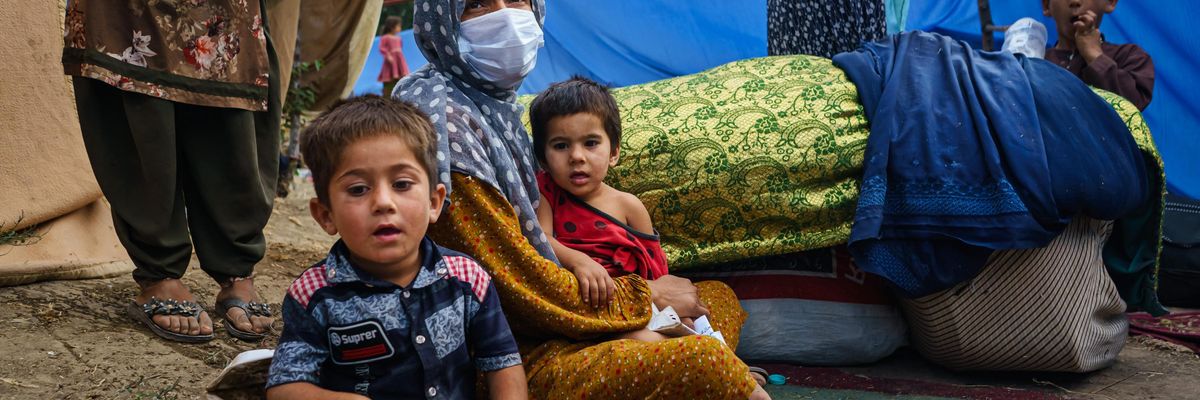
Afghans seek shelter from fighting between the Taliban and Afghan security forces on August 14, 2021. (Photo: Marcus Yam/Los Angeles Times via Getty Images)
As U.S. lawmakers fight over how to reappropriate the roughly $6 billion previously budgeted or requested to support the now defeated Afghan security forces, one U.S.-based peace group is urging Congress to use the freed up war money "to help save Afghan lives, not to boost Pentagon contractor profits."
"After two decades of occupation, tens of thousands of lives lost, and millions more displaced, it would be an insult to the people of Afghanistan to turn around and use the funds freed up by their government's collapse to double down on weapons and war."
--Kate Kizer, Win Without War
The funds in question "include almost $3 billion unspent from fiscal years 2020 and 2021, and $3.3 billion requested by the Pentagon to train and equip the Afghan army, air force, and national police in 2022," Politico reported earlier this week. "The jockeying among lawmakers to find a new home for that money has begun."
In response, Win Without War has launched a petition imploring members of Congress to reject calls to use the billions of dollars currently earmarked for Afghanistan's erstwhile military to buy "a few more F-35s or bombs" and instead spend the money in ways that ameliorate the war-torn country's growing humanitarian crisis.
"In a moment of immense need for the people of Afghanistan, some in Congress intend to divert billions of dollars originally intended for the now-defunct Afghan security forces to wage more endless war abroad," Kate Kizer, policy director at Win Without War, said this week. "This is an outrage."
"We owe the people of Afghanistan an immeasurable debt," Kizer continued. "Every last dollar of the $6 billion must be used to help save Afghan lives, not to boost Pentagon contractor profits."
"Redirecting these $6 billion to finance evacuations, refugee resettlement, and much-needed humanitarian assistance, for example, could spell the difference between life and death for countless Afghans," she said.
Rep. Mike Rogers (R-Ala.), ranking member of the House Armed Services Committee (HASC), told Politico that "there's gonna be a food fight. A whole lot of people have been looking at that money now."
Rogers expects that he and HASC Chair Rep. Adam Smith (D-Wash.) will agree on reallocating previously approved and proposed funding for the Afghan military to so-called "counterterrorism efforts."
Stephen Miles, executive director at Win Without War, tweeted on Wednesday that "if HASC Democrats or HASC Republicans spend one dime of that $6 billion on ANYTHING other than helping the Afghan people, saving lives, and meeting dual need[s] of refugee resettlement and humanitarian aid they should be beyond ashamed of themselves."
Echoing Miles' message, HASC member Rep. Ro Khanna (D-Calif.) said that every lawmaker on the committee "who is on television talking about our moral duty to Afghan women and children and Afghan allies should agree to spend this $6 billion on helping the Afghan people."
The Senate Armed Services Committee in July approved its version of the National Defense Authorization Act, which includes the Pentagon's request for $3.3 billion for Afghan security forces, Politico reported. The news outlet added:
Sen. Jack Reed (D-R.I.), who chairs the committee, is weighing how to handle the funding ahead of a Senate debate on the legislation this fall.
The money would have come on top of the $83 billion the U.S. has already spent to train and equip the Afghan military and security forces over the past two decades. But those forces, however large and well-equipped they were just two weeks ago, no longer exist.
Kizer, meanwhile, stressed that "after two decades of occupation, tens of thousands of lives lost, and millions more displaced, it would be an insult to the people of Afghanistan to turn around and use the funds freed up by their government's collapse to double down on weapons and war."
"The lesson of Afghanistan is that endless war does not work," she added. "Having spent $2 trillion on that lesson, now is our chance to prove we learned it by investing in saving lives, not waging more war."
Dear Common Dreams reader, It’s been nearly 30 years since I co-founded Common Dreams with my late wife, Lina Newhouser. We had the radical notion that journalism should serve the public good, not corporate profits. It was clear to us from the outset what it would take to build such a project. No paid advertisements. No corporate sponsors. No millionaire publisher telling us what to think or do. Many people said we wouldn't last a year, but we proved those doubters wrong. Together with a tremendous team of journalists and dedicated staff, we built an independent media outlet free from the constraints of profits and corporate control. Our mission has always been simple: To inform. To inspire. To ignite change for the common good. Building Common Dreams was not easy. Our survival was never guaranteed. When you take on the most powerful forces—Wall Street greed, fossil fuel industry destruction, Big Tech lobbyists, and uber-rich oligarchs who have spent billions upon billions rigging the economy and democracy in their favor—the only bulwark you have is supporters who believe in your work. But here’s the urgent message from me today. It's never been this bad out there. And it's never been this hard to keep us going. At the very moment Common Dreams is most needed, the threats we face are intensifying. We need your support now more than ever. We don't accept corporate advertising and never will. We don't have a paywall because we don't think people should be blocked from critical news based on their ability to pay. Everything we do is funded by the donations of readers like you. When everyone does the little they can afford, we are strong. But if that support retreats or dries up, so do we. Will you donate now to make sure Common Dreams not only survives but thrives? —Craig Brown, Co-founder |
As U.S. lawmakers fight over how to reappropriate the roughly $6 billion previously budgeted or requested to support the now defeated Afghan security forces, one U.S.-based peace group is urging Congress to use the freed up war money "to help save Afghan lives, not to boost Pentagon contractor profits."
"After two decades of occupation, tens of thousands of lives lost, and millions more displaced, it would be an insult to the people of Afghanistan to turn around and use the funds freed up by their government's collapse to double down on weapons and war."
--Kate Kizer, Win Without War
The funds in question "include almost $3 billion unspent from fiscal years 2020 and 2021, and $3.3 billion requested by the Pentagon to train and equip the Afghan army, air force, and national police in 2022," Politico reported earlier this week. "The jockeying among lawmakers to find a new home for that money has begun."
In response, Win Without War has launched a petition imploring members of Congress to reject calls to use the billions of dollars currently earmarked for Afghanistan's erstwhile military to buy "a few more F-35s or bombs" and instead spend the money in ways that ameliorate the war-torn country's growing humanitarian crisis.
"In a moment of immense need for the people of Afghanistan, some in Congress intend to divert billions of dollars originally intended for the now-defunct Afghan security forces to wage more endless war abroad," Kate Kizer, policy director at Win Without War, said this week. "This is an outrage."
"We owe the people of Afghanistan an immeasurable debt," Kizer continued. "Every last dollar of the $6 billion must be used to help save Afghan lives, not to boost Pentagon contractor profits."
"Redirecting these $6 billion to finance evacuations, refugee resettlement, and much-needed humanitarian assistance, for example, could spell the difference between life and death for countless Afghans," she said.
Rep. Mike Rogers (R-Ala.), ranking member of the House Armed Services Committee (HASC), told Politico that "there's gonna be a food fight. A whole lot of people have been looking at that money now."
Rogers expects that he and HASC Chair Rep. Adam Smith (D-Wash.) will agree on reallocating previously approved and proposed funding for the Afghan military to so-called "counterterrorism efforts."
Stephen Miles, executive director at Win Without War, tweeted on Wednesday that "if HASC Democrats or HASC Republicans spend one dime of that $6 billion on ANYTHING other than helping the Afghan people, saving lives, and meeting dual need[s] of refugee resettlement and humanitarian aid they should be beyond ashamed of themselves."
Echoing Miles' message, HASC member Rep. Ro Khanna (D-Calif.) said that every lawmaker on the committee "who is on television talking about our moral duty to Afghan women and children and Afghan allies should agree to spend this $6 billion on helping the Afghan people."
The Senate Armed Services Committee in July approved its version of the National Defense Authorization Act, which includes the Pentagon's request for $3.3 billion for Afghan security forces, Politico reported. The news outlet added:
Sen. Jack Reed (D-R.I.), who chairs the committee, is weighing how to handle the funding ahead of a Senate debate on the legislation this fall.
The money would have come on top of the $83 billion the U.S. has already spent to train and equip the Afghan military and security forces over the past two decades. But those forces, however large and well-equipped they were just two weeks ago, no longer exist.
Kizer, meanwhile, stressed that "after two decades of occupation, tens of thousands of lives lost, and millions more displaced, it would be an insult to the people of Afghanistan to turn around and use the funds freed up by their government's collapse to double down on weapons and war."
"The lesson of Afghanistan is that endless war does not work," she added. "Having spent $2 trillion on that lesson, now is our chance to prove we learned it by investing in saving lives, not waging more war."
As U.S. lawmakers fight over how to reappropriate the roughly $6 billion previously budgeted or requested to support the now defeated Afghan security forces, one U.S.-based peace group is urging Congress to use the freed up war money "to help save Afghan lives, not to boost Pentagon contractor profits."
"After two decades of occupation, tens of thousands of lives lost, and millions more displaced, it would be an insult to the people of Afghanistan to turn around and use the funds freed up by their government's collapse to double down on weapons and war."
--Kate Kizer, Win Without War
The funds in question "include almost $3 billion unspent from fiscal years 2020 and 2021, and $3.3 billion requested by the Pentagon to train and equip the Afghan army, air force, and national police in 2022," Politico reported earlier this week. "The jockeying among lawmakers to find a new home for that money has begun."
In response, Win Without War has launched a petition imploring members of Congress to reject calls to use the billions of dollars currently earmarked for Afghanistan's erstwhile military to buy "a few more F-35s or bombs" and instead spend the money in ways that ameliorate the war-torn country's growing humanitarian crisis.
"In a moment of immense need for the people of Afghanistan, some in Congress intend to divert billions of dollars originally intended for the now-defunct Afghan security forces to wage more endless war abroad," Kate Kizer, policy director at Win Without War, said this week. "This is an outrage."
"We owe the people of Afghanistan an immeasurable debt," Kizer continued. "Every last dollar of the $6 billion must be used to help save Afghan lives, not to boost Pentagon contractor profits."
"Redirecting these $6 billion to finance evacuations, refugee resettlement, and much-needed humanitarian assistance, for example, could spell the difference between life and death for countless Afghans," she said.
Rep. Mike Rogers (R-Ala.), ranking member of the House Armed Services Committee (HASC), told Politico that "there's gonna be a food fight. A whole lot of people have been looking at that money now."
Rogers expects that he and HASC Chair Rep. Adam Smith (D-Wash.) will agree on reallocating previously approved and proposed funding for the Afghan military to so-called "counterterrorism efforts."
Stephen Miles, executive director at Win Without War, tweeted on Wednesday that "if HASC Democrats or HASC Republicans spend one dime of that $6 billion on ANYTHING other than helping the Afghan people, saving lives, and meeting dual need[s] of refugee resettlement and humanitarian aid they should be beyond ashamed of themselves."
Echoing Miles' message, HASC member Rep. Ro Khanna (D-Calif.) said that every lawmaker on the committee "who is on television talking about our moral duty to Afghan women and children and Afghan allies should agree to spend this $6 billion on helping the Afghan people."
The Senate Armed Services Committee in July approved its version of the National Defense Authorization Act, which includes the Pentagon's request for $3.3 billion for Afghan security forces, Politico reported. The news outlet added:
Sen. Jack Reed (D-R.I.), who chairs the committee, is weighing how to handle the funding ahead of a Senate debate on the legislation this fall.
The money would have come on top of the $83 billion the U.S. has already spent to train and equip the Afghan military and security forces over the past two decades. But those forces, however large and well-equipped they were just two weeks ago, no longer exist.
Kizer, meanwhile, stressed that "after two decades of occupation, tens of thousands of lives lost, and millions more displaced, it would be an insult to the people of Afghanistan to turn around and use the funds freed up by their government's collapse to double down on weapons and war."
"The lesson of Afghanistan is that endless war does not work," she added. "Having spent $2 trillion on that lesson, now is our chance to prove we learned it by investing in saving lives, not waging more war."