SUBSCRIBE TO OUR FREE NEWSLETTER
Daily news & progressive opinion—funded by the people, not the corporations—delivered straight to your inbox.
5
#000000
#FFFFFF
To donate by check, phone, or other method, see our More Ways to Give page.
Daily news & progressive opinion—funded by the people, not the corporations—delivered straight to your inbox.
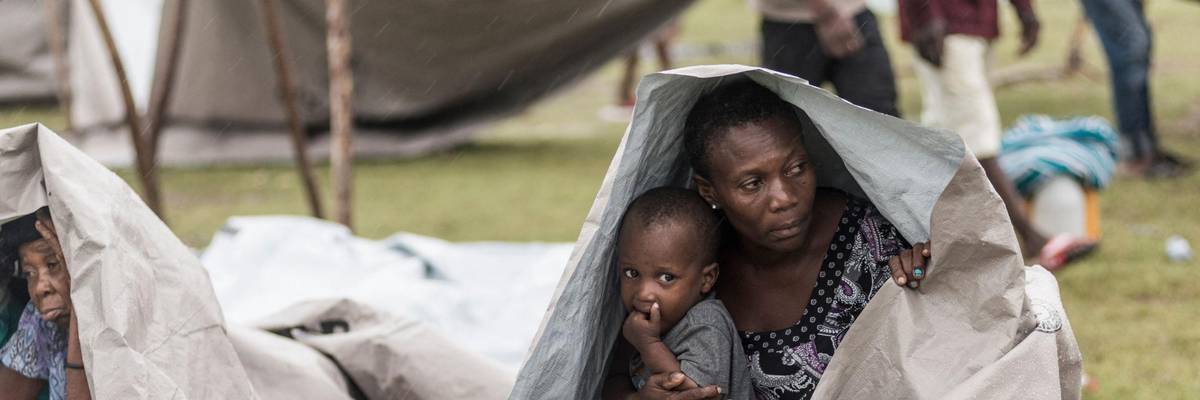
People gather on August 17, 2021 after spending the night outside in Les Cayes, Haiti as heavy rain brought by tropical storm Grace hit just after a 7.2 magnitude earthquake struck the region, killing at least 1,400 people. (Photo: Reginald Louissant Jr./AFP viaGetty Images)
As Haitians reel amid the aftershocks of a major earthquake, a tropical storm, political upheaval, and the ongoing coronavirus pandemic, refugee advocates this week are calling on the Biden administration to stop deporting people back to the ravaged nation and to extend its Temporary Protected Status designation.
"It is unconscionable for the U.S. government to forcibly remove anyone to Haiti right now."
--Blaine Bookey, CRGS
According to the California-based Haitian Bridge Alliance and the Florida Immigration Coalition, two deportation flights left Texas for Haiti last week. Melissa Taveras, director of government relations at the Florida Immigrant Coalition, told the Miami Herald that around "100 Haitians, all noncriminal Haitians including women and children" were deported on August 10 and August 12--just two days before the magnitude 7.2 earthquake that has so far killed at least 1,419 people and injured more than 6,900 others.
"My question is whether it is the goal of the U.S. government to continue to contribute to the destabilization of Haiti?" asked Haitian Bridge Alliance co-founder and executive director Guerline Jozef. "How can the U.S. government deport anyone to Haiti right now? How do they think so little of Haitian lives, deporting children and babies in the middle of the chaos?"
"This is a clear example of external violence that continues to deepen the instability in Haiti," Jozef added. "What is the purpose of sending a two-year-old to Haiti right now? It cannot be deterrence, we all know that deterrence does not work. We also want to know who in Haiti's government is accepting these flights, which is a form of internal violence? We need answers from both the United States and Haiti."
In May, the U.S. Department of Homeland Security designated Haiti for Temporary Protected Status (TPS)--which permits recipients to live and work in the United States for a given period without risk of deportation--for 18 months. According to DHS, the May designation "enables Haitian nationals... currently residing in the United States as of May 21, 2021 to file initial applications for TPS, so long as they meet eligibility requirements."
Following the assassination of former President Jovenel Moise last month, DHS further expanded Haiti's TPS through February 3, 2023 to include Haitians living in the U.S. as of July 29, 2021.
Tessa Petit, Florida Immigrant Coalition's director of operations, questioned expulsions of Haitians this year, noting that some may be illegal, because if the deportees "were on U.S. soil prior to [July] 29th they should be eligible" for TPS residency.
"Our concern is that the folks who are being deported because they don't have due process... It's hard to know if they entered the United States before July 29th," Petit told the Herald.
The Biden administration has faced intense criticism, and legal action, for its use of a public health provision known as Title 42 to fast-track deportations during the Covid-19 pandemic. The administration deported more than 300,000 people in its first 100 days, largely under Title 42.
Additionally, Homeland Security Secretary Alejandro Mayorkas--whose own family fled revolutionary Cuba for the U.S. in the 1960s--drew ire last month after he announced that Cuban and Haitian refugees who flee their countries by boat were not welcome in the United States.
Andre Mondesir, lead organizer at the National TPS Alliance, told the Herald that "we are urgently calling Secretary Mayorkas and the Biden administration to once again extend the new TPS designation date for Haiti to benefit more Haitians currently residing in the United States."
"We are urgently calling Secretary Mayorkas and the Biden administration to once again extend the new TPS designation date for Haiti."
--Andre Mondesir, National TPS Alliance
Leah Chavla, senior police adviser at the Women's Refugee Commission (WRC), said in a statement that "it is crystal-clear that now is not the time for the United States to be forcibly removing anyone to Haiti, and frankly it has been dangerous to do so for months now."
"Sending people back in the midst of a natural disaster... on top of political turmoil and violence following the recent assassination of the president--will only exacerbate human suffering," added Chavla. "Deportations under these circumstances will further destabilize Haiti in a moment when it needs support from the international community."
Blaine Bookey, legal director of Center for Refugee and Gender Studies (CRGS) at the University of California, Hastings College of the Law in San Francisco, said that "it is unconscionable for the U.S. government to forcibly remove anyone to Haiti right now."
"Instead of continuing to forcibly and unlawfully push individuals, including infants and pregnant people, into harm's way," added Bookey, "we should focus U.S. resources on supporting relief organizations that center Haitian, community-led solutions."
Dear Common Dreams reader, It’s been nearly 30 years since I co-founded Common Dreams with my late wife, Lina Newhouser. We had the radical notion that journalism should serve the public good, not corporate profits. It was clear to us from the outset what it would take to build such a project. No paid advertisements. No corporate sponsors. No millionaire publisher telling us what to think or do. Many people said we wouldn't last a year, but we proved those doubters wrong. Together with a tremendous team of journalists and dedicated staff, we built an independent media outlet free from the constraints of profits and corporate control. Our mission has always been simple: To inform. To inspire. To ignite change for the common good. Building Common Dreams was not easy. Our survival was never guaranteed. When you take on the most powerful forces—Wall Street greed, fossil fuel industry destruction, Big Tech lobbyists, and uber-rich oligarchs who have spent billions upon billions rigging the economy and democracy in their favor—the only bulwark you have is supporters who believe in your work. But here’s the urgent message from me today. It's never been this bad out there. And it's never been this hard to keep us going. At the very moment Common Dreams is most needed, the threats we face are intensifying. We need your support now more than ever. We don't accept corporate advertising and never will. We don't have a paywall because we don't think people should be blocked from critical news based on their ability to pay. Everything we do is funded by the donations of readers like you. When everyone does the little they can afford, we are strong. But if that support retreats or dries up, so do we. Will you donate now to make sure Common Dreams not only survives but thrives? —Craig Brown, Co-founder |
As Haitians reel amid the aftershocks of a major earthquake, a tropical storm, political upheaval, and the ongoing coronavirus pandemic, refugee advocates this week are calling on the Biden administration to stop deporting people back to the ravaged nation and to extend its Temporary Protected Status designation.
"It is unconscionable for the U.S. government to forcibly remove anyone to Haiti right now."
--Blaine Bookey, CRGS
According to the California-based Haitian Bridge Alliance and the Florida Immigration Coalition, two deportation flights left Texas for Haiti last week. Melissa Taveras, director of government relations at the Florida Immigrant Coalition, told the Miami Herald that around "100 Haitians, all noncriminal Haitians including women and children" were deported on August 10 and August 12--just two days before the magnitude 7.2 earthquake that has so far killed at least 1,419 people and injured more than 6,900 others.
"My question is whether it is the goal of the U.S. government to continue to contribute to the destabilization of Haiti?" asked Haitian Bridge Alliance co-founder and executive director Guerline Jozef. "How can the U.S. government deport anyone to Haiti right now? How do they think so little of Haitian lives, deporting children and babies in the middle of the chaos?"
"This is a clear example of external violence that continues to deepen the instability in Haiti," Jozef added. "What is the purpose of sending a two-year-old to Haiti right now? It cannot be deterrence, we all know that deterrence does not work. We also want to know who in Haiti's government is accepting these flights, which is a form of internal violence? We need answers from both the United States and Haiti."
In May, the U.S. Department of Homeland Security designated Haiti for Temporary Protected Status (TPS)--which permits recipients to live and work in the United States for a given period without risk of deportation--for 18 months. According to DHS, the May designation "enables Haitian nationals... currently residing in the United States as of May 21, 2021 to file initial applications for TPS, so long as they meet eligibility requirements."
Following the assassination of former President Jovenel Moise last month, DHS further expanded Haiti's TPS through February 3, 2023 to include Haitians living in the U.S. as of July 29, 2021.
Tessa Petit, Florida Immigrant Coalition's director of operations, questioned expulsions of Haitians this year, noting that some may be illegal, because if the deportees "were on U.S. soil prior to [July] 29th they should be eligible" for TPS residency.
"Our concern is that the folks who are being deported because they don't have due process... It's hard to know if they entered the United States before July 29th," Petit told the Herald.
The Biden administration has faced intense criticism, and legal action, for its use of a public health provision known as Title 42 to fast-track deportations during the Covid-19 pandemic. The administration deported more than 300,000 people in its first 100 days, largely under Title 42.
Additionally, Homeland Security Secretary Alejandro Mayorkas--whose own family fled revolutionary Cuba for the U.S. in the 1960s--drew ire last month after he announced that Cuban and Haitian refugees who flee their countries by boat were not welcome in the United States.
Andre Mondesir, lead organizer at the National TPS Alliance, told the Herald that "we are urgently calling Secretary Mayorkas and the Biden administration to once again extend the new TPS designation date for Haiti to benefit more Haitians currently residing in the United States."
"We are urgently calling Secretary Mayorkas and the Biden administration to once again extend the new TPS designation date for Haiti."
--Andre Mondesir, National TPS Alliance
Leah Chavla, senior police adviser at the Women's Refugee Commission (WRC), said in a statement that "it is crystal-clear that now is not the time for the United States to be forcibly removing anyone to Haiti, and frankly it has been dangerous to do so for months now."
"Sending people back in the midst of a natural disaster... on top of political turmoil and violence following the recent assassination of the president--will only exacerbate human suffering," added Chavla. "Deportations under these circumstances will further destabilize Haiti in a moment when it needs support from the international community."
Blaine Bookey, legal director of Center for Refugee and Gender Studies (CRGS) at the University of California, Hastings College of the Law in San Francisco, said that "it is unconscionable for the U.S. government to forcibly remove anyone to Haiti right now."
"Instead of continuing to forcibly and unlawfully push individuals, including infants and pregnant people, into harm's way," added Bookey, "we should focus U.S. resources on supporting relief organizations that center Haitian, community-led solutions."
As Haitians reel amid the aftershocks of a major earthquake, a tropical storm, political upheaval, and the ongoing coronavirus pandemic, refugee advocates this week are calling on the Biden administration to stop deporting people back to the ravaged nation and to extend its Temporary Protected Status designation.
"It is unconscionable for the U.S. government to forcibly remove anyone to Haiti right now."
--Blaine Bookey, CRGS
According to the California-based Haitian Bridge Alliance and the Florida Immigration Coalition, two deportation flights left Texas for Haiti last week. Melissa Taveras, director of government relations at the Florida Immigrant Coalition, told the Miami Herald that around "100 Haitians, all noncriminal Haitians including women and children" were deported on August 10 and August 12--just two days before the magnitude 7.2 earthquake that has so far killed at least 1,419 people and injured more than 6,900 others.
"My question is whether it is the goal of the U.S. government to continue to contribute to the destabilization of Haiti?" asked Haitian Bridge Alliance co-founder and executive director Guerline Jozef. "How can the U.S. government deport anyone to Haiti right now? How do they think so little of Haitian lives, deporting children and babies in the middle of the chaos?"
"This is a clear example of external violence that continues to deepen the instability in Haiti," Jozef added. "What is the purpose of sending a two-year-old to Haiti right now? It cannot be deterrence, we all know that deterrence does not work. We also want to know who in Haiti's government is accepting these flights, which is a form of internal violence? We need answers from both the United States and Haiti."
In May, the U.S. Department of Homeland Security designated Haiti for Temporary Protected Status (TPS)--which permits recipients to live and work in the United States for a given period without risk of deportation--for 18 months. According to DHS, the May designation "enables Haitian nationals... currently residing in the United States as of May 21, 2021 to file initial applications for TPS, so long as they meet eligibility requirements."
Following the assassination of former President Jovenel Moise last month, DHS further expanded Haiti's TPS through February 3, 2023 to include Haitians living in the U.S. as of July 29, 2021.
Tessa Petit, Florida Immigrant Coalition's director of operations, questioned expulsions of Haitians this year, noting that some may be illegal, because if the deportees "were on U.S. soil prior to [July] 29th they should be eligible" for TPS residency.
"Our concern is that the folks who are being deported because they don't have due process... It's hard to know if they entered the United States before July 29th," Petit told the Herald.
The Biden administration has faced intense criticism, and legal action, for its use of a public health provision known as Title 42 to fast-track deportations during the Covid-19 pandemic. The administration deported more than 300,000 people in its first 100 days, largely under Title 42.
Additionally, Homeland Security Secretary Alejandro Mayorkas--whose own family fled revolutionary Cuba for the U.S. in the 1960s--drew ire last month after he announced that Cuban and Haitian refugees who flee their countries by boat were not welcome in the United States.
Andre Mondesir, lead organizer at the National TPS Alliance, told the Herald that "we are urgently calling Secretary Mayorkas and the Biden administration to once again extend the new TPS designation date for Haiti to benefit more Haitians currently residing in the United States."
"We are urgently calling Secretary Mayorkas and the Biden administration to once again extend the new TPS designation date for Haiti."
--Andre Mondesir, National TPS Alliance
Leah Chavla, senior police adviser at the Women's Refugee Commission (WRC), said in a statement that "it is crystal-clear that now is not the time for the United States to be forcibly removing anyone to Haiti, and frankly it has been dangerous to do so for months now."
"Sending people back in the midst of a natural disaster... on top of political turmoil and violence following the recent assassination of the president--will only exacerbate human suffering," added Chavla. "Deportations under these circumstances will further destabilize Haiti in a moment when it needs support from the international community."
Blaine Bookey, legal director of Center for Refugee and Gender Studies (CRGS) at the University of California, Hastings College of the Law in San Francisco, said that "it is unconscionable for the U.S. government to forcibly remove anyone to Haiti right now."
"Instead of continuing to forcibly and unlawfully push individuals, including infants and pregnant people, into harm's way," added Bookey, "we should focus U.S. resources on supporting relief organizations that center Haitian, community-led solutions."