

SUBSCRIBE TO OUR FREE NEWSLETTER
Daily news & progressive opinion—funded by the people, not the corporations—delivered straight to your inbox.
5
#000000
#FFFFFF
To donate by check, phone, or other method, see our More Ways to Give page.
Daily news & progressive opinion—funded by the people, not the corporations—delivered straight to your inbox.
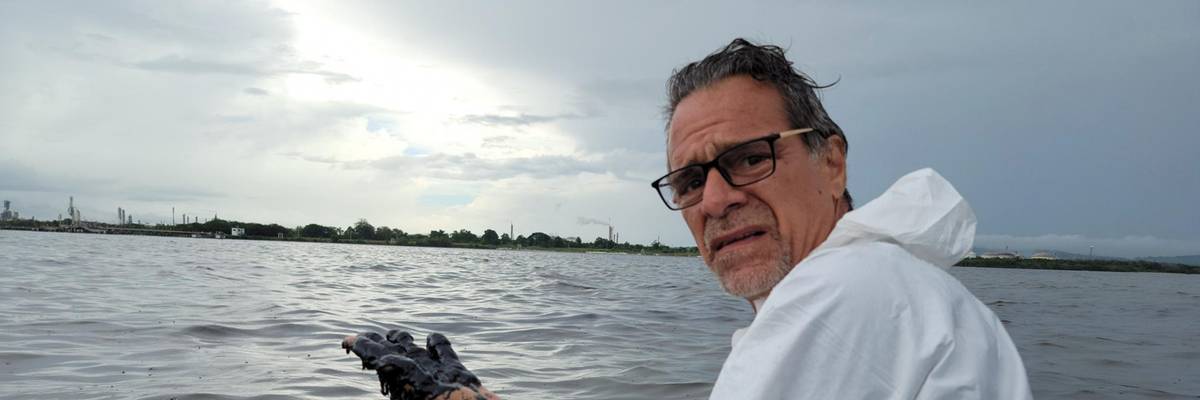
Fishermen and Friends of the Sea (FFOS) corporate secretary Gary Aboud holds up a hand coated in thick oil from a Paria Fuel Trading Company Limited pipeline spill in the Gulf of Paria on August 10, 2021. (Photo: Gary Aboud/Facebook)
Fishers and environmentalists expressed outrage this week over what they called the inadequate response by Trinidad and Tobago's government and one of the country's leading fossil fuel companies to the latest of hundreds of reported oil spills there in recent years.
"What is going to happen to the fisherfolk? What will be the environmental impacts, and what will this do to fishing in the Gulf?"
--Imitiaz Khan, Carli Bay Fishing Association
Earlier this week Trinidad and Tobago's Environmental Management Authority (EMA), Ministry of Energy and Energy Industries (MEEI), and Institute of Marine Affairs (IMA) announced they were investigating the spill, which Paria Fuel Trading Company Limited said originated from a leak in a pipeline near its Pointe-a-Pierre refinery last weekend, according to the Trinidad & Tobago Guardian.
EMA officials said containment measures and booms were deployed in order to mitigate the accident, and that vessels were being used to break up the oil coating the water's surface.
Gary Aboud, corporate secretary of the advocacy group Fishermen and Friends of the Sea (FFOS), disputed claims by the government and Paria Fuel Trading Company. Earlier, Aboud posted videos of the spill, including one in which he cleans a bird slicked in oil, and another showing him dipping his hands into the blackened water before bringing them up completely covered in viscous crude.
"It's like a porridge," Aboud says in the video. "We have a massive oil spill in the Gulf of Paria right now... All day long we have been calling the IMA, the EMA, the Ministry of Energy--no response. The oil continues to flow."
"This oil causes cancer," Aboud continues. "It's so ridiculous. Fishermen can't get any compensation. The fishery is collapsing."
Instead of collecting and cleaning up the oil, Aboud accuses Paria Fuel Trading Company of "driving around and chopping it up" in a boat, "so that it will sink and continue to do damage. When you break the oil up, it sinks and goes to the ocean bed, where it will continue to degrade and get into the food chain."
"It's a sea of oil," laments Aboud. "Please share this video and let the whole country see."
In a statement reported by Loop, Aboud said: "We are calling on the authorities to make public the cause of the spill, volume, nature of the hydrocarbon spilled, and those who are responsible. Furthermore, pray that our government [and] EMA act in the interest of our environment and prosecute this polluter."
"There have been in excess of 377 oil spills since 2015 and no one has ever been charged or prosecuted," said Aboud. "Every drop of hydrocarbon has an ever-lasting impact on our marine ecosystem."
According to FFOS, there have actually been 498 reported spills on land and in the sea since 2018. These rarely draw international attention, although last October, a listing Venezuelan tanker carrying--but not spilling--1.3 million barrels of oil in the Gulf of Paria made headlines around the world.
FFOS program director Lisa Premchand told Britain's The Guardian that her group saw no evidence that Paria Fuel Trading Company was using booms to contain the spill.
"Through our drone imagery, there were no booms in the Gulf of Paria around this spill to contain the oil from spreading even further," she said. "It takes years and years for oil to degrade. There is a buildup of chemicals in our water. Our gulf is becoming more polluted over time with the increase in intensity of oil spills."
Imitiaz Khan, president of the Carli Bay Fishing Association, told the Daily Express that he was speechless when he viewed video footage of the new spill.
"I was wondering what is going to happen to the fisherfolk? What will be the environmental impacts, and what will this do to fishing in the Gulf?" he said. "The Gulf is the nursery of our fisheries, and with the amount of oil we were seeing and the way they were handling it, there is a grave concern."
"Instead of containing it, there is a video where their vessels are spinning in the oil to break it up, and that is not the way it should be dealt with," Khan continued. "We had a similar incident in 2018 in Orange Valley, and it negatively affected fishermen as fish prices went down because a lot of people were concerned about eating fish from the Gulf. Seventy-five percent of the fishing in this country happens in the Gulf, so this is a major concern for us."
Dear Common Dreams reader, It’s been nearly 30 years since I co-founded Common Dreams with my late wife, Lina Newhouser. We had the radical notion that journalism should serve the public good, not corporate profits. It was clear to us from the outset what it would take to build such a project. No paid advertisements. No corporate sponsors. No millionaire publisher telling us what to think or do. Many people said we wouldn't last a year, but we proved those doubters wrong. Together with a tremendous team of journalists and dedicated staff, we built an independent media outlet free from the constraints of profits and corporate control. Our mission has always been simple: To inform. To inspire. To ignite change for the common good. Building Common Dreams was not easy. Our survival was never guaranteed. When you take on the most powerful forces—Wall Street greed, fossil fuel industry destruction, Big Tech lobbyists, and uber-rich oligarchs who have spent billions upon billions rigging the economy and democracy in their favor—the only bulwark you have is supporters who believe in your work. But here’s the urgent message from me today. It's never been this bad out there. And it's never been this hard to keep us going. At the very moment Common Dreams is most needed, the threats we face are intensifying. We need your support now more than ever. We don't accept corporate advertising and never will. We don't have a paywall because we don't think people should be blocked from critical news based on their ability to pay. Everything we do is funded by the donations of readers like you. When everyone does the little they can afford, we are strong. But if that support retreats or dries up, so do we. Will you donate now to make sure Common Dreams not only survives but thrives? —Craig Brown, Co-founder |
Fishers and environmentalists expressed outrage this week over what they called the inadequate response by Trinidad and Tobago's government and one of the country's leading fossil fuel companies to the latest of hundreds of reported oil spills there in recent years.
"What is going to happen to the fisherfolk? What will be the environmental impacts, and what will this do to fishing in the Gulf?"
--Imitiaz Khan, Carli Bay Fishing Association
Earlier this week Trinidad and Tobago's Environmental Management Authority (EMA), Ministry of Energy and Energy Industries (MEEI), and Institute of Marine Affairs (IMA) announced they were investigating the spill, which Paria Fuel Trading Company Limited said originated from a leak in a pipeline near its Pointe-a-Pierre refinery last weekend, according to the Trinidad & Tobago Guardian.
EMA officials said containment measures and booms were deployed in order to mitigate the accident, and that vessels were being used to break up the oil coating the water's surface.
Gary Aboud, corporate secretary of the advocacy group Fishermen and Friends of the Sea (FFOS), disputed claims by the government and Paria Fuel Trading Company. Earlier, Aboud posted videos of the spill, including one in which he cleans a bird slicked in oil, and another showing him dipping his hands into the blackened water before bringing them up completely covered in viscous crude.
"It's like a porridge," Aboud says in the video. "We have a massive oil spill in the Gulf of Paria right now... All day long we have been calling the IMA, the EMA, the Ministry of Energy--no response. The oil continues to flow."
"This oil causes cancer," Aboud continues. "It's so ridiculous. Fishermen can't get any compensation. The fishery is collapsing."
Instead of collecting and cleaning up the oil, Aboud accuses Paria Fuel Trading Company of "driving around and chopping it up" in a boat, "so that it will sink and continue to do damage. When you break the oil up, it sinks and goes to the ocean bed, where it will continue to degrade and get into the food chain."
"It's a sea of oil," laments Aboud. "Please share this video and let the whole country see."
In a statement reported by Loop, Aboud said: "We are calling on the authorities to make public the cause of the spill, volume, nature of the hydrocarbon spilled, and those who are responsible. Furthermore, pray that our government [and] EMA act in the interest of our environment and prosecute this polluter."
"There have been in excess of 377 oil spills since 2015 and no one has ever been charged or prosecuted," said Aboud. "Every drop of hydrocarbon has an ever-lasting impact on our marine ecosystem."
According to FFOS, there have actually been 498 reported spills on land and in the sea since 2018. These rarely draw international attention, although last October, a listing Venezuelan tanker carrying--but not spilling--1.3 million barrels of oil in the Gulf of Paria made headlines around the world.
FFOS program director Lisa Premchand told Britain's The Guardian that her group saw no evidence that Paria Fuel Trading Company was using booms to contain the spill.
"Through our drone imagery, there were no booms in the Gulf of Paria around this spill to contain the oil from spreading even further," she said. "It takes years and years for oil to degrade. There is a buildup of chemicals in our water. Our gulf is becoming more polluted over time with the increase in intensity of oil spills."
Imitiaz Khan, president of the Carli Bay Fishing Association, told the Daily Express that he was speechless when he viewed video footage of the new spill.
"I was wondering what is going to happen to the fisherfolk? What will be the environmental impacts, and what will this do to fishing in the Gulf?" he said. "The Gulf is the nursery of our fisheries, and with the amount of oil we were seeing and the way they were handling it, there is a grave concern."
"Instead of containing it, there is a video where their vessels are spinning in the oil to break it up, and that is not the way it should be dealt with," Khan continued. "We had a similar incident in 2018 in Orange Valley, and it negatively affected fishermen as fish prices went down because a lot of people were concerned about eating fish from the Gulf. Seventy-five percent of the fishing in this country happens in the Gulf, so this is a major concern for us."
Fishers and environmentalists expressed outrage this week over what they called the inadequate response by Trinidad and Tobago's government and one of the country's leading fossil fuel companies to the latest of hundreds of reported oil spills there in recent years.
"What is going to happen to the fisherfolk? What will be the environmental impacts, and what will this do to fishing in the Gulf?"
--Imitiaz Khan, Carli Bay Fishing Association
Earlier this week Trinidad and Tobago's Environmental Management Authority (EMA), Ministry of Energy and Energy Industries (MEEI), and Institute of Marine Affairs (IMA) announced they were investigating the spill, which Paria Fuel Trading Company Limited said originated from a leak in a pipeline near its Pointe-a-Pierre refinery last weekend, according to the Trinidad & Tobago Guardian.
EMA officials said containment measures and booms were deployed in order to mitigate the accident, and that vessels were being used to break up the oil coating the water's surface.
Gary Aboud, corporate secretary of the advocacy group Fishermen and Friends of the Sea (FFOS), disputed claims by the government and Paria Fuel Trading Company. Earlier, Aboud posted videos of the spill, including one in which he cleans a bird slicked in oil, and another showing him dipping his hands into the blackened water before bringing them up completely covered in viscous crude.
"It's like a porridge," Aboud says in the video. "We have a massive oil spill in the Gulf of Paria right now... All day long we have been calling the IMA, the EMA, the Ministry of Energy--no response. The oil continues to flow."
"This oil causes cancer," Aboud continues. "It's so ridiculous. Fishermen can't get any compensation. The fishery is collapsing."
Instead of collecting and cleaning up the oil, Aboud accuses Paria Fuel Trading Company of "driving around and chopping it up" in a boat, "so that it will sink and continue to do damage. When you break the oil up, it sinks and goes to the ocean bed, where it will continue to degrade and get into the food chain."
"It's a sea of oil," laments Aboud. "Please share this video and let the whole country see."
In a statement reported by Loop, Aboud said: "We are calling on the authorities to make public the cause of the spill, volume, nature of the hydrocarbon spilled, and those who are responsible. Furthermore, pray that our government [and] EMA act in the interest of our environment and prosecute this polluter."
"There have been in excess of 377 oil spills since 2015 and no one has ever been charged or prosecuted," said Aboud. "Every drop of hydrocarbon has an ever-lasting impact on our marine ecosystem."
According to FFOS, there have actually been 498 reported spills on land and in the sea since 2018. These rarely draw international attention, although last October, a listing Venezuelan tanker carrying--but not spilling--1.3 million barrels of oil in the Gulf of Paria made headlines around the world.
FFOS program director Lisa Premchand told Britain's The Guardian that her group saw no evidence that Paria Fuel Trading Company was using booms to contain the spill.
"Through our drone imagery, there were no booms in the Gulf of Paria around this spill to contain the oil from spreading even further," she said. "It takes years and years for oil to degrade. There is a buildup of chemicals in our water. Our gulf is becoming more polluted over time with the increase in intensity of oil spills."
Imitiaz Khan, president of the Carli Bay Fishing Association, told the Daily Express that he was speechless when he viewed video footage of the new spill.
"I was wondering what is going to happen to the fisherfolk? What will be the environmental impacts, and what will this do to fishing in the Gulf?" he said. "The Gulf is the nursery of our fisheries, and with the amount of oil we were seeing and the way they were handling it, there is a grave concern."
"Instead of containing it, there is a video where their vessels are spinning in the oil to break it up, and that is not the way it should be dealt with," Khan continued. "We had a similar incident in 2018 in Orange Valley, and it negatively affected fishermen as fish prices went down because a lot of people were concerned about eating fish from the Gulf. Seventy-five percent of the fishing in this country happens in the Gulf, so this is a major concern for us."

