SUBSCRIBE TO OUR FREE NEWSLETTER
Daily news & progressive opinion—funded by the people, not the corporations—delivered straight to your inbox.
5
#000000
#FFFFFF
To donate by check, phone, or other method, see our More Ways to Give page.
Daily news & progressive opinion—funded by the people, not the corporations—delivered straight to your inbox.
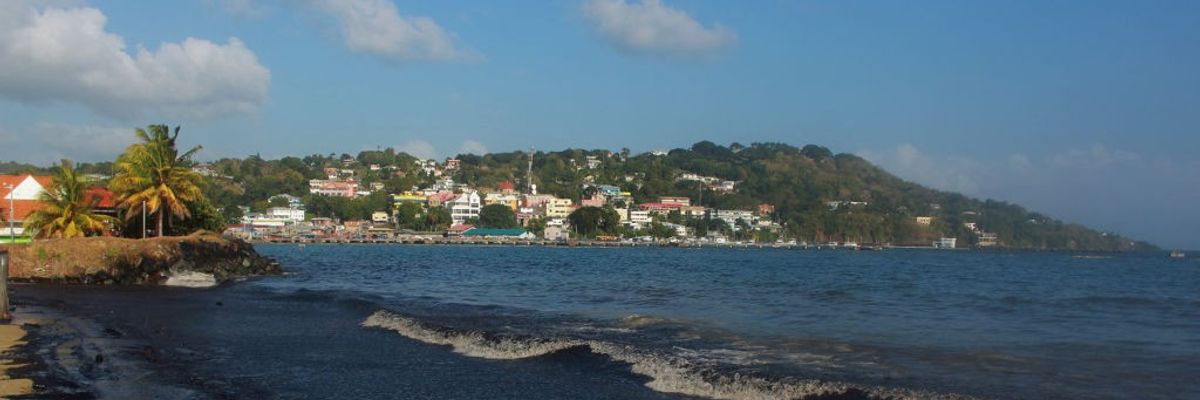
This February 10, 2024 photo shows blackened ocean waves and shore contamination caused by an oil spill three days earlier off the coast of Tobago island, Trinidad and Tobago.
"Right now the situation is not under control," the prime minister said Sunday on the eve of the Caribbean nation's world-renowned Carnival.
The government of Trinidad and Tobago this weekend said it is considering what would be the island nation's first-ever Level 3 diaster declaration amid a worsening environmental disaster caused by an oil spill from a mysterious ship on the eve of the Caribbean country's famed Carinval.
As more than 1,000 emergency workers and volunteers raced to clean up the massive spill off Tobago's southwestern coast, Trinidad and Tobago Prime Minister Keith Rowley told reporters Sunday that "cleaning and restoration can only begin as soon as we have the situation under control. Right now the situation is not under control."
The spill came from a vessel of indeterminate origin that capsized off the coast of the Cove Eco Industrial Park on Wednesday. As Agence France-Presse reported, the ship—named Gulfstream—"made no emergency calls, with no sign of crew, and no clear sign of ownership."
Officials said the spill has affected over 25 miles of coastline and has damaged a coral reef and Atlantic beaches, threatening not only the environment and residents' health but also the vital tourism industry as the country prepares to host its world-renowned Carnival this week.
Farley Augustine, chief secretary of the Tobago House of Assembly, told reporters Saturday that the government may declare a Level 3 disaster for the first time in the nation's history. Level 3 spills require "substantial" international support.
"Everything indicates that we are going in that direction," Augustine said.
There have been hundreds of oil spills off Trinidad and Tobago's coast over the past decade. These accidents rarely attract international media attention and often go unpunished.
Dear Common Dreams reader, It’s been nearly 30 years since I co-founded Common Dreams with my late wife, Lina Newhouser. We had the radical notion that journalism should serve the public good, not corporate profits. It was clear to us from the outset what it would take to build such a project. No paid advertisements. No corporate sponsors. No millionaire publisher telling us what to think or do. Many people said we wouldn't last a year, but we proved those doubters wrong. Together with a tremendous team of journalists and dedicated staff, we built an independent media outlet free from the constraints of profits and corporate control. Our mission has always been simple: To inform. To inspire. To ignite change for the common good. Building Common Dreams was not easy. Our survival was never guaranteed. When you take on the most powerful forces—Wall Street greed, fossil fuel industry destruction, Big Tech lobbyists, and uber-rich oligarchs who have spent billions upon billions rigging the economy and democracy in their favor—the only bulwark you have is supporters who believe in your work. But here’s the urgent message from me today. It's never been this bad out there. And it's never been this hard to keep us going. At the very moment Common Dreams is most needed, the threats we face are intensifying. We need your support now more than ever. We don't accept corporate advertising and never will. We don't have a paywall because we don't think people should be blocked from critical news based on their ability to pay. Everything we do is funded by the donations of readers like you. When everyone does the little they can afford, we are strong. But if that support retreats or dries up, so do we. Will you donate now to make sure Common Dreams not only survives but thrives? —Craig Brown, Co-founder |
The government of Trinidad and Tobago this weekend said it is considering what would be the island nation's first-ever Level 3 diaster declaration amid a worsening environmental disaster caused by an oil spill from a mysterious ship on the eve of the Caribbean country's famed Carinval.
As more than 1,000 emergency workers and volunteers raced to clean up the massive spill off Tobago's southwestern coast, Trinidad and Tobago Prime Minister Keith Rowley told reporters Sunday that "cleaning and restoration can only begin as soon as we have the situation under control. Right now the situation is not under control."
The spill came from a vessel of indeterminate origin that capsized off the coast of the Cove Eco Industrial Park on Wednesday. As Agence France-Presse reported, the ship—named Gulfstream—"made no emergency calls, with no sign of crew, and no clear sign of ownership."
Officials said the spill has affected over 25 miles of coastline and has damaged a coral reef and Atlantic beaches, threatening not only the environment and residents' health but also the vital tourism industry as the country prepares to host its world-renowned Carnival this week.
Farley Augustine, chief secretary of the Tobago House of Assembly, told reporters Saturday that the government may declare a Level 3 disaster for the first time in the nation's history. Level 3 spills require "substantial" international support.
"Everything indicates that we are going in that direction," Augustine said.
There have been hundreds of oil spills off Trinidad and Tobago's coast over the past decade. These accidents rarely attract international media attention and often go unpunished.
The government of Trinidad and Tobago this weekend said it is considering what would be the island nation's first-ever Level 3 diaster declaration amid a worsening environmental disaster caused by an oil spill from a mysterious ship on the eve of the Caribbean country's famed Carinval.
As more than 1,000 emergency workers and volunteers raced to clean up the massive spill off Tobago's southwestern coast, Trinidad and Tobago Prime Minister Keith Rowley told reporters Sunday that "cleaning and restoration can only begin as soon as we have the situation under control. Right now the situation is not under control."
The spill came from a vessel of indeterminate origin that capsized off the coast of the Cove Eco Industrial Park on Wednesday. As Agence France-Presse reported, the ship—named Gulfstream—"made no emergency calls, with no sign of crew, and no clear sign of ownership."
Officials said the spill has affected over 25 miles of coastline and has damaged a coral reef and Atlantic beaches, threatening not only the environment and residents' health but also the vital tourism industry as the country prepares to host its world-renowned Carnival this week.
Farley Augustine, chief secretary of the Tobago House of Assembly, told reporters Saturday that the government may declare a Level 3 disaster for the first time in the nation's history. Level 3 spills require "substantial" international support.
"Everything indicates that we are going in that direction," Augustine said.
There have been hundreds of oil spills off Trinidad and Tobago's coast over the past decade. These accidents rarely attract international media attention and often go unpunished.