

SUBSCRIBE TO OUR FREE NEWSLETTER
Daily news & progressive opinion—funded by the people, not the corporations—delivered straight to your inbox.
5
#000000
#FFFFFF
To donate by check, phone, or other method, see our More Ways to Give page.
Daily news & progressive opinion—funded by the people, not the corporations—delivered straight to your inbox.
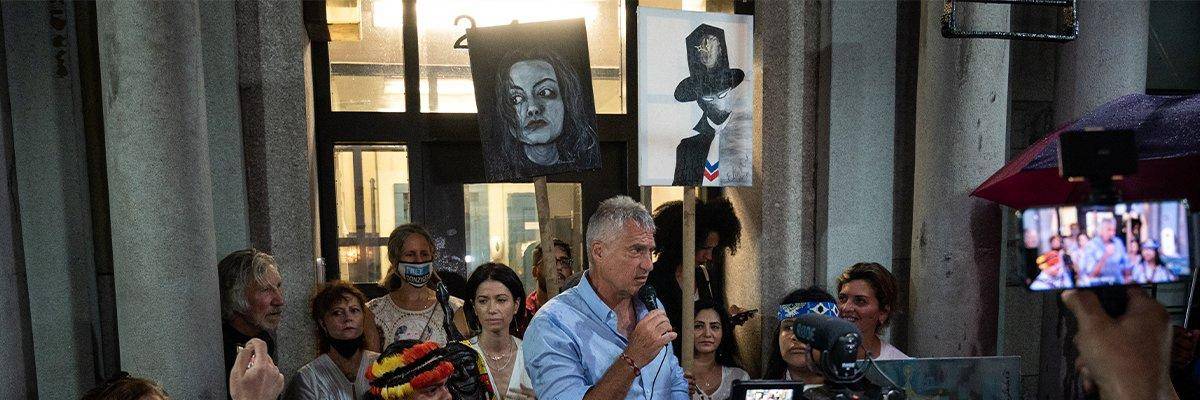
Steven Donziger, who has spent nearly two years on house arrest as a result of Chevron's retaliatory prosecution of him in the wake of his legal team's 2013 courtroom victory over the oil giant, spoke at a rally for his freedom outside his New York City apartment on July 6, 2021. (Photo: Steven Donziger via Twitter)
On the 700th day of Steven Donziger's house arrest, supporters of the human rights attorney gathered outside his New York City apartment on Tuesday night to demand his release and to mourn the 2,000 residents of the Amazon rainforest who have died as a result of carcinogenic fossil fuel pollution.
Donziger led the legal team, which represented more than 30,000 Indigenous people and farmworkers harmed by over three decades of oil drilling in Ecuador, that won a $9.5 billion judgement against Chevron in 2013 for deliberately dumping more than 16 billion gallons of toxic wastewater and other hazardous pollutants in the delicate Amazonian ecosystem--resulting in a "rainforest Chernobyl" that has caused widespread suffering throughout the local population.
In the wake of that historic victory, the oil giant relentlessly demonized and prosecuted Donziger, turning him into a "corporate political prisoner," as his allies describe him. As a result of Chevron's retaliation, the human rights attorney has endured almost two years of house arrest on a misdemeanor charge that carries a maximum sentence of six months.
"If we do not now stop corporations like Chevron from weaponizing the law, the rights of all earth defenders will be in jeopardy," said Donziger, who spoke for a few minutes at the rally.
"Please let's remember the people of Ecuador," the human rights attorney stressed in his remarks. "I was part of an international legal team that won a $9.5 billion judgement against Chevron on behalf of Indigenous peoples and farmer communities who started with no money."
"Texaco and Chevron thought they couldn't do this kind of thing," Donziger continued. "They counted on people not being able to fight back."
"And we figured out a way through grit and struggle and tenacity and the support of so many people and of course the unbelievable leadership at the community level in Ecuador to do a lawsuit, to play by the rules, to hold them accountable," he added, "for the worst environmental disaster in the world ever created by an oil company."
Given that "this was an American company that went down to the Amazon and destroyed the lands of the Indigenous peoples," Donziger emphasized that it is the responsibility of people in the U.S. to hold Chevron accountable.
Donziger was joined by activist celebrities including Pink Floyd co-founder Roger Waters and actor Susan Sarandon, as well as New York City Council member Sandy Nurse and Amazon Shuar leader Lino Wampustrik and hundreds of additional supporters.
Tuesday night's rally for Donziger's freedom was followed by a vigil "to honor the 2,000 Ecuadorians who have died from Chevron's pollution."
Donziger's imprisonment began shortly after U.S. District Judge Lewis A. Kaplan of the Southern District of New York, a former corporate lawyer with investments in Chevron, held Donziger in contempt of court in July 2019 for refusing to turn over his computer and cell phone to the fossil fuel company, a move that would have disclosed privileged client information.
Although the 2013 ruling against Chevron was upheld by three Ecuadorian courts, the oil giant moved its operations out of the country to avoid paying for cleanup, alleged that the $9.5 billion settlement had been fraudulently obtained, and began what six House Democrats described in April as an "unjust legal assault" on Donziger.
Donziger has also received support from human rights organizations and nearly 70 Nobel Prize Laureates, including 1997 peace prize recipient Jody Williams, who argued in May that Donziger's ongoing detention and the criminal contempt case against him is a "gross miscarriage of justice" meant to discourage others from challenging corporations' human rights violations and environmental degradations.
While the U.S. Attorney's Office for the Southern District of New York chose not to prosecute Donziger's misdemeanor contempt of court charge, Kaplan hand-picked a right-wing colleague, Judge Loretta Preska, to hear the case.
Kaplan and Preska, previously a leader in the Chevron-funded Federalist Society, then selected Rita Glavin, an attorney at Seward & Kissel LLP, to act as a special prosecutor even though her law partner was a former member of Chevron's board of directors and Chevron had been one of the firm's clients.
Unsurprisingly, Donziger described his May 10 trial as a "charade." Despite the fact that he has already been confined to his home for nearly 24 months, including over 20 months prior to his trial, Donziger faces six months in prison if convicted.
The Intercept noted earlier this year that "no attorney without a criminal record in the federal court system has ever before been detained pretrial for a misdemeanor offense."
Dear Common Dreams reader, It’s been nearly 30 years since I co-founded Common Dreams with my late wife, Lina Newhouser. We had the radical notion that journalism should serve the public good, not corporate profits. It was clear to us from the outset what it would take to build such a project. No paid advertisements. No corporate sponsors. No millionaire publisher telling us what to think or do. Many people said we wouldn't last a year, but we proved those doubters wrong. Together with a tremendous team of journalists and dedicated staff, we built an independent media outlet free from the constraints of profits and corporate control. Our mission has always been simple: To inform. To inspire. To ignite change for the common good. Building Common Dreams was not easy. Our survival was never guaranteed. When you take on the most powerful forces—Wall Street greed, fossil fuel industry destruction, Big Tech lobbyists, and uber-rich oligarchs who have spent billions upon billions rigging the economy and democracy in their favor—the only bulwark you have is supporters who believe in your work. But here’s the urgent message from me today. It's never been this bad out there. And it's never been this hard to keep us going. At the very moment Common Dreams is most needed, the threats we face are intensifying. We need your support now more than ever. We don't accept corporate advertising and never will. We don't have a paywall because we don't think people should be blocked from critical news based on their ability to pay. Everything we do is funded by the donations of readers like you. When everyone does the little they can afford, we are strong. But if that support retreats or dries up, so do we. Will you donate now to make sure Common Dreams not only survives but thrives? —Craig Brown, Co-founder |
On the 700th day of Steven Donziger's house arrest, supporters of the human rights attorney gathered outside his New York City apartment on Tuesday night to demand his release and to mourn the 2,000 residents of the Amazon rainforest who have died as a result of carcinogenic fossil fuel pollution.
Donziger led the legal team, which represented more than 30,000 Indigenous people and farmworkers harmed by over three decades of oil drilling in Ecuador, that won a $9.5 billion judgement against Chevron in 2013 for deliberately dumping more than 16 billion gallons of toxic wastewater and other hazardous pollutants in the delicate Amazonian ecosystem--resulting in a "rainforest Chernobyl" that has caused widespread suffering throughout the local population.
In the wake of that historic victory, the oil giant relentlessly demonized and prosecuted Donziger, turning him into a "corporate political prisoner," as his allies describe him. As a result of Chevron's retaliation, the human rights attorney has endured almost two years of house arrest on a misdemeanor charge that carries a maximum sentence of six months.
"If we do not now stop corporations like Chevron from weaponizing the law, the rights of all earth defenders will be in jeopardy," said Donziger, who spoke for a few minutes at the rally.
"Please let's remember the people of Ecuador," the human rights attorney stressed in his remarks. "I was part of an international legal team that won a $9.5 billion judgement against Chevron on behalf of Indigenous peoples and farmer communities who started with no money."
"Texaco and Chevron thought they couldn't do this kind of thing," Donziger continued. "They counted on people not being able to fight back."
"And we figured out a way through grit and struggle and tenacity and the support of so many people and of course the unbelievable leadership at the community level in Ecuador to do a lawsuit, to play by the rules, to hold them accountable," he added, "for the worst environmental disaster in the world ever created by an oil company."
Given that "this was an American company that went down to the Amazon and destroyed the lands of the Indigenous peoples," Donziger emphasized that it is the responsibility of people in the U.S. to hold Chevron accountable.
Donziger was joined by activist celebrities including Pink Floyd co-founder Roger Waters and actor Susan Sarandon, as well as New York City Council member Sandy Nurse and Amazon Shuar leader Lino Wampustrik and hundreds of additional supporters.
Tuesday night's rally for Donziger's freedom was followed by a vigil "to honor the 2,000 Ecuadorians who have died from Chevron's pollution."
Donziger's imprisonment began shortly after U.S. District Judge Lewis A. Kaplan of the Southern District of New York, a former corporate lawyer with investments in Chevron, held Donziger in contempt of court in July 2019 for refusing to turn over his computer and cell phone to the fossil fuel company, a move that would have disclosed privileged client information.
Although the 2013 ruling against Chevron was upheld by three Ecuadorian courts, the oil giant moved its operations out of the country to avoid paying for cleanup, alleged that the $9.5 billion settlement had been fraudulently obtained, and began what six House Democrats described in April as an "unjust legal assault" on Donziger.
Donziger has also received support from human rights organizations and nearly 70 Nobel Prize Laureates, including 1997 peace prize recipient Jody Williams, who argued in May that Donziger's ongoing detention and the criminal contempt case against him is a "gross miscarriage of justice" meant to discourage others from challenging corporations' human rights violations and environmental degradations.
While the U.S. Attorney's Office for the Southern District of New York chose not to prosecute Donziger's misdemeanor contempt of court charge, Kaplan hand-picked a right-wing colleague, Judge Loretta Preska, to hear the case.
Kaplan and Preska, previously a leader in the Chevron-funded Federalist Society, then selected Rita Glavin, an attorney at Seward & Kissel LLP, to act as a special prosecutor even though her law partner was a former member of Chevron's board of directors and Chevron had been one of the firm's clients.
Unsurprisingly, Donziger described his May 10 trial as a "charade." Despite the fact that he has already been confined to his home for nearly 24 months, including over 20 months prior to his trial, Donziger faces six months in prison if convicted.
The Intercept noted earlier this year that "no attorney without a criminal record in the federal court system has ever before been detained pretrial for a misdemeanor offense."
On the 700th day of Steven Donziger's house arrest, supporters of the human rights attorney gathered outside his New York City apartment on Tuesday night to demand his release and to mourn the 2,000 residents of the Amazon rainforest who have died as a result of carcinogenic fossil fuel pollution.
Donziger led the legal team, which represented more than 30,000 Indigenous people and farmworkers harmed by over three decades of oil drilling in Ecuador, that won a $9.5 billion judgement against Chevron in 2013 for deliberately dumping more than 16 billion gallons of toxic wastewater and other hazardous pollutants in the delicate Amazonian ecosystem--resulting in a "rainforest Chernobyl" that has caused widespread suffering throughout the local population.
In the wake of that historic victory, the oil giant relentlessly demonized and prosecuted Donziger, turning him into a "corporate political prisoner," as his allies describe him. As a result of Chevron's retaliation, the human rights attorney has endured almost two years of house arrest on a misdemeanor charge that carries a maximum sentence of six months.
"If we do not now stop corporations like Chevron from weaponizing the law, the rights of all earth defenders will be in jeopardy," said Donziger, who spoke for a few minutes at the rally.
"Please let's remember the people of Ecuador," the human rights attorney stressed in his remarks. "I was part of an international legal team that won a $9.5 billion judgement against Chevron on behalf of Indigenous peoples and farmer communities who started with no money."
"Texaco and Chevron thought they couldn't do this kind of thing," Donziger continued. "They counted on people not being able to fight back."
"And we figured out a way through grit and struggle and tenacity and the support of so many people and of course the unbelievable leadership at the community level in Ecuador to do a lawsuit, to play by the rules, to hold them accountable," he added, "for the worst environmental disaster in the world ever created by an oil company."
Given that "this was an American company that went down to the Amazon and destroyed the lands of the Indigenous peoples," Donziger emphasized that it is the responsibility of people in the U.S. to hold Chevron accountable.
Donziger was joined by activist celebrities including Pink Floyd co-founder Roger Waters and actor Susan Sarandon, as well as New York City Council member Sandy Nurse and Amazon Shuar leader Lino Wampustrik and hundreds of additional supporters.
Tuesday night's rally for Donziger's freedom was followed by a vigil "to honor the 2,000 Ecuadorians who have died from Chevron's pollution."
Donziger's imprisonment began shortly after U.S. District Judge Lewis A. Kaplan of the Southern District of New York, a former corporate lawyer with investments in Chevron, held Donziger in contempt of court in July 2019 for refusing to turn over his computer and cell phone to the fossil fuel company, a move that would have disclosed privileged client information.
Although the 2013 ruling against Chevron was upheld by three Ecuadorian courts, the oil giant moved its operations out of the country to avoid paying for cleanup, alleged that the $9.5 billion settlement had been fraudulently obtained, and began what six House Democrats described in April as an "unjust legal assault" on Donziger.
Donziger has also received support from human rights organizations and nearly 70 Nobel Prize Laureates, including 1997 peace prize recipient Jody Williams, who argued in May that Donziger's ongoing detention and the criminal contempt case against him is a "gross miscarriage of justice" meant to discourage others from challenging corporations' human rights violations and environmental degradations.
While the U.S. Attorney's Office for the Southern District of New York chose not to prosecute Donziger's misdemeanor contempt of court charge, Kaplan hand-picked a right-wing colleague, Judge Loretta Preska, to hear the case.
Kaplan and Preska, previously a leader in the Chevron-funded Federalist Society, then selected Rita Glavin, an attorney at Seward & Kissel LLP, to act as a special prosecutor even though her law partner was a former member of Chevron's board of directors and Chevron had been one of the firm's clients.
Unsurprisingly, Donziger described his May 10 trial as a "charade." Despite the fact that he has already been confined to his home for nearly 24 months, including over 20 months prior to his trial, Donziger faces six months in prison if convicted.
The Intercept noted earlier this year that "no attorney without a criminal record in the federal court system has ever before been detained pretrial for a misdemeanor offense."

