SUBSCRIBE TO OUR FREE NEWSLETTER
Daily news & progressive opinion—funded by the people, not the corporations—delivered straight to your inbox.
5
#000000
#FFFFFF
To donate by check, phone, or other method, see our More Ways to Give page.
Daily news & progressive opinion—funded by the people, not the corporations—delivered straight to your inbox.
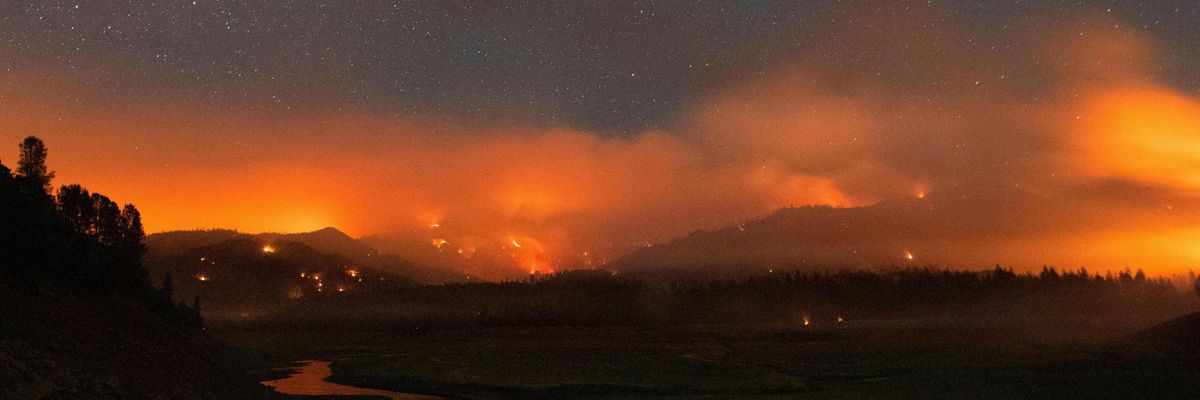
Flames surround the drought-stricken Shasta Lake in Lakehead, California on July 2, 2021. (Photo: Josh Edelson/AFP via Getty Images)
A pair of climate scientists on Thursday said the record-high temperatures that have ravaged the northwestern U.S. and western Canada over the past week--killing hundreds and sparking dozens of wildfires--represent the "world's most extreme heatwave in modern history."
"It's not hype or exaggeration to call the past week's heatwave the most extreme in world weather records."
--Bob Henson, Jeff Masters
"Never in the century-plus history of world weather observation have so many all-time heat records fallen by such a large margin than in the past week's historic heatwave in western North America," meteorologist Bob Henson and former National Oceanic and Atmospheric Administration (NOAA) hurricane scientist Jeff Masters wrote for Yale Climate Connections.
"It's not hype or exaggeration to call the past week's heatwave the most extreme in world weather records," they argued. "The only heatwave that compares is the great Dust Bowl heatwave of July 1936 in the U.S. Midwest and south-central Canada. But even that cannot compare to what happened in the Northwest U.S. and western Canada over the past week."
In British Columbia, the chief coroner said her office has received nearly 500 reports of "sudden and unexpected" deaths since last Friday, many of which are believed to be connected to the record temperatures that the region has suffered in recent days.
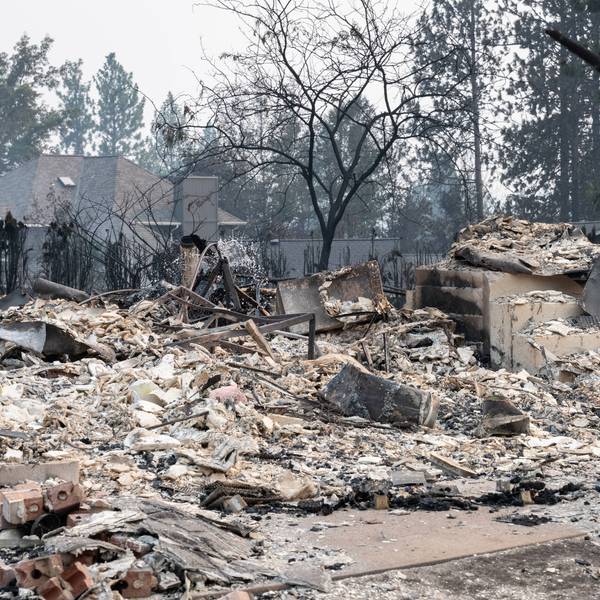
Residents of the small British Columbia village of Lytton--which on Tuesday recorded Canada's all-time high temperature of 121degF--were forced to evacuate Wednesday as a wildfire ripped through the area and quickly engulfed the small town, destroying homes and buildings.
"Our poor little town of Lytton is gone," Edith Loring-Kuhanga, an administrator at a local school, wrote in a Facebook post. "Our community members have lost everything."
Henson and Masters called Lytton--90% of which was burned--the "poster community" of the "horrific" heatwave.
Weather historian Christopher Burt told the two scientists that "this is the most anomalous regional extreme heat event to occur anywhere on Earth since temperature records began."
"Nothing can compare," Burt added.
To emphasize the "extremity of this event," Henson and Masters highlighted just some of the temperature records that have fallen in Canada and the United States since late last week.
"Preliminary data from NOAA's U.S. Records website shows that 55 U.S. stations had the highest temperatures in their history in the week ending June 28," Henson and Masters wrote. "More than 400 daily record highs were set. Over the past year, the nation has experienced about 38,000 daily record highs versus about 18,500 record lows, consistent with the 2:1 ratio of hot to cold records set in recent years."
Scientists have long predicted that heatwaves of the kind that are scorching the Northwestern U.S. and Canada will become more frequent and intense across the globe as the planet continues to warm due to the continued emission of heat-trapping greenhouse gases.
"Nowhere is safe... who would have predicted a temperature of 48/49degC [118.4degF/120.2degF] in British Columbia?" Sir David King, the former chief scientific adviser in the United Kingdom, said in an interview with The Guardian. "The risks have been understood and known for so long and we have not acted, now we have a very narrow timeline for us to manage the problem."
Dear Common Dreams reader, It’s been nearly 30 years since I co-founded Common Dreams with my late wife, Lina Newhouser. We had the radical notion that journalism should serve the public good, not corporate profits. It was clear to us from the outset what it would take to build such a project. No paid advertisements. No corporate sponsors. No millionaire publisher telling us what to think or do. Many people said we wouldn't last a year, but we proved those doubters wrong. Together with a tremendous team of journalists and dedicated staff, we built an independent media outlet free from the constraints of profits and corporate control. Our mission has always been simple: To inform. To inspire. To ignite change for the common good. Building Common Dreams was not easy. Our survival was never guaranteed. When you take on the most powerful forces—Wall Street greed, fossil fuel industry destruction, Big Tech lobbyists, and uber-rich oligarchs who have spent billions upon billions rigging the economy and democracy in their favor—the only bulwark you have is supporters who believe in your work. But here’s the urgent message from me today. It's never been this bad out there. And it's never been this hard to keep us going. At the very moment Common Dreams is most needed, the threats we face are intensifying. We need your support now more than ever. We don't accept corporate advertising and never will. We don't have a paywall because we don't think people should be blocked from critical news based on their ability to pay. Everything we do is funded by the donations of readers like you. When everyone does the little they can afford, we are strong. But if that support retreats or dries up, so do we. Will you donate now to make sure Common Dreams not only survives but thrives? —Craig Brown, Co-founder |
A pair of climate scientists on Thursday said the record-high temperatures that have ravaged the northwestern U.S. and western Canada over the past week--killing hundreds and sparking dozens of wildfires--represent the "world's most extreme heatwave in modern history."
"It's not hype or exaggeration to call the past week's heatwave the most extreme in world weather records."
--Bob Henson, Jeff Masters
"Never in the century-plus history of world weather observation have so many all-time heat records fallen by such a large margin than in the past week's historic heatwave in western North America," meteorologist Bob Henson and former National Oceanic and Atmospheric Administration (NOAA) hurricane scientist Jeff Masters wrote for Yale Climate Connections.
"It's not hype or exaggeration to call the past week's heatwave the most extreme in world weather records," they argued. "The only heatwave that compares is the great Dust Bowl heatwave of July 1936 in the U.S. Midwest and south-central Canada. But even that cannot compare to what happened in the Northwest U.S. and western Canada over the past week."
In British Columbia, the chief coroner said her office has received nearly 500 reports of "sudden and unexpected" deaths since last Friday, many of which are believed to be connected to the record temperatures that the region has suffered in recent days.
Residents of the small British Columbia village of Lytton--which on Tuesday recorded Canada's all-time high temperature of 121degF--were forced to evacuate Wednesday as a wildfire ripped through the area and quickly engulfed the small town, destroying homes and buildings.
"Our poor little town of Lytton is gone," Edith Loring-Kuhanga, an administrator at a local school, wrote in a Facebook post. "Our community members have lost everything."
Henson and Masters called Lytton--90% of which was burned--the "poster community" of the "horrific" heatwave.
Weather historian Christopher Burt told the two scientists that "this is the most anomalous regional extreme heat event to occur anywhere on Earth since temperature records began."
"Nothing can compare," Burt added.
To emphasize the "extremity of this event," Henson and Masters highlighted just some of the temperature records that have fallen in Canada and the United States since late last week.
"Preliminary data from NOAA's U.S. Records website shows that 55 U.S. stations had the highest temperatures in their history in the week ending June 28," Henson and Masters wrote. "More than 400 daily record highs were set. Over the past year, the nation has experienced about 38,000 daily record highs versus about 18,500 record lows, consistent with the 2:1 ratio of hot to cold records set in recent years."
Scientists have long predicted that heatwaves of the kind that are scorching the Northwestern U.S. and Canada will become more frequent and intense across the globe as the planet continues to warm due to the continued emission of heat-trapping greenhouse gases.
"Nowhere is safe... who would have predicted a temperature of 48/49degC [118.4degF/120.2degF] in British Columbia?" Sir David King, the former chief scientific adviser in the United Kingdom, said in an interview with The Guardian. "The risks have been understood and known for so long and we have not acted, now we have a very narrow timeline for us to manage the problem."
A pair of climate scientists on Thursday said the record-high temperatures that have ravaged the northwestern U.S. and western Canada over the past week--killing hundreds and sparking dozens of wildfires--represent the "world's most extreme heatwave in modern history."
"It's not hype or exaggeration to call the past week's heatwave the most extreme in world weather records."
--Bob Henson, Jeff Masters
"Never in the century-plus history of world weather observation have so many all-time heat records fallen by such a large margin than in the past week's historic heatwave in western North America," meteorologist Bob Henson and former National Oceanic and Atmospheric Administration (NOAA) hurricane scientist Jeff Masters wrote for Yale Climate Connections.
"It's not hype or exaggeration to call the past week's heatwave the most extreme in world weather records," they argued. "The only heatwave that compares is the great Dust Bowl heatwave of July 1936 in the U.S. Midwest and south-central Canada. But even that cannot compare to what happened in the Northwest U.S. and western Canada over the past week."
In British Columbia, the chief coroner said her office has received nearly 500 reports of "sudden and unexpected" deaths since last Friday, many of which are believed to be connected to the record temperatures that the region has suffered in recent days.
Residents of the small British Columbia village of Lytton--which on Tuesday recorded Canada's all-time high temperature of 121degF--were forced to evacuate Wednesday as a wildfire ripped through the area and quickly engulfed the small town, destroying homes and buildings.
"Our poor little town of Lytton is gone," Edith Loring-Kuhanga, an administrator at a local school, wrote in a Facebook post. "Our community members have lost everything."
Henson and Masters called Lytton--90% of which was burned--the "poster community" of the "horrific" heatwave.
Weather historian Christopher Burt told the two scientists that "this is the most anomalous regional extreme heat event to occur anywhere on Earth since temperature records began."
"Nothing can compare," Burt added.
To emphasize the "extremity of this event," Henson and Masters highlighted just some of the temperature records that have fallen in Canada and the United States since late last week.
"Preliminary data from NOAA's U.S. Records website shows that 55 U.S. stations had the highest temperatures in their history in the week ending June 28," Henson and Masters wrote. "More than 400 daily record highs were set. Over the past year, the nation has experienced about 38,000 daily record highs versus about 18,500 record lows, consistent with the 2:1 ratio of hot to cold records set in recent years."
Scientists have long predicted that heatwaves of the kind that are scorching the Northwestern U.S. and Canada will become more frequent and intense across the globe as the planet continues to warm due to the continued emission of heat-trapping greenhouse gases.
"Nowhere is safe... who would have predicted a temperature of 48/49degC [118.4degF/120.2degF] in British Columbia?" Sir David King, the former chief scientific adviser in the United Kingdom, said in an interview with The Guardian. "The risks have been understood and known for so long and we have not acted, now we have a very narrow timeline for us to manage the problem."