SUBSCRIBE TO OUR FREE NEWSLETTER
Daily news & progressive opinion—funded by the people, not the corporations—delivered straight to your inbox.
5
#000000
#FFFFFF
To donate by check, phone, or other method, see our More Ways to Give page.
Daily news & progressive opinion—funded by the people, not the corporations—delivered straight to your inbox.
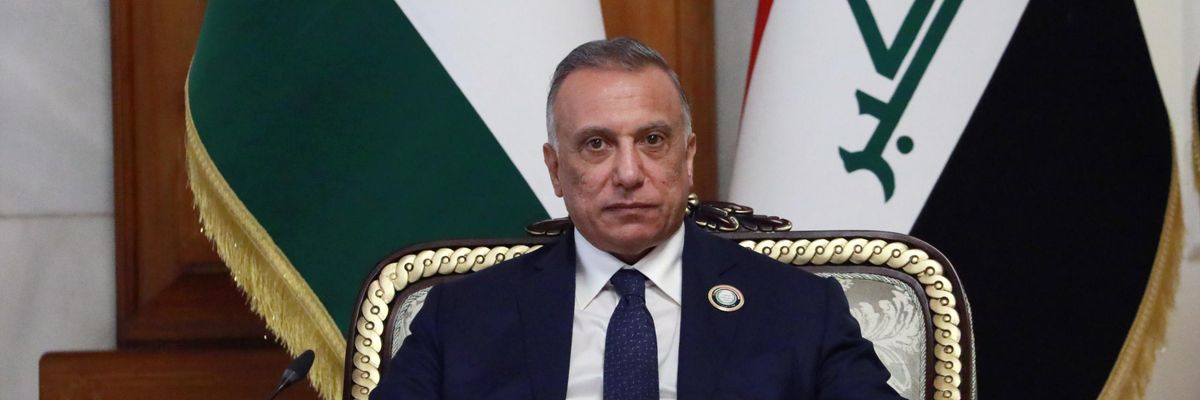
A spokesperson for Iraqi Prime Minister Mustafa al-Kadhimi condemned overnight U.S. airstrikes along the Iraq-Syria border as a violation of sovereignty. (Photo: Murtadha Al-Sudani/Anadolu Agency via Getty Images)
Echoing criticism from across the globe on Monday, the Iraqi government slammed the Biden administration for overnight U.S. airstrikes in Iraq and Syria at facilities the Pentagon says were used by Iran-backed militias.
"We condemn the U.S. air attack that targeted a site last night on the Iraqi-Syrian border, which represents a blatant and unacceptable violation of Iraqi sovereignty and Iraqi national security in accordance with all international conventions," said a spokesperson for the commander in chief of Iraq's armed forces, Prime Minister Mustafa al-Kadhimi.
"Iraq renews its refusal to be an arena for settling accounts, and clings to its right to sovereignty over its lands, and to prevent it from being used as an arena for reactions and attacks," said the Iraqi statement.
"We call for calm and to avoid escalation in all its forms, stressing that Iraq will carry out the necessary investigations, procedures, and contacts at various levels to prevent such violations," the spokesperson added.
The strikes also led to an emergency meeting of national security officials in Iraq:
The Popular Mobilization Forces, a coalition of Iraqi militias, reportedly said that four fighters were killed in the U.S. attack. However, the U.K.-based Syrian Observatory for Human Rights put the death toll at seven fighters and said several others wounded, according to Al Jazeera.
Pentagon Press Secretary John Kirby said that at the direction of President Joe Biden, the U.S. military hit "operational and weapons storage facilities at two locations in Syria and one location in Iraq" used by Iran-backed militia groups to engage in drone attacks against U.S. personnel and facilities in the region.
Although no Americans have been hurt, the New York Times reports that U.S. officials say that "at least five times since April, the Iranian-backed militias have used small, explosive-laden drones that divebomb and crash into their targets in late-night attacks on Iraqi bases--including those used by the CIA and U.S. Special Operations units."
As Common Dreams reported earlier Monday, while Kirby claimed the strikes ordered by Biden were "designed to limit the risk of escalation," Stephen Miles, executive director of U.S.-based advocacy group Win Without War, responded: "Know what would actually be deescalatory? Leaving Iraq."
The U.S. has roughly 2,500 troops in Iraq and about 900 in Syria. Biden previously authorized strikes in Syria in late February, also targeting facilities the administration said belonged to Iran-backed militia groups.
The strikes come amid negotiations to revive the Iran nuclear deal. Biden ran on a promise to return the United States to the Joint Comprehensive Plan of Action (JCPOA), as it is officially called, that his predecessor ditched in 2018. The Trump administration instead pursued a "maximum pressure" campaign that ramped up devastating sanctions against Iran.
"Iran--weakened by years of harsh economic sanctions--is using its proxy militias in Iraq to step up pressure on the United States and other world powers to negotiate an easing of those sanctions as part of a possible revival of the 2015 nuclear deal," the Times reports. "Iraqi and American officials say Iran has devised the drone attacks to minimize casualties to avoid prompting U.S. retaliation."
The U.S. strikes also follow the House of Representatives earlier this month passing legislation to repeal the Authorization for Use of Military Force (AUMF) Against Iraq Resolution of 2002. Now, all eyes are on the Senate for that effort.
Notably, Kirby did not cite the 2002 AUMF for the strikes. Instead, he highlighted the right of self-defense and the president's authority under Article II of the U.S. Constitution to protect American personnel in Iraq.
Dear Common Dreams reader, It’s been nearly 30 years since I co-founded Common Dreams with my late wife, Lina Newhouser. We had the radical notion that journalism should serve the public good, not corporate profits. It was clear to us from the outset what it would take to build such a project. No paid advertisements. No corporate sponsors. No millionaire publisher telling us what to think or do. Many people said we wouldn't last a year, but we proved those doubters wrong. Together with a tremendous team of journalists and dedicated staff, we built an independent media outlet free from the constraints of profits and corporate control. Our mission has always been simple: To inform. To inspire. To ignite change for the common good. Building Common Dreams was not easy. Our survival was never guaranteed. When you take on the most powerful forces—Wall Street greed, fossil fuel industry destruction, Big Tech lobbyists, and uber-rich oligarchs who have spent billions upon billions rigging the economy and democracy in their favor—the only bulwark you have is supporters who believe in your work. But here’s the urgent message from me today. It's never been this bad out there. And it's never been this hard to keep us going. At the very moment Common Dreams is most needed, the threats we face are intensifying. We need your support now more than ever. We don't accept corporate advertising and never will. We don't have a paywall because we don't think people should be blocked from critical news based on their ability to pay. Everything we do is funded by the donations of readers like you. When everyone does the little they can afford, we are strong. But if that support retreats or dries up, so do we. Will you donate now to make sure Common Dreams not only survives but thrives? —Craig Brown, Co-founder |
Echoing criticism from across the globe on Monday, the Iraqi government slammed the Biden administration for overnight U.S. airstrikes in Iraq and Syria at facilities the Pentagon says were used by Iran-backed militias.
"We condemn the U.S. air attack that targeted a site last night on the Iraqi-Syrian border, which represents a blatant and unacceptable violation of Iraqi sovereignty and Iraqi national security in accordance with all international conventions," said a spokesperson for the commander in chief of Iraq's armed forces, Prime Minister Mustafa al-Kadhimi.
"Iraq renews its refusal to be an arena for settling accounts, and clings to its right to sovereignty over its lands, and to prevent it from being used as an arena for reactions and attacks," said the Iraqi statement.
"We call for calm and to avoid escalation in all its forms, stressing that Iraq will carry out the necessary investigations, procedures, and contacts at various levels to prevent such violations," the spokesperson added.
The strikes also led to an emergency meeting of national security officials in Iraq:
The Popular Mobilization Forces, a coalition of Iraqi militias, reportedly said that four fighters were killed in the U.S. attack. However, the U.K.-based Syrian Observatory for Human Rights put the death toll at seven fighters and said several others wounded, according to Al Jazeera.
Pentagon Press Secretary John Kirby said that at the direction of President Joe Biden, the U.S. military hit "operational and weapons storage facilities at two locations in Syria and one location in Iraq" used by Iran-backed militia groups to engage in drone attacks against U.S. personnel and facilities in the region.
Although no Americans have been hurt, the New York Times reports that U.S. officials say that "at least five times since April, the Iranian-backed militias have used small, explosive-laden drones that divebomb and crash into their targets in late-night attacks on Iraqi bases--including those used by the CIA and U.S. Special Operations units."
As Common Dreams reported earlier Monday, while Kirby claimed the strikes ordered by Biden were "designed to limit the risk of escalation," Stephen Miles, executive director of U.S.-based advocacy group Win Without War, responded: "Know what would actually be deescalatory? Leaving Iraq."
The U.S. has roughly 2,500 troops in Iraq and about 900 in Syria. Biden previously authorized strikes in Syria in late February, also targeting facilities the administration said belonged to Iran-backed militia groups.
The strikes come amid negotiations to revive the Iran nuclear deal. Biden ran on a promise to return the United States to the Joint Comprehensive Plan of Action (JCPOA), as it is officially called, that his predecessor ditched in 2018. The Trump administration instead pursued a "maximum pressure" campaign that ramped up devastating sanctions against Iran.
"Iran--weakened by years of harsh economic sanctions--is using its proxy militias in Iraq to step up pressure on the United States and other world powers to negotiate an easing of those sanctions as part of a possible revival of the 2015 nuclear deal," the Times reports. "Iraqi and American officials say Iran has devised the drone attacks to minimize casualties to avoid prompting U.S. retaliation."
The U.S. strikes also follow the House of Representatives earlier this month passing legislation to repeal the Authorization for Use of Military Force (AUMF) Against Iraq Resolution of 2002. Now, all eyes are on the Senate for that effort.
Notably, Kirby did not cite the 2002 AUMF for the strikes. Instead, he highlighted the right of self-defense and the president's authority under Article II of the U.S. Constitution to protect American personnel in Iraq.
Echoing criticism from across the globe on Monday, the Iraqi government slammed the Biden administration for overnight U.S. airstrikes in Iraq and Syria at facilities the Pentagon says were used by Iran-backed militias.
"We condemn the U.S. air attack that targeted a site last night on the Iraqi-Syrian border, which represents a blatant and unacceptable violation of Iraqi sovereignty and Iraqi national security in accordance with all international conventions," said a spokesperson for the commander in chief of Iraq's armed forces, Prime Minister Mustafa al-Kadhimi.
"Iraq renews its refusal to be an arena for settling accounts, and clings to its right to sovereignty over its lands, and to prevent it from being used as an arena for reactions and attacks," said the Iraqi statement.
"We call for calm and to avoid escalation in all its forms, stressing that Iraq will carry out the necessary investigations, procedures, and contacts at various levels to prevent such violations," the spokesperson added.
The strikes also led to an emergency meeting of national security officials in Iraq:
The Popular Mobilization Forces, a coalition of Iraqi militias, reportedly said that four fighters were killed in the U.S. attack. However, the U.K.-based Syrian Observatory for Human Rights put the death toll at seven fighters and said several others wounded, according to Al Jazeera.
Pentagon Press Secretary John Kirby said that at the direction of President Joe Biden, the U.S. military hit "operational and weapons storage facilities at two locations in Syria and one location in Iraq" used by Iran-backed militia groups to engage in drone attacks against U.S. personnel and facilities in the region.
Although no Americans have been hurt, the New York Times reports that U.S. officials say that "at least five times since April, the Iranian-backed militias have used small, explosive-laden drones that divebomb and crash into their targets in late-night attacks on Iraqi bases--including those used by the CIA and U.S. Special Operations units."
As Common Dreams reported earlier Monday, while Kirby claimed the strikes ordered by Biden were "designed to limit the risk of escalation," Stephen Miles, executive director of U.S.-based advocacy group Win Without War, responded: "Know what would actually be deescalatory? Leaving Iraq."
The U.S. has roughly 2,500 troops in Iraq and about 900 in Syria. Biden previously authorized strikes in Syria in late February, also targeting facilities the administration said belonged to Iran-backed militia groups.
The strikes come amid negotiations to revive the Iran nuclear deal. Biden ran on a promise to return the United States to the Joint Comprehensive Plan of Action (JCPOA), as it is officially called, that his predecessor ditched in 2018. The Trump administration instead pursued a "maximum pressure" campaign that ramped up devastating sanctions against Iran.
"Iran--weakened by years of harsh economic sanctions--is using its proxy militias in Iraq to step up pressure on the United States and other world powers to negotiate an easing of those sanctions as part of a possible revival of the 2015 nuclear deal," the Times reports. "Iraqi and American officials say Iran has devised the drone attacks to minimize casualties to avoid prompting U.S. retaliation."
The U.S. strikes also follow the House of Representatives earlier this month passing legislation to repeal the Authorization for Use of Military Force (AUMF) Against Iraq Resolution of 2002. Now, all eyes are on the Senate for that effort.
Notably, Kirby did not cite the 2002 AUMF for the strikes. Instead, he highlighted the right of self-defense and the president's authority under Article II of the U.S. Constitution to protect American personnel in Iraq.