SUBSCRIBE TO OUR FREE NEWSLETTER
Daily news & progressive opinion—funded by the people, not the corporations—delivered straight to your inbox.
5
#000000
#FFFFFF
To donate by check, phone, or other method, see our More Ways to Give page.
Daily news & progressive opinion—funded by the people, not the corporations—delivered straight to your inbox.
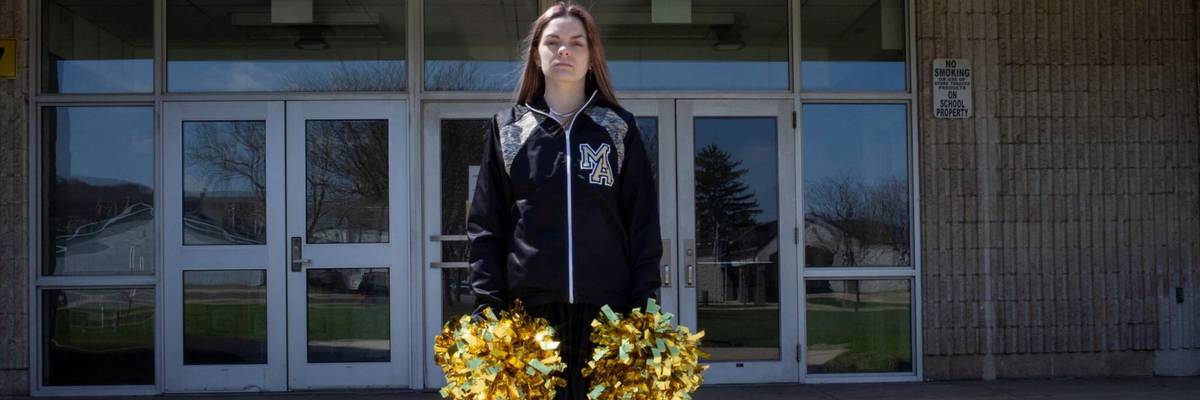
The United States Supreme Court on June 23, 2021 ruled in favor of Brandi Levy, a Pennsylvania high school student disciplined for social media profanity. (Photo: Danna Singer/ACLU via Getty Images)
In a landmark ruling for student free speech in the digital era, the United State Supreme Court on Wednesday ruled that a Pennsylvania high school violated a cheerleader's First Amendment right to freedom of speech when it disciplined her following a profanity-laden social media post.
"The school went too far, and I'm glad that the Supreme Court agrees."
--Brandi Levy, student
The justices ruled 8-1 in Mahanoy Area School District v. B. L. (pdf) in favor of Brandi Levy, who was kicked off the junior varsity cheerleading team at Mahanoy Area High School in 2017 after she posted a Snapchat photo of herself and a friend flipping their middle fingers with the text, "fuck school fuck softball fuck cheer fuck everything." The post was published off campus and after school hours.
"The school itself has an interest in protecting a student's unpopular expression, especially when the expression takes place off campus, because America's public schools are the nurseries of democracy," Justice Stephen Breyer wrote for the majority. Justice Clarence Thomas was the lone dissenter in the case.
"It might be tempting to dismiss B. L.'s words as unworthy of the robust First Amendment protections," Breyer wrote. "But sometimes it is necessary to protect the superfluous in order to preserve the necessary."
Breyer also wrote that the high court does not "now set forth a broad, highly general First Amendment rule stating just what counts as 'off campus' speech and whether or how ordinary First Amendment standards must give way off campus to a school's special need to prevent... substantial disruption of learning-related activities."
Levy, who is now an 18-year-old college student, welcomed the ruling.
"The school went too far, and I'm glad that the Supreme Court agrees," she said in a statement after the decision. "I was frustrated, I was 14 years old, and I expressed my frustration the way teenagers do today. Young people need to have the ability to express themselves without worrying about being punished when they get to school."
"I never could have imagined that one simple snap would turn into a Supreme Court case, but I'm proud that my family and I advocated for the rights of millions of public school students," she added.
Civil liberties advocates also hailed the ruling as one of the most important free speech decisions in decades.
"Protecting young people's free speech rights when they are outside of school is vital, and this is a huge victory for the free speech rights of millions of students who attend our nation's public schools," said ACLU legal director David Cole.
"The school in this case asked the court to allow it to punish speech that it considered 'disruptive,' regardless of where it occurs," Cole continued. "If the court had accepted that argument, it would have put in peril all manner of young people's speech, including their expression on politics, school operations, and general teen frustrations."
"The message from this ruling is clear," added Cole. "Free speech is for everyone, and that includes public school students."
Witold Walczak, legal director of the ACLU of Pennsylvania--which represented Levy--said, "I am proud of our team at the ACLU, who effectively argued before three courts that public school students should not be monitored 24/7 by school officials."
"I am especially proud of Brandi and her family, who stood up for one of the most fundamental rights that we cherish in this country, the right to speak freely without government interference," added Walczak.
Dear Common Dreams reader, It’s been nearly 30 years since I co-founded Common Dreams with my late wife, Lina Newhouser. We had the radical notion that journalism should serve the public good, not corporate profits. It was clear to us from the outset what it would take to build such a project. No paid advertisements. No corporate sponsors. No millionaire publisher telling us what to think or do. Many people said we wouldn't last a year, but we proved those doubters wrong. Together with a tremendous team of journalists and dedicated staff, we built an independent media outlet free from the constraints of profits and corporate control. Our mission has always been simple: To inform. To inspire. To ignite change for the common good. Building Common Dreams was not easy. Our survival was never guaranteed. When you take on the most powerful forces—Wall Street greed, fossil fuel industry destruction, Big Tech lobbyists, and uber-rich oligarchs who have spent billions upon billions rigging the economy and democracy in their favor—the only bulwark you have is supporters who believe in your work. But here’s the urgent message from me today. It's never been this bad out there. And it's never been this hard to keep us going. At the very moment Common Dreams is most needed, the threats we face are intensifying. We need your support now more than ever. We don't accept corporate advertising and never will. We don't have a paywall because we don't think people should be blocked from critical news based on their ability to pay. Everything we do is funded by the donations of readers like you. When everyone does the little they can afford, we are strong. But if that support retreats or dries up, so do we. Will you donate now to make sure Common Dreams not only survives but thrives? —Craig Brown, Co-founder |
In a landmark ruling for student free speech in the digital era, the United State Supreme Court on Wednesday ruled that a Pennsylvania high school violated a cheerleader's First Amendment right to freedom of speech when it disciplined her following a profanity-laden social media post.
"The school went too far, and I'm glad that the Supreme Court agrees."
--Brandi Levy, student
The justices ruled 8-1 in Mahanoy Area School District v. B. L. (pdf) in favor of Brandi Levy, who was kicked off the junior varsity cheerleading team at Mahanoy Area High School in 2017 after she posted a Snapchat photo of herself and a friend flipping their middle fingers with the text, "fuck school fuck softball fuck cheer fuck everything." The post was published off campus and after school hours.
"The school itself has an interest in protecting a student's unpopular expression, especially when the expression takes place off campus, because America's public schools are the nurseries of democracy," Justice Stephen Breyer wrote for the majority. Justice Clarence Thomas was the lone dissenter in the case.
"It might be tempting to dismiss B. L.'s words as unworthy of the robust First Amendment protections," Breyer wrote. "But sometimes it is necessary to protect the superfluous in order to preserve the necessary."
Breyer also wrote that the high court does not "now set forth a broad, highly general First Amendment rule stating just what counts as 'off campus' speech and whether or how ordinary First Amendment standards must give way off campus to a school's special need to prevent... substantial disruption of learning-related activities."
Levy, who is now an 18-year-old college student, welcomed the ruling.
"The school went too far, and I'm glad that the Supreme Court agrees," she said in a statement after the decision. "I was frustrated, I was 14 years old, and I expressed my frustration the way teenagers do today. Young people need to have the ability to express themselves without worrying about being punished when they get to school."
"I never could have imagined that one simple snap would turn into a Supreme Court case, but I'm proud that my family and I advocated for the rights of millions of public school students," she added.
Civil liberties advocates also hailed the ruling as one of the most important free speech decisions in decades.
"Protecting young people's free speech rights when they are outside of school is vital, and this is a huge victory for the free speech rights of millions of students who attend our nation's public schools," said ACLU legal director David Cole.
"The school in this case asked the court to allow it to punish speech that it considered 'disruptive,' regardless of where it occurs," Cole continued. "If the court had accepted that argument, it would have put in peril all manner of young people's speech, including their expression on politics, school operations, and general teen frustrations."
"The message from this ruling is clear," added Cole. "Free speech is for everyone, and that includes public school students."
Witold Walczak, legal director of the ACLU of Pennsylvania--which represented Levy--said, "I am proud of our team at the ACLU, who effectively argued before three courts that public school students should not be monitored 24/7 by school officials."
"I am especially proud of Brandi and her family, who stood up for one of the most fundamental rights that we cherish in this country, the right to speak freely without government interference," added Walczak.
In a landmark ruling for student free speech in the digital era, the United State Supreme Court on Wednesday ruled that a Pennsylvania high school violated a cheerleader's First Amendment right to freedom of speech when it disciplined her following a profanity-laden social media post.
"The school went too far, and I'm glad that the Supreme Court agrees."
--Brandi Levy, student
The justices ruled 8-1 in Mahanoy Area School District v. B. L. (pdf) in favor of Brandi Levy, who was kicked off the junior varsity cheerleading team at Mahanoy Area High School in 2017 after she posted a Snapchat photo of herself and a friend flipping their middle fingers with the text, "fuck school fuck softball fuck cheer fuck everything." The post was published off campus and after school hours.
"The school itself has an interest in protecting a student's unpopular expression, especially when the expression takes place off campus, because America's public schools are the nurseries of democracy," Justice Stephen Breyer wrote for the majority. Justice Clarence Thomas was the lone dissenter in the case.
"It might be tempting to dismiss B. L.'s words as unworthy of the robust First Amendment protections," Breyer wrote. "But sometimes it is necessary to protect the superfluous in order to preserve the necessary."
Breyer also wrote that the high court does not "now set forth a broad, highly general First Amendment rule stating just what counts as 'off campus' speech and whether or how ordinary First Amendment standards must give way off campus to a school's special need to prevent... substantial disruption of learning-related activities."
Levy, who is now an 18-year-old college student, welcomed the ruling.
"The school went too far, and I'm glad that the Supreme Court agrees," she said in a statement after the decision. "I was frustrated, I was 14 years old, and I expressed my frustration the way teenagers do today. Young people need to have the ability to express themselves without worrying about being punished when they get to school."
"I never could have imagined that one simple snap would turn into a Supreme Court case, but I'm proud that my family and I advocated for the rights of millions of public school students," she added.
Civil liberties advocates also hailed the ruling as one of the most important free speech decisions in decades.
"Protecting young people's free speech rights when they are outside of school is vital, and this is a huge victory for the free speech rights of millions of students who attend our nation's public schools," said ACLU legal director David Cole.
"The school in this case asked the court to allow it to punish speech that it considered 'disruptive,' regardless of where it occurs," Cole continued. "If the court had accepted that argument, it would have put in peril all manner of young people's speech, including their expression on politics, school operations, and general teen frustrations."
"The message from this ruling is clear," added Cole. "Free speech is for everyone, and that includes public school students."
Witold Walczak, legal director of the ACLU of Pennsylvania--which represented Levy--said, "I am proud of our team at the ACLU, who effectively argued before three courts that public school students should not be monitored 24/7 by school officials."
"I am especially proud of Brandi and her family, who stood up for one of the most fundamental rights that we cherish in this country, the right to speak freely without government interference," added Walczak.