SUBSCRIBE TO OUR FREE NEWSLETTER
Daily news & progressive opinion—funded by the people, not the corporations—delivered straight to your inbox.
5
#000000
#FFFFFF
To donate by check, phone, or other method, see our More Ways to Give page.
Daily news & progressive opinion—funded by the people, not the corporations—delivered straight to your inbox.
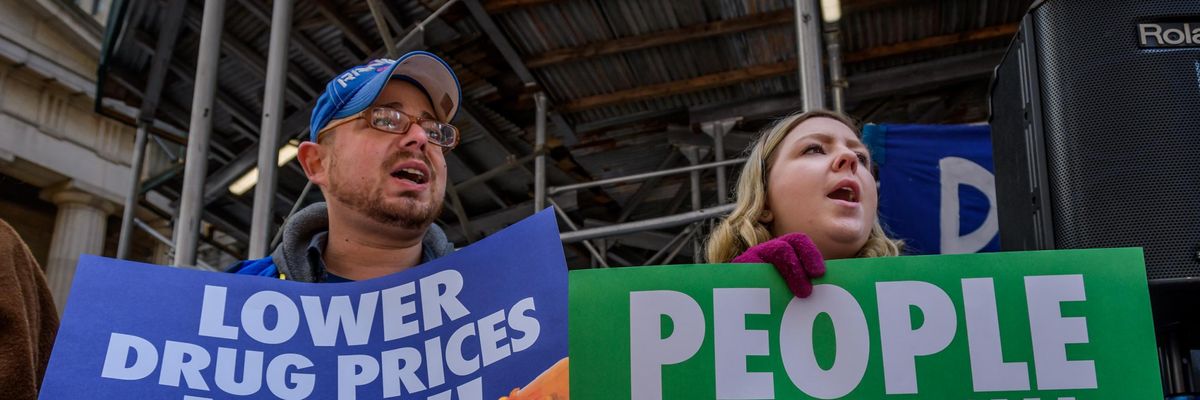
Demonstrators protest for lower prescription drug costs in front of the New York Stock Exchange on November 14, 2019. (Photo: Erik McGregor/LightRocket via Getty Images)
Rejecting Big Pharma's assertion that lower medication costs would stifle innovation and competition, and affirming efforts by House Democrats to change U.S. law so that Medicare can seek lower prescription drug prices, over 80% of Americans surveyed in a poll published Thursday said they support empowering the federal government to negotiate with pharmaceutical companies.
"Americans aren't buying the claim that attempts to rein in drug prices will stifle innovation and devastate the pharmaceutical industry."
--Tim Lash, West Health
The West Health/Gallup survey (pdf) of more than 3,700 U.S. adults found that 97% of respondents who identified as Democrats, 80% of Independents, and 61% of Republicans agreed with the statement that "government needs to play a major role in negotiating prescription drug prices with Medicare in order to control costs."
Survey participants were also asked whether "allowing government to negotiate drug prices for Medicare will hurt pharmaceutical competition and innovation." Only 19% of overall respondents concurred, including just 3% of Democrats, 20% of Independents, and 39% of Republicans.
Fully 90% of all survey respondents also agreed with the statement that "drug pricing needs to undergo major reform in order to control costs."
The survey's findings come as a broad coalition of over 150 House Democrats led by Rep. Pramila Jayapal (D-Wash.) is demanding that Medicare expansion--including a provision that would allow the federal program to negotiate prescription drug prices--is included in President Joe Biden's infrastructure package.
The negotiations which other nations conduct with drugmakers for lower prices are currently outlawed in the United States, which pays an average of 256% more for brand-name medications than 32 other countries, according to a recent RAND Corporation report.
While campaigning for president, Biden promised to repeal what he called "the outrageous exception allowing drug corporations to avoid negotiating with Medicare." The lawmakers calling for Medicare expansion cited estimates showing that such a move would save the federal government $450 billion over the next decade.
On broader healthcare issues, 71% of those polled in the new survey said the government should play a major or moderate role "in making sure that all Americans have access to healthcare coverage," with 47% of all participants saying that role should be major.
For this question, respondents were broken down into groups based on income, not party affiliation. At 53%, support for government playing a major role in delivering healthcare access was strongest among people earning over $120,000 annually, while 50% of those earning less than $48,000 and 43% of respondents earning between $48,000 and $120,000 concurred.
"There is little question that substantial public support exists for more government action when it comes to addressing drug costs," Gallup senior researcher Dan Witters said in a statement. "And while there are differences across the political spectrum, even among Republicans, sentiment for public action is substantial."
Tim Lash, chief strategy officer for the nonprofit, nonpartisan West Health group, added that "Americans aren't buying the claim that attempts to rein in drug prices will stifle innovation and devastate the pharmaceutical industry."
"These misleading arguments are meant to preserve profits rather than protect patients," said Lash. "The time has come to finally enable Medicare negotiation. Americans are becoming increasing restless for it to happen even if the pharmaceutical companies are not."
As Common Dreams has reported, pharmaceutical industry consolidation--with mergers and acquisitions often executed to boost stock prices and acquire highly profitable blockbuster drugs--harms both competition and consumers.
Belying Big Pharma claims, a January report from the office of Rep. Katie Porter (D-Calif.) found that as U.S. drug prices have soared in recent decades, pharmaceutical companies' "investment in research and development have failed to match this same pace."
"Instead, they've dedicated more and more of their funds to enrich shareholders or to purchase other companies to eliminate competition," the report said, noting that "in 2018, the year that [former President] Donald Trump's tax giveaway to the wealthy went into effect, 12 of the biggest pharmaceutical companies spent more money on stock buybacks than on research and development."
The report also underscored that large pharmaceutical companies are generally not responsible for most major new drug breakthroughs, and that innovation is largely driven by small firms reliant upon taxpayer-funded academic research. These smaller companies are then often purchased by pharma giants, which avoid the risks inherent in product development while reaping the rewards of owning the latest blockbuster drug.
"Instead of producing lifesaving drugs for diseases with few or no cures, large pharmaceutical companies often focus on small, incremental changes to existing drugs in order to kill off generic threats to their government-granted monopoly patents," the report stated.
Dear Common Dreams reader, It’s been nearly 30 years since I co-founded Common Dreams with my late wife, Lina Newhouser. We had the radical notion that journalism should serve the public good, not corporate profits. It was clear to us from the outset what it would take to build such a project. No paid advertisements. No corporate sponsors. No millionaire publisher telling us what to think or do. Many people said we wouldn't last a year, but we proved those doubters wrong. Together with a tremendous team of journalists and dedicated staff, we built an independent media outlet free from the constraints of profits and corporate control. Our mission has always been simple: To inform. To inspire. To ignite change for the common good. Building Common Dreams was not easy. Our survival was never guaranteed. When you take on the most powerful forces—Wall Street greed, fossil fuel industry destruction, Big Tech lobbyists, and uber-rich oligarchs who have spent billions upon billions rigging the economy and democracy in their favor—the only bulwark you have is supporters who believe in your work. But here’s the urgent message from me today. It's never been this bad out there. And it's never been this hard to keep us going. At the very moment Common Dreams is most needed, the threats we face are intensifying. We need your support now more than ever. We don't accept corporate advertising and never will. We don't have a paywall because we don't think people should be blocked from critical news based on their ability to pay. Everything we do is funded by the donations of readers like you. When everyone does the little they can afford, we are strong. But if that support retreats or dries up, so do we. Will you donate now to make sure Common Dreams not only survives but thrives? —Craig Brown, Co-founder |
Rejecting Big Pharma's assertion that lower medication costs would stifle innovation and competition, and affirming efforts by House Democrats to change U.S. law so that Medicare can seek lower prescription drug prices, over 80% of Americans surveyed in a poll published Thursday said they support empowering the federal government to negotiate with pharmaceutical companies.
"Americans aren't buying the claim that attempts to rein in drug prices will stifle innovation and devastate the pharmaceutical industry."
--Tim Lash, West Health
The West Health/Gallup survey (pdf) of more than 3,700 U.S. adults found that 97% of respondents who identified as Democrats, 80% of Independents, and 61% of Republicans agreed with the statement that "government needs to play a major role in negotiating prescription drug prices with Medicare in order to control costs."
Survey participants were also asked whether "allowing government to negotiate drug prices for Medicare will hurt pharmaceutical competition and innovation." Only 19% of overall respondents concurred, including just 3% of Democrats, 20% of Independents, and 39% of Republicans.
Fully 90% of all survey respondents also agreed with the statement that "drug pricing needs to undergo major reform in order to control costs."
The survey's findings come as a broad coalition of over 150 House Democrats led by Rep. Pramila Jayapal (D-Wash.) is demanding that Medicare expansion--including a provision that would allow the federal program to negotiate prescription drug prices--is included in President Joe Biden's infrastructure package.
The negotiations which other nations conduct with drugmakers for lower prices are currently outlawed in the United States, which pays an average of 256% more for brand-name medications than 32 other countries, according to a recent RAND Corporation report.
While campaigning for president, Biden promised to repeal what he called "the outrageous exception allowing drug corporations to avoid negotiating with Medicare." The lawmakers calling for Medicare expansion cited estimates showing that such a move would save the federal government $450 billion over the next decade.
On broader healthcare issues, 71% of those polled in the new survey said the government should play a major or moderate role "in making sure that all Americans have access to healthcare coverage," with 47% of all participants saying that role should be major.
For this question, respondents were broken down into groups based on income, not party affiliation. At 53%, support for government playing a major role in delivering healthcare access was strongest among people earning over $120,000 annually, while 50% of those earning less than $48,000 and 43% of respondents earning between $48,000 and $120,000 concurred.
"There is little question that substantial public support exists for more government action when it comes to addressing drug costs," Gallup senior researcher Dan Witters said in a statement. "And while there are differences across the political spectrum, even among Republicans, sentiment for public action is substantial."
Tim Lash, chief strategy officer for the nonprofit, nonpartisan West Health group, added that "Americans aren't buying the claim that attempts to rein in drug prices will stifle innovation and devastate the pharmaceutical industry."
"These misleading arguments are meant to preserve profits rather than protect patients," said Lash. "The time has come to finally enable Medicare negotiation. Americans are becoming increasing restless for it to happen even if the pharmaceutical companies are not."
As Common Dreams has reported, pharmaceutical industry consolidation--with mergers and acquisitions often executed to boost stock prices and acquire highly profitable blockbuster drugs--harms both competition and consumers.
Belying Big Pharma claims, a January report from the office of Rep. Katie Porter (D-Calif.) found that as U.S. drug prices have soared in recent decades, pharmaceutical companies' "investment in research and development have failed to match this same pace."
"Instead, they've dedicated more and more of their funds to enrich shareholders or to purchase other companies to eliminate competition," the report said, noting that "in 2018, the year that [former President] Donald Trump's tax giveaway to the wealthy went into effect, 12 of the biggest pharmaceutical companies spent more money on stock buybacks than on research and development."
The report also underscored that large pharmaceutical companies are generally not responsible for most major new drug breakthroughs, and that innovation is largely driven by small firms reliant upon taxpayer-funded academic research. These smaller companies are then often purchased by pharma giants, which avoid the risks inherent in product development while reaping the rewards of owning the latest blockbuster drug.
"Instead of producing lifesaving drugs for diseases with few or no cures, large pharmaceutical companies often focus on small, incremental changes to existing drugs in order to kill off generic threats to their government-granted monopoly patents," the report stated.
Rejecting Big Pharma's assertion that lower medication costs would stifle innovation and competition, and affirming efforts by House Democrats to change U.S. law so that Medicare can seek lower prescription drug prices, over 80% of Americans surveyed in a poll published Thursday said they support empowering the federal government to negotiate with pharmaceutical companies.
"Americans aren't buying the claim that attempts to rein in drug prices will stifle innovation and devastate the pharmaceutical industry."
--Tim Lash, West Health
The West Health/Gallup survey (pdf) of more than 3,700 U.S. adults found that 97% of respondents who identified as Democrats, 80% of Independents, and 61% of Republicans agreed with the statement that "government needs to play a major role in negotiating prescription drug prices with Medicare in order to control costs."
Survey participants were also asked whether "allowing government to negotiate drug prices for Medicare will hurt pharmaceutical competition and innovation." Only 19% of overall respondents concurred, including just 3% of Democrats, 20% of Independents, and 39% of Republicans.
Fully 90% of all survey respondents also agreed with the statement that "drug pricing needs to undergo major reform in order to control costs."
The survey's findings come as a broad coalition of over 150 House Democrats led by Rep. Pramila Jayapal (D-Wash.) is demanding that Medicare expansion--including a provision that would allow the federal program to negotiate prescription drug prices--is included in President Joe Biden's infrastructure package.
The negotiations which other nations conduct with drugmakers for lower prices are currently outlawed in the United States, which pays an average of 256% more for brand-name medications than 32 other countries, according to a recent RAND Corporation report.
While campaigning for president, Biden promised to repeal what he called "the outrageous exception allowing drug corporations to avoid negotiating with Medicare." The lawmakers calling for Medicare expansion cited estimates showing that such a move would save the federal government $450 billion over the next decade.
On broader healthcare issues, 71% of those polled in the new survey said the government should play a major or moderate role "in making sure that all Americans have access to healthcare coverage," with 47% of all participants saying that role should be major.
For this question, respondents were broken down into groups based on income, not party affiliation. At 53%, support for government playing a major role in delivering healthcare access was strongest among people earning over $120,000 annually, while 50% of those earning less than $48,000 and 43% of respondents earning between $48,000 and $120,000 concurred.
"There is little question that substantial public support exists for more government action when it comes to addressing drug costs," Gallup senior researcher Dan Witters said in a statement. "And while there are differences across the political spectrum, even among Republicans, sentiment for public action is substantial."
Tim Lash, chief strategy officer for the nonprofit, nonpartisan West Health group, added that "Americans aren't buying the claim that attempts to rein in drug prices will stifle innovation and devastate the pharmaceutical industry."
"These misleading arguments are meant to preserve profits rather than protect patients," said Lash. "The time has come to finally enable Medicare negotiation. Americans are becoming increasing restless for it to happen even if the pharmaceutical companies are not."
As Common Dreams has reported, pharmaceutical industry consolidation--with mergers and acquisitions often executed to boost stock prices and acquire highly profitable blockbuster drugs--harms both competition and consumers.
Belying Big Pharma claims, a January report from the office of Rep. Katie Porter (D-Calif.) found that as U.S. drug prices have soared in recent decades, pharmaceutical companies' "investment in research and development have failed to match this same pace."
"Instead, they've dedicated more and more of their funds to enrich shareholders or to purchase other companies to eliminate competition," the report said, noting that "in 2018, the year that [former President] Donald Trump's tax giveaway to the wealthy went into effect, 12 of the biggest pharmaceutical companies spent more money on stock buybacks than on research and development."
The report also underscored that large pharmaceutical companies are generally not responsible for most major new drug breakthroughs, and that innovation is largely driven by small firms reliant upon taxpayer-funded academic research. These smaller companies are then often purchased by pharma giants, which avoid the risks inherent in product development while reaping the rewards of owning the latest blockbuster drug.
"Instead of producing lifesaving drugs for diseases with few or no cures, large pharmaceutical companies often focus on small, incremental changes to existing drugs in order to kill off generic threats to their government-granted monopoly patents," the report stated.