
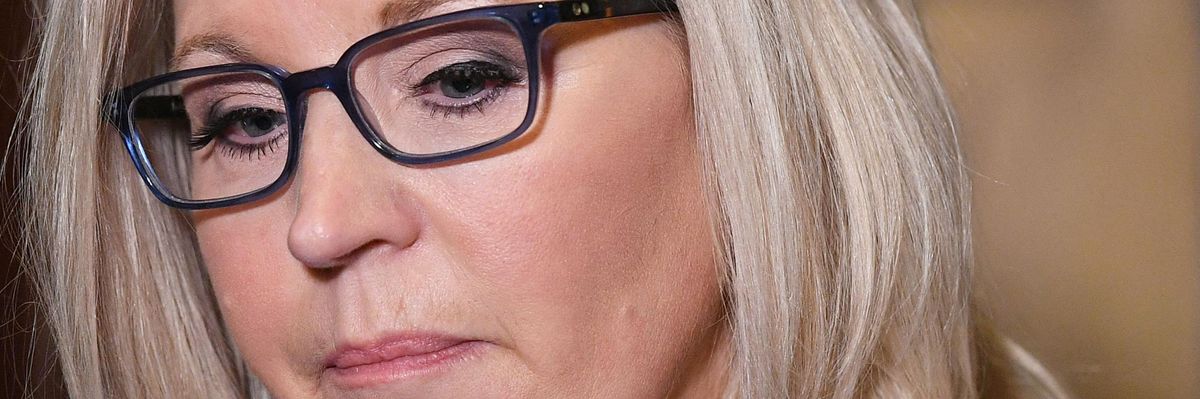
Rep. Liz Cheney (R-Wyo.) speaks during a press conference at the U.S. Capitol in Washington, D.C. on May 12, 2021 following her ouster as chair of the House Republican Conference. (Photo: Mandel Ngan/AFP via Getty Images)
GOP Ouster of 'Xenophobic Extremist' Liz Cheney Called 'Flashing Red Danger Sign' for Democracy
"Political parties that promote lies and propaganda are setting their countries up for authoritarianism and fascism."
As Republican lawmakers expelled Rep. Liz Cheney from her House leadership post on Wednesday, Democratic lawmakers and progressive observers--who stand staunchly opposed to her policy positions--sounded the alarm over what they say is the grave threat to U.S. democracy posed by a party in thrall to former President Donald Trump's "Big Lie."
"What we are witnessing on the right when it comes to not acknowledging the outcome of the 2020 election is a symptom of mass psychosis, a collective delusion hinged on a Big Lie that is incompatible with democracy."
--Sen. Alex Padilla
Cheney (R-Wyo.) was ousted from her position as chair of the House Republican Conference by voice vote during a closed-door session Wednesday morning for what many of her GOP colleagues consider the cardinal offense of vocally opposing Trump's efforts to undermine the 2020 election.
Describing Trump's actions as "a threat America has never seen before," Cheney said Tuesday that the former president "provoked a violent attack on this Capitol in an effort to steal the election."
"Remaining silent and ignoring the lie only emboldens the liar," she added. "I will not participate in that."
While there is no love lost between Cheney and progressives--who have called her a "xenophobic extremist," a "warmonger," and worse--some left-leaning observers noted the larger significance and ominous implications of her purge.
Sen. Bernie Sanders (I-Vt.) tweeted following Wednesday's GOP House vote that while "Cheney and I disagree on nearly every major issue, she deserves credit for saying, 'I will not sit back and watch in silence as others lead our party down a path that abandons the rule of law and joins the former president's crusade to undermine our democracy.'"
Sen. Alex Padilla (D-Calif.) said Tuesday that "what we are witnessing on the right when it comes to not acknowledging the outcome of the 2020 election is a symptom of mass psychosis, a collective delusion hinged on a Big Lie that is incompatible with democracy."
"We must treat this threat with the seriousness it deserves," he added.
As GOP officials move to fill the now-vacant leadership post in the coming weeks, Rep. Elise Stefanik (R-N.Y.) remains widely considered as a front-runner for the seat, despite serious conservative concerns about a voting record that earned her a 37% score from the right-wing advocacy group FreedomWorks.
Cheney, on the other hand, almost always cast votes in line with Trump's policy positions. And despite her defiant denunciation of lies and liars, she remained tight-lipped amid the unending deluge of deception by Trump, who New Yorker staff writer Susan B. Glasser called "the most mendacious president in U.S. history."
In a post decrying Cheney's "fraudulent martyrdom," Discourse Blog co-founder Paul Blest lamented how the archconservative congresswoman "has been rapidly turned into the Joan of Arc of American democracy, burned at the stake for the heresy of believing in our beloved institutions."
Other progressives also weighed in on the danger of the Cheney martyrdom narrative:
While discussing Cheney's impending removal on Tuesday, House Minority Whip Steve Scalise (R-La.) insisted the move is "not about right or wrong," but rather "about the focus of our conference." Critics pointed to Scalise's remarks as evidence that the congresswoman's ignominious ouster proves that to many Republicans, Trump loyalty trumps not only truth, but also policy.
Progressives also questioned the GOP leadership's priorities:
Meanwhile, purveyors of Trump's "Big Lie" crowed triumphantly over Cheney's demotion, while making sweeping statements about the future of the Republican Party that some Democratic critics wryly refuted.
Rep. Adam Schiff (D-Calif.) said of Wednesday's GOP House vote that "the dangerous evolution of the Republican Party into an anti-truth, autocratic cult has never been more clear, or our need to defeat it."
As for Cheney's future, some progressives speculated that the congresswoman--who now faces a primary challenge in next year's midterm election--may have her sights set on a bigger prize down the road.
"Cheney's a hyper-partisan, ideologically-inflexible political strategist who is playing the long game, just as her father did over the course of a political career that began in the Nixon White House during the Vietnam War," wrote John Nichols for The Capital Times.
We are at a crossroads
This country and this world are at a monumental crossroads. In a few short weeks, US voters will have an opportunity to beat back the forces of fascism and confront the billionaires who are rigging the economy, our media system, and our democracy, making it increasingly impossible for ordinary people to get by. We’re not just talking about the election. We’re talking about what must be done once these fascist elements are vanquished from power. We need a bolder set of solutions than what either major party has so far been willing to offer and a working-class movement ready to fight like hell for it. Trump didn't emerge from nowhere. The conditions that fueled MAGA authoritarianism were created by decades of radical neoliberal economic policies and a corrupt political system dominated by corporate interests. They slashed taxes on the super-rich, promising that the benefits would trickle down. They said giveaways to the corporate titans would make life more affordable for the rest of us. It was all bullshit. And when a bitter, betrayed populace searches for someone to blame, right-wing demagogues have little trouble finding scapegoats. People know when they're being lied to, but you won't hear any of this from the corporate media. Only independent journalism—powered and funded by people who believe in building a better world—can deliver truly trustworthy daily news. Our Fall Campaign is underway, and we need your help. To power our newsroom through the rest of the year, we need to raise $125,000 by midnight on October 31. So if you share our vision, please contribute whatever you can to sustain our work. |
As Republican lawmakers expelled Rep. Liz Cheney from her House leadership post on Wednesday, Democratic lawmakers and progressive observers--who stand staunchly opposed to her policy positions--sounded the alarm over what they say is the grave threat to U.S. democracy posed by a party in thrall to former President Donald Trump's "Big Lie."
"What we are witnessing on the right when it comes to not acknowledging the outcome of the 2020 election is a symptom of mass psychosis, a collective delusion hinged on a Big Lie that is incompatible with democracy."
--Sen. Alex Padilla
Cheney (R-Wyo.) was ousted from her position as chair of the House Republican Conference by voice vote during a closed-door session Wednesday morning for what many of her GOP colleagues consider the cardinal offense of vocally opposing Trump's efforts to undermine the 2020 election.
Describing Trump's actions as "a threat America has never seen before," Cheney said Tuesday that the former president "provoked a violent attack on this Capitol in an effort to steal the election."
"Remaining silent and ignoring the lie only emboldens the liar," she added. "I will not participate in that."
While there is no love lost between Cheney and progressives--who have called her a "xenophobic extremist," a "warmonger," and worse--some left-leaning observers noted the larger significance and ominous implications of her purge.
Sen. Bernie Sanders (I-Vt.) tweeted following Wednesday's GOP House vote that while "Cheney and I disagree on nearly every major issue, she deserves credit for saying, 'I will not sit back and watch in silence as others lead our party down a path that abandons the rule of law and joins the former president's crusade to undermine our democracy.'"
Sen. Alex Padilla (D-Calif.) said Tuesday that "what we are witnessing on the right when it comes to not acknowledging the outcome of the 2020 election is a symptom of mass psychosis, a collective delusion hinged on a Big Lie that is incompatible with democracy."
"We must treat this threat with the seriousness it deserves," he added.
As GOP officials move to fill the now-vacant leadership post in the coming weeks, Rep. Elise Stefanik (R-N.Y.) remains widely considered as a front-runner for the seat, despite serious conservative concerns about a voting record that earned her a 37% score from the right-wing advocacy group FreedomWorks.
Cheney, on the other hand, almost always cast votes in line with Trump's policy positions. And despite her defiant denunciation of lies and liars, she remained tight-lipped amid the unending deluge of deception by Trump, who New Yorker staff writer Susan B. Glasser called "the most mendacious president in U.S. history."
In a post decrying Cheney's "fraudulent martyrdom," Discourse Blog co-founder Paul Blest lamented how the archconservative congresswoman "has been rapidly turned into the Joan of Arc of American democracy, burned at the stake for the heresy of believing in our beloved institutions."
Other progressives also weighed in on the danger of the Cheney martyrdom narrative:
While discussing Cheney's impending removal on Tuesday, House Minority Whip Steve Scalise (R-La.) insisted the move is "not about right or wrong," but rather "about the focus of our conference." Critics pointed to Scalise's remarks as evidence that the congresswoman's ignominious ouster proves that to many Republicans, Trump loyalty trumps not only truth, but also policy.
Progressives also questioned the GOP leadership's priorities:
Meanwhile, purveyors of Trump's "Big Lie" crowed triumphantly over Cheney's demotion, while making sweeping statements about the future of the Republican Party that some Democratic critics wryly refuted.
Rep. Adam Schiff (D-Calif.) said of Wednesday's GOP House vote that "the dangerous evolution of the Republican Party into an anti-truth, autocratic cult has never been more clear, or our need to defeat it."
As for Cheney's future, some progressives speculated that the congresswoman--who now faces a primary challenge in next year's midterm election--may have her sights set on a bigger prize down the road.
"Cheney's a hyper-partisan, ideologically-inflexible political strategist who is playing the long game, just as her father did over the course of a political career that began in the Nixon White House during the Vietnam War," wrote John Nichols for The Capital Times.
As Republican lawmakers expelled Rep. Liz Cheney from her House leadership post on Wednesday, Democratic lawmakers and progressive observers--who stand staunchly opposed to her policy positions--sounded the alarm over what they say is the grave threat to U.S. democracy posed by a party in thrall to former President Donald Trump's "Big Lie."
"What we are witnessing on the right when it comes to not acknowledging the outcome of the 2020 election is a symptom of mass psychosis, a collective delusion hinged on a Big Lie that is incompatible with democracy."
--Sen. Alex Padilla
Cheney (R-Wyo.) was ousted from her position as chair of the House Republican Conference by voice vote during a closed-door session Wednesday morning for what many of her GOP colleagues consider the cardinal offense of vocally opposing Trump's efforts to undermine the 2020 election.
Describing Trump's actions as "a threat America has never seen before," Cheney said Tuesday that the former president "provoked a violent attack on this Capitol in an effort to steal the election."
"Remaining silent and ignoring the lie only emboldens the liar," she added. "I will not participate in that."
While there is no love lost between Cheney and progressives--who have called her a "xenophobic extremist," a "warmonger," and worse--some left-leaning observers noted the larger significance and ominous implications of her purge.
Sen. Bernie Sanders (I-Vt.) tweeted following Wednesday's GOP House vote that while "Cheney and I disagree on nearly every major issue, she deserves credit for saying, 'I will not sit back and watch in silence as others lead our party down a path that abandons the rule of law and joins the former president's crusade to undermine our democracy.'"
Sen. Alex Padilla (D-Calif.) said Tuesday that "what we are witnessing on the right when it comes to not acknowledging the outcome of the 2020 election is a symptom of mass psychosis, a collective delusion hinged on a Big Lie that is incompatible with democracy."
"We must treat this threat with the seriousness it deserves," he added.
As GOP officials move to fill the now-vacant leadership post in the coming weeks, Rep. Elise Stefanik (R-N.Y.) remains widely considered as a front-runner for the seat, despite serious conservative concerns about a voting record that earned her a 37% score from the right-wing advocacy group FreedomWorks.
Cheney, on the other hand, almost always cast votes in line with Trump's policy positions. And despite her defiant denunciation of lies and liars, she remained tight-lipped amid the unending deluge of deception by Trump, who New Yorker staff writer Susan B. Glasser called "the most mendacious president in U.S. history."
In a post decrying Cheney's "fraudulent martyrdom," Discourse Blog co-founder Paul Blest lamented how the archconservative congresswoman "has been rapidly turned into the Joan of Arc of American democracy, burned at the stake for the heresy of believing in our beloved institutions."
Other progressives also weighed in on the danger of the Cheney martyrdom narrative:
While discussing Cheney's impending removal on Tuesday, House Minority Whip Steve Scalise (R-La.) insisted the move is "not about right or wrong," but rather "about the focus of our conference." Critics pointed to Scalise's remarks as evidence that the congresswoman's ignominious ouster proves that to many Republicans, Trump loyalty trumps not only truth, but also policy.
Progressives also questioned the GOP leadership's priorities:
Meanwhile, purveyors of Trump's "Big Lie" crowed triumphantly over Cheney's demotion, while making sweeping statements about the future of the Republican Party that some Democratic critics wryly refuted.
Rep. Adam Schiff (D-Calif.) said of Wednesday's GOP House vote that "the dangerous evolution of the Republican Party into an anti-truth, autocratic cult has never been more clear, or our need to defeat it."
As for Cheney's future, some progressives speculated that the congresswoman--who now faces a primary challenge in next year's midterm election--may have her sights set on a bigger prize down the road.
"Cheney's a hyper-partisan, ideologically-inflexible political strategist who is playing the long game, just as her father did over the course of a political career that began in the Nixon White House during the Vietnam War," wrote John Nichols for The Capital Times.