SUBSCRIBE TO OUR FREE NEWSLETTER
Daily news & progressive opinion—funded by the people, not the corporations—delivered straight to your inbox.
5
#000000
#FFFFFF
To donate by check, phone, or other method, see our More Ways to Give page.
Daily news & progressive opinion—funded by the people, not the corporations—delivered straight to your inbox.
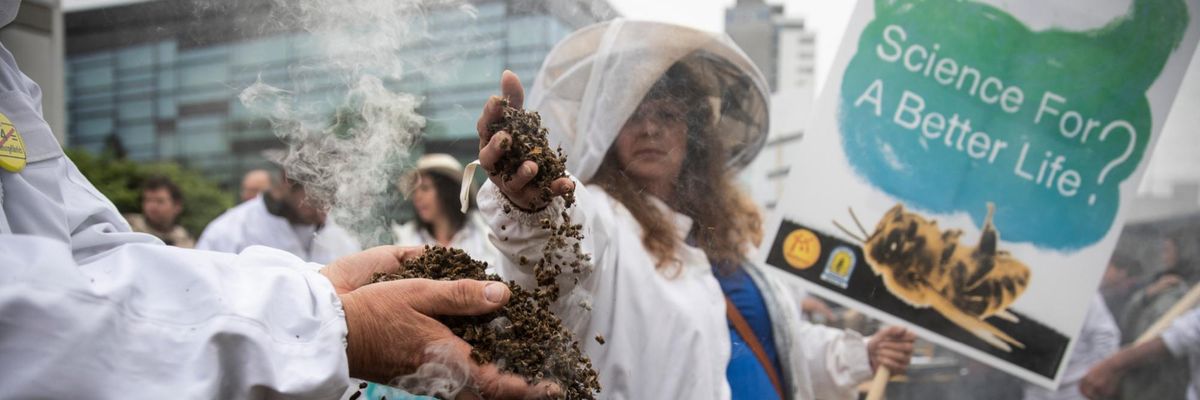
Protesters hold bees killed by pesticides prior to the annual shareholders meeting of German chemicals and pharmaceuticals conglomerate Bayer AG on April 26, 2019 in Bonn, Germany. (Photo: Maja Hitij via Getty Images)
The European Union's top court ruled Thursday in favor of the European Commission's partial ban on three pesticides hazardous to bees, much to the chagrin of Bayer--the German pharmaceutical and biotech company that merged with agrochemical giant Monsanto in 2018.
Bayer attempted to overturn the ban and undermine the E.U.'s "precautionary principle" for the protection of environmental and human health, but the European Court of Justice dismissed the corporation's appeal and backed a lower court's 2018 decision to uphold restrictions on the use of some pesticides on certain crops. In 2013, the Commission banned the use of imidacloprid, clothianidin, and thiamethoxam--three bee-killing neonicotinoid pesticides--on maize, rapseed, and some cereals.
"The Court of Justice has reaffirmed that protecting nature and people's health takes precedence over the narrow economic interests of powerful multinationals and that the precautionary principle is a cornerstone of E.U. law," Greenpeace E.U. legal strategist Andrea Carta said in response to the top court's ratification of the ban.
"This means the E.U. has a responsibility and the power to ensure the safety of all pesticides, chemicals, GM crops, and other dangerous products and substances," said Carta.
While hailing the "landmark decision," Greenpeace E.U. warned that it "does not mean an end to threats to bees and other pollinators in the E.U."
"E.U. courts have again ruled that bees and other essential insects should be protected from dangerous pesticides, but governments continue to dish out exemptions and hold up attempts to put in place effective safety testing," said Carta. "This ruling shows they must adopt rigorous testing rules without further delay."
According to Reuters, 206 emergency authorizations were granted for the use of the neonicotinoids in the E.U. between 2013 and 2019, and the ban did not prevent the use of the toxic substances on other crops, such as sugar beet. "E.U. auditors last year said this pesticide use, while legal, was thought to be responsible for honeybee losses," the news outlet reported.
In addition, Greenpeace E.U. pointed out, "Research also indicates that several other pesticides currently used in the E.U. are a threat to bees and other pollinating insects, including four more neonicotinoids not covered by the 2013 ban."
Reuters noted that the Commission, in an effort to protect bees, has proposed targets to reduce the E.U.'s use of pesticides by 50% and to cut fertilizer use by 20% by 2030.
Dear Common Dreams reader, It’s been nearly 30 years since I co-founded Common Dreams with my late wife, Lina Newhouser. We had the radical notion that journalism should serve the public good, not corporate profits. It was clear to us from the outset what it would take to build such a project. No paid advertisements. No corporate sponsors. No millionaire publisher telling us what to think or do. Many people said we wouldn't last a year, but we proved those doubters wrong. Together with a tremendous team of journalists and dedicated staff, we built an independent media outlet free from the constraints of profits and corporate control. Our mission has always been simple: To inform. To inspire. To ignite change for the common good. Building Common Dreams was not easy. Our survival was never guaranteed. When you take on the most powerful forces—Wall Street greed, fossil fuel industry destruction, Big Tech lobbyists, and uber-rich oligarchs who have spent billions upon billions rigging the economy and democracy in their favor—the only bulwark you have is supporters who believe in your work. But here’s the urgent message from me today. It's never been this bad out there. And it's never been this hard to keep us going. At the very moment Common Dreams is most needed, the threats we face are intensifying. We need your support now more than ever. We don't accept corporate advertising and never will. We don't have a paywall because we don't think people should be blocked from critical news based on their ability to pay. Everything we do is funded by the donations of readers like you. When everyone does the little they can afford, we are strong. But if that support retreats or dries up, so do we. Will you donate now to make sure Common Dreams not only survives but thrives? —Craig Brown, Co-founder |
The European Union's top court ruled Thursday in favor of the European Commission's partial ban on three pesticides hazardous to bees, much to the chagrin of Bayer--the German pharmaceutical and biotech company that merged with agrochemical giant Monsanto in 2018.
Bayer attempted to overturn the ban and undermine the E.U.'s "precautionary principle" for the protection of environmental and human health, but the European Court of Justice dismissed the corporation's appeal and backed a lower court's 2018 decision to uphold restrictions on the use of some pesticides on certain crops. In 2013, the Commission banned the use of imidacloprid, clothianidin, and thiamethoxam--three bee-killing neonicotinoid pesticides--on maize, rapseed, and some cereals.
"The Court of Justice has reaffirmed that protecting nature and people's health takes precedence over the narrow economic interests of powerful multinationals and that the precautionary principle is a cornerstone of E.U. law," Greenpeace E.U. legal strategist Andrea Carta said in response to the top court's ratification of the ban.
"This means the E.U. has a responsibility and the power to ensure the safety of all pesticides, chemicals, GM crops, and other dangerous products and substances," said Carta.
While hailing the "landmark decision," Greenpeace E.U. warned that it "does not mean an end to threats to bees and other pollinators in the E.U."
"E.U. courts have again ruled that bees and other essential insects should be protected from dangerous pesticides, but governments continue to dish out exemptions and hold up attempts to put in place effective safety testing," said Carta. "This ruling shows they must adopt rigorous testing rules without further delay."
According to Reuters, 206 emergency authorizations were granted for the use of the neonicotinoids in the E.U. between 2013 and 2019, and the ban did not prevent the use of the toxic substances on other crops, such as sugar beet. "E.U. auditors last year said this pesticide use, while legal, was thought to be responsible for honeybee losses," the news outlet reported.
In addition, Greenpeace E.U. pointed out, "Research also indicates that several other pesticides currently used in the E.U. are a threat to bees and other pollinating insects, including four more neonicotinoids not covered by the 2013 ban."
Reuters noted that the Commission, in an effort to protect bees, has proposed targets to reduce the E.U.'s use of pesticides by 50% and to cut fertilizer use by 20% by 2030.
The European Union's top court ruled Thursday in favor of the European Commission's partial ban on three pesticides hazardous to bees, much to the chagrin of Bayer--the German pharmaceutical and biotech company that merged with agrochemical giant Monsanto in 2018.
Bayer attempted to overturn the ban and undermine the E.U.'s "precautionary principle" for the protection of environmental and human health, but the European Court of Justice dismissed the corporation's appeal and backed a lower court's 2018 decision to uphold restrictions on the use of some pesticides on certain crops. In 2013, the Commission banned the use of imidacloprid, clothianidin, and thiamethoxam--three bee-killing neonicotinoid pesticides--on maize, rapseed, and some cereals.
"The Court of Justice has reaffirmed that protecting nature and people's health takes precedence over the narrow economic interests of powerful multinationals and that the precautionary principle is a cornerstone of E.U. law," Greenpeace E.U. legal strategist Andrea Carta said in response to the top court's ratification of the ban.
"This means the E.U. has a responsibility and the power to ensure the safety of all pesticides, chemicals, GM crops, and other dangerous products and substances," said Carta.
While hailing the "landmark decision," Greenpeace E.U. warned that it "does not mean an end to threats to bees and other pollinators in the E.U."
"E.U. courts have again ruled that bees and other essential insects should be protected from dangerous pesticides, but governments continue to dish out exemptions and hold up attempts to put in place effective safety testing," said Carta. "This ruling shows they must adopt rigorous testing rules without further delay."
According to Reuters, 206 emergency authorizations were granted for the use of the neonicotinoids in the E.U. between 2013 and 2019, and the ban did not prevent the use of the toxic substances on other crops, such as sugar beet. "E.U. auditors last year said this pesticide use, while legal, was thought to be responsible for honeybee losses," the news outlet reported.
In addition, Greenpeace E.U. pointed out, "Research also indicates that several other pesticides currently used in the E.U. are a threat to bees and other pollinating insects, including four more neonicotinoids not covered by the 2013 ban."
Reuters noted that the Commission, in an effort to protect bees, has proposed targets to reduce the E.U.'s use of pesticides by 50% and to cut fertilizer use by 20% by 2030.