SUBSCRIBE TO OUR FREE NEWSLETTER
Daily news & progressive opinion—funded by the people, not the corporations—delivered straight to your inbox.
5
#000000
#FFFFFF
To donate by check, phone, or other method, see our More Ways to Give page.
Daily news & progressive opinion—funded by the people, not the corporations—delivered straight to your inbox.
"Despite today's ruling in favor of secrecy, we will only increase our demands on insurance companies to publicly state that they will cut ties with Trans Mountain and all tar sands projects," said Elana Sulakshana, energy finance Campaigner with Rainforest Action Network.
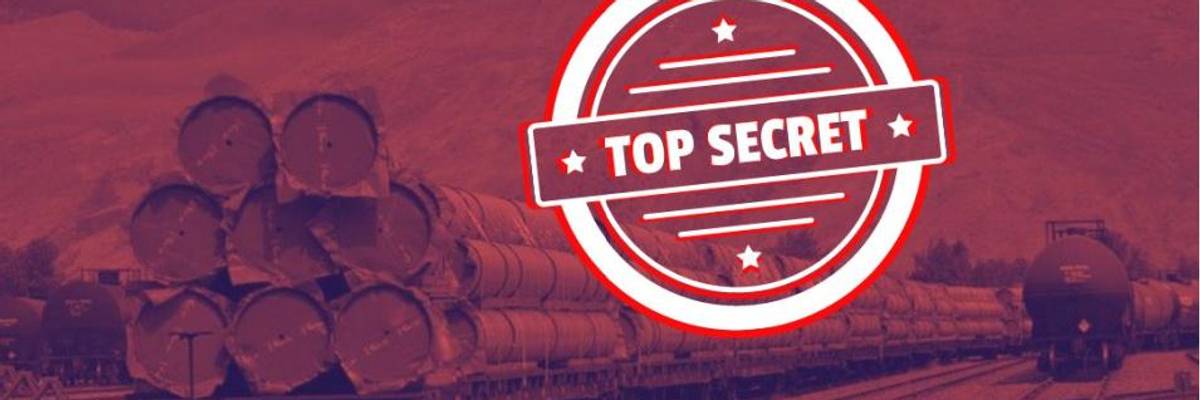
A Canadian regulatory agency on Thursday granted a request by the operator of the government-owned Trans Mountain pipeline to keep its insurers hidden from public view, a decision environmentalists said is a "dangerous precedent" and yet another reason to shut the dirty energy project down immediately.
"A project which can only be insured secretly has lost its social license to operate," Sven Biggs, Canadian Oil and Gas Program director at Stand.earth, said in a statement. "The fact that Trans Mountain is struggling to obtain adequate insurance makes clear that this pipeline system is too risky, and the Canadian government must shut it down and cancel the expansion project."
"These insurers can't hide. Any company that refuses to rule out insuring tar sands extraction and pipeline projects is complicit in Indigenous rights violations."
--Kanahus Manuel, Tiny House Warriors
The Canada Energy Regulator (CER) said in a ruling Thursday that it accepts Trans Mountain Corporation's argument that unveiling the names of companies insuring the pipeline project would "prejudice its competitive position" and harm "its ability to obtain adequate insurance at a reasonable price."
"Trans Mountain has satisfied the requirements for confidentiality," CER said in its decision (pdf), which applies only to the existing pipeline and not the ongoing expansion.
Charlene Aleck, spokesperson for Tsleil-Waututh Nation Sacred Trust Initiative, which opposes the pipeline, said in a statement that "by making the certificate of insurance confidential and removing a layer of transparency, the CER has reduced the options for Tsleil Waututh Nation to assert our inherent and constitutionally protected Aboriginal rights and fulfill our sacred obligation to protect and steward our territory."
"After all these years of regulatory process, including sharing our own independent assessment, grounded in our Indigenous own laws, the CER continues to undermine our sovereignty," Aleck added. "This is not reconciliation."
In the wake of Thursday's decision, a coalition of Indigenous communities and climate organizations is planning to intensify its pressure campaign targeting insurance companies that have not ruled out backing the Trans Mountain pipeline, including AIG, Liberty Mutual, and Energy Insurance Limited.
Under pressure from environmentalists, Zurich Insurance Group AG dropped its coverage of the Trans Mountain pipeline last year.
"These insurers can't hide. Any company that refuses to rule out insuring tar sands extraction and pipeline projects is complicit in Indigenous rights violations," said Kanahus Manuel, a Secwepemc and Ktunaxa land defender with the Tiny House Warriors. "By not dropping Trans Mountain, insurers are also making a misguided business decision. Our presence and our assertions of Indigenous jurisdiction and territorial authority to our lands represent major risks to the construction and financial liability of the expansion project."
In 2018, the government of Canadian Prime Minister Justin Trudeau purchased the Trans Mountain pipeline--which carries around 300,000 barrels of crude oil a day from Alberta to the Vancouver area--from Kinder Morgan for $4.5 billion (CAD) in an effort to rescue the project from financial struggles and complete a major expansion.
Elana Sulakshana, energy finance Campaigner with Rainforest Action Network, said Thursday that "hiding the details of Trans Mountain's insurance certificate will do nothing to address the very real problems this pipeline faces: lack of consent from Indigenous communities, decaying infrastructure, mounting costs, and a massive carbon footprint."
A paper published last month by a team of researchers at Simon Fraser University's School of Resource and Environmental Management estimates that Canada is set to lose an estimated $11.9 billion from the Trans Mountain pipeline expansion project due to soaring construction costs and national climate policies aimed at reducing demand for oil.
"Despite today's ruling in favor of secrecy," said Sulakshana, "we will only increase our demands on insurance companies to publicly state that they will cut ties with Trans Mountain and all tar sands projects."
Dear Common Dreams reader, It’s been nearly 30 years since I co-founded Common Dreams with my late wife, Lina Newhouser. We had the radical notion that journalism should serve the public good, not corporate profits. It was clear to us from the outset what it would take to build such a project. No paid advertisements. No corporate sponsors. No millionaire publisher telling us what to think or do. Many people said we wouldn't last a year, but we proved those doubters wrong. Together with a tremendous team of journalists and dedicated staff, we built an independent media outlet free from the constraints of profits and corporate control. Our mission has always been simple: To inform. To inspire. To ignite change for the common good. Building Common Dreams was not easy. Our survival was never guaranteed. When you take on the most powerful forces—Wall Street greed, fossil fuel industry destruction, Big Tech lobbyists, and uber-rich oligarchs who have spent billions upon billions rigging the economy and democracy in their favor—the only bulwark you have is supporters who believe in your work. But here’s the urgent message from me today. It's never been this bad out there. And it's never been this hard to keep us going. At the very moment Common Dreams is most needed, the threats we face are intensifying. We need your support now more than ever. We don't accept corporate advertising and never will. We don't have a paywall because we don't think people should be blocked from critical news based on their ability to pay. Everything we do is funded by the donations of readers like you. When everyone does the little they can afford, we are strong. But if that support retreats or dries up, so do we. Will you donate now to make sure Common Dreams not only survives but thrives? —Craig Brown, Co-founder |
A Canadian regulatory agency on Thursday granted a request by the operator of the government-owned Trans Mountain pipeline to keep its insurers hidden from public view, a decision environmentalists said is a "dangerous precedent" and yet another reason to shut the dirty energy project down immediately.
"A project which can only be insured secretly has lost its social license to operate," Sven Biggs, Canadian Oil and Gas Program director at Stand.earth, said in a statement. "The fact that Trans Mountain is struggling to obtain adequate insurance makes clear that this pipeline system is too risky, and the Canadian government must shut it down and cancel the expansion project."
"These insurers can't hide. Any company that refuses to rule out insuring tar sands extraction and pipeline projects is complicit in Indigenous rights violations."
--Kanahus Manuel, Tiny House Warriors
The Canada Energy Regulator (CER) said in a ruling Thursday that it accepts Trans Mountain Corporation's argument that unveiling the names of companies insuring the pipeline project would "prejudice its competitive position" and harm "its ability to obtain adequate insurance at a reasonable price."
"Trans Mountain has satisfied the requirements for confidentiality," CER said in its decision (pdf), which applies only to the existing pipeline and not the ongoing expansion.
Charlene Aleck, spokesperson for Tsleil-Waututh Nation Sacred Trust Initiative, which opposes the pipeline, said in a statement that "by making the certificate of insurance confidential and removing a layer of transparency, the CER has reduced the options for Tsleil Waututh Nation to assert our inherent and constitutionally protected Aboriginal rights and fulfill our sacred obligation to protect and steward our territory."
"After all these years of regulatory process, including sharing our own independent assessment, grounded in our Indigenous own laws, the CER continues to undermine our sovereignty," Aleck added. "This is not reconciliation."
In the wake of Thursday's decision, a coalition of Indigenous communities and climate organizations is planning to intensify its pressure campaign targeting insurance companies that have not ruled out backing the Trans Mountain pipeline, including AIG, Liberty Mutual, and Energy Insurance Limited.
Under pressure from environmentalists, Zurich Insurance Group AG dropped its coverage of the Trans Mountain pipeline last year.
"These insurers can't hide. Any company that refuses to rule out insuring tar sands extraction and pipeline projects is complicit in Indigenous rights violations," said Kanahus Manuel, a Secwepemc and Ktunaxa land defender with the Tiny House Warriors. "By not dropping Trans Mountain, insurers are also making a misguided business decision. Our presence and our assertions of Indigenous jurisdiction and territorial authority to our lands represent major risks to the construction and financial liability of the expansion project."
In 2018, the government of Canadian Prime Minister Justin Trudeau purchased the Trans Mountain pipeline--which carries around 300,000 barrels of crude oil a day from Alberta to the Vancouver area--from Kinder Morgan for $4.5 billion (CAD) in an effort to rescue the project from financial struggles and complete a major expansion.
Elana Sulakshana, energy finance Campaigner with Rainforest Action Network, said Thursday that "hiding the details of Trans Mountain's insurance certificate will do nothing to address the very real problems this pipeline faces: lack of consent from Indigenous communities, decaying infrastructure, mounting costs, and a massive carbon footprint."
A paper published last month by a team of researchers at Simon Fraser University's School of Resource and Environmental Management estimates that Canada is set to lose an estimated $11.9 billion from the Trans Mountain pipeline expansion project due to soaring construction costs and national climate policies aimed at reducing demand for oil.
"Despite today's ruling in favor of secrecy," said Sulakshana, "we will only increase our demands on insurance companies to publicly state that they will cut ties with Trans Mountain and all tar sands projects."
A Canadian regulatory agency on Thursday granted a request by the operator of the government-owned Trans Mountain pipeline to keep its insurers hidden from public view, a decision environmentalists said is a "dangerous precedent" and yet another reason to shut the dirty energy project down immediately.
"A project which can only be insured secretly has lost its social license to operate," Sven Biggs, Canadian Oil and Gas Program director at Stand.earth, said in a statement. "The fact that Trans Mountain is struggling to obtain adequate insurance makes clear that this pipeline system is too risky, and the Canadian government must shut it down and cancel the expansion project."
"These insurers can't hide. Any company that refuses to rule out insuring tar sands extraction and pipeline projects is complicit in Indigenous rights violations."
--Kanahus Manuel, Tiny House Warriors
The Canada Energy Regulator (CER) said in a ruling Thursday that it accepts Trans Mountain Corporation's argument that unveiling the names of companies insuring the pipeline project would "prejudice its competitive position" and harm "its ability to obtain adequate insurance at a reasonable price."
"Trans Mountain has satisfied the requirements for confidentiality," CER said in its decision (pdf), which applies only to the existing pipeline and not the ongoing expansion.
Charlene Aleck, spokesperson for Tsleil-Waututh Nation Sacred Trust Initiative, which opposes the pipeline, said in a statement that "by making the certificate of insurance confidential and removing a layer of transparency, the CER has reduced the options for Tsleil Waututh Nation to assert our inherent and constitutionally protected Aboriginal rights and fulfill our sacred obligation to protect and steward our territory."
"After all these years of regulatory process, including sharing our own independent assessment, grounded in our Indigenous own laws, the CER continues to undermine our sovereignty," Aleck added. "This is not reconciliation."
In the wake of Thursday's decision, a coalition of Indigenous communities and climate organizations is planning to intensify its pressure campaign targeting insurance companies that have not ruled out backing the Trans Mountain pipeline, including AIG, Liberty Mutual, and Energy Insurance Limited.
Under pressure from environmentalists, Zurich Insurance Group AG dropped its coverage of the Trans Mountain pipeline last year.
"These insurers can't hide. Any company that refuses to rule out insuring tar sands extraction and pipeline projects is complicit in Indigenous rights violations," said Kanahus Manuel, a Secwepemc and Ktunaxa land defender with the Tiny House Warriors. "By not dropping Trans Mountain, insurers are also making a misguided business decision. Our presence and our assertions of Indigenous jurisdiction and territorial authority to our lands represent major risks to the construction and financial liability of the expansion project."
In 2018, the government of Canadian Prime Minister Justin Trudeau purchased the Trans Mountain pipeline--which carries around 300,000 barrels of crude oil a day from Alberta to the Vancouver area--from Kinder Morgan for $4.5 billion (CAD) in an effort to rescue the project from financial struggles and complete a major expansion.
Elana Sulakshana, energy finance Campaigner with Rainforest Action Network, said Thursday that "hiding the details of Trans Mountain's insurance certificate will do nothing to address the very real problems this pipeline faces: lack of consent from Indigenous communities, decaying infrastructure, mounting costs, and a massive carbon footprint."
A paper published last month by a team of researchers at Simon Fraser University's School of Resource and Environmental Management estimates that Canada is set to lose an estimated $11.9 billion from the Trans Mountain pipeline expansion project due to soaring construction costs and national climate policies aimed at reducing demand for oil.
"Despite today's ruling in favor of secrecy," said Sulakshana, "we will only increase our demands on insurance companies to publicly state that they will cut ties with Trans Mountain and all tar sands projects."