SUBSCRIBE TO OUR FREE NEWSLETTER
Daily news & progressive opinion—funded by the people, not the corporations—delivered straight to your inbox.
5
#000000
#FFFFFF
To donate by check, phone, or other method, see our More Ways to Give page.
Daily news & progressive opinion—funded by the people, not the corporations—delivered straight to your inbox.
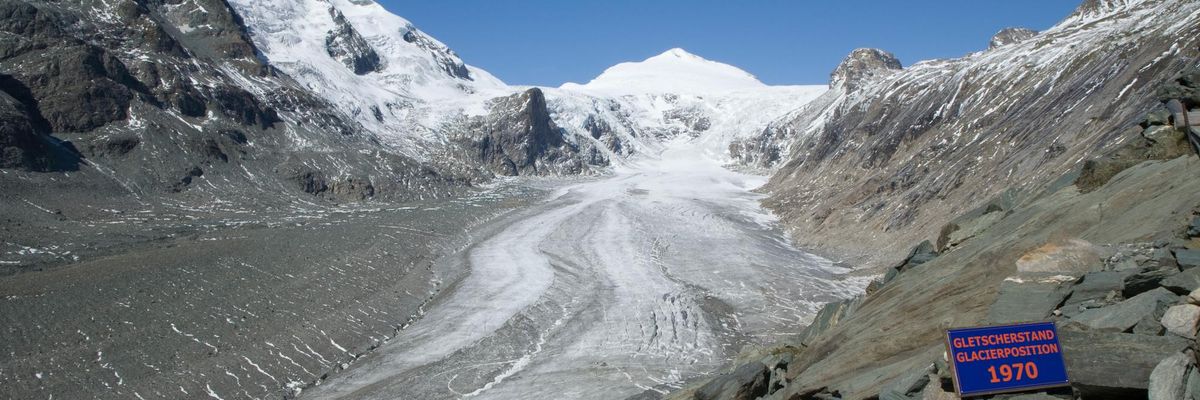
A sign shows the location of the Pasterze Glacier--the longest remaining one in Austria--in 1970, with its current position seen far in the distance. (Photo: Robert Wallis/Corbis via Getty Images)
Researchers warned of the need for urgent climate action as a study published Wednesday revealed that the world's mountain glaciers are melting at an unprecedented pace, with glacial thinning rates outside Antarctica and Greenland doubling this century.
"If we do not plan ahead, there could be a crisis for water and food, affecting the most vulnerable."
--Romain Hugonnet,
University of Toulouse
For the first time ever, researchers analyzed three-dimensional satellite measurements of the world's approximately 220,000 glaciers, except for those on the Antarctic and Greenland ice sheets. The results, published in Nature, show that the planet's glaciers lost 267 billion tonnes of ice each year from 2000 to 2019, the equivalent of 21% of sea level rise. The study's authors said that is enough water to flood all of Switzerland under six feet of water every year.
The paper notes that "thinning rates of glaciers outside ice sheet peripheries doubled over the past two decades."
The study's authors found that, on average, glaciers lost 4% of their volume during the two decades studied. They determined that the fastest-melting glaciers are in Alaska and the Alps. Alaska alone accounted for one-quarter of the world's glacial melt, with the Columbia Glacier in Prince William Sound retreating by around 115 feet annually.
"A doubling of the thinning rates in 20 years for glaciers outside Greenland and Antarctica tells us we need to change the way we live," Romain Hugonnet of the University of Toulouse in France, the study's lead author, told The Guardian.
"It can be difficult to get the public to understand why glaciers are important because they seem so remote," he added, "but they affect many things in the global water cycle including regional hydrology, and by changing too rapidly, can lead to the alteration or collapse of downstream ecosystems."
Hugonnet said he was particularly concerned about glacier loss in high Asian mountain ranges, which are the sources of rivers upon which more than 1.5 billion people rely for water.
"India and China are depleting underground sources and relying on river water, which substantially originates from glaciers during times of drought," he told The Guardian.
"This will be fine for a few decades because glaciers will keep melting and provide more river runoff, which acts as a buffer to protect populations from water stress," said Hugonnet. "But after these decades, the situation could go downhill. If we do not plan ahead, there could be a crisis for water and food, affecting the most vulnerable."
Mark Serreze, director of the Colorado-based National Snow and Ice Data Center, told the Associated Press that sea level rise--which is exacerbated by glacier melt--"is going to be a bigger and bigger problem as we move through the 21st century." Serreze did not contribute to the new paper.
The new study's authors implore policymakers to devise adaptive measures for the estimated billion people threatened with water and food insecurity before 2050.
"We need to act now," stressed Hugonnet.
"Never before in history has change happened this fast."
--Samuel Nussbaumer,
World Glacier Monitoring Service
Samuel Nussbaumer of the World Glacier Monitoring Service, which did not take part in the study, said that "the new paper will have a big impact."
"This is the most global, complete study. The gain in new information is huge," Nussbaumer told The Guardian. "The rapid change we see now is really interesting from a scientific point of view. Never before in history has change happened this fast."
The new study follows research published last week showing shifts in the Earth's rotational axis--which have accelerated over the past three decades--are caused by melting glaciers.
Dear Common Dreams reader, It’s been nearly 30 years since I co-founded Common Dreams with my late wife, Lina Newhouser. We had the radical notion that journalism should serve the public good, not corporate profits. It was clear to us from the outset what it would take to build such a project. No paid advertisements. No corporate sponsors. No millionaire publisher telling us what to think or do. Many people said we wouldn't last a year, but we proved those doubters wrong. Together with a tremendous team of journalists and dedicated staff, we built an independent media outlet free from the constraints of profits and corporate control. Our mission has always been simple: To inform. To inspire. To ignite change for the common good. Building Common Dreams was not easy. Our survival was never guaranteed. When you take on the most powerful forces—Wall Street greed, fossil fuel industry destruction, Big Tech lobbyists, and uber-rich oligarchs who have spent billions upon billions rigging the economy and democracy in their favor—the only bulwark you have is supporters who believe in your work. But here’s the urgent message from me today. It's never been this bad out there. And it's never been this hard to keep us going. At the very moment Common Dreams is most needed, the threats we face are intensifying. We need your support now more than ever. We don't accept corporate advertising and never will. We don't have a paywall because we don't think people should be blocked from critical news based on their ability to pay. Everything we do is funded by the donations of readers like you. When everyone does the little they can afford, we are strong. But if that support retreats or dries up, so do we. Will you donate now to make sure Common Dreams not only survives but thrives? —Craig Brown, Co-founder |
Researchers warned of the need for urgent climate action as a study published Wednesday revealed that the world's mountain glaciers are melting at an unprecedented pace, with glacial thinning rates outside Antarctica and Greenland doubling this century.
"If we do not plan ahead, there could be a crisis for water and food, affecting the most vulnerable."
--Romain Hugonnet,
University of Toulouse
For the first time ever, researchers analyzed three-dimensional satellite measurements of the world's approximately 220,000 glaciers, except for those on the Antarctic and Greenland ice sheets. The results, published in Nature, show that the planet's glaciers lost 267 billion tonnes of ice each year from 2000 to 2019, the equivalent of 21% of sea level rise. The study's authors said that is enough water to flood all of Switzerland under six feet of water every year.
The paper notes that "thinning rates of glaciers outside ice sheet peripheries doubled over the past two decades."
The study's authors found that, on average, glaciers lost 4% of their volume during the two decades studied. They determined that the fastest-melting glaciers are in Alaska and the Alps. Alaska alone accounted for one-quarter of the world's glacial melt, with the Columbia Glacier in Prince William Sound retreating by around 115 feet annually.
"A doubling of the thinning rates in 20 years for glaciers outside Greenland and Antarctica tells us we need to change the way we live," Romain Hugonnet of the University of Toulouse in France, the study's lead author, told The Guardian.
"It can be difficult to get the public to understand why glaciers are important because they seem so remote," he added, "but they affect many things in the global water cycle including regional hydrology, and by changing too rapidly, can lead to the alteration or collapse of downstream ecosystems."
Hugonnet said he was particularly concerned about glacier loss in high Asian mountain ranges, which are the sources of rivers upon which more than 1.5 billion people rely for water.
"India and China are depleting underground sources and relying on river water, which substantially originates from glaciers during times of drought," he told The Guardian.
"This will be fine for a few decades because glaciers will keep melting and provide more river runoff, which acts as a buffer to protect populations from water stress," said Hugonnet. "But after these decades, the situation could go downhill. If we do not plan ahead, there could be a crisis for water and food, affecting the most vulnerable."
Mark Serreze, director of the Colorado-based National Snow and Ice Data Center, told the Associated Press that sea level rise--which is exacerbated by glacier melt--"is going to be a bigger and bigger problem as we move through the 21st century." Serreze did not contribute to the new paper.
The new study's authors implore policymakers to devise adaptive measures for the estimated billion people threatened with water and food insecurity before 2050.
"We need to act now," stressed Hugonnet.
"Never before in history has change happened this fast."
--Samuel Nussbaumer,
World Glacier Monitoring Service
Samuel Nussbaumer of the World Glacier Monitoring Service, which did not take part in the study, said that "the new paper will have a big impact."
"This is the most global, complete study. The gain in new information is huge," Nussbaumer told The Guardian. "The rapid change we see now is really interesting from a scientific point of view. Never before in history has change happened this fast."
The new study follows research published last week showing shifts in the Earth's rotational axis--which have accelerated over the past three decades--are caused by melting glaciers.
Researchers warned of the need for urgent climate action as a study published Wednesday revealed that the world's mountain glaciers are melting at an unprecedented pace, with glacial thinning rates outside Antarctica and Greenland doubling this century.
"If we do not plan ahead, there could be a crisis for water and food, affecting the most vulnerable."
--Romain Hugonnet,
University of Toulouse
For the first time ever, researchers analyzed three-dimensional satellite measurements of the world's approximately 220,000 glaciers, except for those on the Antarctic and Greenland ice sheets. The results, published in Nature, show that the planet's glaciers lost 267 billion tonnes of ice each year from 2000 to 2019, the equivalent of 21% of sea level rise. The study's authors said that is enough water to flood all of Switzerland under six feet of water every year.
The paper notes that "thinning rates of glaciers outside ice sheet peripheries doubled over the past two decades."
The study's authors found that, on average, glaciers lost 4% of their volume during the two decades studied. They determined that the fastest-melting glaciers are in Alaska and the Alps. Alaska alone accounted for one-quarter of the world's glacial melt, with the Columbia Glacier in Prince William Sound retreating by around 115 feet annually.
"A doubling of the thinning rates in 20 years for glaciers outside Greenland and Antarctica tells us we need to change the way we live," Romain Hugonnet of the University of Toulouse in France, the study's lead author, told The Guardian.
"It can be difficult to get the public to understand why glaciers are important because they seem so remote," he added, "but they affect many things in the global water cycle including regional hydrology, and by changing too rapidly, can lead to the alteration or collapse of downstream ecosystems."
Hugonnet said he was particularly concerned about glacier loss in high Asian mountain ranges, which are the sources of rivers upon which more than 1.5 billion people rely for water.
"India and China are depleting underground sources and relying on river water, which substantially originates from glaciers during times of drought," he told The Guardian.
"This will be fine for a few decades because glaciers will keep melting and provide more river runoff, which acts as a buffer to protect populations from water stress," said Hugonnet. "But after these decades, the situation could go downhill. If we do not plan ahead, there could be a crisis for water and food, affecting the most vulnerable."
Mark Serreze, director of the Colorado-based National Snow and Ice Data Center, told the Associated Press that sea level rise--which is exacerbated by glacier melt--"is going to be a bigger and bigger problem as we move through the 21st century." Serreze did not contribute to the new paper.
The new study's authors implore policymakers to devise adaptive measures for the estimated billion people threatened with water and food insecurity before 2050.
"We need to act now," stressed Hugonnet.
"Never before in history has change happened this fast."
--Samuel Nussbaumer,
World Glacier Monitoring Service
Samuel Nussbaumer of the World Glacier Monitoring Service, which did not take part in the study, said that "the new paper will have a big impact."
"This is the most global, complete study. The gain in new information is huge," Nussbaumer told The Guardian. "The rapid change we see now is really interesting from a scientific point of view. Never before in history has change happened this fast."
The new study follows research published last week showing shifts in the Earth's rotational axis--which have accelerated over the past three decades--are caused by melting glaciers.