SUBSCRIBE TO OUR FREE NEWSLETTER
Daily news & progressive opinion—funded by the people, not the corporations—delivered straight to your inbox.
5
#000000
#FFFFFF
To donate by check, phone, or other method, see our More Ways to Give page.
Daily news & progressive opinion—funded by the people, not the corporations—delivered straight to your inbox.
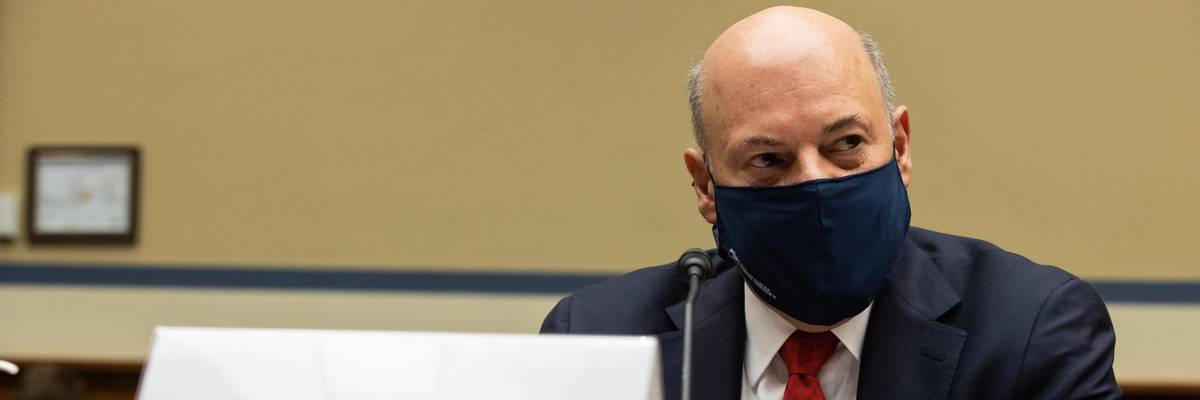
Postmaster General Louis Dejoy speaks during a House Committee on Oversight and Reform hearing on February 24, 2021 on Capitol Hill in Washington, D.C. (Photo: Graeme Jennings-Pool/Getty Images)
The 200,000-member American Postal Workers Union reacted with outrage Tuesday to news that USPS management is moving ahead with a plan to consolidate 18 mail processing facilities as part of Postmaster General Louis DeJoy's sweeping overhaul of delivery operations.
Mark Dimondstein, the president of APWU, said in a statement that the union has "made crystal clear to postal management that any further plant consolidations are a misguided strategy that not only disrupts the lives of postal workers but will further delay mail."
"APWU stands ready to defend the jobs and livelihoods of postal workers and the prompt, reliable, and efficient mail service the law requires and the people of the country deserve."
--American Postal Workers Union
"After a year of courageous and essential frontline work in this pandemic," Dimondstein added, "management's actions are a slap in the face of postal workers."
Months after his operational changes caused significant mail slowdowns and sparked nationwide backlash, DeJoy unveiled a 10-year strategy that Democratic lawmakers decried as a plan to further degrade USPS performance and ensure that the beloved government agency remains in a "death spiral."
Part of DeJoy's plan includes restarting mail processing plant consolidations and closures that were halted in 2015 amid pushback from lawmakers, APWU, and others. As Eric Katz of Government Executive reported Tuesday, "USPS is moving forward with its facility consolidations despite a 2018 inspector general report that found USPS realized just 5% of the $1.6 billion in savings it had projected from the consolidations."
"The agency successfully shuttered 141 plants in the first phase of its plan, but pulled the plug on its second phase to close an additional 82 plants when it was halfway through," Katz noted. "Lawmakers at the time pleaded with postal management to suspend the plan--which would have cost thousands of jobs and further reduced delivery standards--and USPS ultimately agreed."
Calling the previous round of plant closures "a complete failure," Dimondstein vowed that "we will fight back facility-by-facility and community-by-community to save these processing plants."
In a statement announcing the new consolidations and other operational changes--including the continued removal of letter- and flat-sorting equipment--the Postal Service vowed that the moves "will not result in employee layoffs." But APWU was not remotely satisfied with that pledge.
"Management as of yet has not provided the union any impact statements on how these changes will affect the workforce, whether there is any planned excessing of employees, or whether some of these facilities will be 'repurposed' to address the changing mail mix," the organization said. "APWU stands ready to defend the jobs and livelihoods of postal workers and the prompt, reliable, and efficient mail service the law requires and the people of the country deserve."
DeJoy is pressing forward with his agenda as Democratic lawmakers continue to urge President Joe Biden to replace the entire Postal Service Board of Governors, a move that could pave the way for the postmaster general's removal. The board, which has maintained its public support for DeJoy throughout his scandal-plagued 10 months in charge, is currently filled with officials nominated by former President Donald Trump.
"The entire board and then Mr. DeJoy should be handed their walking papers," Rep. Bill Pascrell, Jr. (D-N.J.) told the Washington Post last week. "Their unquestioning support for this postmaster general is unacceptable."
But Biden, who does not have the authority to fire DeJoy on his own, has thus far resisted taking such a sweeping step, opting instead to advance nominees to fill the board's three existing vacancies. Those nominees--two Democrats and one Independent--sat for their first confirmation hearing on April 22.
Dear Common Dreams reader, It’s been nearly 30 years since I co-founded Common Dreams with my late wife, Lina Newhouser. We had the radical notion that journalism should serve the public good, not corporate profits. It was clear to us from the outset what it would take to build such a project. No paid advertisements. No corporate sponsors. No millionaire publisher telling us what to think or do. Many people said we wouldn't last a year, but we proved those doubters wrong. Together with a tremendous team of journalists and dedicated staff, we built an independent media outlet free from the constraints of profits and corporate control. Our mission has always been simple: To inform. To inspire. To ignite change for the common good. Building Common Dreams was not easy. Our survival was never guaranteed. When you take on the most powerful forces—Wall Street greed, fossil fuel industry destruction, Big Tech lobbyists, and uber-rich oligarchs who have spent billions upon billions rigging the economy and democracy in their favor—the only bulwark you have is supporters who believe in your work. But here’s the urgent message from me today. It's never been this bad out there. And it's never been this hard to keep us going. At the very moment Common Dreams is most needed, the threats we face are intensifying. We need your support now more than ever. We don't accept corporate advertising and never will. We don't have a paywall because we don't think people should be blocked from critical news based on their ability to pay. Everything we do is funded by the donations of readers like you. When everyone does the little they can afford, we are strong. But if that support retreats or dries up, so do we. Will you donate now to make sure Common Dreams not only survives but thrives? —Craig Brown, Co-founder |
The 200,000-member American Postal Workers Union reacted with outrage Tuesday to news that USPS management is moving ahead with a plan to consolidate 18 mail processing facilities as part of Postmaster General Louis DeJoy's sweeping overhaul of delivery operations.
Mark Dimondstein, the president of APWU, said in a statement that the union has "made crystal clear to postal management that any further plant consolidations are a misguided strategy that not only disrupts the lives of postal workers but will further delay mail."
"APWU stands ready to defend the jobs and livelihoods of postal workers and the prompt, reliable, and efficient mail service the law requires and the people of the country deserve."
--American Postal Workers Union
"After a year of courageous and essential frontline work in this pandemic," Dimondstein added, "management's actions are a slap in the face of postal workers."
Months after his operational changes caused significant mail slowdowns and sparked nationwide backlash, DeJoy unveiled a 10-year strategy that Democratic lawmakers decried as a plan to further degrade USPS performance and ensure that the beloved government agency remains in a "death spiral."
Part of DeJoy's plan includes restarting mail processing plant consolidations and closures that were halted in 2015 amid pushback from lawmakers, APWU, and others. As Eric Katz of Government Executive reported Tuesday, "USPS is moving forward with its facility consolidations despite a 2018 inspector general report that found USPS realized just 5% of the $1.6 billion in savings it had projected from the consolidations."
"The agency successfully shuttered 141 plants in the first phase of its plan, but pulled the plug on its second phase to close an additional 82 plants when it was halfway through," Katz noted. "Lawmakers at the time pleaded with postal management to suspend the plan--which would have cost thousands of jobs and further reduced delivery standards--and USPS ultimately agreed."
Calling the previous round of plant closures "a complete failure," Dimondstein vowed that "we will fight back facility-by-facility and community-by-community to save these processing plants."
In a statement announcing the new consolidations and other operational changes--including the continued removal of letter- and flat-sorting equipment--the Postal Service vowed that the moves "will not result in employee layoffs." But APWU was not remotely satisfied with that pledge.
"Management as of yet has not provided the union any impact statements on how these changes will affect the workforce, whether there is any planned excessing of employees, or whether some of these facilities will be 'repurposed' to address the changing mail mix," the organization said. "APWU stands ready to defend the jobs and livelihoods of postal workers and the prompt, reliable, and efficient mail service the law requires and the people of the country deserve."
DeJoy is pressing forward with his agenda as Democratic lawmakers continue to urge President Joe Biden to replace the entire Postal Service Board of Governors, a move that could pave the way for the postmaster general's removal. The board, which has maintained its public support for DeJoy throughout his scandal-plagued 10 months in charge, is currently filled with officials nominated by former President Donald Trump.
"The entire board and then Mr. DeJoy should be handed their walking papers," Rep. Bill Pascrell, Jr. (D-N.J.) told the Washington Post last week. "Their unquestioning support for this postmaster general is unacceptable."
But Biden, who does not have the authority to fire DeJoy on his own, has thus far resisted taking such a sweeping step, opting instead to advance nominees to fill the board's three existing vacancies. Those nominees--two Democrats and one Independent--sat for their first confirmation hearing on April 22.
The 200,000-member American Postal Workers Union reacted with outrage Tuesday to news that USPS management is moving ahead with a plan to consolidate 18 mail processing facilities as part of Postmaster General Louis DeJoy's sweeping overhaul of delivery operations.
Mark Dimondstein, the president of APWU, said in a statement that the union has "made crystal clear to postal management that any further plant consolidations are a misguided strategy that not only disrupts the lives of postal workers but will further delay mail."
"APWU stands ready to defend the jobs and livelihoods of postal workers and the prompt, reliable, and efficient mail service the law requires and the people of the country deserve."
--American Postal Workers Union
"After a year of courageous and essential frontline work in this pandemic," Dimondstein added, "management's actions are a slap in the face of postal workers."
Months after his operational changes caused significant mail slowdowns and sparked nationwide backlash, DeJoy unveiled a 10-year strategy that Democratic lawmakers decried as a plan to further degrade USPS performance and ensure that the beloved government agency remains in a "death spiral."
Part of DeJoy's plan includes restarting mail processing plant consolidations and closures that were halted in 2015 amid pushback from lawmakers, APWU, and others. As Eric Katz of Government Executive reported Tuesday, "USPS is moving forward with its facility consolidations despite a 2018 inspector general report that found USPS realized just 5% of the $1.6 billion in savings it had projected from the consolidations."
"The agency successfully shuttered 141 plants in the first phase of its plan, but pulled the plug on its second phase to close an additional 82 plants when it was halfway through," Katz noted. "Lawmakers at the time pleaded with postal management to suspend the plan--which would have cost thousands of jobs and further reduced delivery standards--and USPS ultimately agreed."
Calling the previous round of plant closures "a complete failure," Dimondstein vowed that "we will fight back facility-by-facility and community-by-community to save these processing plants."
In a statement announcing the new consolidations and other operational changes--including the continued removal of letter- and flat-sorting equipment--the Postal Service vowed that the moves "will not result in employee layoffs." But APWU was not remotely satisfied with that pledge.
"Management as of yet has not provided the union any impact statements on how these changes will affect the workforce, whether there is any planned excessing of employees, or whether some of these facilities will be 'repurposed' to address the changing mail mix," the organization said. "APWU stands ready to defend the jobs and livelihoods of postal workers and the prompt, reliable, and efficient mail service the law requires and the people of the country deserve."
DeJoy is pressing forward with his agenda as Democratic lawmakers continue to urge President Joe Biden to replace the entire Postal Service Board of Governors, a move that could pave the way for the postmaster general's removal. The board, which has maintained its public support for DeJoy throughout his scandal-plagued 10 months in charge, is currently filled with officials nominated by former President Donald Trump.
"The entire board and then Mr. DeJoy should be handed their walking papers," Rep. Bill Pascrell, Jr. (D-N.J.) told the Washington Post last week. "Their unquestioning support for this postmaster general is unacceptable."
But Biden, who does not have the authority to fire DeJoy on his own, has thus far resisted taking such a sweeping step, opting instead to advance nominees to fill the board's three existing vacancies. Those nominees--two Democrats and one Independent--sat for their first confirmation hearing on April 22.