

SUBSCRIBE TO OUR FREE NEWSLETTER
Daily news & progressive opinion—funded by the people, not the corporations—delivered straight to your inbox.
5
#000000
#FFFFFF
To donate by check, phone, or other method, see our More Ways to Give page.
Daily news & progressive opinion—funded by the people, not the corporations—delivered straight to your inbox.
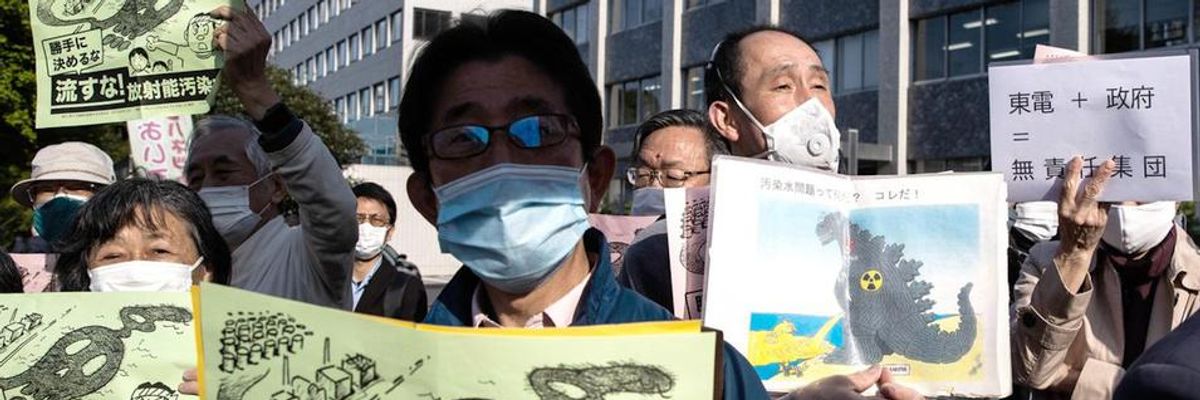
Anti-nuclear demonstrators protest outside the home of Japanese Prime Minister Suga Yoshihide on April 12, 2021 ahead of the government's announced decision to dump 1.25 million tonnes of radioactive wastewater from the damaged Fukushima Daiichi nuclear power plant into the Pacific Ocean. (Photo: Takashi Aoyama/Getty Images)
A trio of United Nations experts on Thursday added their voices to the chorus of concern over the Japanese government's decision to dump hundreds of millions of gallons of radioactive wastewater from the Fukushima Daiichi Nuclear Power Plant into the Pacific Ocean, saying the move threatens not only the environment but also the human rights of people in and beyond Japan.
"The release of one million tonnes of contaminated water into the marine environment imposes considerable risks to the full enjoyment of human rights of concerned populations in and beyond the borders of Japan."
--U.N. experts
Japanese officials announced earlier this week that 1.25 million tonnes of treated radioactive water from the deactivated nuclear plant--which in March 2011 suffered major damage from a magnitude 9.0 earthquake and subsequent tsunami--would be discharged into the sea starting in about two years. Prime Minister Suga Yoshihide called the planned release "a realistic solution."
However, anti-nuclear campaigners joined Japan's neighbors China and South Korea in condemning the decision, with Greenpeace saying that it "completely disregards the human rights and interests of the people in Fukushima, wider Japan, and the Asia-Pacific region."
Marcos Orellana, Michael Fakhri, and David Boyd--respectively the U.N.'s special rapporteurs on toxics and human rights, the right to food, and human rights and the environment--weighed in on the issue Thursday with a joint statement calling Tokyo's decision "very concerning."
"The release of one million tonnes of contaminated water into the marine environment imposes considerable risks to the full enjoyment of human rights of concerned populations in and beyond the borders of Japan," they said, adding that "the decision is particularly disappointing as experts believe alternative solutions to the problem are available."
Critics say other options for disposing of the the water, including evaporating and then releasing it into the air, were not fully considered, although nuclear experts stress that evaporation would not isolate radioactivity.
Japanese officials claim that levels of radioactive tritium are low enough to pose no threat to human health. However, scientists and other experts warn that the isotope bonds with other molecules in water and can make their way up the food chain to humans.
Cindy Folkers, radiation and health hazards specialist at the advocacy group Beyond Nuclear, said in a statement Wednesday that Fukushima Daiichi operator Tokyo Electric Power Company (TEPCO) "wants us to believe that the radioactive contamination in this water will be diluted in the ocean waters, but some of the radioactive isotopes will concentrate up the food chain in ocean life."
"Some of the contamination may not travel out to sea and can double back on itself," said Folkers. "Dilution doesn't work for radioactive isotopes, particularly tritium, which research shows can travel upstream."
"TEPCO data show that even twice-through filtration leaves the water 13.7 times more concentrated with hazardous tritium--radioactive hydrogen--than Japan's allowable standard for ocean dumping, and about one million times higher than the concentration of natural tritium in Earth's surface waters," she added.
Japanese officials did reverse one highly controversial policy related to the wastewater dump this week. Amid intense public backlash, the government hastily retired Little Mr. Tritium, an animated radioactive mascot meant to promote and popularize the discharge.
"It seems the government's desire to release the water into the sea takes priority over everything," Katsuo Watanabe, an 82-year-old fisher from Fukushima, told Kyodo News. "We fisherman can't understand it."
Dear Common Dreams reader, It’s been nearly 30 years since I co-founded Common Dreams with my late wife, Lina Newhouser. We had the radical notion that journalism should serve the public good, not corporate profits. It was clear to us from the outset what it would take to build such a project. No paid advertisements. No corporate sponsors. No millionaire publisher telling us what to think or do. Many people said we wouldn't last a year, but we proved those doubters wrong. Together with a tremendous team of journalists and dedicated staff, we built an independent media outlet free from the constraints of profits and corporate control. Our mission has always been simple: To inform. To inspire. To ignite change for the common good. Building Common Dreams was not easy. Our survival was never guaranteed. When you take on the most powerful forces—Wall Street greed, fossil fuel industry destruction, Big Tech lobbyists, and uber-rich oligarchs who have spent billions upon billions rigging the economy and democracy in their favor—the only bulwark you have is supporters who believe in your work. But here’s the urgent message from me today. It's never been this bad out there. And it's never been this hard to keep us going. At the very moment Common Dreams is most needed, the threats we face are intensifying. We need your support now more than ever. We don't accept corporate advertising and never will. We don't have a paywall because we don't think people should be blocked from critical news based on their ability to pay. Everything we do is funded by the donations of readers like you. When everyone does the little they can afford, we are strong. But if that support retreats or dries up, so do we. Will you donate now to make sure Common Dreams not only survives but thrives? —Craig Brown, Co-founder |
A trio of United Nations experts on Thursday added their voices to the chorus of concern over the Japanese government's decision to dump hundreds of millions of gallons of radioactive wastewater from the Fukushima Daiichi Nuclear Power Plant into the Pacific Ocean, saying the move threatens not only the environment but also the human rights of people in and beyond Japan.
"The release of one million tonnes of contaminated water into the marine environment imposes considerable risks to the full enjoyment of human rights of concerned populations in and beyond the borders of Japan."
--U.N. experts
Japanese officials announced earlier this week that 1.25 million tonnes of treated radioactive water from the deactivated nuclear plant--which in March 2011 suffered major damage from a magnitude 9.0 earthquake and subsequent tsunami--would be discharged into the sea starting in about two years. Prime Minister Suga Yoshihide called the planned release "a realistic solution."
However, anti-nuclear campaigners joined Japan's neighbors China and South Korea in condemning the decision, with Greenpeace saying that it "completely disregards the human rights and interests of the people in Fukushima, wider Japan, and the Asia-Pacific region."
Marcos Orellana, Michael Fakhri, and David Boyd--respectively the U.N.'s special rapporteurs on toxics and human rights, the right to food, and human rights and the environment--weighed in on the issue Thursday with a joint statement calling Tokyo's decision "very concerning."
"The release of one million tonnes of contaminated water into the marine environment imposes considerable risks to the full enjoyment of human rights of concerned populations in and beyond the borders of Japan," they said, adding that "the decision is particularly disappointing as experts believe alternative solutions to the problem are available."
Critics say other options for disposing of the the water, including evaporating and then releasing it into the air, were not fully considered, although nuclear experts stress that evaporation would not isolate radioactivity.
Japanese officials claim that levels of radioactive tritium are low enough to pose no threat to human health. However, scientists and other experts warn that the isotope bonds with other molecules in water and can make their way up the food chain to humans.
Cindy Folkers, radiation and health hazards specialist at the advocacy group Beyond Nuclear, said in a statement Wednesday that Fukushima Daiichi operator Tokyo Electric Power Company (TEPCO) "wants us to believe that the radioactive contamination in this water will be diluted in the ocean waters, but some of the radioactive isotopes will concentrate up the food chain in ocean life."
"Some of the contamination may not travel out to sea and can double back on itself," said Folkers. "Dilution doesn't work for radioactive isotopes, particularly tritium, which research shows can travel upstream."
"TEPCO data show that even twice-through filtration leaves the water 13.7 times more concentrated with hazardous tritium--radioactive hydrogen--than Japan's allowable standard for ocean dumping, and about one million times higher than the concentration of natural tritium in Earth's surface waters," she added.
Japanese officials did reverse one highly controversial policy related to the wastewater dump this week. Amid intense public backlash, the government hastily retired Little Mr. Tritium, an animated radioactive mascot meant to promote and popularize the discharge.
"It seems the government's desire to release the water into the sea takes priority over everything," Katsuo Watanabe, an 82-year-old fisher from Fukushima, told Kyodo News. "We fisherman can't understand it."
A trio of United Nations experts on Thursday added their voices to the chorus of concern over the Japanese government's decision to dump hundreds of millions of gallons of radioactive wastewater from the Fukushima Daiichi Nuclear Power Plant into the Pacific Ocean, saying the move threatens not only the environment but also the human rights of people in and beyond Japan.
"The release of one million tonnes of contaminated water into the marine environment imposes considerable risks to the full enjoyment of human rights of concerned populations in and beyond the borders of Japan."
--U.N. experts
Japanese officials announced earlier this week that 1.25 million tonnes of treated radioactive water from the deactivated nuclear plant--which in March 2011 suffered major damage from a magnitude 9.0 earthquake and subsequent tsunami--would be discharged into the sea starting in about two years. Prime Minister Suga Yoshihide called the planned release "a realistic solution."
However, anti-nuclear campaigners joined Japan's neighbors China and South Korea in condemning the decision, with Greenpeace saying that it "completely disregards the human rights and interests of the people in Fukushima, wider Japan, and the Asia-Pacific region."
Marcos Orellana, Michael Fakhri, and David Boyd--respectively the U.N.'s special rapporteurs on toxics and human rights, the right to food, and human rights and the environment--weighed in on the issue Thursday with a joint statement calling Tokyo's decision "very concerning."
"The release of one million tonnes of contaminated water into the marine environment imposes considerable risks to the full enjoyment of human rights of concerned populations in and beyond the borders of Japan," they said, adding that "the decision is particularly disappointing as experts believe alternative solutions to the problem are available."
Critics say other options for disposing of the the water, including evaporating and then releasing it into the air, were not fully considered, although nuclear experts stress that evaporation would not isolate radioactivity.
Japanese officials claim that levels of radioactive tritium are low enough to pose no threat to human health. However, scientists and other experts warn that the isotope bonds with other molecules in water and can make their way up the food chain to humans.
Cindy Folkers, radiation and health hazards specialist at the advocacy group Beyond Nuclear, said in a statement Wednesday that Fukushima Daiichi operator Tokyo Electric Power Company (TEPCO) "wants us to believe that the radioactive contamination in this water will be diluted in the ocean waters, but some of the radioactive isotopes will concentrate up the food chain in ocean life."
"Some of the contamination may not travel out to sea and can double back on itself," said Folkers. "Dilution doesn't work for radioactive isotopes, particularly tritium, which research shows can travel upstream."
"TEPCO data show that even twice-through filtration leaves the water 13.7 times more concentrated with hazardous tritium--radioactive hydrogen--than Japan's allowable standard for ocean dumping, and about one million times higher than the concentration of natural tritium in Earth's surface waters," she added.
Japanese officials did reverse one highly controversial policy related to the wastewater dump this week. Amid intense public backlash, the government hastily retired Little Mr. Tritium, an animated radioactive mascot meant to promote and popularize the discharge.
"It seems the government's desire to release the water into the sea takes priority over everything," Katsuo Watanabe, an 82-year-old fisher from Fukushima, told Kyodo News. "We fisherman can't understand it."

