SUBSCRIBE TO OUR FREE NEWSLETTER
Daily news & progressive opinion—funded by the people, not the corporations—delivered straight to your inbox.
5
#000000
#FFFFFF
To donate by check, phone, or other method, see our More Ways to Give page.
Daily news & progressive opinion—funded by the people, not the corporations—delivered straight to your inbox.
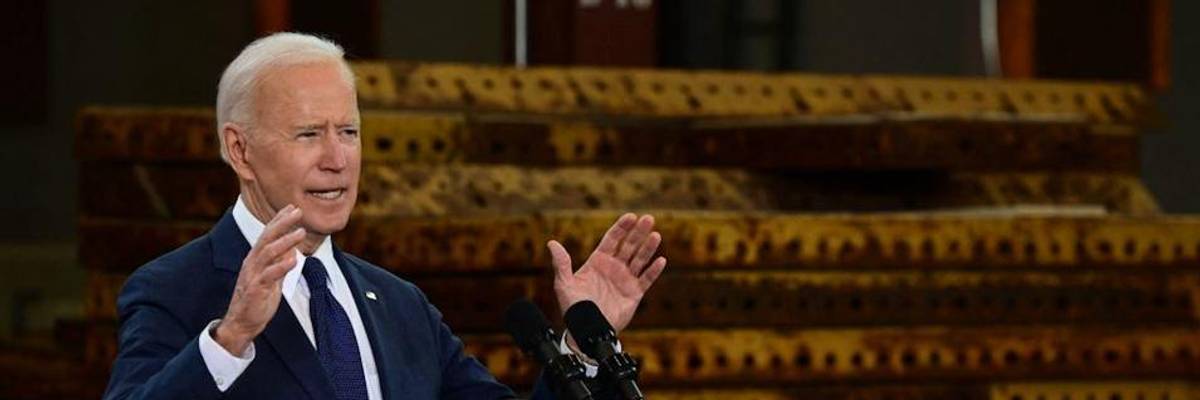
President Joe Biden discusses his administration's American Jobs Plan in Pittsburgh on March 31, 2021. (Photo: Jim Watson/AFP via Getty Images)
Roundly rejecting Republican and conservative Democratic lawmakers who oppose President Joe Biden's proposed corporate tax increase to fund the American Jobs Plan, a poll published Wednesday revealed nearly two-thirds of U.S. voters favor higher taxes on businesses to pay for the administration's $2.25 trillion infrastructure and employment legislative proposal.
"On a broad level, nearly three-quarters of voters agree that corporations should pay higher taxes, including 85% of Democrats and 59% of Republicans."
--Morning Consult
Morning Consult pollsters surveyed nearly 2,000 registered voters and found that 65% of respondents somewhat or strongly support funding the American Jobs Plan (AJP) through 15 years of higher corporate taxes, compared with just 21% who somewhat or strongly oppose the move.
Among Democratic voters, 85% support--62% of them strongly--the tax hike, with only 15% against the increase. Sixty percent of independents and 42% of Republicans favor funding the AJP through higher corporate taxes, with 47% GOP voters opposing the proposed policy.
"On a broad level, nearly three-quarters of voters agree that corporations should pay higher taxes, including 85% of Democrats and 59% of Republicans," said Morning Consult.
According to an analysis published Wednesday by the Penn Wharton Budget Model, Biden's proposal--under which the corporate tax rate would rise from 21% to 28%--would increase government revenue by $891.6 billion between 2022 and 2031, and by nearly $1.49 trillion between 2022 and 2036.
The Wharton analysts further forecast that overall, the AJP would generate $2.1 trillion in tax revenue, while spending $2.7 trillion, between 2021 and 2030. The higher corporate tax rate, combined with improved U.S. infrastructure, is expected to decrease the nation's debt by 6.4% and its GDP by 0.8% in 2050.
A separate poll published Tuesday by Invest in America and Data for Progress found that a bipartisan majority of U.S. voters--73% overall, 93% of Democrats, 67% of independents, and 57% of Republicans--support the AJP in general.
The Morning Consult poll found even higher overall support for the plan when the proposed corporate tax hike is withdrawn, with approval rising to 83% among all voters.
While support for the AJP's corporate tax increase is strongest among progressives--whose biggest complaint about the plan is that it doesn't do enough--prominent capitalists and financial institutions have also said they favor the measure.
On Wednesday, International Monetary Fund officials endorsed Biden's proposal, with Vitor Gaspar, the organization's fiscal affairs director, telling reporters that "the IMF has been calling for a minimum global corporate income tax rate as a way to interrupt the race to the bottom in corporate income taxation."
Jeff Bezos, the outgoing CEO of Amazon and the world's wealthiest person, said Tuesday that "we recognize this investment will require concessions from all sides--both on the specifics of what's included as well as how it gets paid for," adding, "we're supportive of a rise in the corporate tax rate."
On the other hand, Republicans in Congress and conservative Democrats--led by Sen. Joe Manchin (W.Va.)--strongly oppose the corporate tax increase component of the AJP.
Dear Common Dreams reader, It’s been nearly 30 years since I co-founded Common Dreams with my late wife, Lina Newhouser. We had the radical notion that journalism should serve the public good, not corporate profits. It was clear to us from the outset what it would take to build such a project. No paid advertisements. No corporate sponsors. No millionaire publisher telling us what to think or do. Many people said we wouldn't last a year, but we proved those doubters wrong. Together with a tremendous team of journalists and dedicated staff, we built an independent media outlet free from the constraints of profits and corporate control. Our mission has always been simple: To inform. To inspire. To ignite change for the common good. Building Common Dreams was not easy. Our survival was never guaranteed. When you take on the most powerful forces—Wall Street greed, fossil fuel industry destruction, Big Tech lobbyists, and uber-rich oligarchs who have spent billions upon billions rigging the economy and democracy in their favor—the only bulwark you have is supporters who believe in your work. But here’s the urgent message from me today. It's never been this bad out there. And it's never been this hard to keep us going. At the very moment Common Dreams is most needed, the threats we face are intensifying. We need your support now more than ever. We don't accept corporate advertising and never will. We don't have a paywall because we don't think people should be blocked from critical news based on their ability to pay. Everything we do is funded by the donations of readers like you. When everyone does the little they can afford, we are strong. But if that support retreats or dries up, so do we. Will you donate now to make sure Common Dreams not only survives but thrives? —Craig Brown, Co-founder |
Roundly rejecting Republican and conservative Democratic lawmakers who oppose President Joe Biden's proposed corporate tax increase to fund the American Jobs Plan, a poll published Wednesday revealed nearly two-thirds of U.S. voters favor higher taxes on businesses to pay for the administration's $2.25 trillion infrastructure and employment legislative proposal.
"On a broad level, nearly three-quarters of voters agree that corporations should pay higher taxes, including 85% of Democrats and 59% of Republicans."
--Morning Consult
Morning Consult pollsters surveyed nearly 2,000 registered voters and found that 65% of respondents somewhat or strongly support funding the American Jobs Plan (AJP) through 15 years of higher corporate taxes, compared with just 21% who somewhat or strongly oppose the move.
Among Democratic voters, 85% support--62% of them strongly--the tax hike, with only 15% against the increase. Sixty percent of independents and 42% of Republicans favor funding the AJP through higher corporate taxes, with 47% GOP voters opposing the proposed policy.
"On a broad level, nearly three-quarters of voters agree that corporations should pay higher taxes, including 85% of Democrats and 59% of Republicans," said Morning Consult.
According to an analysis published Wednesday by the Penn Wharton Budget Model, Biden's proposal--under which the corporate tax rate would rise from 21% to 28%--would increase government revenue by $891.6 billion between 2022 and 2031, and by nearly $1.49 trillion between 2022 and 2036.
The Wharton analysts further forecast that overall, the AJP would generate $2.1 trillion in tax revenue, while spending $2.7 trillion, between 2021 and 2030. The higher corporate tax rate, combined with improved U.S. infrastructure, is expected to decrease the nation's debt by 6.4% and its GDP by 0.8% in 2050.
A separate poll published Tuesday by Invest in America and Data for Progress found that a bipartisan majority of U.S. voters--73% overall, 93% of Democrats, 67% of independents, and 57% of Republicans--support the AJP in general.
The Morning Consult poll found even higher overall support for the plan when the proposed corporate tax hike is withdrawn, with approval rising to 83% among all voters.
While support for the AJP's corporate tax increase is strongest among progressives--whose biggest complaint about the plan is that it doesn't do enough--prominent capitalists and financial institutions have also said they favor the measure.
On Wednesday, International Monetary Fund officials endorsed Biden's proposal, with Vitor Gaspar, the organization's fiscal affairs director, telling reporters that "the IMF has been calling for a minimum global corporate income tax rate as a way to interrupt the race to the bottom in corporate income taxation."
Jeff Bezos, the outgoing CEO of Amazon and the world's wealthiest person, said Tuesday that "we recognize this investment will require concessions from all sides--both on the specifics of what's included as well as how it gets paid for," adding, "we're supportive of a rise in the corporate tax rate."
On the other hand, Republicans in Congress and conservative Democrats--led by Sen. Joe Manchin (W.Va.)--strongly oppose the corporate tax increase component of the AJP.
Roundly rejecting Republican and conservative Democratic lawmakers who oppose President Joe Biden's proposed corporate tax increase to fund the American Jobs Plan, a poll published Wednesday revealed nearly two-thirds of U.S. voters favor higher taxes on businesses to pay for the administration's $2.25 trillion infrastructure and employment legislative proposal.
"On a broad level, nearly three-quarters of voters agree that corporations should pay higher taxes, including 85% of Democrats and 59% of Republicans."
--Morning Consult
Morning Consult pollsters surveyed nearly 2,000 registered voters and found that 65% of respondents somewhat or strongly support funding the American Jobs Plan (AJP) through 15 years of higher corporate taxes, compared with just 21% who somewhat or strongly oppose the move.
Among Democratic voters, 85% support--62% of them strongly--the tax hike, with only 15% against the increase. Sixty percent of independents and 42% of Republicans favor funding the AJP through higher corporate taxes, with 47% GOP voters opposing the proposed policy.
"On a broad level, nearly three-quarters of voters agree that corporations should pay higher taxes, including 85% of Democrats and 59% of Republicans," said Morning Consult.
According to an analysis published Wednesday by the Penn Wharton Budget Model, Biden's proposal--under which the corporate tax rate would rise from 21% to 28%--would increase government revenue by $891.6 billion between 2022 and 2031, and by nearly $1.49 trillion between 2022 and 2036.
The Wharton analysts further forecast that overall, the AJP would generate $2.1 trillion in tax revenue, while spending $2.7 trillion, between 2021 and 2030. The higher corporate tax rate, combined with improved U.S. infrastructure, is expected to decrease the nation's debt by 6.4% and its GDP by 0.8% in 2050.
A separate poll published Tuesday by Invest in America and Data for Progress found that a bipartisan majority of U.S. voters--73% overall, 93% of Democrats, 67% of independents, and 57% of Republicans--support the AJP in general.
The Morning Consult poll found even higher overall support for the plan when the proposed corporate tax hike is withdrawn, with approval rising to 83% among all voters.
While support for the AJP's corporate tax increase is strongest among progressives--whose biggest complaint about the plan is that it doesn't do enough--prominent capitalists and financial institutions have also said they favor the measure.
On Wednesday, International Monetary Fund officials endorsed Biden's proposal, with Vitor Gaspar, the organization's fiscal affairs director, telling reporters that "the IMF has been calling for a minimum global corporate income tax rate as a way to interrupt the race to the bottom in corporate income taxation."
Jeff Bezos, the outgoing CEO of Amazon and the world's wealthiest person, said Tuesday that "we recognize this investment will require concessions from all sides--both on the specifics of what's included as well as how it gets paid for," adding, "we're supportive of a rise in the corporate tax rate."
On the other hand, Republicans in Congress and conservative Democrats--led by Sen. Joe Manchin (W.Va.)--strongly oppose the corporate tax increase component of the AJP.