

SUBSCRIBE TO OUR FREE NEWSLETTER
Daily news & progressive opinion—funded by the people, not the corporations—delivered straight to your inbox.
5
#000000
#FFFFFF
To donate by check, phone, or other method, see our More Ways to Give page.
Daily news & progressive opinion—funded by the people, not the corporations—delivered straight to your inbox.
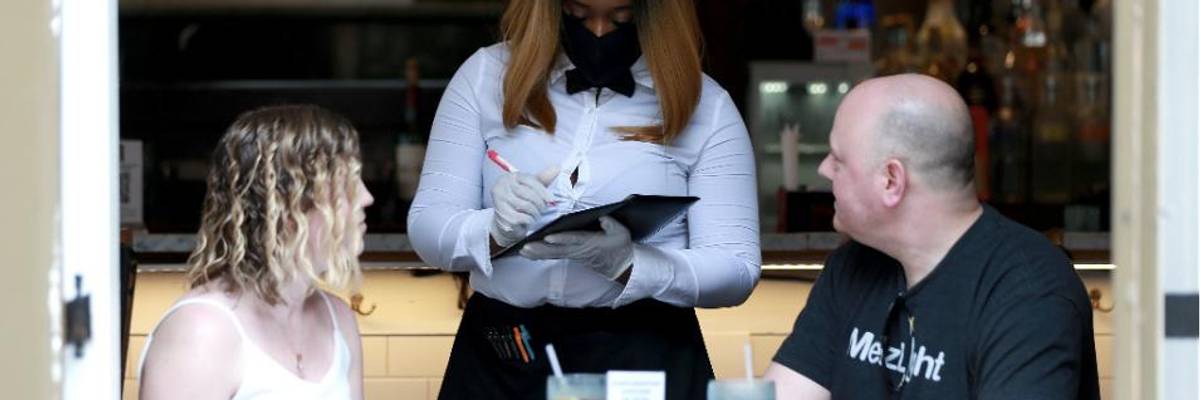
A waitress takes an order during lunch on May 22, 2020 at a restaurant in New Orleans. (Photo: Sean Gardner/Getty Images)
Ahead of the United States marking Equal Pay Day, advocates sent a letter to top federal policymakers and One Fair Wage released a new report detailing how the subminimum wage perpetuates gender-based income inequality and contributes to high levels of sexual harassment in the nation's restaurant industry.
Equal Pay Day on Wednesday will represent how far into this year, on average, women in the United States must work to earn what men made last year. On Tuesday, One Fair Wage joined with key lawmakers as well as restaurant workers, employers, experts, and leaders at women's advocacy groups including TimesUp and UltraViolet to highlight the impacts of the subminimum wage for tipped workers.
"A legacy of slavery, the subminimum wage for tipped workers persists in 43 states, and has subjected a largely female workforce of servers, bartenders, bussers, and others to economic instability and the highest rates of sexual harassment of any industry for decades."
--Saru Jayaraman,
One Fair Wage
"Covid-19's devastation of the service sector has been well documented, including the closure of thousands of independently owned restaurants and the unemployment, underemployment, and destitution of millions of food service workers nationwide," said Saru Jayaraman, president of One Fair Wage. "Destitution among these workers can be traced in large part to the subminimum wage for tipped workers, still an unthinkable $2.13 an hour at the federal level."
"A legacy of slavery, the subminimum wage for tipped workers persists in 43 states, and has subjected a largely female workforce of servers, bartenders, bussers, and others to economic instability and the highest rates of sexual harassment of any industry for decades," she explained. "Now, thousands of tipped workers, disproportionately women and women of color in particular, are returning to work as restaurants have re-opened for indoor or outdoor dining."
The group leader noted that until now, "no study has thoroughly documented service workers' experiences of working in restaurants during the pandemic."
"Understanding these workers' experiences is critical not only to address the needs of these workers and their families, but also to stem the public health crisis," Jayaraman added. "The CDC reported in September 2020 that adults are twice as likely to contract the virus after eating in a restaurant. Food service workers have thus become at once essential workers and public health marshals, enforcing critical mask and social distancing protocols in one of the most dangerous social environments for spreading the pandemic. Unfortunately, unlike all other essential workers, they are not paid even a minimum wage and thus continue to live at the mercy of customers' tips."
Key findings of the advocacy group's new report--entitled The Tipping Point: How the Subminimum Wage Keeps Incomes Low and Harassment High (pdf)--include:
The report notes that Congress is considering legislation that would not only more than double the federal hourly minimum wage form $7.25 to $15 but also phase out the subminimum wage for tipped workers. In January, Sen. Bernie Sanders (I-Vt.) and Rep. Bobby Scott (D-Va.) reintroduced the Raise the Wage Act, which is backed by more than 200 small business restaurant employers nationwide.
Sanders and Rep. Madeleine Dean (D-Pa.) joined the Tuesday event hosted by One Fair Wage, during which Sanders called low wages "the most pressing economic problem was in the country today."
Although President Joe Biden initially included the wage boost in his proposed $1.9 trillion coronavirus pandemic relief package, eight conservative Democrats partnered with Senate Republicans to keep it out of the final legislation Biden signed earlier this month--a move that could have long-term consequences for the political futures of those lawmakers due to widespread public support for the measure.
The Economic Policy Institute recently found that 32 million workers nationwide would would benefit from raising the minimum wage, and 24 million--or 75%--are represented by the 58 senators who voted against an attempt by Sanders, chair of the Senate Budget Committee, to put the measure back into the package.
On Monday, female leaders including Gloria Steinem, Jane Fonda, Lily Tomlin, Rosario Dawson, Sophia Bush, and Amy Schumer joined with dozens of women's organizations to send a letter (pdf) to Biden, Senate Majority Leader Chuck Schumer (D-N.Y.), and House Speaker Nancy Pelosi (D-Calif.).
While thanking the trio for their "important work" on the relief package, the letter also urges them to "not compromise for anything less than 100% of the full minimum wage for tipped workers, because anything less than a full minimum wage with tips on top will perpetuate gender and racial pay disparities and a sexual harassment rate in the restaurant industry that is higher than all others."
Dear Common Dreams reader, It’s been nearly 30 years since I co-founded Common Dreams with my late wife, Lina Newhouser. We had the radical notion that journalism should serve the public good, not corporate profits. It was clear to us from the outset what it would take to build such a project. No paid advertisements. No corporate sponsors. No millionaire publisher telling us what to think or do. Many people said we wouldn't last a year, but we proved those doubters wrong. Together with a tremendous team of journalists and dedicated staff, we built an independent media outlet free from the constraints of profits and corporate control. Our mission has always been simple: To inform. To inspire. To ignite change for the common good. Building Common Dreams was not easy. Our survival was never guaranteed. When you take on the most powerful forces—Wall Street greed, fossil fuel industry destruction, Big Tech lobbyists, and uber-rich oligarchs who have spent billions upon billions rigging the economy and democracy in their favor—the only bulwark you have is supporters who believe in your work. But here’s the urgent message from me today. It's never been this bad out there. And it's never been this hard to keep us going. At the very moment Common Dreams is most needed, the threats we face are intensifying. We need your support now more than ever. We don't accept corporate advertising and never will. We don't have a paywall because we don't think people should be blocked from critical news based on their ability to pay. Everything we do is funded by the donations of readers like you. When everyone does the little they can afford, we are strong. But if that support retreats or dries up, so do we. Will you donate now to make sure Common Dreams not only survives but thrives? —Craig Brown, Co-founder |
Ahead of the United States marking Equal Pay Day, advocates sent a letter to top federal policymakers and One Fair Wage released a new report detailing how the subminimum wage perpetuates gender-based income inequality and contributes to high levels of sexual harassment in the nation's restaurant industry.
Equal Pay Day on Wednesday will represent how far into this year, on average, women in the United States must work to earn what men made last year. On Tuesday, One Fair Wage joined with key lawmakers as well as restaurant workers, employers, experts, and leaders at women's advocacy groups including TimesUp and UltraViolet to highlight the impacts of the subminimum wage for tipped workers.
"A legacy of slavery, the subminimum wage for tipped workers persists in 43 states, and has subjected a largely female workforce of servers, bartenders, bussers, and others to economic instability and the highest rates of sexual harassment of any industry for decades."
--Saru Jayaraman,
One Fair Wage
"Covid-19's devastation of the service sector has been well documented, including the closure of thousands of independently owned restaurants and the unemployment, underemployment, and destitution of millions of food service workers nationwide," said Saru Jayaraman, president of One Fair Wage. "Destitution among these workers can be traced in large part to the subminimum wage for tipped workers, still an unthinkable $2.13 an hour at the federal level."
"A legacy of slavery, the subminimum wage for tipped workers persists in 43 states, and has subjected a largely female workforce of servers, bartenders, bussers, and others to economic instability and the highest rates of sexual harassment of any industry for decades," she explained. "Now, thousands of tipped workers, disproportionately women and women of color in particular, are returning to work as restaurants have re-opened for indoor or outdoor dining."
The group leader noted that until now, "no study has thoroughly documented service workers' experiences of working in restaurants during the pandemic."
"Understanding these workers' experiences is critical not only to address the needs of these workers and their families, but also to stem the public health crisis," Jayaraman added. "The CDC reported in September 2020 that adults are twice as likely to contract the virus after eating in a restaurant. Food service workers have thus become at once essential workers and public health marshals, enforcing critical mask and social distancing protocols in one of the most dangerous social environments for spreading the pandemic. Unfortunately, unlike all other essential workers, they are not paid even a minimum wage and thus continue to live at the mercy of customers' tips."
Key findings of the advocacy group's new report--entitled The Tipping Point: How the Subminimum Wage Keeps Incomes Low and Harassment High (pdf)--include:
The report notes that Congress is considering legislation that would not only more than double the federal hourly minimum wage form $7.25 to $15 but also phase out the subminimum wage for tipped workers. In January, Sen. Bernie Sanders (I-Vt.) and Rep. Bobby Scott (D-Va.) reintroduced the Raise the Wage Act, which is backed by more than 200 small business restaurant employers nationwide.
Sanders and Rep. Madeleine Dean (D-Pa.) joined the Tuesday event hosted by One Fair Wage, during which Sanders called low wages "the most pressing economic problem was in the country today."
Although President Joe Biden initially included the wage boost in his proposed $1.9 trillion coronavirus pandemic relief package, eight conservative Democrats partnered with Senate Republicans to keep it out of the final legislation Biden signed earlier this month--a move that could have long-term consequences for the political futures of those lawmakers due to widespread public support for the measure.
The Economic Policy Institute recently found that 32 million workers nationwide would would benefit from raising the minimum wage, and 24 million--or 75%--are represented by the 58 senators who voted against an attempt by Sanders, chair of the Senate Budget Committee, to put the measure back into the package.
On Monday, female leaders including Gloria Steinem, Jane Fonda, Lily Tomlin, Rosario Dawson, Sophia Bush, and Amy Schumer joined with dozens of women's organizations to send a letter (pdf) to Biden, Senate Majority Leader Chuck Schumer (D-N.Y.), and House Speaker Nancy Pelosi (D-Calif.).
While thanking the trio for their "important work" on the relief package, the letter also urges them to "not compromise for anything less than 100% of the full minimum wage for tipped workers, because anything less than a full minimum wage with tips on top will perpetuate gender and racial pay disparities and a sexual harassment rate in the restaurant industry that is higher than all others."
Ahead of the United States marking Equal Pay Day, advocates sent a letter to top federal policymakers and One Fair Wage released a new report detailing how the subminimum wage perpetuates gender-based income inequality and contributes to high levels of sexual harassment in the nation's restaurant industry.
Equal Pay Day on Wednesday will represent how far into this year, on average, women in the United States must work to earn what men made last year. On Tuesday, One Fair Wage joined with key lawmakers as well as restaurant workers, employers, experts, and leaders at women's advocacy groups including TimesUp and UltraViolet to highlight the impacts of the subminimum wage for tipped workers.
"A legacy of slavery, the subminimum wage for tipped workers persists in 43 states, and has subjected a largely female workforce of servers, bartenders, bussers, and others to economic instability and the highest rates of sexual harassment of any industry for decades."
--Saru Jayaraman,
One Fair Wage
"Covid-19's devastation of the service sector has been well documented, including the closure of thousands of independently owned restaurants and the unemployment, underemployment, and destitution of millions of food service workers nationwide," said Saru Jayaraman, president of One Fair Wage. "Destitution among these workers can be traced in large part to the subminimum wage for tipped workers, still an unthinkable $2.13 an hour at the federal level."
"A legacy of slavery, the subminimum wage for tipped workers persists in 43 states, and has subjected a largely female workforce of servers, bartenders, bussers, and others to economic instability and the highest rates of sexual harassment of any industry for decades," she explained. "Now, thousands of tipped workers, disproportionately women and women of color in particular, are returning to work as restaurants have re-opened for indoor or outdoor dining."
The group leader noted that until now, "no study has thoroughly documented service workers' experiences of working in restaurants during the pandemic."
"Understanding these workers' experiences is critical not only to address the needs of these workers and their families, but also to stem the public health crisis," Jayaraman added. "The CDC reported in September 2020 that adults are twice as likely to contract the virus after eating in a restaurant. Food service workers have thus become at once essential workers and public health marshals, enforcing critical mask and social distancing protocols in one of the most dangerous social environments for spreading the pandemic. Unfortunately, unlike all other essential workers, they are not paid even a minimum wage and thus continue to live at the mercy of customers' tips."
Key findings of the advocacy group's new report--entitled The Tipping Point: How the Subminimum Wage Keeps Incomes Low and Harassment High (pdf)--include:
The report notes that Congress is considering legislation that would not only more than double the federal hourly minimum wage form $7.25 to $15 but also phase out the subminimum wage for tipped workers. In January, Sen. Bernie Sanders (I-Vt.) and Rep. Bobby Scott (D-Va.) reintroduced the Raise the Wage Act, which is backed by more than 200 small business restaurant employers nationwide.
Sanders and Rep. Madeleine Dean (D-Pa.) joined the Tuesday event hosted by One Fair Wage, during which Sanders called low wages "the most pressing economic problem was in the country today."
Although President Joe Biden initially included the wage boost in his proposed $1.9 trillion coronavirus pandemic relief package, eight conservative Democrats partnered with Senate Republicans to keep it out of the final legislation Biden signed earlier this month--a move that could have long-term consequences for the political futures of those lawmakers due to widespread public support for the measure.
The Economic Policy Institute recently found that 32 million workers nationwide would would benefit from raising the minimum wage, and 24 million--or 75%--are represented by the 58 senators who voted against an attempt by Sanders, chair of the Senate Budget Committee, to put the measure back into the package.
On Monday, female leaders including Gloria Steinem, Jane Fonda, Lily Tomlin, Rosario Dawson, Sophia Bush, and Amy Schumer joined with dozens of women's organizations to send a letter (pdf) to Biden, Senate Majority Leader Chuck Schumer (D-N.Y.), and House Speaker Nancy Pelosi (D-Calif.).
While thanking the trio for their "important work" on the relief package, the letter also urges them to "not compromise for anything less than 100% of the full minimum wage for tipped workers, because anything less than a full minimum wage with tips on top will perpetuate gender and racial pay disparities and a sexual harassment rate in the restaurant industry that is higher than all others."

